Questions

3 Mark Question

Take a timed test

9 questions · self-marked practice — reveal the answer and mark yourself.

Question 13 Marks
Write the subset relations between the following sets.
X = set of all quadrilaterals.
Y = set of all rhombuses.
S = set of all squares.
T = set of all parallelograms.
V = set of all rectangles.
Answer
i. Rhombus, square, parallelogram and rectangle all are quadrilaterals.
∴ Y ⊆ X,S ⊆ X,T ⊆ X,V ⊆ X

ii. Every square is a rhombus, parallelogram and rectangle.
∴ S ⊆ Y, S ⊆ T, S ⊆ V

iii. Every rhombus and rectangle is a parallelogram.
∴ Y ⊆ T, V ⊆ T
View full question & answer
Question 23 Marks
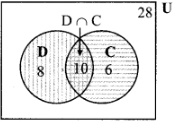
In a class, 8 students out of 28 have a dog as their pet animal at home, 6 students have a cat as their pet animal, 10 students have dog and cat both, then how many students do not have dog or cat as their pet animal at home?
Answer
i. Let U be the set of all the students, then n(U) = 28
Let D be the set of students who have dog as pet and C be the set of students who have cat as pet.
10 students have dog and cat as their pet animal
n(D ∩ C) = 10
Image

From venn diagram,

ii. Number of students who have cat or dog as pet
= n(D ∪ C)
= 8 + 10 + 6
= 24

iii. Number of students who do not have dog or cat as pet = n (U) – n(D ∪ C)
= 28 – 24
= 4

View full question & answer
Question 33 Marks
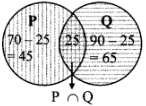
70 trees were planted by Parth and 90 trees were planted by Pradnya on the occasion of Tree Plantation Week. Out of these 25 trees were planted by both of them together. How many trees were planted by Parth or Pradnya?
Answer
i. Let P be the trees planted by Parth and Q be the trees planted by Pradnya
∴ n(P) = 70 and n(Q) = 90
Total number of trees planted by Parth and Pradnya = n(P ∩ Q) = 25

ii. Number of trees planted by Parth or Pradnya = n(P ∪ Q)
= n(P) + n(Q) – n(P ∩ Q)
= 70 + 90 – 25 = 135
∴ A total of 135 trees were planted by Parth or Pradnya.

Alternate Method:
Let P be the trees planted by Parth and Q be the trees planted by Pradnya

Image
From Venn diagram
∴ Total trees planted by parth or pradnya = n(P ∪ Q)
= 45 + 25 + 65
= 135
A total of 135 trees were planted by Parth or Pradnya.

View full question & answer
Question 43 Marks
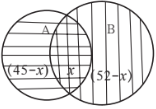
In a class of 70 students, 45 students like to play Cricket. 52 students like to play Kho-kho. All the students like to play atleast one of the two games. How many students like to play Cricket or Kho-kho ?
Answer
We will solve this example in wo ways.

Method I : Total number of students = 70
Let A be the set of students who likes to play Cricket.
Let B be the set of students who likes to play Kho-kho.
Hence the number of students who likes to play Cricket or Kho-kho is n (A ∪ B )
\ n (A ∪ B ) = 70
Number of students who likes to play both Cricket and Kho-kho = n (A ∩ B)
n (A) = 45, n (B) = 52
We know, n (A ∪ B ) = n (A) + n (B) - n (A ∩ B) .
\ n (A ∩ B) = n (A) + n (B) - n (A ∪ B )
= 45 + 52 - 70 = 27
\ Number of students who likes to play both the games are 27,
Number of students who likes to play Kho-kho are 45.
\ Number of students who likes to play only Cricket = 45 -27 = 18
\ A∩B is the set of students who play both the games. \ n (A ∩ B)= 27

Method II : Given information can be shown by Venn diagrams as follows.
Let n (A ∩ B) = x, n (A) = 45, n (B) = 52,
We know that, n (A ∪ B ) = 70
\ n (A ∩ B) = x = n (A) + n (B) - n (A ∩ B)
= 52 + 45 - 70 = 27
Students who like to play only cricket = 45 - 27
=18
Image

View full question & answer
Question 53 Marks
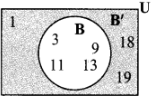
Suppose U = {1, 3, 9, 11, 13, 18, 19}, and B = {3, 9, 11, 13}. Find (B’)’ and draw the inference.
Image
Answer
U = {1, 3, 9, 11, 13, 18, 19},
B= {3, 9, 11, 13} ….(i)
∴ B’= {1, 18, 19}
(B’)’= {3, 9, 11, 13} ….(ii)
∴ (B’)’ = B … [From (i) and (ii)]
∴ Complement of a complement is the given set itself.
View full question & answer
Question 63 Marks
Some sets are given below.
A ={…,-4, -2, 0, 2, 4, 6,…}
B = {1, 2, 3,…}
C = {…,-12, -6, 0, 6, 12, 18, }
D = {…, -8, -4, 0, 4, 8,…}
I = {…,-3, -2, -1, 0, 1, 2, 3, 4, }
Discuss and decide which of the following statements are true.
a. A is a subset of sets B, C and D.
b. B is a subset of all the sets which are given above.
Answer
a. All elements of set A are not present in set B, C and D.
∴ A ⊆ B,
∴ A ⊆ C,
∴ A ⊆ D
∴ Statement (a) is false.

b. All elements of set B are not present in set A, C and D.
∴ B ⊆ A,
∴ B ⊆ C,
∴ B ⊆ D
∴ Statement (b) is false.

View full question & answer
Question 73 Marks
If A = {1, 3, 4, 7, 8}, then write all possible subsets of A.
i. e. P = {1, 3}, T = {4, 7, 8}, V = {1, 4, 8}, S = {1, 4, 7, 8}
In this way many subsets can be written. Write five more subsets of set A.
Answer
B = { },
E = {4},
C = {1, 4},
D = {3, 4, 7},
F = {3, 4, 7,8}
View full question & answer
Question 83 Marks
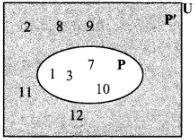
U = {1, 2, 3, 7, 8, 9, 10, 11, 12} P = {1, 3, 7,10}, then
i. show the sets U, P and P’ by Venn diagram.
ii. Verify (P’)’ = P
Answer
Here, U = {1,2, 3, 7, 8,9, 10, 11, 12} P = {1, 3, 7, 10}
∴ P’ = {2, 8, 9, 11, 12}
Image

Here, U = {1, 2, 3, 7, 8, 9, 10, 11, 12}
P = {1, 3, 7, 10} ….(i)
∴ P’= {2, 8, 9, 11, 12}
Also, (P’)’ = {1,3,7, 10} …(ii)
∴ (P’)’ = P … [From (i) and (ii)]

View full question & answer
Question 93 Marks
Decide whether set A and B are equal sets. Give reason for your answer.
A = Even prime numbers
B = {x | 7x – 1 = 13}
Answer
A = Even prime numbers
Since 2 is the only even prime number,
∴ A = {2} …(i)

B= {x | 7x – 1 = 13}
Here, 7x – 1 = 13
∴ 7x = 14
∴ x = 2
∴ B = {2} …(ii)
∴ The element in set A and B is identical. … [From (i) and (ii)]
∴ A and B are equal sets.

View full question & answer