Questions

1 Mark Question

Take a timed test

14 questions · self-marked practice — reveal the answer and mark yourself.

Question 11 Mark
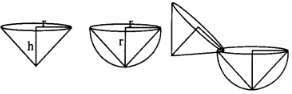
Make a cone and a hemisphere of cardsheet such that radii of cone and hemisphere are equal and height of cone is equal to radius of the hemisphere.
Fill the cone with fine sand. Pour the sand in the hemisphere. How many cones are required to fill the hemisphere completely ?
Image

Answer
To fill the hemisphere, two coneful of sand is required.
View full question & answer
Question 21 Mark
Finding total surface area of sphere.
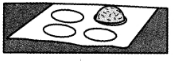
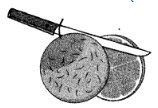
i. Take a sweet lime (Mosambe), Cut it into two equal parts.Image
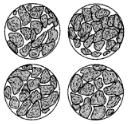
ii. Take one of the parts. Place its circular face on a paper. Draw its circular border. Copy three more such circles. Again, cut each half of the sweet lime into two equal parts.
Image
iii. Now you get 4 quarters of sweet lime. Separate the peel of a quarter part. Cut it into pieces as small as possible. Try to cover one o’f the circles drawn, by the small pieces. Observe that the circle gets nearly covered.
The activity suggests that,
Curved surface area of a sphere = $4\pi r^2$
Image
Answer
∴ Curved surface area of a sphere = 4 x Area of a circle
View full question & answer
Question 31 Mark
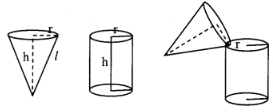
Prepare a cylinder of a card sheet, keeping one of its faces open. Prepare an open cone of card sheet which will have the same base-radius and the same height as that of the cylinder. Pour fine sand in the cone till it just fills up the cone. Empty the cone in the cylinder. Repeat the procedure till the cylinder is just filled up with sand. Note how many coneful of sand is required to fill up the cylinder.

Image

Answer
To fill the cylinder, three coneful of sand is required.
View full question & answer
Question 41 Mark
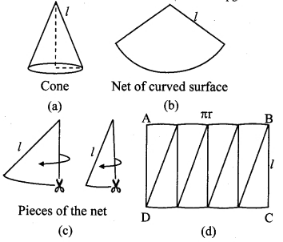
Curved surface area of cone.

Image
Circumference of base of the cone = 2πr
As shown in the figure (c), make pieces of the net as small as possible. Join them as shown in the figure (d),. By joining the small pieces of net of the cone, we get a rectangle ABCD approximately.
Total length of AB and CD is 2πr.
∴ length of side AB of rectangle ABCD is πr and length of side CD is also πr.
Length of side BC of rectangle = slant height of cone = l.
Curved surface area of cone is equal to the area of the rectangle.

Answer
∴ curved surface area of cone = Area of rectangle = AB x BC = πr x l = πrl
View full question & answer
Question 51 Mark
Find the radius of a sphere whose volume is$113040 \text { cubic } \mathrm{cm} .(\pi=3.14)$
Answer
Volume of sphere $=\frac{4}{3} \pi r^3$
$
\begin{aligned}
113040 & =\frac{4}{3} \times 3.14 \times r^3 \\
\frac{113040 \times 3}{4 \times 3.14} & =r^3 \\
\frac{28260 \times 3}{3.14} & =r^3 \\
\therefore 9000 \times 3 & =r^3 \\
\therefore \quad r^3 & =27000 \\
\therefore \quad r & =30 \mathrm{~cm}
\end{aligned}
$
$\therefore$ radius of sphere is $30 \mathrm{~cm}$.
View full question & answer
Question 61 Mark
Find the volume of a sphere having$\text { radius } 21 \mathrm{~cm} .\left(\pi=\frac{22}{7}\right)$
Answer
Volume of sphere $=\frac{4}{3} \pi r^3$
$=\frac{4}{3} \times \frac{22}{7} \times(21)^3$
$=\frac{4}{3} \times \frac{22}{7} \times 21 \times 21 \times 21$
$=88 \times 441$
$\therefore \quad$ volume of sphere $=38808$ cubic cm.
View full question & answer
Question 71 Mark
Find the radius of a sphere having surface area 1256 sq. cm. $(\pi=3.14)$
Answer
Surface Area of Sphere $=4 \pi r^2$
$
\begin{aligned}
\therefore 1256 & =4 \times 3.14 \times r^2 \\
\therefore \quad r^2 & =\frac{1256}{4 \times 3.14} \\
& =\frac{31400}{314} \\
\therefore \quad 100 & =r^2 \\
\therefore \quad 10 & =r
\end{aligned}
$
$\therefore$ radius of the sphere is $10 \mathrm{~cm}$.
View full question & answer
Question 81 Mark
Find the surface area of a sphere having radius $7 \mathrm{~cm} .\left(\pi=\frac{22}{7}\right)$
Answer
Surface Area of sphere $=4 \pi r^2$
$=4 \times \frac{22}{7} \times(7)^2$
$=4 \times \frac{22}{7} \times 7 \times 7$
$=88 \times 7$
$=616$
Surface Area of sphere $=616$ sq.cm.
View full question & answer
Question 91 Mark
The total surface area of a cone is 704 sq. $\mathrm{cm}$ and radius of its base is $7 \mathrm{~cm}$, find the slant height of the cone. $\left(\pi=\frac{22}{7}\right)$
Answer
Total surface area of cone $=\pi r(l+r)$
$\therefore \quad 704=\frac{22}{7} \times 7(l+7)$
$\therefore \quad \frac{704}{22}=l+7$
$\therefore \quad 32=l+7$
$\therefore \quad 32-7=l$
$\therefore \quad l=25 \mathrm{~cm}$
View full question & answer
Question 101 Mark
Find total surface area of a cone, if its base radius is 12 cm and height is 16 cm. (p = 3.14)
Answer
Total surface area of cone
$=\pi r(l+r)$
$=3.14 \times 12(20+12)$
$=3.14 \times 12 \times 32$
$=1205.76 \mathrm{~cm}^2$
View full question & answer
Question 111 Mark
Find the curved surface area and
Answer
$
\begin{aligned}
\text { Curved surface area } & =\pi r l \\
& =3.14 \times 12 \times 20 \\
& =753.6 \mathrm{~cm}^2
\end{aligned}
$
View full question & answer
Question 121 Mark
Find the slant height
Answer
$\begin{aligned} & r=12 \mathrm{~cm}, h=16 \mathrm{~cm} \\ & l^2=r^2+h^2 \\ \therefore & l^2=(12)^2+(16)^2 \\ \therefore & l^2=144+256 \\ \therefore & l^2=400 \\ \therefore l & =20 \mathrm{~cm}\end{aligned}$
View full question & answer
Question 131 Mark
Radius of base (r) and perpendicular height (h) of cone is given. Find its slant height (l) r = 9 cm, h = 12 cm
Answer
$\begin{aligned} r & =9 \mathrm{~cm}, h=12 \mathrm{~cm} \\ & l^2=r^2+h^2 \\ \therefore & l^2=(9)^2+(12)^2 \\ \therefore & l^2=81+144 \\ \therefore & l^2=225 \\ \therefore & l=15 \mathrm{~cm}\end{aligned}$
View full question & answer
Question 141 Mark
Radius of base (r) and perpendicular height (h) of cone is given. Find its slant height (l) r = 6 cm, h = 8 cm
Answer
$r=6 \mathrm{~cm}, h=8 \mathrm{~cm}$
$\quad l^2=r^2+h^2$
$\therefore l^2=(6)^2+(8)^2$
$\therefore l^2=36+64$
$\therefore l^2=100$
$\therefore l=10 \mathrm{~cm}$
View full question & answer