Question types

Non-textual Passages question types

4 questions across 1 question group — pick any mix to generate a My English Coursebook paper with step-by-step answer keys.

4
Questions
1
Question groups
5
Question types
Sample Questions

Non-textual Passages questions

One sample from each question group in this chapter. Select any group above to see the full set with answer keys.

(A) Read the following passages and do the activities:
A1. Simple Factual Activity:

Complete the following sentences with the help of the passage.
(1) The headquatrers of the Interpol is situated in _______________.
(2) The job of the Interpol is _______________.

     Interpol is an International Criminal Police organisation. The word 'Interpol' is derived from the two words 'International' and 'Police'. Interpol is a strictly non-political, non-religious, non-racial organisation in which the police forces of more than hundred nations co-operate with each other. Its headquarters are situated in Paris.
     The job of the Interpol is to trace criminals. According to international law, police of one country cannot enter the territory of another country to apprehend a criminal who, after committing a crime, has absconded there. Interpol helps in such situations to trace out the criminals. Every country has its representative in Interpol. Interpol makes use of the most modern scientific means to catch the criminals. To trace and arrest criminals is the only function of this organisation. It cannot be used for any political, military or religious activity.

A2. Complex Factual Activity:
Describe the Interpol organisation:
A3. Activity based on Vocabulary:
Give your own opposites for the following:
(1) international
(2) enter
(3) modern
(4) non-political
A4. Activities based on Contextual Grammar:
(1) Interpol helps to trace out the criminals.
(State the kind of tense.)
(2) The job of the Interpol is to trace criminals.
(Rewrite the sentence by using the present participle of the infinitive.)
A5. Personal Response:
Why should we respect our army and police force? 
(B) Read the passage given for comprehension and write the Summary of it. Suggest a suitable title to your summary:
View full solution
(A) Read the following passages and do the activities:
A1. Simple Factual Activity:
State whether the following statements are True or False:
(1) The female peacock has fan-shaped crest.
(2) The peacock is the most beautiful among male birds.
(3) The peacock is our national bird.
(4) Peacocks shed their tail feathers twice a year.

     The peacock is perhaps the most beautiful among male birds, with its long blue neck, fan- shaped crest, and its gorgeous train or tail of feathers. Each feather ends in a half-moon or 'eye'. When raised, the tail spreads like a fan from which thousands of eyes seem to gaze. Ironically, the female or peahen, is a small, drab bird in comparison, without the sweeping train.
     Peacocks shed their tail feathers once a year and grow new ones. People carefully collect these old feathers, which are then made into lovely fans and other decorative items.
     The peacock, although a shy bird, dances in front of the peahens during courtship. He then struts before them showing off his many-coloured train.
     The sight of rain clouds is another occasion for such display, perhaps to hail the arrival of rain after the long hot summer. The peacock's lordly strutting has also given rise to the commonly used phrases, 'proud as a peacock' and 'as vain as a peacock'.
      The peacock is our national bird. The peacocks have a special place in our arts, songs, dances, culture and stories.

A2. Complex Factual Activity:
Complete the table based on the informaton from the passage:

 Beauty of peacock's tail of feathers
 (1)  (2) 

A3. Activity based on Vocabulary:
Match the words in Column 'A' with their antonyms (opposites) in Column 'B':

Column 'A'Column 'B'
 (1) gorgeous (a) too proud of one's appearance
 (2) shy (b) not attractive
 (3) vain (c) very beautiful and attractive
 (4) drab (d) nervous

A4. Activities based on Contextual Grammar:
(1) Choose the correct Question Tag from the given alternatives for the following:
His tail spreads like a fan....
(a), isn't it?
(b), doesn't it?
(c), don't it?
(2) Choose the correct comparative degree from the given alternatives for the following:
The peacock is the most beautiful among male birds.
(a) No other among male birds are as beautiful as the peacock.
(b) Very few among male birds are as beautiful as the peacock.
(c) No other among male birds is more beautiful than the peacock.
(d) Not many male birds are beautiful as the peacock is.
A5. Personal Response:
Why, do you think, should we love birds?
(B) Read the passage given for comprehension and write the Summary of it. Suggest a suitable title to your summary:

View full solution
(A) Read the following passages and do the activities:
A1. Simple Factual Activity:

Arrange the following sentences in order of their occurrence in the passage:
(1) Man began to use the leaves of the palm and the lotus to write.
(2) The e-book brought about a great change in the field of printing.
(3) The art of printing was invented and books were available.
(4) Paper was invented and writing on paper began.

      Man has always felt a need to express himself In ancient times, before paper was invented, man used to inscribe his thoughts on stones or walls. Later, he began using the leaves of the palm and the lotus to write. The art of printing was invented in 1454. Soon it became popular all over the world. Knowledge could now reach even the common man. Thousands of editions of any book became available for anyone who wanted them.
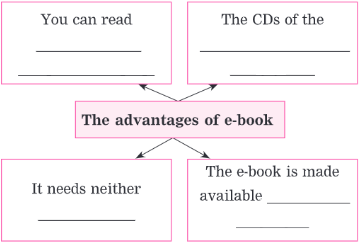
      The latest invention, the e-book, has brought about a great change in the field of printing. The e-book is an electronic book. It is a book printed in digital form. You can read an e-book on a computer or laptop. The e-book needs neither paper nor ink. The CDs of the e-books have a life of many years. The same e-book can be made available in different languages. Even CD's of famous Marathi books are available today. In the future, there will be libraries of e-books. What a wonderful invention the e-book is!

A2. Complex Factual Activity:
Complete the following webs:
Image
A3. Activity based on Vocabulary:
Match the words in column 'A' with their meanings in column 'B':

Column 'A'Column 'B'
 (1) modern (a) knowledge
 (2) different (b) ancient
 (3) ignorance (c) later
 (4) earlier (d) same

A4. Activities based on Contextual Grammar:
Do as directed:
(1) What a wonderful invention the e-book is!
(Rewrite the sentence beginning with "The e-book is... to make it an assertive sentence.)
(2) Choose the active voice sentence from the given alternatives for the following:
The art of printing was invented in 1454.
(a) They were invented the art of printing in 1454.
(b) They invent the art of printing in 1454.
(c) They invented the art of printing in 1454.
(d) They have invented the art of printing in 1454.
A5. Personal Response:
Do you think that printed books will lose their importance because of e-books?  
(B) Read the passage given for comprehension and write the Summary of it. Suggest a suitable title to your summary:

View full solution
(A) Read the following passages and do the activities:
A1. Simple Factual Activity:

Choose the correct alternatives and complete the following sentences:
(1) Seismograph shows _______________ during a severe earthquake.
(a) a straight line                  (b) large wiggles
(c) a slight wiggly lines         (d) circular lines
(2) The needle of a seismograph scratches _______________ on a strip of a black paper.
(a) a black line          (b) a curve line
(c) a white line          (d) dotted line

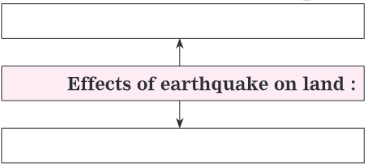
    At least one earthquake happens somewhere in the world every day. On some days there are many more. A few cause great damage and loss of life; some are felt only as slight shudders of the ground; many more are so small that they cannot be felt at all. We know about them only because they are shown on a seismograph a delicate instrument which records movements of the ground. It has a small needle which scratches a white line on a strip of black paper, which is going round on a drum. When everything is quite still the line is straight, but when the ground shakes the line becomes wiggly. A severe earthquake, even though it is a long way away, makes large wiggles on the line.
     Many earthquakes happen under the sea and they often cause great waves, called tsunamis. Tsunamis are taller than a house and they race across the sea one after another at high speed. Ships in their path may be wrecked and, when the waves reach land, there may be flooding and enormous damage.

A2. Complex Factual Activity:
Complete the following webs:
Image
A3. Activity based on Vocabulary:
Match the words in column 'A' with their meanings in column 'B':

Column 'A'Column 'B'
 (1) huge (a) wiggly
 (2) vibrations (b) wrecked
 (3) wavy (c) enormous
 (4) destroyed (d) shudders

A4. Activities based on Contextual Grammar:
(1) Frame a wh-question to get the underlined. part as answer:
A severe earthquake can cause great damage and loss of life.
(2) Choose the correct passive voice from the alternatives given for the following:
Earthquakes often cause great waves under the sea.
(a) Great waves under the sea often cause earthquakes.
(b) Great waves under the sea are often caused by earthquakes.
(c) Great waves under the sea is often caused by earthquakes.
(d) Great waves often cause earthquakes under the sea.
A5. Personal Response:
What according to you are the effects of the earthquake on people's life? 
(B) Read the passage given for comprehension and write the Summary of it. Suggest a suitable title to your summary:

View full solution

Generate a Non-textual Passages paper free

Pick question groups from the list above, set marks and difficulty, and export a branded PDF with step-by-step answer keys. First 3 chapters free — no signup.

Download App