Adding water to acid is an …………………. reaction.
- Aendothermic
- ✓exothermic
- Cneutralisation
- Dcrystallisation
Answer: B.
View full solution →175 questions across 12 question groups — pick any mix to generate a Science paper with step-by-step answer keys.
Write the Correct Alternative.
21 Q→02Find the odd one out.
14 Q→03Write the following Statement Is True Or False. & Write True Statement.
1 Q→04Name The Following.
17 Q→05Answer the following questions in detail.
50 Q→06Distinguish Between.
3 Q→07complete the Graph/Table.
6 Q→08Answer the following question.
14 Q→09Answer the following question.
24 Q→10Give scientific Reasons For The Following.
18 Q→11Match The Columns/pair.
5 Q→12Draw Diagram.
2 Q→One sample from each question group in this chapter. Select any group above to see the full set with answer keys.
Answer: B.
View full solution →Answer: A.
View full solution →Answer: A.
View full solution →Answer: A.
View full solution →Answer: B.
View full solution →Hydrochloric acid, Sodium chloride, Potassium hydroxide, Ammonia, Acetic acid, Magnesium chloride, Copper sulphate.
$CaO , MgO , CO _2, SO _3, Na _2 O , ZnO , Al _2 O _3, Fe _2 O _3$
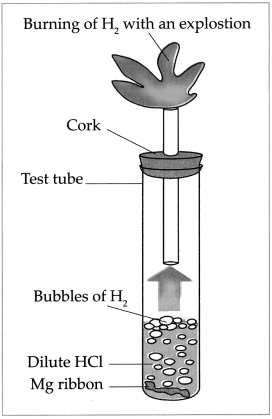
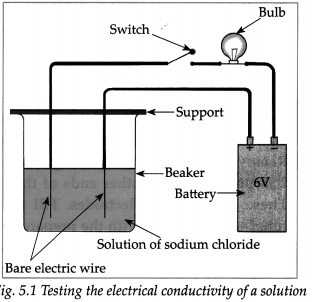
| Column ‘A’ | Column ‘B’ |
| (1) Crystalline blue vitriol | (a) $FeSO _4-7 H _2 O$ |
| (2) Crystalline green vitriol | (b) $K _2 SO _4- A1 _2\left( SO _4\right)_3 \cdot 24 H _2 O$ |
| (3) Crystalline | (c) $CuSO _4-5 H _2 O$ |
| (4) washing soda Crystalline alum | (d) $Na _2 CO _3 10 H _2 O$ |
| Column ‘A’ | Column’B’ |
| (1) Urine(2) Apples(3) Orange(4) Butter | (a) Butyric acid(b) Uric acid(c) Malic acid(d) Citric acid |
| Column ‘A’ Solution | Column ‘B’ pH | ||
| (1) | Milk | (a) | 0 |
| (2) | Milk of Magnesia | (b) | 14 |
| (3) | 1 M HCl | (c) | 10.5 |
| (4) | 1 M NaOH | (d) | 6.5 |
| Column ‘A’ | Column ‘B’ |
| (1) $NH _4 OH$ | (a) Aluminium Hydroxide |
| (2) $Ca ( OH )_2$ | (b) Barium Hydroxide |
| (3) $Al ( OH )_3$ | (c) Calcium Hydroxide |
| (4) $Ba ( OH )_2$ | (d) Ammonium Hydroxide |
| Column A | Column B |
| (1) $HNO _3$ | (a) Acetic acid |
| (2) $H _3 PO _4$ | (b) Carbonic acid |
| (3) $CH _3 COOH$ | (c) Phosphoric acid |
| (4) $H _2 CO _3$ | (d) Nitric acid |
Pick question groups from the list above, set marks and difficulty, and export a branded PDF with step-by-step answer keys. First 3 chapters free — no signup.