Questions

Answer the following question.

Take a timed test

11 questions · self-marked practice — reveal the answer and mark yourself.

Question 13 Marks
Three resistances 15Ω, 20Ω and 10Ω are connected in parallel. Find the effective resistance of the circuit.
Answer
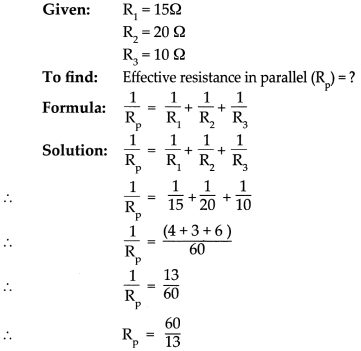

Maharashtra Board Class 9 Science Solutions Chapter 3 Current Electricity 10
Maharashtra Board Class 9 Science Solutions Chapter 3 Current Electricity 11
The effective resistance of the circuit is 4.615 Ω. It is less than the least of the three i.e., 10Ω.
View full question & answer
Question 23 Marks
If three resistors $15Ω, 3Ω$ and $4Ω$ each are connected in series, what is the effective resistance in the circuit?
Answer
Given:
$R_1 =15Ω$
$R_2 = 3Ω$
$R_3 = 4Ω$
Effective resistance in series $(R_s) = ?$
$R_s = R_1 + R_2 + R_3$
$R_s = 15 + 3 + 4$
$R_s = 22Ω$
The effective resistance in the circuit is $22Ω$.
View full question & answer
Question 33 Marks
A current of 0.24 A flows through a conductor when a potential difference of 24 V is applied between its two ends. What is its resistance?
Answer
https://pg-data.sgp1.digitaloceanspaces.com/chapter_wise/15899/Q10.png" alt="Image" /> 
View full question & answer
Question 43 Marks
The length of a conducting wire is 50 cm and its radius is 0.5 mm. If its resistance is 30Ω, what is the resistivity of its material?
Answer
https://pg-data.sgp1.digitaloceanspaces.com/chapter_wise/15899/Q9.png" alt="Image" width="300" height="" />The resistivity of the wire is 4.71 x 10⁻⁵ Qm.
View full question & answer
Question 53 Marks
The resistance of the filament of a bulb is 1000Ω. It is drawing a current from a source of 230 V. How much current is flowing through it?
Answer
https://pg-data.sgp1.digitaloceanspaces.com/chapter_wise/15899/Q8.png" alt="Image" width="250" height="" />
The current flowing through the filament of bulb is 0.23 A.
View full question & answer
Question 63 Marks
Find the amount of work done if 3 C of charge is moved through a potential difference of 9 V.
Answer
https://pg-data.sgp1.digitaloceanspaces.com/chapter_wise/15899/Q7.png" alt="Image" width="250" height="" />
The work done is 27 joule.

View full question & answer
Question 73 Marks
A current of 0.4 A flows through a conductor for 5 minutes. How much charge would have passed through the conductor?
Answer
Given: Current (I) = 0.4 A
Time (t) = 5 min = 5 x 60 = 300 s
To find: Charge (Q) =?
Formula: Q = 1 x
Solution: Q = 0.4 x 300
Q= 120 C.
Charge passing through the conductor is 120
View full question & answer
Question 83 Marks
explain the statement : Bulbs arranged in parallel glow brighter than bulbs arranged in series.
Answer
  • The amount of light given out by bulbs in parallel combination will be more than that in series combination.
  • In parallel combination the resistance of the overall circuit decreases whereas in series it increases, so the current flowing through the bulbs in parallel circuit is more.
  • Due to this, intensity of light given out by bulbs in parallel combination is more than the bulbs in series combination.
View full question & answer
Question 93 Marks
explain the statement : Fuse used in electrical circuit can save electrical objects from damage.
Answer
  • Fuse wire is used to protect domestic appliances.
  • It is made of a mixture of substances and has a specific melting point.
  • It is connected in series to the electric appliances. If for some reason, the current in the circuit increases excessively, the fuse wire gets heated and melts.
  • The circuit gets broken and the flow of current stops, thus protecting the appliance.
  • This wire is fitted in a groove in a body of porcelain-like non-conducting material. For domestic use, fuse wires with upper limits of 1 A, 2 A, 3 A, 4 A, 5 A and 10 A are used.
View full question & answer
Question 103 Marks
explain the statement : In a domestic circuit colour code is followed while setting up electrical wiring.
Answer
  • The electricity in our homes is brought through the main conducting cable either from the electric pole or from underground cables.
  • Usually, there are three wires in the cable.
    (a) Live wire which brings in the current. It has a red or brown insulation.
    (b) Neutral wire through which the current returns. It is blue or black.
    (c) Earth wire is of yellow or green colour. This is connected to a metal plate buried deep underground near the house and is for safety purposes.
  • In India, the voltage difference between the live and neutral wires is about 220 V.
  • Live and neutral wires are connected to the electric meter through a fuse.
  • They are connected through a main switch, to all the conducting wires inside the home so as to provide electricity to every room.
  • In each separate circuit, various electrical appliances are connected between the live and neutral wires.
  • The different appliances are connected in parallel and the potential difference across every appliance is the same.
View full question & answer
Question 113 Marks
explain the statement : Safety precautions are to be taken while using electricity.
Answer
  • Electric switches and sockets should be fitted at a height at which small children cannot reach and put pins or nails inside. Plug wires should not be pulled while removing a plug from its socket.
  • Before cleaning an electrical appliance it should be switched off and its plug removed from the socket.
  • One’s hands should be dry while handling an electrical appliance, and, as far as possible, one should use footwear with rubber soles. 
  • As rubber is an insulator, it prevents the current from flowing’ through our body, thereby protecting it.
  • If a person gets an electric shock, you should not touch that person. You should switch off the main switch or remove the plug from the socket if possible.
  • If not, then you should use a wooden pole to push the person away from the electric wire.
View full question & answer
Answer the following question. - Science STD 9 Questions - Vidyadip