Questions

complete the Graph/Table.

Take a timed test

6 questions · self-marked practice — reveal the answer and mark yourself.

Question 13 Marks
If a number of resistors are connected in parallel,
Answer
The inverse of the effective resistance is equal to the sum of the inverses of individual resistances. The current flowing through an individual resistor is proportional to the r inverse of its resistance and the total current flowing through the circuit is the sum of the currents flowing through individual resistors. The potential difference across all r resistors is the same. The effective resistance of resistors connected in parallel is less than r the least resistance of individual resistors. This arrangement is used to reduce the resistance in a circuit. Even if any one of the several bulbs connected in parallel becomes non-functional because of some damage to its filament, the circuit does not break as the current flows, through the other paths, and the rest of the bulbs light up. When several bulbs are connected in parallel, they emit the same amount of light as when they are connected individually in the circuit, while bulbs connected in series emit less light than when connected individually.
View full question & answer
Question 23 Marks
If resistors are connected in series,
Answer
The same current flows through each resistor. The effective resistance of the resistors is equal to the sum of their individual resistances. The potential difference between the two extremes of the arrangement is equal to the sum of the potential differences across individual resistors. The effective resistance is larger than each of the individual resistances. This arrangement is used to increase the resistance in a circuit. This type of connection is used in electrical heating equipment like geysers, iron, and hair dryers.
View full question & answer
Question 33 Marks
Complete the following table:
Answer
https://pg-data.sgp1.digitaloceanspaces.com/chapter_wise/15899/Q6.png" alt="Image" width="430" height="" />
View full question & answer
Question 53 Marks
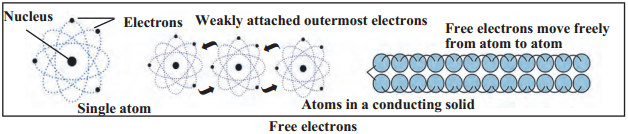
Explain with the help of a diagram, what are free electrons and how they move through the conductor?
Maharashtra Board Class 9 Science Solutions Chapter 3 Current Electricity 25
Answer
  • Every atom of a metallic conductor has one or more outermost electrons which are very weakly bound to nucleus.
  • These are called free electrons.
  • These electrons can easily move from one part of a conductor to its other parts.
View full question & answer
Question 63 Marks
The following figure shows the symbols for components used in the accompanying electrical circuit.https://pg-data.sgp1.digitaloceanspaces.com/chapter_wise/15899/Q3.png" alt="Image">
(a) Place them at proper places and complete the circuit.
(b) Which law can you prove with the help of the above circuit?
(c) State expression for Ohm’s law
Answer
https://pg-data.sgp1.digitaloceanspaces.com/chapter_wise/15899/Q4.png" alt="Image" width="250" height="" />
(b) This circuit can be used to prove Ohm’s law.
(c) V = IR is the expression of Ohm’s law
View full question & answer
complete the Graph/Table. - Science STD 9 Questions - Vidyadip