Questions

Question Answer (5 Marks)

Take a timed test

6 questions · self-marked practice — reveal the answer and mark yourself.

Question 15 Marks
If the back of your hand is moistened with alcohol, you will find that it rapidly becomes dry. Why is it that while it is drying, your hand feels cool?
Answer
Liquids like alcohol, petrol and perfume are volatile (which can change into vapours easily). When we apply alcohol to the back of our hand, we find that it dries up quickly and while it is drying, the hands feel cold. This happens due to the fact that to change from liquid to the vapour state, alcohol requires latent heat of vaporization. The alcohol takes this latent heat of vaporization from the hand due to which the hand loses heat and we feel cold.
View full question & answer
Question 25 Marks
When a beam of sunlight enters a room through a window, we can see tiny particles X suspended in a gas (or rather a mixture of gases) Y which are moving rapidly in a very haphazard manner.
  1. What could particles X be?
  2. Name the gas (or mixture of gases) Y.
  3. What is the phenomenon exhibited by particles X known as?
  4. What is causing the movement of particles X?
  5. What conclusion does the existence of this phenomenon give us about the nature of matter?
Answer
  1. The particles, 'X' are dust particles.
  2. Gas 'Y' is Air.
  3. This phenomenon being exhibited by 'X' particles is called the Brownian motion.
  4. The fast moving air molecules are constantly hitting the tiny dust particles, causing them to move rapidly in a very haphazard manner.
  5. The gaseous matter ‘air’ is made up of tiny particles that are constantly moving.
View full question & answer
Question 35 Marks
There are four substances W, X, Y and Z. The substance W is a dark violet solid having diatomic molecules. A solution of W in alcohol is used as a common antiseptic C. The substance X is a white solid which is usually recovered from sea water on a large scale. The substance Y is a white solid which is insoluble in water and used in the form of small balls for the safe storage of woollen clothes. The substance Z is a yet another white solid which is used in making commonly used dry cells.
  1. Name (i) W (ii) X (iii) Y and (iv) Z.
  2. Out of W, X, Y and Z, which substance/ substances can undergo sublimation?
  3. Which substances organic in nature?
  4. What is the name of substance C?
  5. Which substance belongs to the halogen family?
Answer
  1. The names are:
  • Iodine.
  • Sodium chloride, which is commonly known as common salt.
  • Naphthalene.
  • Ammonium chloride.
  1. In this ‘W’-iodine, ‘Y’-naphthalene and ‘Z’-ammonium chloride that undergo sublimation.
  2. ‘Naphthalene’ is organic in nature.
  3. The name of the substance ‘C’ is tincture iodine.
  4. In this Iodine belongs to the halogen family.
View full question & answer
Question 45 Marks
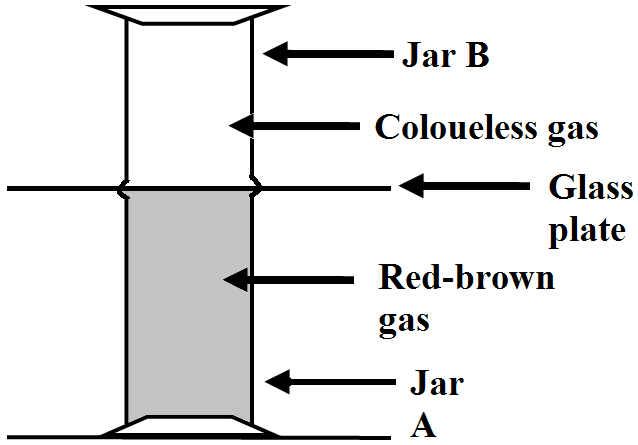
Look at the diagram on the right side. Jar A contains are d-brown gas whereas Jar B contains a colourless gas. The two gas jars are separated by a glass plate placed between them:
  1. What will happen when the glass plate between the two jars is pulled away?
  2. What name is given to the phenomenon which takes place?
  3. Name the brown gas which could be in jar A.
  4. Which is the colorless gas most likely to be present in jar B?
  5. Name one coloured solid and one colourless liquid which can show the same phenomenon.
Answer
  1. When the glass plate between the two jars is pulled away then the red brown gas will diffuse from jar A into colourless jar B and vice versa, due to which the red brown colour will spread into jar B.
  2. The phenomenon occurring here is diffusion.
  3. Bromine vapour.
  4. Air.
  5. Potassium permanganate (coloured solid) and water (colourless liquid) also show the same phenomenon.
View full question & answer
Question 55 Marks
Why are we able to sip hot tea or milk faster from a saucer rather than from a cup?
Answer
If the hot tea or milk is taken in a cup, then due to the narrow shape of the cup, the surface area of hot tea in the cup is comparatively small. Due to this, the evaporation of hot tea is slow, cooling caused by evaporation is less and hence the hot tea remains appreciably hot for a much longer time. On the other hand, the saucer has a large surface area due to which the tea taken in the saucer evaporates much faster, thus cooling it quickly and making it convenient to sip or drink.
View full question & answer
Question 65 Marks
When extremely small particles X derived from the another of a flower were suspended in a liquid Y and observed through a microscope, it was found that the particles X were moving throughout the liquid Y in a very zig zag way. It was also observed that warmer the liquid Y, faster the particles X moved in its surface.
  1. What could particles X be?
  2. What do you think liquid Y is?
  3. What is the zig-zag movement of particles X?
  4. What is causing the zig-zag movement of particles X?
  5. Name the scientist who discovered this phenomenon.
  6. What does this experiment tell us about the nature of liquid Y?
Answer
  1. The particles, 'X' are pollen grains.
  2. The fluid, 'Y' is Water.
  3. The zigzag movement of 'X' is called Brownian motion.
  4. The zigzag motion of the pollen grains occurs because the particles of water are in constant motion. These particles collide with the pollen grains and cause them to move.
  5. Robert Brown is the scientist who discovered Brownian motion.
  6. Liquid Y is made up of extremely small particles, which are moving constantly.
View full question & answer
Question Answer (5 Marks) - Science STD 9 Questions - Vidyadip