The ……………………………… receives the vibrations coming from the membrane and converts them into electrical signals which are sent to the brain through the nerve.
- ✓Cochlea
- BTympanic cavity
- CStapes
- DPinna
Answer: A.
View full solution →84 questions across 12 question groups — pick any mix to generate a Science paper with step-by-step answer keys.
Write the Correct Alternative.
9 Q→02Find the odd one out.
4 Q→03Answer the following in one sentece.
21 Q→04Name The Following.
8 Q→05Answer the following questions in detail.
15 Q→06Distinguish Between.
6 Q→07Answer the following question.
6 Q→08Give Scientific Reason.
6 Q→09Answer the following question.
5 Q→10Fill In The Blanks.
1 Q→11Match The Columns/pair.
2 Q→12Observe The Picture And Explain.
1 Q→One sample from each question group in this chapter. Select any group above to see the full set with answer keys.
Answer: A.
View full solution →Answer: A.
View full solution →Answer: A.
View full solution →Answer: B.
View full solution →Answer: C.
View full solution →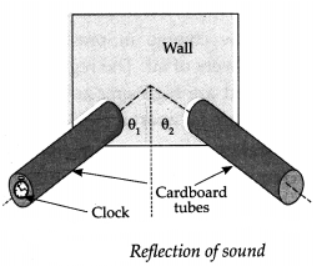
(1) In the above activity, what will happen if you lift one of the tubes to some height?
(2) Measure the angle of incidence 01 and the angle of reflection 02. Try to see if they are related in any way.
| Column A’ | Column ‘B’ | Column C |
| (1) Amplitude | (a) T | (i) Pitch of sound |
| (2) Frequency | (b) A | (ii) Loudness of sound |
| (3) Wavelength | (c) υ | (iii) Reciprocal of frequency |
| (4) Time period | (d) λ | (iv) v/υ |
| Column ‘A’ | Column B’ | Column C |
| (1) Transverse wave | (a) Particles oscillate parallel to direction of propagation | (i) Wave produced in a slinky |
| (2) Longitudinal wave | (b) Particles oscillate perpendicular to direction of propagation | (ii) Frequency less than 20 Hz |
| 3) Ultrasound | (c) Echo formation is heard under particular conditions | (iii) Wave produced in string |
| (4) Infrasound | (d) High frequency waves | (iv) Frequency between 20 Hz to 20000 Hz |
| (5) Audible frequency | (e) Low frequency waves | (v) Frequency greater than 20000 Hz |
Pick question groups from the list above, set marks and difficulty, and export a branded PDF with step-by-step answer keys. First 3 chapters free — no signup.