Questions

Answer the following question.

🎯

Test yourself on this topic

22 questions · timed · auto-graded

Question 15 Marks
Explain how powder coating is done.
Answer
  • Powder coating is a method of applying a layer harder than paint on the surface of an iron object to prevent rusting.
  • In this method, a polymer resin, a pigment and some other ingredients are melt, mixed, cooled and ground into a uniform powder.
  • This powder is sprayed on the polished metal surface by electrostatic spray deposition (ESD).
  • In this method, the particles of the powder are given an electrostatic charge due to which a uniform layer of the powder sticks to the metal surface.
  • Then the object is heated in the oven along with the coating.
  • A chemical reaction occurs in the layer, resulting in the formation of long cross-linked polymeric chains.
  • This powder coating is highly durable, hard and attractive.
  • Powder coating can be done on plastic and medium density fibre (MDF) board in day to day use as well.
View full question & answer
Question 25 Marks
Why are deodorant used? Give their types and content.
Answer
  • Body odour is caused by the bacterial decomposition of the sweat. A deodorant is used to prevent this odour.
  • Deodorants contain parabens (methyl, ethyl, propyl, benzyl and butyl) and also alcohol in large proportions. Aluminium compounds and silica are also used.
  • Types of deodorants are :
    (a) Ordinary deo: It contains a smaller proportion of aluminium. It decreases the odour of the sweat.
    (b) Antiperspirant deo : This decreases the extent of sweating. It contains about 15% of aluminium chlorohydrate. It clogs the sweat pores on the skin.
    (c) Clinical deo : Some people sweat heavily and it has harmful effects on the skin. Clinical deo is meant for such people. It contains 20 to 25% aluminium. It is used during the night.
View full question & answer
Question 35 Marks
What are the hazards of radioactive substances and radiation?
Answer
  • The central nervous system is affected by radioactive radiations.
  • Hereditary defects are generated by bombardment of radiation on D.N.A in the body.
  • Radioactive radiation can penetrate the skin, and causes diseases like skin cancer, leukemia.
  • The radiative pollutants created due to explosions enter the body through air and it is difficult to control them.
  • The radioactive pollutants released in the sea enter the bodies of fishes and through them enter the human body.
  • The radioactive paint on the watch can cause cancer.
  • The radioactive isotopes strontium-90 can enter the body through plants, fruits, flowers, cereals, milk, etc. and cause diseases like bone cancer, leukemia.
View full question & answer
Question 45 Marks
Give the uses of radioactive isotopes in Medical science.
Answer
Medical science:
  • Polycythemia: The red blood cell count increases in the disease polycythemia. Phosphorus- 32 is used in its treatment.
  • Bone cancer: Strontium-89, strontium-90, samarium-153 and radium-223 are used in the treatment of bone cancer.
  • Hyperthyroidism: Enlargement of thyroid gland, weight loss in spite of appetite, insomnia are the symptoms of hyperthyroidism.
  • It occurs due to overproduction of hormones by the thyroid gland. Iodine-123 is used in the treatment of hyperthyroidism.
  • Tumour detection: Boron-10, iodine-131, cobalt-60 are used in the treatment of brain tumour, while arsenic-74 is used in detection of small tumours in the body.
View full question & answer
Question 65 Marks
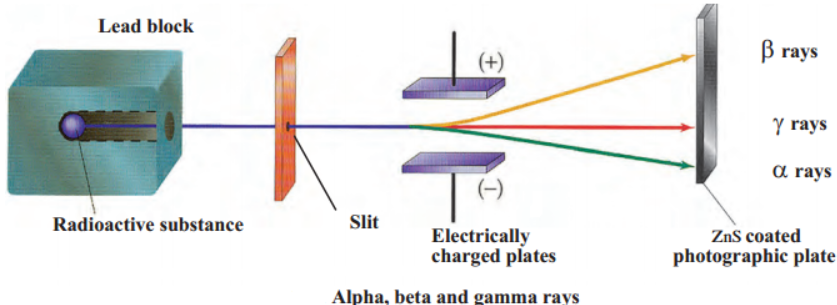
Explain with neat labelled diagram the nature of radioactive radiation.

Image

Answer
  • When radioactive radiations are allowed to pass through two oppositely charged plates they get separated. This method was introduced by Rutherford in 1902.
  • Rutherford and Willard studied the radiation emitted by radioactive substances.
  • For this purpose, the rays were allowed to pass through an electrical field and a photographic plate was held in their path.
  • It was found that the radiation was divided into three types.
  • One type of radiation deviated slightly towards the negatively charged plate, while the second type of radiation deviated substantially towards the positively charged plate.
  • However, the third type of radiation did not deviate at all in the electrical field.
  • The rays which deviated slightly toward negatively charged plate are called alpha rays.
  • Those which deviate substantially towards the positively charged plate are called beta rays and those which did not deviate at all are called gamma rays.
View full question & answer
Question 75 Marks
Give the properties and uses of Bleaching Powder.
Answer
  • Bleaching powder is a yellowish-white coloured solid substance.
  • Its chemical name is Calcium oxychloride.
  • It has a strong odour of chlorine gas.
  • It is used for disinfection of drinking water at the water works and the water in the swimming pool.
  • It is used for bleaching of cloth.
  • It is used for disinfection by the road side and garbage sites.
  • Dilute sulphuric acid and dilute hydrochloric acid react rapidly with bleaching powder to release chlorine gas completely.$CaOCl_2+H_2 SO_4 \rightarrow CaSO_4+Cl_2 \uparrow+H_2 O CaOCl 2+2 HCl \rightarrow CaCl_2+Cl_2 \uparrow+H_2 O$
  • Calcium oxychloride reacts slowly with carbon dioxide to form calcium carbonate and chlorine.$CaOCl_2 + CO_2 → CaCOs + Cl_2↑$
View full question & answer
Question 95 Marks
What are salts? Give their source.
Answer
  • The ionic compounds which do not contain H+ and OH ions and contain only one kind of cation and anion are called simple salts.
  • For example, $Na_2SO_4, K_3PO_4, CaCl_2.$
  • The sea is said to be a rich source of salts of various elements such as chlorine, sodium, magnesium, potassium, calcium, bromine.
  • The important salts found in sea water are:
    (a) Sodium chloride
    (b) Magnesium chloride
    (c) Magnesium sulphate
    (d) Potassium chloride
    (e) Calcium carbonate
    (f) Magnesium bromide
View full question & answer
Question 105 Marks
Anodizing.
Answer
  • A protective layer is formed naturally on the surface of aluminium metal by reaction with oxygen in air.
  • In the anodizing process, this layer can be made of the desired thickness.
  • Anodizing is done by electrolysis.
  • Dilute sulphuric acid is taken in the electrolytic cell and the aluminium article is dipped in it as the anode.
  • When an electric current is passed, hydrogen gas is released at the cathode and oxygen gas at the anode.
  • A reaction with oxygen occurs and a layer of hydrated aluminium oxide is formed on the anode, i.e. the aluminium article.
  • This layer can be made attractive by adding colour in the cell during electrolysis.
View full question & answer
Question 115 Marks
Food colours.
Answer
  • Food colours are mixed in most soft drinks and foodstuffs available in the market.
  • These food colours are in the form of powders, gels and pastes.
  • Food colours are used in domestic as well as commercial products.
  • Certain colours and essences are added to ice cream, ice candies, sauces, fruit juices, cold drinks, pickles, jams and jellies.
  • Food colours are often found to be added to packaged meat (chicken, mutton), chilli powder, turmeric, sweets and other similar substances so as to give them a good colour.
  • Food colours are natural as well as artificial.
  • The food colours prepared from seeds, beetroot, flowers and fruit concentrate are natural.
  • Tetrazene, sunset yellow are artificial food colours used extensively.
  • However, over-consumption of artificial food colours can be detrimental to health. Therefore, usage of natural food colours is always good.
View full question & answer
Question 125 Marks
Chernobyl disaster.
Answer
  • On 26th April 1986, the graphite reactor in the Chernobyl atomic power plant exploded, and suddenly the radioactive isotopes and radiation came out.
  • Due to this episode, radioactive isotopes entered the human body through water and land and caused genetic disorders.
  • These got carried further into the next generation.
  • Thyroid disorders increased in children as well as adults.
  • As a result, the incidence of throat diseases is greater there than in other places.
View full question & answer
Question 135 Marks
A doctor gives you medicines when you fall ill. What are the medicines made from?
Answer
  • Long before pure chemicals were manufactured in labs, people used plants for medicine.
  • There are over a hundred active ingredients derived from plants for use as drugs and medicines.
  • The emergence of synthetic chemistry in the 1800s opened up new avenues for scientific research into drugs.
  • Many chemists tried to locate medically active ingredients in plants (for instance the important malaria remedy quinine), and subsequently tried to make those substances in the laboratory in order to become independent of plant supplies.
  • At the same time, a new industry developed as scientists developed processes to synthesise new chemicals on a large scale.
  • New production methods developed in the late 1800s and early 1900s made it easier to standardise, package and transport medicines.
View full question & answer
Question 145 Marks
How is it determined whether a substance is acidic, basic or neutral?
Answer
  • In the pH scale, the pH of solutions varies from 0 to 14 in accordance with the strength of the acids or base.
  • The pH scale shows different colours at different values of pH. Colour from dark red to yellow or from pH value 0 to 6 indicates the substances are acidic.
  • Colour from light blue to violet or from pH value 8 to 14 indicates the substances are basic.
  • Green colour or pH value 7 indicates the substances are neutral.
View full question & answer
Question 155 Marks
Write the harmful effects : a. Artificial dye
b. Artificial food colour
c. Radioactive substances
d. Deodorant
Answer
(a) Artificial dye:

  • Dyeing hair can have adverse effects like hair fall, damage to hair texture, burning of skin, adverse effect on eyes, etc.
  • Lipstick contains a dye named carmine. It does not affect lips but causes stomach disorders.
  • Excessive use of plants for making natural dyes results in deterioration of the environment.

(b) Artificial food colour:

  • Food colours added to pickles, jams and sauces contain small quantities of lead and mercury. These can be harmful for those who consume these products on a regular basis.
  • Diseases like ADHD (Attention Deficit Hyperactivity Disorder) can affect children due to excessive consumption of foods with added food colours.

(c) Radioactive substances :

  • The central nervous system is affected by radioactive radiations.
  • Hereditary defects are generated by bombardment of radiation on D.N.A in the body.
  • Radioactive radiation can penetrate the skin, and causes diseases like skin cancer, leukemia.
  • The radioactive pollutants created due to explosions enter the body through air and it is difficult to control them.
  • The radioactive pollutants released in the sea enter the bodies of fishes and through them enter the human body.
  • The radioactive paint on the watch can cause cancer.
  • The radioactive isotopes strontium-90 can enter the body through plants, fruits, flowers, cereals, milk, etc. and cause diseases like bone cancer, leukemia.

(d) Deodorant:

  • Aluminium – Zirconium compounds are the most harmful chemicals in the deodorant. Disorders like headache, asthma, respiratory disorders, heart disease are likely to occur without our knowledge.
  • There is a possibility of various skin disorders and also skin cancer due to the aluminium chlorohydrates.
View full question & answer
Question 165 Marks
Write briefly about the three methods of electrolysis of sodium chloride.
Answer
  • When an electric current is passed through a saturated solution of sodium chloride (brine) it is electrolysed and hydrogen gas is released at the cathode while chlorine gas is released at the anode.
  • This method is used for production of chlorine gas. In this method an important basic compound NaOH is formed in the cell.
  • Chemical reaction $2NaCl + 2H_2O → 2NaOH + Cl_2 ↑ + H_2↑$
  • When salt is heated to a high temperature (about $800^\circ$ C), it melts. This is called the fused state of the salt.
View full question & answer
Question 175 Marks
What is meant by water of crystallization? Give examples of salts with water of crystallization, and their uses.
Answer
The exact number of water molecules which are chemically bonded to a molecule of a salt within a hydrated crystalline compound is called as water of crystallization are:Some substances in our daily use which contain water of crystallization are:
  • Alum (Potash alum – $K_2SO_4.Al_2(SO_4)_3.24H_2O$)
  • Borax ($Na_2B_4O_7.10H_2O$)
  • Epsom salt (Magnesium sulphate $MgSO_4.7H_2O$)
  • Barium chloride ($BaCl_2.2H_2O$)
  • Sodium sulphate (Glauber’s salt $Na_2SO_4.10 H_2O$)
  • Blue vitriol (Copper Sulphate – $CuSO_4.5H_2O$)
Uses of these salts are as given below:
(i) Alum (Potash alum – $K_2SO_4.Al_2(SO_4)_3.24H_2O$)
  • Alum is used in the process of water purification.
  • Because of the property of coagulation, the solid impurities in water come together, become heavy and settle to the bottom. As a result, the impure water or muddy above becomes clear.
  • Alum powder, found in the spice section of many grocery stores, may be used in pickling recipes as a preservative to maintain fruit and vegetable crispness.
  • Alum is used as the acidic component of some commercial baking powders.
  • Alum has been used as an after shave treatment.
(ii) Borax ($Na_2B_4O_7.10H_2O$)
  • Borax today is used for many cleaning purposes.
  • It is used to make homemade laundry detergent.
  • It is added as a cleaning boost to any other detergent.
  • It even keeps ants and other pests away.
(iii) Epsom salt (Magnesium sulphate $MgSO_4.7H_2O$)
  • Epsom salt is used as a relaxing magnesium bath soak.
  • To grow better vegetables – Add a tablespoon of Epsom salt to the soil below a vegetable plant to boost growth.
(iv) Barium chloride ($BaCl_2.2H_2O$)
  • In industry, Barium chloride is mainly used in the purification of brine solution in caustic chlorine plants.
  • It is also used in the manufacture of heat treatment salts.
  • It is used in hardening of steel.
  • It is used in the manufacture of pigments.
(v) Sodium sulphate (Glauber’s salt $Na_2SO_4.10H_2O$)
  • In the laboratory, anhydrous Sodium sulphate is widely used as an inert drying agent, for removing traces of water from organic solutions.
  • Glauber’s salt, the decahydrate, is used as a laxative.
(vi) Blue vitriol (Copper sulphate $CuSO_4.5H_2O$)
  • Blue vitriol is used in the blood test for diagnosing anaemia.
  • Slaked Time is used with blue vitriol in the Bordeaux mixture which is used as a fungicide on fruits like grapes and musk melon.
View full question & answer
Question 185 Marks
Write about artificial food colours, the substances used in them and their harmful effects.
Answer
(a) Artificial food colour and substances in them.

  • Food colours are mixed in most soft drinks and foodstuffs available in the market.
  • These food colours are in the form of powders, gels and pastes.
  • Food colours are used in domestic as well as commercial products.
  • Certain colours and essences are added to ice cream, ice candies, sauce, fruit juices, cold drinks, pickles, jams and jelly.
  • Food colours are often found to be added to packaged meat (chicken, mutton), chilli powder, turmeric, sweets and other similar substances so as to give them a good colour.
  • Tetrazene, sunset yellow are artificial food colours used extensively.

(b) Harmful effects of artificial food colours

  1. Food colours added to pickles, jam and sauce contain small quantities of lead and mercury. These can be harmful for those who consume these products on a regular basis.
  2. Diseases like ADHD (Attention Deficit Hyperactivity Disorder) can affect children due to excessive consumption of foods with added food colours.
View full question & answer
Question 195 Marks
Why has the use of methods like Teflon coating become more common?
Answer
The use of methods like Teflon coating became more common because of following properties of teflon:
  • The atmosphere, rain water and chemical substances have no effect on Teflon.
  • Neither water nor oil will stick to Teflon coated articles.
  • High temperatures do not affect Teflon as its melting point is 327 °C.
  • Teflon coated articles are easy to clean.
  • Teflon is a poor conductor of electricity.
View full question & answer
Question 205 Marks
What type of colours will you use to celebrate ecofriendly Rang Panchami? Why?
Answer
  • We regularly use artificial colours on Rang Panchami.
  • The red colour used on Rang Panchami is very dangerous. It contains a high proportion of mercury in it.
  • This poses risks like blindness, skin cancer, asthma, itching of the skin, permanent blocking of sweat pores, etc.
  • Therefore, it is necessary to use eco-friendly colours.
  • We will prepare colours for Rang Panchami from natural resources such as beet root, flowers of flame of forest, spinach, flame tree (gulmohar) and protect your health by using these.
View full question & answer
Question 215 Marks
Write down properties of teflon.
Answer
  • The atmosphere and chemical substances have no effect on Teflon.
  • Neither water nor oil will stick to Teflon coated articles.
  • High temperatures do not affect Teflon as its melting point is 327 °C.
  • Teflon coated articles are easy to clean.
View full question & answer
Question 225 Marks
Where in the industrial field is radioactivity used?
Answer
Industrial field Radiography

  • Internal cracks and voids in cast iron articles and iron solder can be detected with the help of gamma rays.
  • For this purpose, isotopes like cobalt-60, iridium-192 are used in the radiography camera.
  • This technique is used for detecting flaws in metal work.

Measurement of thickness, density and level

  • It is necessary to maintain the required thickness in the manufacture of aluminium, plastic, iron sheets of differing thickness.
  • In the manufacturing process, a radioactive substance is placed on one side and an instrument to measure radiation on the other.
  • The radiation read by the measuring instrument varies with the thickness of the sheet.
  • Material inside a packing can also be examined by the same technique.

Luminescent paint and radio luminescence:

  • The radioactive substances radium, promethium, tritium with some phosphor are used to make certain objects visible in the dark, for example, the hands of a clock, and certain other objects.
  • Krypton-85 is used in HID (High-Intensity Discharge) lamps while promethium – 147 is used in portable X-ray units as the source of beta rays.

Use in Ceramic articles:

  • Luminous colours are used to decorate ceramic tiles, utensils, plates, etc.
  • Earlier uranium oxide was used in these paints.
View full question & answer