MCQ 11 Mark
The device which converts mechanical energy into energy which runs our microwave oven is:
AnswerAlternator is the device that converts mechanical energy into energy,
which runs in microwave oven.
View full question & answer→MCQ 21 Mark
The work done on an object does not depend on the:
- A
- B
Angle between force and displacement.
- C
- ✓
Initial velocity of the object.
AnswerCorrect option: D. Initial velocity of the object.
The work done on an object does not depend upon the initial velocity of the moving object.
View full question & answer→MCQ 31 Mark
In case of negative work, the angle between the force and displacement is:
- A
$0^\circ$
- B
$45^\circ$
- C
$90^\circ$
- ✓
$180^\circ$
AnswerCorrect option: D. $180^\circ$
Work done is negative when the direction of force is opposite to the direction of motion.
So, the angle between force and displacement in the case of negative work.
View full question & answer→MCQ 41 Mark
A girl is carrying a school bag of $3\ kg$ mass on her back and moves $200\ m$ on a levelled road. If the value of g be $10\ m/s^2$, the work done by the girl against the gravitational force will be:
- A
$6000\ J$
- B
$0.6\ J$
- ✓
$0\ J$
- D
$6\ J$
AnswerCorrect option: C. $0\ J$
The girl is moving with the bag on a levelled road. Her direction of motion is perpendicular to the direction of gravitational force.
So, work done by the girl against gravity is zero.
View full question & answer→MCQ 51 Mark
A car is accelerated on a levelled road and acquires a velocity $4$ times of its initial velocity. During this process, the potential energy of the car:
- ✓
- B
Becomes twice that of initial potential energy.
- C
Becomes 4 times that of initial potential energy.
- D
Becomes 16 times that of initial potential energy.
AnswerPotential energy of an object depends only on its position above the ground and mass.
So, the potential energy of a car traveling on a leveled road does not change.
View full question & answer→MCQ 61 Mark
A girl weighing $400\ N$ climbs a vertical ladder. If the value of g be $10\ ms^2$, the work done by her after climbing $2\ m$ will be:
- A
$200\ J$
- ✓
$800\ J$
- C
$8000\ J$
- D
$2000\ J$
AnswerCorrect option: B. $800\ J$
Weight of the girl $(W) = 400\ N$
Vertical height $(h) = 2\ m$
Acceleration due to gravity $(g) = 10\ m/s^2$
We can calculate the work done against gravity in moving a body of mass $(m)$ by a height $(h)$ as,
Work done in lifting a body $= ($Weight of body$)($Vertical distance$)$
So, W =$ (m)(g)(h)$
So, Work done in lifting a body
$= (400)(2)J$
$= 800\ J$
View full question & answer→MCQ 71 Mark
The commercial unit of energy is:
- A
- B
Watt$-$hour.
- ✓
Kilowatt$-$hour.
- D
AnswerCorrect option: C. Kilowatt$-$hour.
Kilowatt$-$hour is the commercial unit of electricity.
View full question & answer→MCQ 81 Mark
How much energy does a $100W$ electric bulb transfer in $1$ minute?
- A
$100J$
- B
$600J$
- C
$3600J$
- ✓
$6000J$
AnswerCorrect option: D. $6000J$
Power, $(P) = 100W$
Time duration, $(t) = 60s$
Now, we can calculate the electrical energy consumed as,
Energy consumed $= ($Power$)($Time$)$
So,
Energy consumed
$= (100)(60)J$
$= 6000J$
So, the energy consumed is $6000 J.$
View full question & answer→MCQ 91 Mark
An iron sphere of mass $10\ kg$ has the same diameter as an aluminium sphere of mass $3.5\ kg$. Both the spheres are dropped simultaneously from a tower. When they are $10 m$ above the ground, they have the same:
AnswerMomentum, potential energy and kinetic energy depend on the mass of the body.
So, the answer is acceleration as it is independent of mass.
View full question & answer→MCQ 101 Mark
A car is accelerated on a levelled road and attains a speed of $4$ times its initial speed. In this process, the kinetic energy of the car:
- A
- B
Becomes $4$ times that of initial kinetic energy.
- C
Becomes $8$ times that of initial kinetic energy.
- ✓
Becomes $16$ times that of initial kinetic energy.
AnswerCorrect option: D. Becomes $16$ times that of initial kinetic energy.
Kinetic energy of a body is directly proportional to the square of the velocity.
So, the kinetic energy will become $16$ times its initial value if the velocity is increased $4$ times.
View full question & answer→MCQ 111 Mark
An electric motor raises a load of $0.2\ kg$, at a constant speed, through a vertical distance of $3.0\ m$ in $2\ s$. If the acceleration power stations and thermal power stations, alternators produce electricity.
AnswerMass of the load $(m_1) = 0.2\ kg$
Height $(h) = 3m$
Acceleration due to gravity $(g) = 10\ m/s^2$
Time taken $(t) = 2s$
We can calculate the work done against gravity as,
Work done by the car $= ($Weight of body$)($Vertical distance$)$
$= (0.2)(10)(3)J$
$= 6J$
Now, we can calculate the power of the boy as,
$\text{Power}=\frac{\text{Work done}}{\text{Time}}$
So,
$\text{Power}=\frac{6}{2}\text{W}$
$=3\text{W}$
So, the power is $3W$.
View full question & answer→MCQ 121 Mark
Which one of the following is not the unit of energy?
- A
- ✓
Newton$-$metre.
- C
- D
Kilowatt$-$hour.
AnswerCorrect option: B. Newton$-$metre.
Kilowatt is the unit of power.
View full question & answer→MCQ 131 Mark
The momentum of a bullet of mass $20g$ fired from a gun is $10\ kg m/s.$ The kinetic energy of this bullet in $kJ$ will be:
AnswerMass of the bullet, $(m), = 0.02 gm$
Momentum of the bullet, $(P) = 10\ kg.m/s$
The relation between momentum, mass and kinetic energy is as follows:
$\text{K.E.}=\frac{1}{2}\Big(\frac{\text{p}^2}{\text{m}}\Big)$
So,
$\text{K.E.}=\frac{1}{2}\Big(\frac{(10)^2}{0.02}\Big)\text{J}$
$=\frac{100}{0.04}\text{J}$
$=2500\text{J}$
$=2.5\text{KJ}$
View full question & answer→MCQ 141 Mark
When an object falls freely towards the earth, then its total energy:
- A
- B
- ✓
- D
First increases and then decreases.
AnswerTotal energy of a freely falling object remains conserved.
View full question & answer→MCQ 151 Mark
Each of the following statement describes a force acting. Which force is causing work to be done?
- A
The weight of a book at rest on a table.
- ✓
The pull of a moving railway engine on its coaches.
- C
The tension in an elastic band wrapped around a parcel.
- D
The push of a person's feet when standing on the floor.
AnswerCorrect option: B. The pull of a moving railway engine on its coaches.
$a.$ The weight of a book at rest on a table cannot do any work as the book is at rest. So, the work done by this force is zero.
$b.$ The pulling force applied by the railway engine on its coaches is doing work, as the force applied by the engine results in the motion of the coaches.
$c.$ The tension force in an elastic band wrapped around a parcel cannot do any work, as there is no motion of the parcel because of the tension force of the rubber band.
$d.$ The push of a person’s feet on a floor when he is standing cannot do any work because there is no motion involved due to the applied force.
View full question & answer→MCQ 161 Mark
A stone is thrown upwards as shown in the diagram. When it reaches $P,$ which of the following has the greatest value for the stone?
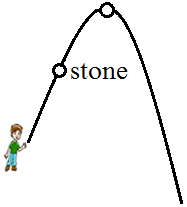
AnswerWhen a stone is thrown vertically upwards, the following conclusions can be done for point $P:$
$a.$ The acceleration for the entire journey of the stone is constant, as acceleration due to gravity near the surface of the earth is constant.
$b.$ The velocity of the stone at $P$ will be the least. Hence, kinetic energy at this point will be the least.
$c.$ The stone is at a maximum height at point $P.$ Hence, the potential energy is the maximum at $P.$
$d.$ Weight of the stone will remain nearly constant, as acceleration due to gravity near the surface of the earth is constant.
View full question & answer→MCQ 171 Mark
- A
Electrical energy into sound energy in ordinary telephone.
- B
Microwave energy into sound energy in a mobile phone.
- C
Sound energy into mechanical energy in a stereo system.
- ✓
Sound energy into electrical energy in public address system.
AnswerCorrect option: D. Sound energy into electrical energy in public address system.
A microphone converts sound energy into electrical energy in public address systems.
View full question & answer→MCQ 181 Mark
Which of the following energy change involves frictional force?
- A
Chemical energy to heat energy.
- ✓
Kinetic energy to heat energy.
- C
Potential energy to sound energy.
- D
Chemical energy to kinetic energy.
AnswerCorrect option: B. Kinetic energy to heat energy.
Frictional force is responsible for heating up of the tires of a moving vehicle. In such a situation, kinetic energy is converted into heat energy due to the frictional force.
View full question & answer→MCQ 191 Mark
An object is falling freely from a height $x.$ After it has fallen a height, it will possess:
- A
- B
- ✓
Half potential and half kinetic energy.
- D
Less potential and more kinetic energy.
AnswerCorrect option: C. Half potential and half kinetic energy.
During the free fall, potential energy is gradually converted into kinetic energy. At half of the maximum height, energy is equally distributed in the form of potential and kinetic energy.
View full question & answer→MCQ 201 Mark
Which of the following does not possess the ability to do work not because motion?
- A
A sparrow flying in the sky.
- B
A sparrow moving slowly on the ground.
- ✓
A sparrow in the nest on a tree.
- D
A squiral going up a tree.
AnswerCorrect option: C. A sparrow in the nest on a tree.
We will justify all statements one by one as:
$a.$ A sparrow flying in the sky possesses kinetic energy, which can be transformed into work.
$b.$ A sparrow moving slowly on the ground possesses kinetic energy, which can be transformed into work.
$c.$ A sparrow in the nest does not possess any kinetic energy as it is at rest. It does not possess the ability to do work in terms of motion of the body.
$d.$ A squirrel going up a tree possesses kinetic energy, which can be transformed into work.
View full question & answer→MCQ 211 Mark
Water stored in a dam possesses:
AnswerWater stored in a tank possesses gravitational potential energy because of its position above the ground.
View full question & answer→MCQ 221 Mark
Which one of the following statements about power stations is not true?
- A
Hydroelectric power stations use water to drive turbines.
- B
In a power station, turbines drive generators.
- ✓
Electricity from thermal power stations differs from that produced in hydroelectric power stations.
- D
In hydroelectric power stations and thermal power stations, alternators produce electricity.
AnswerCorrect option: C. Electricity from thermal power stations differs from that produced in hydroelectric power stations.
Electricity produced in a hydroelectric power station is similar to electricity produced in thermal power plants.
View full question & answer→MCQ 231 Mark
The device which converts mechanical energy into energy which runs our microwave oven is:
AnswerAlternator is the device that converts mechanical energy into energy,
which runs in microwave oven.
View full question & answer→MCQ 241 Mark
The work done on an object does not depend on the:
- A
- B
Angle between force and displacement.
- C
- ✓
Initial velocity of the object.
AnswerCorrect option: D. Initial velocity of the object.
The work done on an object does not depend upon the initial velocity of the moving object.
View full question & answer→MCQ 251 Mark
In case of negative work, the angle between the force and displacement is:
- A
$0^\circ$
- B
$45^\circ$
- C
$90^\circ$
- ✓
$180^\circ$
AnswerCorrect option: D. $180^\circ$
Work done is negative when the direction of force is opposite to the direction of motion.
So, the angle between force and displacement in the case of negative work.
View full question & answer→MCQ 261 Mark
A girl is carrying a school bag of $3\ kg$ mass on her back and moves $200\ m$ on a levelled road. If the value of g be $10\ m/s^2$, the work done by the girl against the gravitational force will be:
- A
$6000\ J$
- B
$0.6\ J$
- ✓
$0\ J$
- D
$6\ J$
AnswerCorrect option: C. $0\ J$
The girl is moving with the bag on a levelled road. Her direction of motion is perpendicular to the direction of gravitational force.
So, work done by the girl against gravity is zero.
View full question & answer→MCQ 271 Mark
A car is accelerated on a levelled road and acquires a velocity $4$ times of its initial velocity. During this process, the potential energy of the car:
AnswerPotential energy of an object depends only on its position above the ground and mass.
So, the potential energy of a car traveling on a leveled road does not change.
View full question & answer→MCQ 281 Mark
A girl weighing $400\ N$ climbs a vertical ladder. If the value of g be $10\ ms^2$, the work done by her after climbing $2\ m$ will be:
- A
$200J$
- ✓
$800J$
- C
$8000J$
- D
$2000J$
AnswerCorrect option: B. $800J$
Weight of the girl $(W)=400 N$
Vertical height $( h )=2 m$
Acceleration due to gravity $( g )=10 m / s ^2$
We can calculate the work done against gravity in moving a body of mass $( m )$ by a height $( h )$ as, Work done in lifting a body $= ($Weight of body$)($Vertical distance$)$
So,$W=(m)(g)(h)$
So, Work done in lifting a body
$=(400)(2) J$
$=800 J$
View full question & answer→MCQ 291 Mark
The commercial unit of energy is:
- A
- B
Watt$-$hour.
- ✓
Kilowatt$-$hour.
- D
AnswerCorrect option: C. Kilowatt$-$hour.
Kilowatt$-$hour is the commercial unit of electricity.
View full question & answer→MCQ 301 Mark
How much energy does a $100W$ electric bulb transfer in $1$ minute?
- A
$100J$
- B
$600J$
- C
$3600J$
- ✓
$6000J$
AnswerCorrect option: D. $6000J$
Power, $(P) = 100W$
Time duration, $(t) = 60s$
Now, we can calculate the electrical energy consumed as,
Energy consumed $= ($Power$)($Time$)$
So,
Energy consumed
$= (100)(60)J$
$= 6000J$
So, the energy consumed is $6000 J.$
View full question & answer→MCQ 311 Mark
An iron sphere of mass $10\ kg$ has the same diameter as an aluminium sphere of mass $3.5\ kg.$ Both the spheres are dropped simultaneously from a tower. When they are $10 m$ above the ground, they have the same:
AnswerMomentum, potential energy and kinetic energy depend on the mass of the body.
So, the answer is acceleration as it is independent of mass.
View full question & answer→MCQ 321 Mark
A car is accelerated on a levelled road and attains a speed of $4$ times its initial speed. In this process, the kinetic energy of the car:
- A
- B
Becomes $4$ times that of initial kinetic energy.
- C
Becomes $8$ times that of initial kinetic energy.
- ✓
Becomes $16$ times that of initial kinetic energy.
AnswerCorrect option: D. Becomes $16$ times that of initial kinetic energy.
Kinetic energy of a body is directly proportional to the square of the velocity.
So, the kinetic energy will become $16$ times its initial value if the velocity is increased $4$ times.
View full question & answer→Question 331 Mark
An electric motor raises a load of $0.2\ kg$, at a constant speed, through a vertical distance of $3.0\ m$ in $2\ s.$ If the acceleration power stations and thermal power stations, alternators produce electricity.
Answer$3.0$
Explanation:
Mass of the load $\left(m_1\right)=0.2 kg$
Height $(h)=3 m$
Acceleration due to gravity $( g )=10 m / s ^2$
Time taken $( t )=2 s$
We can calculate the work done against gravity as,
Work done by the car = (Weight of body)(Vertical distance)
$=(0.2)(10)(3) J$
$=6 J$
Now, we can calculate the power of the boy as,
$\text { Power }=\frac{\text { Work done }}{\text { Time }}$
So,
$\text { Power }=\frac{6}{2} W$
$=3 W$
So, the power is $3 W$ .
View full question & answer→MCQ 341 Mark
Which one of the following is not the unit of energy?
- A
- ✓
Newton$-$metre.
- C
- D
Kilowatt$-$hour.
AnswerCorrect option: B. Newton$-$metre.
Kilowatt is the unit of power.
View full question & answer→MCQ 351 Mark
The momentum of a bullet of mass $20g$ fired from a gun is $10\ kg m/s.$ The kinetic energy of this bullet in $kJ$ will be:
AnswerMass of the bullet, $(m), = 0.02 gm$
Momentum of the bullet, $(P) = 10\ kg.m/s$
The relation between momentum, mass and kinetic energy is as follows:
$\text{K.E.}=\frac{1}{2}\Big(\frac{\text{p}^2}{\text{m}}\Big)$
So,
$\text{K.E.}=\frac{1}{2}\Big(\frac{(10)^2}{0.02}\Big)\text{J}$
$=\frac{100}{0.04}\text{J}$
$=2500\text{J}$
$2.5\text{KJ}$
View full question & answer→MCQ 361 Mark
When an object falls freely towards the earth, then its total energy:
- A
- B
- ✓
- D
First increases and then decreases.
AnswerTotal energy of a freely falling object remains conserved.
View full question & answer→MCQ 371 Mark
Each of the following statement describes a force acting. Which force is causing work to be done?
- A
The weight of a book at rest on a table.
- ✓
The pull of a moving railway engine on its coaches.
- C
The tension in an elastic band wrapped around a parcel.
- D
The push of a person's feet when standing on the floor.
AnswerCorrect option: B. The pull of a moving railway engine on its coaches.
$a.$ The weight of a book at rest on a table cannot do any work as the book is at rest. So, the work done by this force is zero.
$b.$ The pulling force applied by the railway engine on its coaches is doing work, as the force applied by the engine results in the motion of the coaches.
$c.$ The tension force in an elastic band wrapped around a parcel cannot do any work, as there is no motion of the parcel because of the tension force of the rubber band.
$d.$ The push of a person’s feet on a floor when he is standing cannot do any work because there is no motion involved due to the applied force.
View full question & answer→MCQ 381 Mark
A stone is thrown upwards as shown in the diagram. When it reaches $P$, which of the following has the greatest value for the stone?
AnswerWhen a stone is thrown vertically upwards, the following conclusions can be done for point $P:$
$a.$ The acceleration for the entire journey of the stone is constant, as acceleration due to gravity near the surface of the earth is constant.
$b.$ The velocity of the stone at $P$ will be the least. Hence, kinetic energy at this point will be the least.
$c.$ The stone is at a maximum height at point $P.$ Hence, the potential energy is the maximum at $P.$
$d.$ Weight of the stone will remain nearly constant, as acceleration due to gravity near the surface of the earth is constant.
View full question & answer→MCQ 391 Mark
- A
Electrical energy into sound energy in ordinary telephone.
- B
Microwave energy into sound energy in a mobile phone.
- C
Sound energy into mechanical energy in a stereo system.
- ✓
Sound energy into electrical energy in public address system.
AnswerCorrect option: D. Sound energy into electrical energy in public address system.
A microphone converts sound energy into electrical energy in public address systems.
View full question & answer→MCQ 401 Mark
Which of the following energy change involves frictional force?
- A
Chemical energy to heat energy.
- ✓
Kinetic energy to heat energy.
- C
Potential energy to sound energy.
- D
Chemical energy to kinetic energy.
AnswerCorrect option: B. Kinetic energy to heat energy.
Frictional force is responsible for heating up of the tires of a moving vehicle.
In such a situation, kinetic energy is converted into heat energy due to the frictional force.
View full question & answer→MCQ 411 Mark
An object is falling freely from a height $x$. After it has fallen a height, it will possess:
- A
- B
- ✓
Half potential and half kinetic energy.
- D
Less potential and more kinetic energy.
AnswerCorrect option: C. Half potential and half kinetic energy.
During the free fall, potential energy is gradually converted into kinetic energy. At half of the maximum height, energy is equally distributed in the form of potential and kinetic energy.
View full question & answer→MCQ 421 Mark
Which of the following does not possess the ability to do work not because motion?
- A
A sparrow flying in the sky.
- B
A sparrow moving slowly on the ground.
- ✓
A sparrow in the nest on a tree.
- D
A squiral going up a tree.
AnswerCorrect option: C. A sparrow in the nest on a tree.
We will justify all statements one by one as:
$a.$ A sparrow flying in the sky possesses kinetic energy, which can be transformed into work.
$b.$ A sparrow moving slowly on the ground possesses kinetic energy, which can be transformed into work.
$c.$ A sparrow in the nest does not possess any kinetic energy as it is at rest. It does not possess the ability to do work in terms of motion of the body.
$d.$ A squirrel going up a tree possesses kinetic energy, which can be transformed into work.
View full question & answer→MCQ 431 Mark
Water stored in a dam possesses:
AnswerWater stored in a tank possesses gravitational potential energy because of its position above the ground.
View full question & answer→MCQ 441 Mark
Which one of the following statements about power stations is not true?
- A
Hydroelectric power stations use water to drive turbines.
- B
In a power station, turbines drive generators.
- ✓
Electricity from thermal power stations differs from that produced in hydroelectric power stations.
- D
In hydroelectric power stations and thermal power stations, alternators produce electricity.
AnswerCorrect option: C. Electricity from thermal power stations differs from that produced in hydroelectric power stations.
Electricity produced in a hydroelectric power station is similar to electricity produced in thermal power plants.
View full question & answer→