Questions · Page 1 of 2

Question Answer (2 Marks)

Take a timed test

50 questions · self-marked practice — reveal the answer and mark yourself.

Question 12 Marks
A trolley is pushed along a road with a force of 400N through a distance of 60m in 1 minute. Calculate the power developed.
Answer
Force, F = 400N
Distance, s = 60m
Time taken, t = 1 minute = 60s
Work done, W = F × s
= 400 × 60
$\text{Power}=\frac{\text{Work done}}{\text{Time taken}}$
$=\frac{400\times60}{60}=400\text{W}$
View full question & answer
Question 22 Marks
Two bodies having equal masses are moving with uniform speeds of $v$ and $2v$ respectively. Find the ratio of their kinetic energies.
Answer
Let masses of bodies be m.
Velocity of one body, $v_1 = v$
Velocity of another body, $v_2 = 2v$
$\text{KE}_1=\frac{1}{2}\text{mv}_1^2=\frac{1}{2}\text{mv}^2$
$\text{KE}_1=\frac{1}{2}\text{mv}_2^2=\frac{1}{2}\text{m}(2\text{v})^2$
$\frac{\text{KE}_1}{\text{KE}_2}=\frac{\text{v}^2}{4\text{v}^2}=\frac{1}{4}$
View full question & answer
Question 32 Marks
In an experiment to measure his power, a student records the time taken by him in running in a flight of steps on a staircase. Use the following data to calculate the power of the student:
Number of steps $= 28$
Height of each step $= 20\ cm$
Time taken $= 5.4\ s$
Mass of student $= 55\ kg$
Acceleration $= 9.8ms^{-2}$
Due to gravity.
Answer
No. of steps $= 28$
Height of each steps $= 28\ cm$
Tptal height $= 20 × 28 = 560\ cm = 5.6$
Mass of student $= 55\ kg$
g $= 9.8m/s^2$
time $= 5.4s$
Work done $= m \times g \times h$
$= 55 \times 9.8 \times 5.6 = 3018.4J$
$\text{Power}=\frac{\text{Work done}}{\text{Time}}$
$=\frac{3018.4}{5.4}=559\text{W}$
View full question & answer
Question 42 Marks
A man is instructed to carry a package from the base camp at B to submit A of a hill at a height of $1200$ metres. The man weighs $800\ N$ and the package weighs $200\ N$. If $g = 10m/s^2$,
  1. How much work does man do against gravity?
  2. What is the potential energy of the package at A if it is assumed to be
Answer
Weight of man = Mg $= 800\ N$
Weight of package = mg $= 200\ N$
Total weight of man and package $= Mg + mg$
$= (M + m)g = 1000\ N$
Height of the summit, $h = 1200\ m$
  1. Work done $= (M + m) \times g \times h$
$= 1000 \times 1200 = 12 \times 105J$
  1. Potential energy of the package $= m \times g \times h$
$= 200 \times 1200 = 2.4 \times 105J$
View full question & answer
Question 52 Marks
The work done by a force acting obliquely is given by the formula: $\text{W} =\text{F}\cos\theta\times\text{s}.$ What will happen to the work done if angle between the direction of force and motion of the body is increased gradually? Will it increase, decrease or remain constant?
Answer
The work done will decrease as the angle between the direction of force and direction of motion is increased gradually because,
$\text{W} =\text{F}\cos\theta\times\text{s}.$
And $\cos\theta$ decreases as the angle $\theta$ is increased.
View full question & answer
Question 62 Marks
An electric heater uses 600kJ of electrical energy in 5 minutes. Calculate its power rating.
Answer
Energy consumed = 600kJ
Time taken = 5minutes = 300s
$\text{Power}=\frac{\text{Energy}}{\text{Time}}$
$=\frac{600}{300}=2\text{kW}$
View full question & answer
Question 72 Marks
A boy weighing $40\ kg$ carries a box weighing $20\ kg$ to the top of a building $15\ m$ high in $25$ seconds. Calculate the power. $(g = 10m/s^2)$
Answer
Mass of the boy $= 40\ kg$
Mass of the box $= 20\ kg$
Total mass $= 60\ kg$
Height $h = 15\ m$
$g = m/s^2$
Work done $= m \times g \times h$
$= 60 \times 15 \times 10 = 9000J$
$\text{Power}=\frac{\text{Work done}}{\text{Time}}$
$=\frac{9000}{25}=360\text{W}$
View full question & answer
Question 82 Marks
How fast should a man of 50kg run so that his kinetic energy be 625J?
Answer
Mass = 50kg
Kinetic energy = 625J
$\text{KE}=\frac{1}{2}\text{mv}^2$
$625=\frac{1}{2}\times50\times\text{v}^2$
$\text{V}=\sqrt{\frac{625\times2}{50}}=5\text{m}/\text{s}$
View full question & answer
Question 92 Marks
How much work is done when a force of 2N moves a body through a distance of 10cm in the direction of force?
Answer
Force, F = 2N
Distance, s = 10cm = 0.1m
Work done W = F × s
= 2 × 0.1 = 0.2J
View full question & answer
Question 102 Marks
A force of 50N acts on a body and moves it a distance of 4m on a horizontal surface. Calculate the work done if the direction of force is at an angle of 60° to the horizontal surface.
Answer
Force, F = 50N
Distance, s = 4m
Angle between direction of force and direction of motion $\theta=60^\circ$
Work done, $\text{W}=\text{F}\cos\theta\times\text{s}$
$=50\times\cos60^\circ\times4$
$=50\times0.5\times4=100\text{J}$
View full question & answer
Question 112 Marks
If $784\ J$ of work was done in lifting a $20\ kg$ mass, calculate the height through which it was lifted. $(8 = 9.8m/s^2)$
Answer
Work done, $W = 784\ J$
Mass, $m = 20\ kg$
$g = 9.8m/s^2$
$W = m \times g \times h$
$784 = 20 \times 9.8 \times h$
$\text{h}=\frac{784}{20\times9.8}=4\text{m}$
View full question & answer
Question 122 Marks
Five electric fans of 120 watts each are used for 4 hours. Calculate the electrical energy consumed in kilowatt hours.
Answer
Power of 1 fan = 120W
Power of 5 fans = 5 × 120
= 600 W = 0.6 kW
Time = 4 hours
Electrical energy = 0.6 × 4 = 2.4kWh
View full question & answer
Question 132 Marks
Give one example each of a body possessing: (i) kinetic energy, and (ii) potential energy.
Answer
  1. Kinetic energy: A moving cricket ball has kinetic energy.
  2. Potential energy: A stretched rubber band has potential energy.
View full question & answer
Question 142 Marks
A boy weighing $40\ kg$ makes a high jump of $1.5\ m.$
  1. What is his kinetic energy at the highest point?
  2. What is his potential energy at the highest point? $(8 = 10m/s^2).$
Answer
Mass of boy, $m = 40\ kg$
Height, $h = 1.5\ m$
Acceleration due to gravity, $g = 10\ m/s^2$
  1. At highest point, velocity, $v = 0$
Therefore KE $= 0$
  1. $PE = m × g × h$
$= 40 \times 10 \times 1.5 = 600J$
View full question & answer
Question 152 Marks
A boy tries to push a truck parked on the roadside.The truck does not move at all. Another boy pushes a bicycle moves through a certain distance. In which case was the work done more: on the truck or on the bicycle? Give a reason to support your answer.
Answer
Work done is more when the boy pushes a bicycle because the force applied by him on the bicycle results in the motion of the bicycle. On the other hand, the boy trying to push a heavy truck parked on the roadside results in zero work, as there is no motion in the truck.
View full question & answer
Question 162 Marks
By how much will the kinetic energy of a body increase if its speed is doubled?
Answer
Kinetic energy will become four times when the speed is doubled because kinetic energy is directly proportional to square of speed of the body.
$\text{K.E.}\propto\text{v}^2$
View full question & answer
Question 172 Marks
Write the formula for work done on a body when the body moves at an angle to the direction of force. Give the meaning of each symbol used.
Answer
$\text{W}=\text{F}\cos\theta\times\text{s}$
Where, W is work done.
F is the force applied.
$\theta$ is the angle between the direction of force and the direction of motion of the body.
s is the distance moved by the body.
View full question & answer
Question 182 Marks
A car is being driven by a force of $2.5 \times 1010N$. Travelling at a constant speed of $5\ m/s$, it takes $2$ minutes to reach a certain place. Calculate the work done.
Answer
Force, $F = 2.5 \times 10^{10}N$
Velocity, $v = 5m/s$
Time, $t = 2$ minutes = $120s$
Distance, $s = v \times t$
$= 5 \times 120 = 600m$
Work done, $W = F \times s$
$= 2.5 \times 10^{10} \times 600m$
$= 15 \times 10^{12}J$
View full question & answer
Question 192 Marks
Is it possible that a force is acting on a body but still the work done is zero? Explain giving one example.
Answer
Yes, it is possible that a force is acting on a body but still work done is zero. For example, in the case of a man pushing a wall, the work done is zero despite of non-zero force, since there is no displacement of the wall.
View full question & answer
Question 202 Marks
A bulb lights up when connected to a battery. State the energy change which takes place:
  1. In the battery.
  2. In the bulb.
Answer
  1. Chemical energy to electrical energy.
  2. Electrical energy to heat and light energy.
View full question & answer
Question 212 Marks
A person of mass $50\ kg$ climbs a tower of height $72$ metres. Calculate the work done. $(8 = 9.8\ ms^{-2})$
Answer
Mass of the person, $m = 50\ kg$
Height of tower, $h = 72\ m$
Acceleration due to gravity $= 9.8m/s^2$
Work done $W = m \times g \times h$
$= 50 \times 9.8 \times 72 = 3528\ J$
View full question & answer
Question 222 Marks
A man X goes to the top of a building by a vertical spiral staircase. Another man Y of the same mass goes to the top of the same building by a slanting ladder. Which of the two does more work against gravity and why?
Answer
The work done by both X and Y are equal because irrespective of whether they reach the top of building by using a spiral or slanted ladder, the vertical distance moved by them against the gravity is same.
View full question & answer
Question 232 Marks
What is the work done against gravity when a body is moved horizontally along a frictionless surface?
Answer
The work done against gravity is zero when a body is moved horizontally along a frictionless surface because force of gravity acts perpendicular to the direction of motion.
View full question & answer
Question 242 Marks
What kind of energy transformations takes place at a coal-based thermal power station?
Answer
At a coal-based thermal power station, the chemical energy of coal is transformed into heat energy, which is further converted into kinetic energy and electrical energy.
View full question & answer
Question 252 Marks
A certain household consumes $650$ units of electricity in a month. How much is this electricity in joules?
Answer
Energy consumption = $650$ units = $650\ kWh$
$1kWh = 3.6 \times 10^6J$
$650kWh = 3.6 \times 650 \times 10^6$
$= 2.34 \times 10^9J$
View full question & answer
Question 262 Marks
How much electrical energy in joules does a 100 watt lamp consumes:
  1. In 1 second?
  2. In 1 minute?
Answer
Power = 100W
  1. time = 1s
energy = power × time = 100 J
  1. time = 1 minute = 60 s
energy = power × time

= 100 × 60 = 6kJ
View full question & answer
Question 272 Marks
Define power. Give the SI unit of power.
Answer
Power: Power is the rate of doing work.
$\text{Power}=\frac{\text{Work done}}{\text{Time}}$
SI unit of power is watt (W).
View full question & answer
Question 282 Marks
State whether the following objects possess kinetic energy, potential energy, or both:
  1. A man climbing a hill.
  2. A flying aeroplane.
  3. A bird running on the ground.
  4. A ceiling fan in the off position.
  5. A stretched spring lying on the ground.
Answer
  1. Both kinetic and potential energy.
  2. Both kinetic and potential energy.
  3. Only kinetic energy.
  4. Only potential energy.
  5. Only potential energy.
Note: In all the above cases we take ground as reference level where potential energy is zero.
View full question & answer
Question 292 Marks
To what height should a box of mass $150$ $kg$ be lifted, so that its potential energy may become $7350$ joules?
$(8=$ $9.8 m / s ^2$ ).
Answer
Mass of the box, $m=150 kg$
$P E=7350 J$
Acceleration due to gravity, $g=9.8 m / s ^2$
$PE=m \times g \times h$
$7350=150 \times 9.8 \times h$
$h=\frac{7350}{150 \times 9.8}=5 m$
View full question & answer
Question 302 Marks
What is the kinetic energy of a body of mass 1kg moving with a speed of 2m/s?
Answer
Mass = 1kg
Velocity = 2m/s
$\text{K}.\text{E}.=\frac{1}{2}\text{m}\times\text{v}^2$
$=\frac{1}{2}\times1\times2^2=2\text{J}$
View full question & answer
Question 312 Marks
On what factors does the gravitational potential energy of a body depend?
Answer
Gravitational potential energy of a body depends on:
  1. Mass of the body, m.
  2. Height to which the body is lifted, h.
  3. Acceleration due to gravity, g.
View full question & answer
Question 322 Marks
Explain by an example that a body may possess energy even when it is not in motion.
Answer
A stretched rubber band is an example of a body possessing energy while it is not in motion. The rubber band contains potential energy due to the change in its shape or configuration.
View full question & answer
Question 332 Marks
The power output of an engine is 3kW. How much work does the engine do in 20s?
Answer
Power = 3kW
Time = 20s
$\text{Power}=\frac{\text{Work done}}{\text{Time}}$
Work done = Power × time
= 3 × 20kWs = 60kJ
View full question & answer
Question 342 Marks
Give two examples where a body possesses both, kinetic energy as well as potential energy.
Answer
Two examples where a body possesses both kinetic energy as well as potential energy are:
  1. A man climbing up a hill.
  2. A flying aeroplane.
View full question & answer
Question 352 Marks
What are the quantities on which the amount on which the amount of work done depends? How are they related to work?
Answer
The work done by a force on a body depends on two factors:
  1. Magnitude of force.
  2. Distance through which the body moves.
Work done is directly proportional to the force applied and the distance through which the body moves.
W = F × s
where W is work done, F is force applied and s is distance through which the body moves.
View full question & answer
Question 362 Marks
How does the kinetic energy of a moving body depend on its (i) speed, and (ii) mass?
Answer
Kinetic energy is directly proportional to the mass of the body, m.
$\text{KE}\propto\text{m}$
Kinetic energy is directly proportional to square speed of the body, v.
$\text{KE}\propto\text{v}^2$
View full question & answer
Question 372 Marks
Define the term 'work'. Write the formula for the work done on a body when a force acts on the body in the direction of its displacement. Give the meaning of each symbol which occurs in the formula.
Answer
Work is done when a force applied on a body produces motion in it.
Formula for work done:
W = F × s
where W is the work done.
F is force applied.
S is the displacement of the body in the direction of force.
View full question & answer
Question 382 Marks
If the speed of a body is halved, what will be the change in its kinetic energy?
Answer
Kinetic energy will become one-fourth when the speed is halved because kinetic energy is directly proportional to square of speed of the body.
$\text{K.E.}\propto\text{v}^2$
View full question & answer
Question 392 Marks
In loading a truck, a man lifts boxes of $100\ N$ each through a height of $1.5\ m .$
a. How much work does he do in lifting one box?
b. How much energy is transferred when one box is lifted?
c. If the man lifts $4$ boxes per minute, at what is he working? $\left( g =10 ms^{-2}\right)$
Answer
$\text { solumion Weight of box }=100 N$
$\text { Height }=1.5 m$
$\quad \text { a. Work done }=m \times g \times h$
$=100 \times 1.5=150 J$
$\quad \text { b. Potential energy }=m \times g \times h$
$=100 \times 1.5=150 J$
c. Weight of 4 boxes $=400 N$
$\text { time }=1 \text { minute }=60 s$
Work done $=400 \times 1.5=600 J$
Power $=\frac{\text { Work done }}{\text { Time }}$
$=\frac{600}{60}=10 W$
View full question & answer
Question 402 Marks
A boy weighing $50\ kg$ climbs up a vertical height of $100m$. Calculate the amount of work done by him. How much potential energy does he gain? $(8 = 9.8m/s^2).$
Answer
Height,$ h = 100m$
Acceleration due to gravity, $g = 9.8m/s^2$​​​​​​​
Work done by the boy, $W = m \times g \times h$
$= 50 \times 9.8 \times 100 = 49000\ J = 49\ kJ$
Potential energy gained by the boy = work done by the boy $= 49\ kJ$
View full question & answer
Question 412 Marks
A body of mass $100\ kg$ is lifted up by 10m. Find:
  1. The amount of work done.
  2. Potential energy of the body at that height. (value of g $= 10\ m/s$).
Answer
Height, $h = 10m$
Acceleration due to gravity, $g = 10m/s^2$
Work done, $W = m \times g \times h = 100 \times 10 \times 10 = 10000 = 10kJ$
Potential energy of the body = work done $= 10\ kJ.$
View full question & answer
Question 422 Marks
When a ball is thrown inside a mocking bus, does its kinetic energy depend on the speed of the bus? Explain.
Answer
Yes, the kinetic energy of the ball thrown inside a moving bus depends on the speed of the bus because the speed of the bus adds up to the speed with which the ball is thrown inside the moving bus.
View full question & answer
Question 432 Marks
Two bodies $A$ and $B$ of equal masses are kept at heights of $h$ and $2h$ respectively. What will be the ratio of in their potential energies?
Answer
Let mass of body $A$ and $B$ be m
Height of body $A = h$
Height of body $B = 2h$
Potential energy for body $A, PE_A = m \times g \times h$
Potential energy for body $A, PE_B = m \times g \times 2h$
$\text{Ratio}=\text{PE}_\text{A}:\text{PE}_\text{B}=\frac{\text{m}\times\text{g}\times\text{h}}{\text{m}\times\text{g}\times2\text{h}}=\frac{1}{2}$
View full question & answer
Question 442 Marks
How much work is done when a body of mass m is raised to a height h above the ground?
Answer
Mass = m
Height above the ground = h
Work done = Potential energy acquired by the body = m × g × h
where g is acceleration due to gravity.
View full question & answer
Question 452 Marks
A boy throws a rubber ball vertically upwards. What type of work, positive or negative, is done:
  1. By the force applied by the boy?
  2. By the gravitational force of earth?
Answer
  1. Work done by force applied by the boy is positive because this force is in the direction of motion of the body.
  2. Work done by the gravitational force is negative because this force is against the direction of motion of the body.
View full question & answer
Question 462 Marks
The hanging bob of a simple pendulum is displaced to one extreme position B and then released. It swings towards centre position A and then to the other position C. In which position does the bob have:
  1. Maximum potential energy?
  2. Maximum kinetic energy?
Give reasons for your answer.
Answer
  1. Maximum potential energy is present in the bob at point C as at point C bob is at maximum height.
  2. Maximum kinetic energy is present in the bob at point A as at point A bob is at maximum speed.
View full question & answer
Question 472 Marks
What happens to the work done when the displacement of a body is at right angles to the direction of force acting on it? Explain your answer.
Answer
When the displacement of a body is at right angles to the direction of force acting on it, then work done is zero.
$\text{W}=\text{F}\cos\theta\times\text{s}$
When $\theta=90^\circ,\ \cos90^\circ=0$
$\text{W}=0\times\text{s}=0$
View full question & answer
Question 482 Marks
What type of energy is possessed:
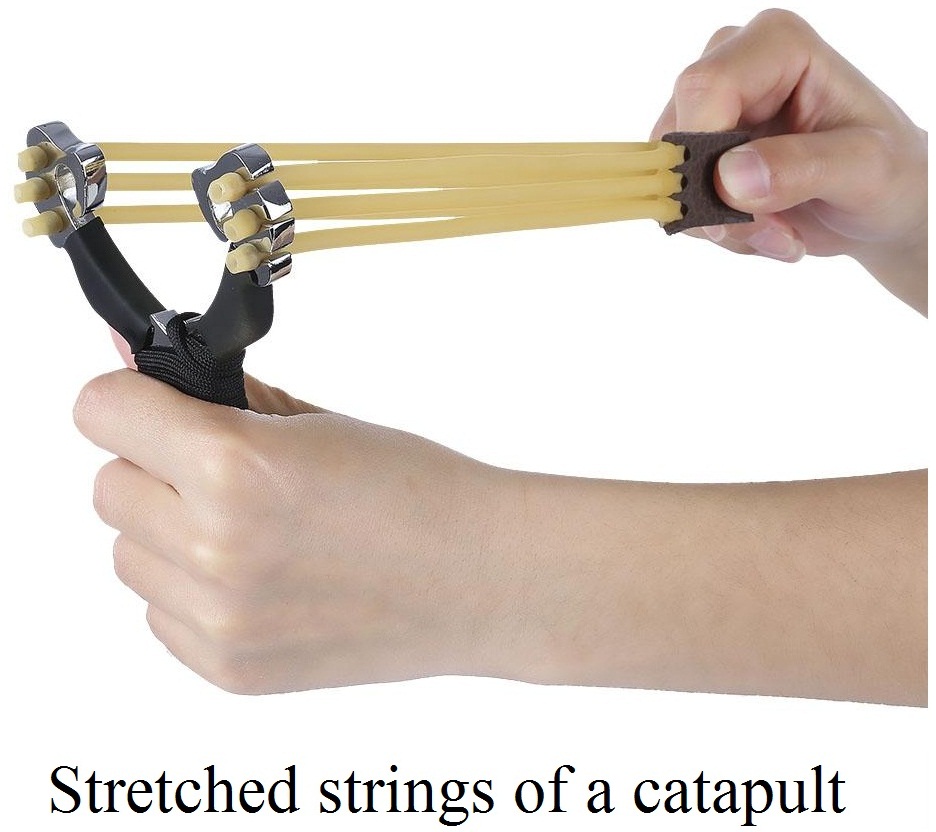
  1. By the stretched rubber strings of a catapult?
  1. By the piece of stone which is thrown away on releasing the stretched rubber strings of catapult?
Answer
  1. Potential energy.
  2. Both potential energy and kinetic energy.
View full question & answer
Question 492 Marks
A trolley is pushed along a road with a force of 400N through a distance of 60m in 1 minute. Calculate the power developed.
Answer
Force, F = 400N
Distance, s = 60m
Time taken, t = 1 minute = 60s
Work done, W = F × s
= 400 × 60
$\text{Power}=\frac{\text{Work done}}{\text{Time taken}}$
$=\frac{400\times60}{60}=400\text{W}$
View full question & answer
Question 502 Marks
Two bodies having equal masses are moving with uniform speeds of $v$ and $2v$ respectively. Find the ratio of their kinetic energies.
Answer
Let masses of bodies be m.
Velocity of one body, $v_1 = v$
Velocity of another body, $v_2 = 2v$
$\text{KE}_1=\frac{1}{2}\text{mv}_1^2=\frac{1}{2}\text{mv}^2$
$\text{KE}_1=\frac{1}{2}\text{mv}_2^2=\frac{1}{2}\text{m}(2\text{v})^2$
$\frac{\text{KE}_1}{\text{KE}_2}=\frac{\text{v}^2}{4\text{v}^2}=\frac{1}{4}$
View full question & answer
Question Answer (2 Marks) - Science STD 9 Questions - Vidyadip