MCQ 1011 Mark
The circumference of a circle exceeds its diameter by $120\ cm,$ then its radius is :
- ✓
$28\ cm$
- B
$14\ cm$
- C
$42\ cm$
- D
$56\ cm$
AnswerCorrect option: A. $28\ cm$
Let radius be $r \ cm.$
$\therefore$ According to the question, $2\pi\text{r} = 2\text{r} + 120$
$\Rightarrow2\text{r}(\pi-1)=120$
$\Rightarrow2\text{r}(\frac{22}{7}-1)=120$
$\Rightarrow2\text{r}\frac{120\times7}{15\times2}=28\text{ cm}$
View full question & answer→MCQ 1021 Mark
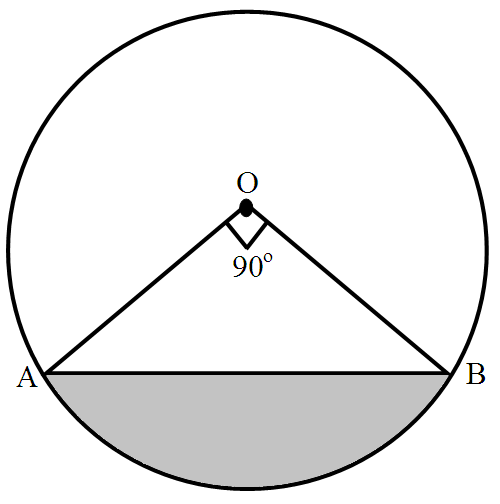
In the following figure, the shaded area is :
- A
$50(\pi-2)\text{ cm}^2$
- ✓
$25(\pi-2)\text{ cm}^2$
- C
$25(\pi+2)\text{ cm}^2$
- D
$5(\pi-2)\text{ cm}^2$
AnswerCorrect option: B. $25(\pi-2)\text{ cm}^2$
Area of the shaded region is $-$
$=\Big[\frac{\pi\theta}{360}-\sin\frac{\theta}{2}\cos\frac{\theta}{2}\Big](\text{r})^2$
$=\Big(\frac{\pi}{4}-\frac{1}{2}\Big)(10) ^2$
$=25(\pi-2)\text{ cm}^2$
So the answer is $(b).$
View full question & answer→MCQ 1031 Mark
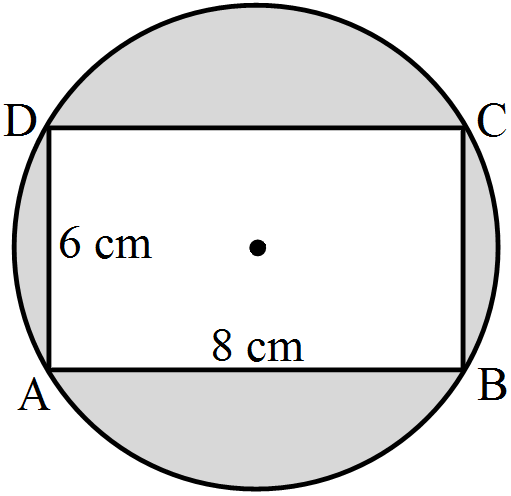
In the given figure, ABCD is a rectangle inscribed in a circle having length 8 cm and breadth 6 cm. If $\pi=3.14$ then the area of the shaded region is:
- A
$264cm^2$
- B
$266cm^2$
- C
$272cm^2$
- ✓
Answer(D). All options are incorrect; the correct answer is 30.5cm.
Solution:
Join AC.
Now, AC is the diameter of the circle.
We have:
$AC^2= AB^2+ BC^2$ [By pythagoras' theorem]
$\Rightarrow\text{AC}^2=\big\{(8)^2+(6)^2\big\}\text{cm}^2$
$\Rightarrow\text{AC}^2=(64+36)\text{cm}^2$
$\Rightarrow\text{AC}^2=100\text{cm}^2$
$\Rightarrow\text{AC}=10\text{cm}$
$\therefore$ Radius of the circle $=\frac{10}{2}\text{cm}$
$=5\text{cm}$
Now,
Area of the shaded region = Area of the circle with radius 5cm - Area of the rectangle ABCD
$=\big|(3.14\times5\times5)-(8\times6)\big|\text{cm}^2$
$=\Big|\Big(\frac{314}{100}\times25\Big)-48\Big|\text{cm}^2$
$=\Big(\frac{157}{2}-48\Big)\text{cm}^2$
$=\frac{61}{2}\text{cm}^2$
$=30.5\text{cm}^2$
View full question & answer→MCQ 1041 Mark
If $AB$ is a chord of length $5\sqrt{3}\text{ cm}$ of a circle with centre $O$ and radius $5\ cm,$ then area of sector $\text{OAB}$ is :
- A
$\frac{3\pi}{8}\text{ cm}^2$
- B
$\frac{8\pi}{3}\text{ cm}^2$
- C
$25\pi\text{ cm}^2$
- ✓
$\frac{25\pi}{3}\text{ cm}^2$
AnswerCorrect option: D. $\frac{25\pi}{3}\text{ cm}^2$
We have to find the area of the sector $\text{OAB}.$
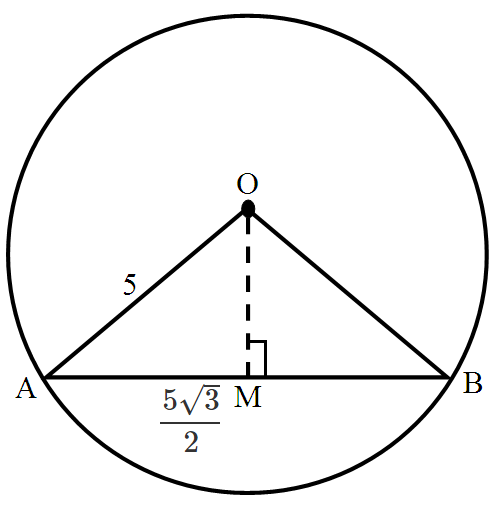
We have,
$\text{AM}=\frac{5\sqrt{3}}{2}$
So,
$\sin\angle\text{AOM}=\frac{5\sqrt{3}}{2(5)}$
Hence,
$\angle\text{AOM}=60^\circ$
Therefore area of the sector,
$=\frac{1}{2}\text{r}^2\theta$
$=\frac{1}{2}(25)\Big(\frac{2\pi}{3}\Big)$
$=\frac{25\pi}{3}\text{ cm}^2$
So answer is $(d).$ View full question & answer→MCQ 1051 Mark
The area of a sector of a circle whose radius is $r$ units and the length of the arc is $l$ units is :
- A
$\frac{1}{3}\text{lr sq.units}$
- B
$\frac{1}{4}\text{lr sq.units}$
- C
$\frac{1}{2}\text{l}^2\text{r sq.units}$
- ✓
$\frac{1}{2}\text{lr sq.units}$
AnswerCorrect option: D. $\frac{1}{2}\text{lr sq.units}$
Area of sector whose radius is $r =\frac{\theta}{360^\circ}\times\pi\text{r}^2$
$\Rightarrow $ Area of sector radious is $ r =\frac{\theta}{360^\circ}\times\pi\text{r.r}=\frac{1}{2}\times\frac{\theta}{360^\circ}\times2\pi\text{r.l}$
$\Rightarrow $ Area of sector $=\frac{1}{2}\text{l.r}\text{ sq.units}\bigg[\because\text{l}=\frac{\theta}{360^\circ}\times2\pi\text{r}\bigg]$
View full question & answer→MCQ 1061 Mark
The radii of two concentric circles are $19\ cm$ and $16\ cm$. The area of the ring enclosed between them is :
- A
$390 \text{ sq.cm}$
- B
$370 \text{ sq.cm}$
- C
$350 \text{ sq.cm}$
- ✓
$330 \text{ sq.cm}$
AnswerCorrect option: D. $330 \text{ sq.cm}$
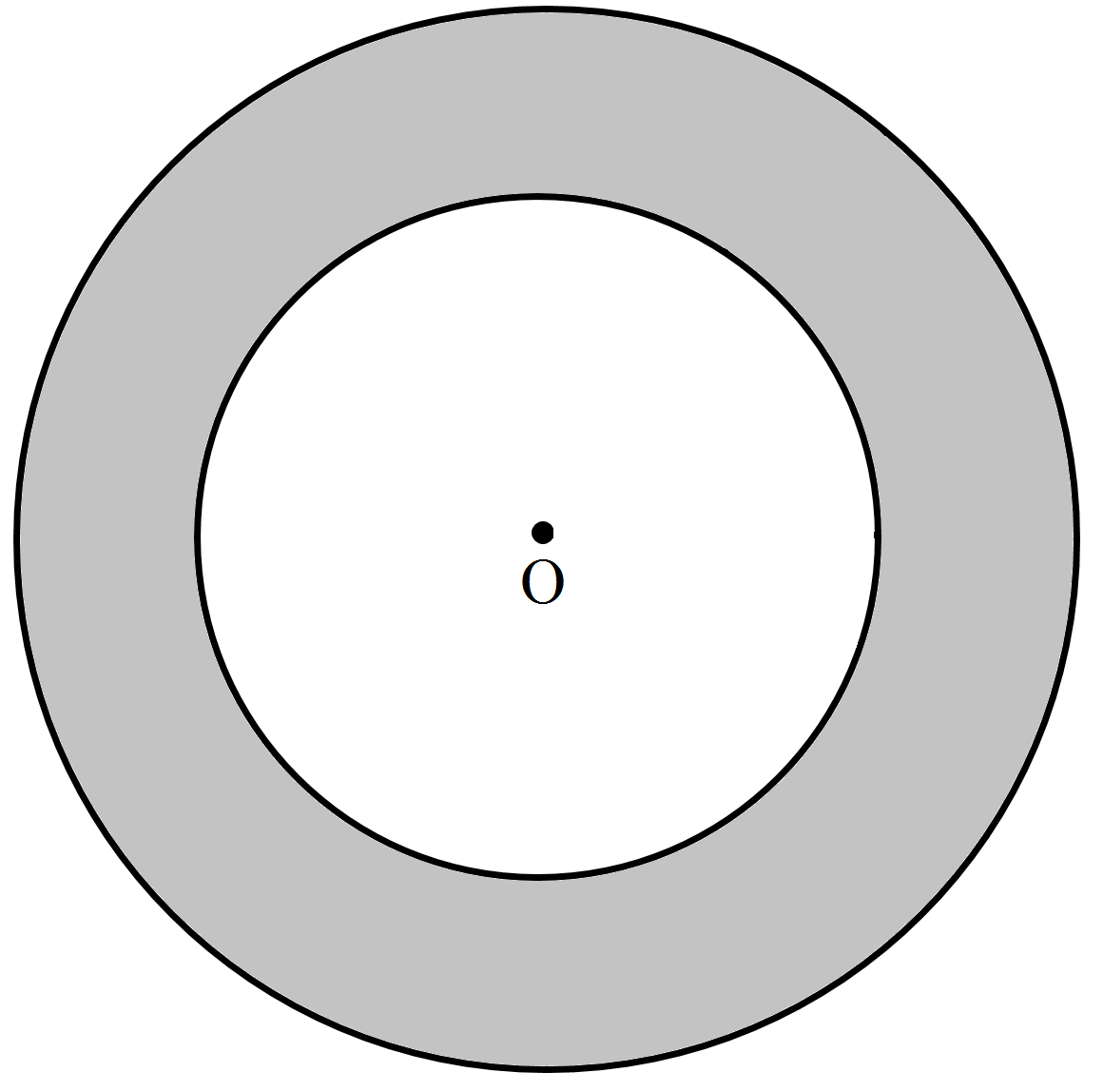
Let radius of outer circle be $R \ cm$ and radius of inner circle be $r \ cm$
$\therefore$ Area of the ring $=\pi\Big(\text{R}^2-\text{r}^2\Big)$
$=\frac{22}{7}\Big[(19)^2-(16)^2\Big]$
$=\frac{22}{7}(19)+(16) (19)-(16)$
$=\frac{22}{7}\times 35\times3=330\text{ sq.m}$ View full question & answer→MCQ 1071 Mark
The area of a sector of a circle with radius $r,$ making an angle of $x^\circ$ at the centre is :
- A
$\frac{\text{x}}{180}\times2\pi\text{r}$
- B
$\frac{\text{x}}{180}\times\pi\text{r}^2$
- C
$\frac{\text{x}}{360}\times2\pi\text{r}$
- ✓
$\frac{\text{x}}{360}\times\pi\text{r}^2$
AnswerCorrect option: D. $\frac{\text{x}}{360}\times\pi\text{r}^2$
The area of a sector of a circle with radius $r$ making an angle of $x^\circ$ at the centre is $\frac{\text{x}}{360}\times\pi\text{r}^2.$
View full question & answer→MCQ 1081 Mark
In a circle of radius $21\ cm$. an arc subtends an angle of $60^\circ$ at the centre. The length of the arc is :
- A
$21\ cm$
- ✓
$22\ cm$
- C
$18.16\ cm$
- D
$23.5\ cm$
AnswerCorrect option: B. $22\ cm$
We have, $\text{r}=21\text{ cm}$ and $\theta=60^\circ$
Length of arc $=\frac{\theta}{360^\circ}\times2\pi\text{r}\frac{60^\circ}{360^\circ}\times2\times\frac{22}{7}\times21=22\text{ cm}$
Hence, the correct answer is option $(b)$
View full question & answer→MCQ 1091 Mark
The area of a circle is $38.5\ \text{sq.cm}$. Its circumference is :
- A
$1\ cm$
- B
$33\ cm$
- C
$44\ cm$
- ✓
$22\ cm$
AnswerCorrect option: D. $22\ cm$
Given : Area of the circle $=\pi\text{r}=38.5\text{ sq}.\text{cm}$
$\Rightarrow\text{r}^2=\frac{38.5}{\pi}$
$=\frac{38.5\times7}{22}=12.25\text{ cm}$
$\Rightarrow\text{r}=3.5\text{ cm}$
$\therefore$ Circumference of the circle $=2\pi\text{r}$
$=2\times\frac{22}{7}\times3.5=22\text{ cm}$
View full question & answer→MCQ 1101 Mark
If the perimeter of a sector of a circle of radius $6.5\ cm$ is $29\ cm,$ then its area is :
- A
$58\ cm^2$
- ✓
$52\ cm^2$
- C
$25\ cm^2$
- D
$56\ cm^2$
AnswerCorrect option: B. $52\ cm^2$
We know that perimeter of a sector of radius $\text{r}=2\text{r}+\frac{\theta}{360}\times2\pi\text{r}\ \dots(1)$
We have given perimeter of the sector and radius of the sector and we are asked to find the area of the sector.
For that we have to find the sector angle.
Therefore, substituting the corresponding values of perimeter and radius in equation $(1)$ we get,
$29=2\times6.5+\frac{\theta}{360}\times2\pi\times6.5\ \dots(2)$
We will simplify equation $(2)$ as shown below,
$29=2\times6.5\Big(1+\frac{\theta}{360}\times\pi\Big)$
Subtracting $1$ from both sides of the equation we get,
$\frac{29}{2\times6.5}-1=\frac{\theta}{360}\times\pi\ \dots(3)$
We know that area of the sector $=\frac{\theta}{360}\times\pi\text{r}^2$
From equation $(3),$ we get
Area of the sector $=\Big(\frac{29}{2\times6.5}-1\Big)\text{r}^2$
Substituting $r = 6.5$ we get,
Area of the sector $=\Big(\frac{29}{2\times6.5}-1\Big)6.5^2$
$\therefore$ Area of sector $=\Big(\frac{29\times6.5^2}{2\times6.5}-6.5^2\Big)$
$\therefore$ Area of sector $=\Big(\frac{29\times6.5}{2}-6.5^2\Big)$
$\therefore$ Area of sector $=\Big(\frac{188.5}{2}-42.25\Big)$
$\therefore$ Area of sector $= (94.25 - 42.25)$
$\therefore$ Area of sector $= 52$
Therefore, area of the sector is $52\ cm^2$.
Hence, the correct answer is option $(b).$
View full question & answer→MCQ 1111 Mark
A shuttlecock used for playing badminton has the shape of a combination of :
- A
- ✓
Frustum of a cone and a hemisphere
- C
A cylinder and a hemisphere
- D
AnswerCorrect option: B. Frustum of a cone and a hemisphere
A shuttlecock used for playing badminton has the shape of a combination of frustum of a cone and a hemisphere.
View full question & answer→MCQ 1121 Mark
State true or false : A circle of radius $3\ cm$ can be drawn through two points $A,B$ such that $AB = 6\ cm :$
AnswerWe know, diameter of a circle $= 2 \times$ radius of the circle.
A circle with $AB = 6\ cm$ as diameter will have its radius equal to $3\ cm.$
View full question & answer→MCQ 1131 Mark
On decreasing the radius of a circle by $30\%,$ its area is decreased by :
AnswerLet the original radius
Thus, we have;
Original area $=\pi\text{r}^2$
Also,
New radius $= 70\%$ of $r$
$=\Big(\frac{70}{100}\times\text{r}\Big)$
$=\frac{7\text{r}}{10}$
New area $=\pi\times\Big(\frac{7\text{r}}{10}\Big)^2$
$=\frac{49\pi\text{r}^2}{100}$
Decrease in the area $=\Big(\pi\text{r}^2-\frac{49\pi\text{r}^2}{100}\Big)$
$=\frac{59\pi\text{r}^2}{100}$
Thus, we have :
Decrease in the area $=\Big(\frac{59\pi\text{r}^2}{100}\times\frac{1}{\pi\text{r}^2}\times100\Big)\%$
$=51\%$
View full question & answer→MCQ 1141 Mark
The angle described by the hour hand in $2$ hours is :
- ✓
$60^\circ$
- B
$360^\circ$
- C
$90^\circ$
- D
$30^\circ$
AnswerCorrect option: A. $60^\circ$
$\because$ Angle described by the hour hand in $12$ hours $= 360^\circ$
$\therefore$ Angle described by the hour hand in $2$ hours $=\frac{360^\circ}{12}\times2=60^\circ$
View full question & answer→MCQ 1151 Mark
In the following figure, the area of the segment $\text{PAQ}$ is :
- A
$\frac{\text{a}^2}{4}(\pi+2)$
- ✓
$\frac{\text{a}^2}{4}(\pi-2)$
- C
$\frac{\text{a}^2}{4}(\pi-1)$
- D
$\frac{\text{a}^2}{4}(\pi+1)$
AnswerCorrect option: B. $\frac{\text{a}^2}{4}(\pi-2)$
a is the radius of the circle arc $\text{PAQ}$ subtends angle $90^\circ $ at the centre
$\therefore$ Area of segment $\text{PAQ}$
$= $ Area of quadrant $-$ area of $\triangle\text{OPQ}$
$=\frac{1}{4}\pi\text{a}^2-\frac{1}{2}\text{a}\times\text{a}$
$=\frac{1}{4}\pi\text{a}^2-\frac{1}{2}\text{a}^2$
$=\frac{1}{4}\text{a}^2(\pi-2)$
$=\frac{\text{a}^2}{4}(\pi-2)\text{(b)}$
View full question & answer→MCQ 1161 Mark
On increasing the diameter of a circle by $40\%,$ its area will be increased by :
- A
$40\%$
- B
$80\%$
- ✓
$96\%$
- D
$82\%$
AnswerCorrect option: C. $96\%$
Let $d$ the original diameter.
Radius $=\frac{\text{d}}{2}$
Thus, we have :
Original area $=\pi\times\Big(\frac{\text{d}}{2}\Big)^2$
$=\frac{\pi\text{d}^2}{4}$
New diameter $=140\%$ of $d$
$=\Big(\frac{140}{100}\times\text{d}\Big)$
$=\frac{7\text{d}}{5}$
Now,
New radius $=\frac{7\text{d}}{5\times2}$
$=\frac{7\text{d}}{10}$
New area $=\pi\times\Big(\frac{7\text{d}}{10}\Big)^2$
$=\frac{49\pi\text{d}^2}{10}$
Increase in the area $=\Big(\frac{49\pi\text{d}^2}{10}-\frac{\pi\text{d}^2}{4}\Big)$
$=\frac{24\pi\text{a}^2}{100}$
$=\frac{6\pi\text{a}^2}{25}$
We have :
Increase in the area $=\Big(\frac{6\pi\text{a}^2}{25}\times\frac{4}{\pi\text{a}^2}\times100\Big)\%$
$=96\%$
View full question & answer→MCQ 1171 Mark
A horse is tied to a peg at one corner of a square $-$ shaped gross field of side $25m$ by means of a $14m$ long rope. The area of that part of the field in which the horse can graze is :
- A
$128 \text{ sq. cm}$
- ✓
$102 \text{ sq. cm}$
- C
$156 \text{ sq. cm}$
- D
$142 \text{ sq. cm}$
AnswerCorrect option: B. $102 \text{ sq. cm}$
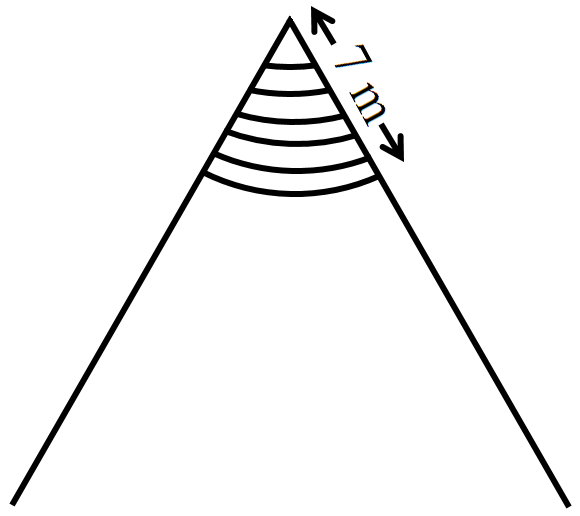
Area of the shaded region $=\frac{\theta}{360^\circ}\times\pi\text{r}^2$
$\Rightarrow$ Area of the shaded region $=\frac{60^\circ}{360^\circ}\times\frac{22}{7}\times14\times14$
$\Rightarrow$ Area of the shaded region $=102\text{ sq.cm}$ View full question & answer→MCQ 1181 Mark
The circumference of a circle whose diameter is $4.2\ cm$ is :
- ✓
$13.2\ cm$
- B
$4.2\ cm$
- C
$11\ cm$
- D
$22\ cm$
AnswerCorrect option: A. $13.2\ cm$
Given : Diameter $(d) = 4.2\ cm$
$\therefore $ Circumference $=\pi\text{d}=\frac{22}{7}\times4.2=13.2\text{ cm}$
View full question & answer→MCQ 1191 Mark
A circular park has a path of uniform width around it. The difference betweenthe outer and inner circumferences of the circular path is $132\ m$. Its width is :
AnswerLet $R$ and $r$ the radil of the outer and inner circles of the park, then
$2\pi\text{R}-2\pi\text{r}=132$
$\Rightarrow2\pi(\text{R $-$ r})=132$
$\Rightarrow\frac{2\times22}{7}(\text{R $-$ r})=132$
$\Rightarrow\text{R $-$ r}=\frac{132\times7}{2\times22}=21$
$\therefore$ Width of parth $= 21m\ \ (b)$
View full question & answer→MCQ 1201 Mark
Identify which among the pieces given below will not be requires to complete the square :
AnswerAmong the following we can see that $,J$ is not required to complete the square.
By rotating and arranging the pieces $H, I$ and $K$ we can form a square.
View full question & answer→MCQ 1211 Mark
If the area of a sector of a circle is $\frac{5}{18}$ of the area of the circle, then the sector angle is equal to :
- A
$60^\circ$
- B
$90^\circ$
- ✓
$100^\circ$
- D
$120^\circ$
AnswerCorrect option: C. $100^\circ$
Area of sector of a circle $=\frac{5}{18} x$ area of circle.
Let $\theta$ be its angle at the centre and $r$ be radius.
Then, $\pi\text{r}^2\times\frac{\theta}{360^\circ}=\frac{5}{18}\pi\text{r}^2$
$\frac{\theta}{360^\circ}=\frac{5}{18}$
$\Rightarrow\theta=\frac{5}{18}\times360^\circ=100^\circ\text{(c)}$
View full question & answer→MCQ 1221 Mark
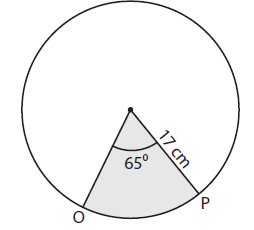
The length of the arc $OP$ is :
- A
$16.28\ cm$
- B
$12.28\ cm$
- C
$15.28\ cm$
- ✓
$19.28\ cm$
AnswerCorrect option: D. $19.28\ cm$
Arc length $=\frac{\theta}{360}2\pi \text{r}$
$=\frac{65}{360}\times2\times\pi\times17$
$=19.28\text{ cm}$
View full question & answer→MCQ 1231 Mark
If the perimeter of a circle is equal to that of a square, then the ratio of their areas is :
- A
$22 : 7$
- ✓
$14 : 11$
- C
$7 : 22$
- D
$11 : 14$
AnswerCorrect option: B. $14 : 11$
Let radius of circle be $r$ and side of a square be a
According to the given condition,
Perimeter of a circle $=$ Perimeter of a square
$\therefore2\pi\text{r}=4\text{a}$
$\Rightarrow\text{a}=\frac{\pi\text{r}}{2}\dots(\text{i})$
Now, $\frac{\text{Area of circle}}{\text{Area of square}}=\frac{\pi\text{r}^2}{\text{a}^2}$
$=\frac{\pi\text{r}^2}{\Big(\frac{\pi\text{r}}{2}\Big)^2}$
$[$From Eq. $(i)]$
$=\frac{\pi\text{r}^2}{\frac{\pi^2\text{r}^2}{4}}$
$=\frac{4}{\pi}=\frac{4}{\frac{22}{7}}$
$=\frac{28}{22}=\frac{14}{11}$
View full question & answer→MCQ 1241 Mark
In making $1000$ revolutions, a wheel covers $88\ km$. The diameter of the wheel is :
AnswerDistance covered by the wheel in $1$ revolution $=\Big(\frac{88\times1000}{1000}\Big)\text{m}$
$=88\text{m}$
We have :
Circumference of the wheel $= 88m$
Now, let the diameter of the wheel be $d m.$
Thus. we have
$\pi\text{d}=88$
$\Rightarrow\frac{22}{7}\times\text{d}=88$
$\Rightarrow\text{d}=\Big(88\times\frac{7}{22}\Big)$
$\Rightarrow\text{d}=28\text{m}$
View full question & answer→MCQ 1251 Mark
The length of the minute hand of a clock is $14\ cm.$ The area swept by the minute hand in $1$ hour is :
- A
$516 \text{ sq. cm}$
- B
$628 \text{ sq. cm}$
- ✓
$616 \text{ sq. cm}$
- D
$542 \text{ sq. cm}$
AnswerCorrect option: C. $616 \text{ sq. cm}$
$\because$ Angle described by minute hand in $1$ hour $= 360^\circ$
$\therefore\theta=360^\circ$
$\therefore$ Area of the sector $=\frac{\theta}{360^\circ}\times\pi\text{r}^2$
$\frac{360^\circ}{360^\circ}\times\frac{22}{7}\times14\times14$
$=616\text{ sq.cm}$
View full question & answer→MCQ 1261 Mark
If the perimeter of a square is equal to the circumference of a circle then the ratio of their areas is :
- A
$4:\pi$
- ✓
$\pi:4$
- C
$\pi:7$
- D
$7:\pi$
AnswerCorrect option: B. $\pi:4$
Let the side of the square be a and the radius of the circle be $r.$
Now, Perimeter of circle $=$ Circumference of the circle
$\Rightarrow4\text{a}=2\pi\text{r}$
$\Rightarrow\frac{\text{a}}{\text{r}}=\frac{\pi}{2}$
Now,
$\frac{\text{Area of square}}{\text{Area of circle}}=\frac{\text{a}^2}{\pi\text{r}^2}$
$=\frac{1}{\pi}\times\Big(\frac{\text{a}}{\text{r}}\Big)^2$
$=\frac{1}{\pi}\times\frac{\pi^2}{4}$
$=\frac{\pi}{4}$
$=\pi:4$
Hence, the correct answer is option $(b)$.
View full question & answer→MCQ 1271 Mark
From the figure, identify the center of the circle.
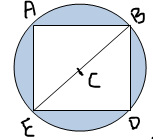
AnswerCenter of a circle is a point inside the circle and is at an equal distance from all of the points on its circumference.
In the given figure $,C$ is such point.
So $, C$ is the center of the given circle.
View full question & answer→MCQ 1281 Mark
The distance around the circle is called its $............$
AnswerThe distance around the edge of a circle $($or any curvy shape$)$ is called circumference.
It is a type of perimeter
View full question & answer→MCQ 1291 Mark
If a chord subtends an angle of $120^\circ$ at the centre, then the area of the corresponding segment is :
- A
$\Big(\frac{\text{x}}{3}+\frac{\sqrt{3}}{4}\Big)\text{r}^2\text{ sq.units}$
- ✓
$\Big(\frac{\text{x}}{6}+\frac{\sqrt{3}}{4}\Big)\text{r}^2\text{ sq.units}$
- C
$\Big(\frac{\text{x}}{3}+\frac{\sqrt{3}}{2}\Big)\text{r}^2\text{ sq.units}$
- D
$\Big(\frac{\text{x}}{4}+\frac{\sqrt{3}}{4}\Big)\text{r}^2\text{ sq.units}$
AnswerCorrect option: B. $\Big(\frac{\text{x}}{6}+\frac{\sqrt{3}}{4}\Big)\text{r}^2\text{ sq.units}$
Area of segment $=\frac{\theta}{360^\circ}\times\pi\text{r}^2-\frac{1}{2}\text{r}^2\sin\theta$
$\Rightarrow$ Area of segment $=\frac{120^\circ}{360^\circ}\times\pi\text{r}^2-\frac{1}{2}\text{r}^2\sin120^\circ$
$\Rightarrow$ Area of segment $=\frac{\pi\text{r}^2}{6}-\frac{\text{r}^2}{2}\times\Big(\frac{-\sqrt{3}}{2}\Big)$
$\Rightarrow $ Area of segment $=\Big(\frac{\pi}{6}+\frac{\sqrt{3}}{4}\Big)\text{r}^2\text{ sq.units}$
View full question & answer→MCQ 1301 Mark
The area of the circle that can be inscribed in a square of side $10\ cm$ is :
- A
$40\pi\text{ cm}^2$
- B
$30\pi\text{ cm}^2$
- C
$100\pi\text{ cm}^2$
- ✓
$25\pi\text{ cm}^2$
AnswerCorrect option: D. $25\pi\text{ cm}^2$
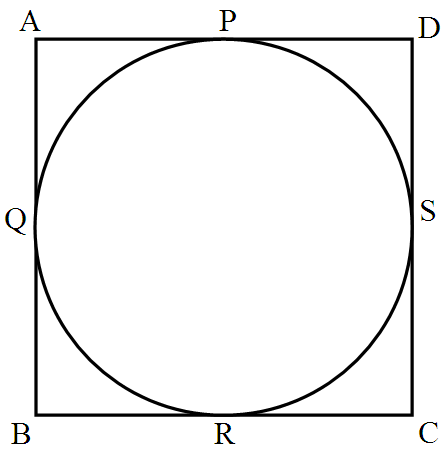
We know that $\text{ABCD}$ is a square of length $10\ cm$.
A circle is inscribed in the square therefore, all the sides of the square are become tangents of the circle.
By, the tangent property, we have
$AP = PD = 5$
$AQ = QB = 5$
$BR = RC = 5$
$CS = DS = 5$
If we join $PR$ then it will be the diameter of the circle of $10\ cm.$
Therefore, radius of the circle $= 5\ cm$
$\therefore$ Area of the circle $=\pi\text{ r}^2$
$\therefore$ Area of the circle $=\pi\times5^2$
$\therefore$ Area of the circle $=25\pi$
Therefore, area of the circle is $25\pi\text{ cm}^2.$
Hence, the correct answer is option $(d).$ View full question & answer→MCQ 1311 Mark
If a chord of a circle of radius $28\ cm$ makes an angle of $90^\circ$ at the centre, then the area of the major segment is :
- A
$392\ cm^2$
- B
$1456\ cm^2$
- C
$1848\ cm^2$
- ✓
$2240\ cm^2$
AnswerCorrect option: D. $2240\ cm^2$
Area of major segment,
$=$ Area of circle $-\Big[\frac{\pi\theta}{360}-\sin\frac{\theta}{2}\cos\frac{\theta}{2}\Big]\text{(r)}^2$
$=\pi(28)^2-\Big(\frac{\pi}{4}-\frac{1}{2}\Big)(28)^2$
$=784\pi-196(\pi-2)$
$=2240\text{ cm}^2$
So the answer is $(d)$
View full question & answer→MCQ 1321 Mark
A chord of a circle of radius $10\ cm$ subtends a right angle at the centre. The area of the minor segments $($given, $\pi=3.14)$ is :
- A
$32.5\ cm^2$
- B
$34.5\ cm^2$
- ✓
$28.5\ cm^2$
- D
$30.5\ cm^2$
AnswerCorrect option: C. $28.5\ cm^2$
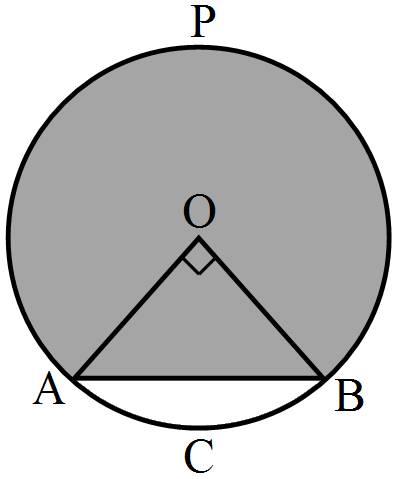
Area of minor segment $=$ Area of sector $\text{AOBC}\ -$ Area of right triangle $\text{AOB}$
$=\frac{90^\circ}{360^\circ}.\pi(\text{OA})^2-\frac{1}{2}\times\text{OA}\times\text{OB}$
$=\frac{1}{4}\times3.14\times(10)^2-\frac{1}{2}\times10\times10$
$=78.5-50$
$=28.5\text{ cm}^2$
Hence, the correct answer is option $(c).$ View full question & answer→MCQ 1331 Mark
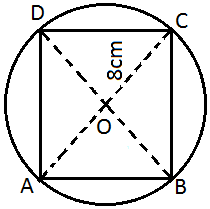
Choose the correct answer from the given four options: The area of the square that can be inscribed in a circle of radius $8\ cm$ is :
- A
$256\text{ cm}^2$
- ✓
$128\text{ cm}^2$
- C
$64\sqrt{2}\text{ cm}^2$
- D
$64\text{ cm}^2$
AnswerCorrect option: B. $128\text{ cm}^2$
Given, radius of circle $, r = OC = 8\ cm.$
$\therefore$ Diameter of a circie $, = AC = 2 \times 8 = 16\ cm$
Which is equal to the diagonal of a square.
Let side of square be $x$.
In right angled $\triangle\text{ABC}, AC^2= AB^2+ BC^2 \ [$by Phthagoras theorem$]$
$\Rightarrow (16)^2= x^2+ x^2$
$\Rightarrow 256 = 2x^2$
$\Rightarrow x^2= 128$
$\therefore$ Area of square $= x^2= 128\ cm^2$
Alternate Answer
Radius of circle $(r) = 8\ cm$
Diameter of circle $(d) = 2r = 2 \times 8 = 16\ cm$
Since, square inscribed in circle,
$\therefore$ Diagonal of the squre $=$ Diameter of circle
Now, Area of square $=\frac{(\text{Diagonal})^2}{2}$
$=\frac{(16)^2}{2}=\frac{256}{2}=128\text{ cm}^2$ View full question & answer→MCQ 1341 Mark
If the difference between the circumference and radius of a circle is $37\ cm,$ then its area is :
- ✓
$154 \mathrm{~cm}^2$
- B
$160 \mathrm{~cm}^2$
- C
$200 \mathrm{~cm}^2$
- D
$150 \mathrm{~cm}^2$
AnswerCorrect option: A. $154 \mathrm{~cm}^2$
Let $r$ be the radius of a circle then circum $-$ ference $=2\pi\text{r}$
$\therefore2\pi\text{ r}-\text{r}=37$
$\text{r}\Big(2\times\frac{22}{7}-1\Big)=37$
$\Rightarrow\text{r}\Big(\frac{44}{7}-7\Big)=37$
$\Rightarrow\text{r}\Big(\frac{37}{7}\Big)=37$
$\Rightarrow\text{r}=\frac{37\times7}{37}=7\text{ cm}$
Now area of the circle $=\pi\text{r}^2$
$=\frac{22}{7}\times7\times7=154\text{ cm}^2\text{(a)}$
View full question & answer→MCQ 1351 Mark
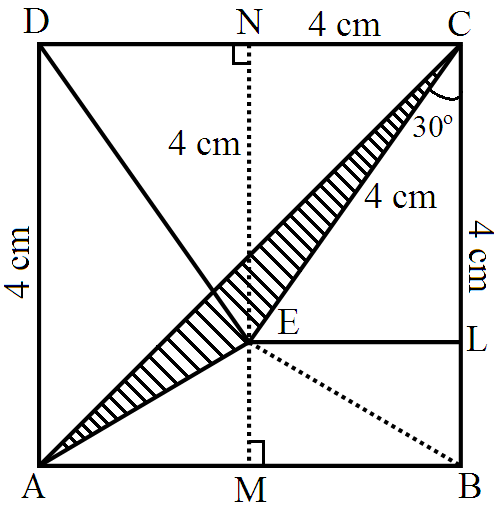
$\text{ABCD}$ is a square of side $4\ cm$. If $E$ is a point in the interior of the square such that $\triangle\text{CED}$ is equilateral, then area of $\triangle\text{ACE}$ is :
- A
$2\sqrt{3}-1\text{ cm}^2$
- ✓
$4\sqrt{3}-1\text{ cm}^2$
- C
$6\sqrt{3}-1\text{ cm}^2$
- D
$8\sqrt{3}-1\text{ cm}^2$
AnswerCorrect option: B. $4\sqrt{3}-1\text{ cm}^2$
Side of square $\text{ABCD} = 4\ cm$
and side of equilateral $\triangle\text{CED}=4\text{ cm}$
Area of square $\mathrm{= (side)^2= 4 \times 4 = 16\ cm^2}$
and area of $\triangle\text{CED}=\frac{\sqrt{3}}{4}\text{(side)}^2$
$=\frac{\sqrt{3}}{4}\times4\times4=4\sqrt{3}\text{cm}^2$
Join $AE, AB$ and $AC$ and draw $\text{EL}\perp\text{BC},$
$\text{EM}\perp\text{AB}$ and $\text{EN}\perp\text{CD}$
Now area of $\triangle\text{ABC}$
$=\frac{1}{2}\text{AD}\times\text{BC}=\frac{1}{2}\times4\times4=8\text{ cm}^2$
In $\triangle\text{BEC},\text{EL}=\frac{4}{2}=2$
$\Big(\therefore\sin30^\circ=\frac{1}{2}\Big)$
$\therefore$ area $\triangle\text{BEC}=\frac{1}{2}\times\text{BC}\times\text{EL}$
$=\frac{1}{2}\times4\times2=4\text{ cm}^2$
and in $\triangle\text{AEB}\perp\text{EM}=\text{MN}-\text{EN}$
$\big(4-2\sqrt{3}\big)\text{cm}$
$\therefore$ area $\triangle\text{AEB}=\frac{1}{2}\text{AB}\times\text{EM}=\frac{1}{2}\times4\big(4-2\sqrt{3}\big)$
$=4\big(2-\sqrt{3}\big)=8-4\sqrt{4}\text{ cm}^2$
$\therefore$ area $\triangle\text{AEC} =$ area $\triangle\text{ABC}\ -$
$\big($area $\triangle\text{AEB}\ +$ area $\triangle\text{BEC}\big)$
$=8-\big(8-4\sqrt{3}+4\big)=8-8-4+4\sqrt{3}$
$=4\sqrt{3}-4=4\big(\sqrt{3}-1\big)\text{cm}^2\text{(b)}$ View full question & answer→MCQ 1361 Mark
If the area of a sector of a circle bounded by an arc of length $5\pi\text{ cm}$ is equal to $20\pi\text{ cm}^2,$ then its radius is :
- A
$12\ cm$
- B
$16\ cm$
- ✓
$8\ cm$
- D
$10\ cm$
AnswerCorrect option: C. $8\ cm$
Let $r$ be the radius, then
Length of the arc of sector of $\theta$ angle $=5\pi$
$\Rightarrow2\pi\text{r}\frac{\theta}{360^\circ}=5\pi$
$\therefore\text{r}\frac{\theta}{360^\circ}=\frac{5}{2}\ \dots\text{(i)}$
and area of sector of $\theta$ angle $=20\pi\text{ cm}^2$
$\therefore\pi\text{r}^2\frac{\theta}{360^\circ}=20\pi$
$\text{r}^2\frac{\theta}{360^\circ}=20$
$\Rightarrow\text{r}.\text{r}\frac{\theta}{360^\circ}=20$
$\Rightarrow\text{r}\times\frac{5}{2}=20$
$\Rightarrow\text{r}=\frac{20\times2}{5}=8$
$\therefore$ Radius $= 8\ cm (c)$
View full question & answer→MCQ 1371 Mark
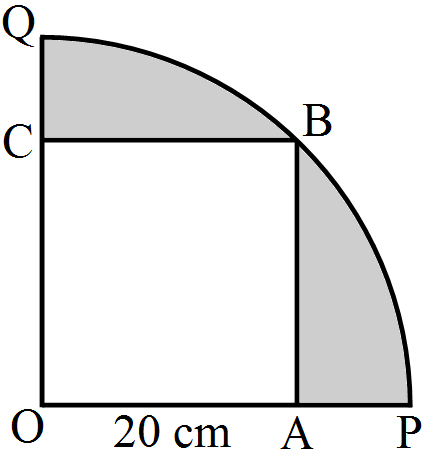
In the given figure, a square $\text{OABC}$ has been inscribed in the quadrant $\text{OPBQ}$. If $OA = 20\ cm,$ then the area of the shaded region is : $\big[\text{Take }\pi=3.14\big]$
- A
$214\ cm^2$
- ✓
$228\ cm^2$
- C
$242\ cm^2$
- D
$248\ cm^2$
AnswerCorrect option: B. $228\ cm^2$
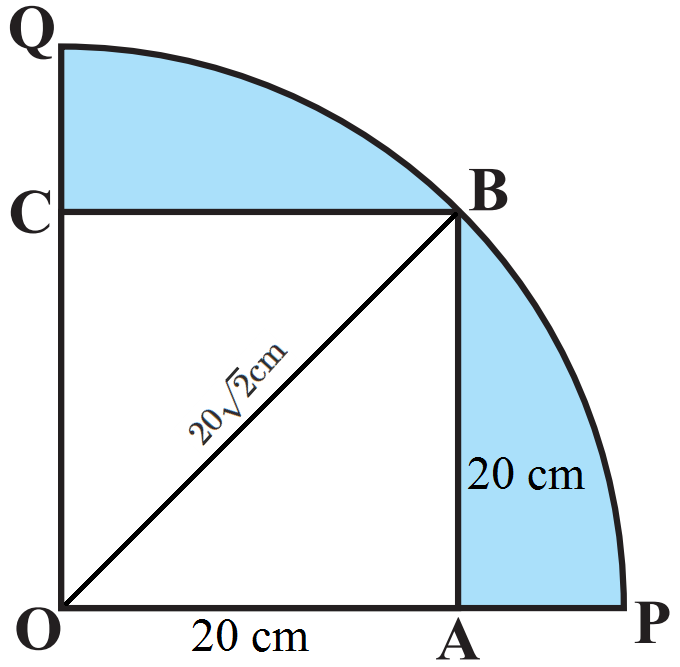
Join $OB$.
Now, $OB$ is the radius of the circle.
We have:
$OB^2= OA^2+ AB^2 [$By pythagoras' theorem$]$
$\Rightarrow\text{OB}^2=\big\{(20)^2+(20)^2\big\}\text{ cm}^2$
$\Rightarrow\text{OB}^2=(400+400)\text{ cm}^2$
$\Rightarrow\text{OB}^2=800\text{ cm}^2$
$\Rightarrow\text{OB}=20\sqrt{2}\text{ cm}$
Hence, the radius of the circle is $20\sqrt{2}\text{ cm}.$
Now,
Area of the shaded region $=$ Area of the quadrant $-$ Area of the square $\text{OABC}$
$=\Big|\Big(\frac{1}{4}\times3.14\times20\sqrt{2}\times20\sqrt{2}\Big)-(20\times20)\Big|\text{ cm}^2$
$=\Big|\Big(\frac{1}{4}\times\frac{314}{100}\times800\Big)-400\Big|\text{ cm}^2$
$=(628-400)\text{ cm}^2$
$=228\text{ cm}^2$ View full question & answer→MCQ 1381 Mark
The distance covered by a circular wheel of diameter $d$ in $100$ revolutions is :
- A
$\pi\text{d}$
- ✓
$100\pi\text{d}$
- C
$100\pi$
- D
$100\text{d}$
AnswerCorrect option: B. $100\pi\text{d}$
Number of revolutions $=\frac{\text{Total distance}}{\text{Circumferrnce of wheel}}$
$\Rightarrow100=\frac{\text{Total distence}}{\pi\text{d}}$
$\Rightarrow{\text{Total distence}}=100\pi\text{d}$
View full question & answer→MCQ 1391 Mark
Choose the correct answer from the given four options : The radius of a circle whose circumference is equal to the sum of the circumferences of two circles of diameters $36\ cm$ and $20\ cm$ is :
- A
$56\ cm$
- B
$42\ cm$
- ✓
$28\ cm$
- D
$16\ cm$
AnswerCorrect option: C. $28\ cm$
$\because$ Circumference of first circle $=2\pi\text{r}=\pi\text{d}_1=36\pi\text{ cm}\ [$given, $\mathrm{d}_1 = 36\ cm]$
and circumference of second circle $=\pi\text{d}_2=20\pi\text{ cm}\ [$given, $\mathrm{d}_2 = 20\ cm]$
According to the given condition,
Circumference of circle $=$ Circumference of first circle $+$ Circumference of second circle
$\Rightarrow \pi\text{D}=36\pi+20\pi \ [$where $,D$ is diameter of a circle$]$
$\Rightarrow \text{D}=56\text{ cm}$
So, diameter of a circle is $56\ cm.$
$\therefore$ Required radius of circle $\frac{56}{2}=28\text{ cm}$
View full question & answer→MCQ 1401 Mark
$\pi\text{r}^2 $ gives us the $.........$ of the circle.
Answer$\pi\text{r}^2$ gives us the area of the circle,
where $r$ is radius of the circle.
View full question & answer→MCQ 1411 Mark
In a circle of radius $21 \ cm,$ an arc subtends an angle of $60^{\circ}$ at the centre the length of the arc is $22 \ cm$ :
AnswerArc length $\frac{\theta}{360}\times2\pi\text{r}$
$=\frac{60}{360}\times2\times\frac{22}{7}\times21=22\text{ cm}.$
View full question & answer→MCQ 1421 Mark
The areas of two circles are in the ratio $9 : 4.$ The ratio of their circumferences is :
- ✓
$3 : 2$
- B
$4 : 9$
- C
$2 : 3$
- D
$81 : 16$
AnswerCorrect option: A. $3 : 2$
Let the the radii of the two circles be $r$ and $R,$ the circumferences of the circles be $c$ and $C$ and the areas of the two circles be $a$ and $A$.
Now,
$\frac{\text{a}}{\text{A}}=\frac{9}{4}$
$\Rightarrow\frac{\pi\text{r}^2}{\pi\text{R}^2}=\Big(\frac{3}{2}\Big)^2$
$\Rightarrow\frac{\text{r}}{\text{R}}=\frac{3}{2}$
Now, the ratio between their circumferences is given by
$\frac{\text{c}}{\text{C}}=\frac{2\pi\text{r}}{2\pi\text{R}}$
$=\frac{\text{r}}{\text{R}}$
$=\frac{3}{2}$
Hence, the correct answer is option $(a)$
View full question & answer→MCQ 1431 Mark
If a chord subtends an angle of $60^\circ$ at the centre, then the area of the corresponding segment is :
- A
$\Big(\frac{\text{x}}{2}+\frac{\sqrt{3}}{2}\Big)\text{r}^2\text{ sq.units} $
- B
$\Big(\frac{\text{x}}{6}+\frac{\sqrt{3}}{2}\Big)\text{r}^2\text{ sq.units} $
- ✓
$\Big(\frac{\text{x}}{6}-\frac{\sqrt{3}}{4}\Big)\text{r}^2\text{ sq.units} $
- D
$\Big(\frac{\text{x}}{2}-\frac{\sqrt{3}}{2}\Big)\text{r}^2\text{ sq.units} $
AnswerCorrect option: C. $\Big(\frac{\text{x}}{6}-\frac{\sqrt{3}}{4}\Big)\text{r}^2\text{ sq.units} $
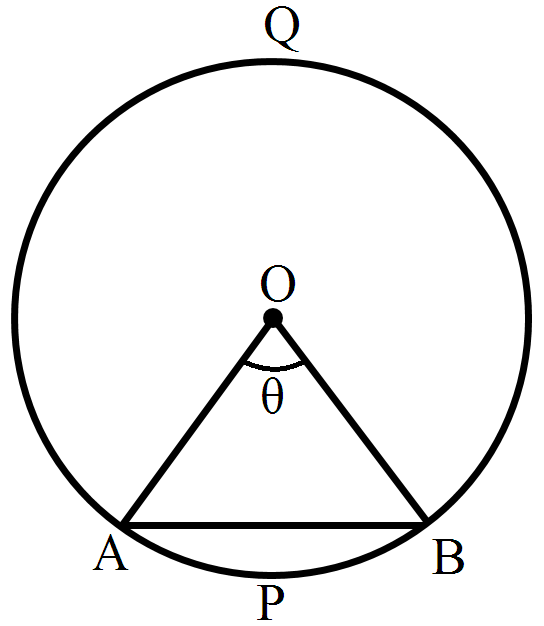
Area of segment $=\frac{\theta}{360^\circ}\times\pi\text{r}^2-\frac{1}{2}\text{r}^2\sin\theta$
$\Rightarrow$ Area of segment $=\frac{60^\circ}{360^\circ}\times\pi\text{r}^2-\frac{1}{2}\text{r}^2\sin60^\circ$
$\Rightarrow$ Area of segment $=\frac{\pi\text{r}^2}{6}-\frac{\text{r}^2}{2}\times\frac{\sqrt{3}}{2}$
$\Rightarrow$ Area of segment $=\Big(\frac{\pi}{6}-\frac{\sqrt{3}}{4}\Big)\text{r}^2\text{ sq.units}$ View full question & answer→MCQ 1441 Mark
Choose the correct answer from the given four options : The area of the circle that can be inscribed in a square of side $6\ cm$ is :
- A
$36\pi\text{ cm}^2$
- B
$18\pi\text{ cm}^2$
- C
$12\pi\text{ cm}^2$
- ✓
$9\pi\text{ cm}^2$
AnswerCorrect option: D. $9\pi\text{ cm}^2$
Given, side of square $= 6\ cm$
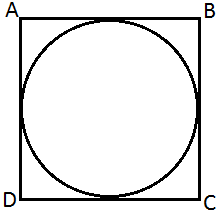
$\therefore$ Diameter of a circie, $(d) =$ Side of square $= 6\ cm$
$\therefore$ Radius of a circle $(\text{r})=\frac{\text{d}}{2}=\frac{6}{2}=3\text{ cm}$
$\therefore$ Area of circle $=\pi(\text{r})^2$
$=\pi(3)^2=9\pi\text{ cm}^2$ View full question & answer→MCQ 1451 Mark
If a wire is bent into the shape of a square, then the area of the square is $81\ cm^2$.When wire is bent into a semi-circular shape, then the area of the semi $-$ circle will be :
- A
$22\ cm^2$
- B
$44\ cm^2$
- ✓
$77\ cm^2$
- D
$154\ cm^2$
AnswerCorrect option: C. $77\ cm^2$
We have given that a wire is bent in the form of square of side $a \ cm$ such that the area of the square is. $81\ cm^2$
If we bent the same wire in the form of a semicircle with radius $r \ cm,$ the perimeter of the wire will not change.
$\therefore$ perimeter of the square $=$ perimeter of semi circle
$4\text{a}=\frac{1}{2}(2\pi\text{r})+2\text{r} \dots(1)$
We know that area of the square $= 81\ cm^2$
$\therefore\text{a}^2=81$
$\therefore\text{a}=9$
Now we will substitute the value of a in the equation $(1),$
$4\times9=\frac{1}{2}(2\pi\text{r})+2\text{r}$
$\therefore36=\frac{1}{2}(2\pi\text{r})+2\text{r}$
$\therefore36=(\pi\text{r})+2\text{r}$
$\therefore36=\text{r}(\pi+2)$
Now we will substitute $\pi=\frac{22}{7}$
$\therefore36=\text{r}\big(\frac{22}{7}+2\big)$
$\therefore=\text{r}\Big(\frac{22+14}{7}\Big)$
$\therefore36=\text{r}\Big(\frac{36}{7}\Big)$
Multiplying both sides of the equation by $7$ we get $, 36 \times 7 = r \times 36$
Now we will divide both sides of the equation by $36$ we get $, r = 7$
Therefore, radius of the semi circle is $7\ cm.$
Now we will find the area of the semicircle.
Area of the semicircle $=\frac{1}{2}\times\pi\text{r}^2$
$=\frac{1}{2}\times\pi\times7^2$
$=\frac{1}{2}\times\frac{22}{7}\times7^2$
$=11\times7$
$=7$
Therefore, area of the semicircle is $77\ cm^2$
Hence the correct answer is option $(c).$
View full question & answer→MCQ 1461 Mark
If a chord of a circle of radius $7\ cm$ subtends a right angle at the centre of the circle, then the area of the minor segment is :
- A
$28 \text{ sq. cm}$
- B
$56 \text{ sq. cm}$
- C
$42 \text{ sq. cm}$
- ✓
$13.96 \text{ sq. cm}$
AnswerCorrect option: D. $13.96 \text{ sq. cm}$
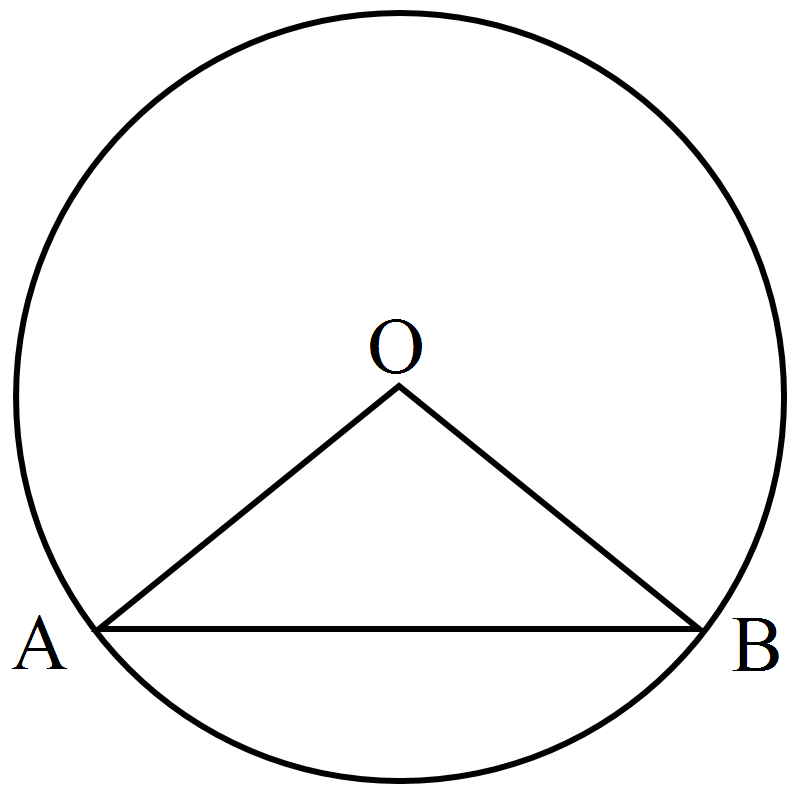
Area of minor sector.
$=\frac{1}{4}\times\pi\text{r}^2$
$=\frac{1}{4}\times\pi\text7^2$
$=\frac{1}{4}\times\pi\times49$
$=12.25\pi\text{ sq.cm}$
Area of major sector.
$=\frac{3}{4}\times\pi\text{r}^2$
$=\frac{3}{4}\times\pi\times7^2$
$=\frac{3}{4}\times\pi\times49$
$=3\times12.25\pi$
$=36.75\pi\text{ sq.cm}$
Area of triangle formed by two radii.
$=\frac{1}{2}\times\text{base}\times\text{height}$
$=\frac{1}{2}\times7\times7$
$=24.5\text{ sq.cm}$
Area of minor segment $=$ Area of minor sector $-$ Area of triangle
$=12.25\pi-25.5$
$=12.25(\pi-2)$
$=12.25(3.14-2)$
$=12.25\times1.14$
$=13.96\text{ sq.cm}$ View full question & answer→MCQ 1471 Mark
The area of the sector of angle $60^\circ$ of a circle with radius $10\ cm$ is :
- A
$52\frac{2}{21}\text{ cm}^2$
- ✓
$52\frac{8}{21}\text{ cm}^2$
- C
$52\frac{4}{21}\text{ cm}^2$
- D
AnswerCorrect option: B. $52\frac{8}{21}\text{ cm}^2$
Area of sector $=\frac{\theta}{360^\circ}\times\pi\text{r}^2$
$\frac{60^\circ}{360^\circ}\times\frac{22}{7}\times10\times10$
$=\frac{1100}{21}=52\frac{8}{21}\text{ sq.cm}$
View full question & answer→MCQ 1481 Mark
The area of a sector whose perimeter is four times its radius $r$ units, is :
- A
$\frac{\text{r}^2}{4}\text{ sq. units}$
- B
$2\text{r}^2\text{ sq. units}$
- ✓
$\text{r}^2\text{ sq. units}$
- D
$\frac{\text{r}^2}{2}\text{ sq. units}$
AnswerCorrect option: C. $\text{r}^2\text{ sq. units}$
Radius of sector $= r$
Perimeter $= 4r$
and length of arc $= 4r\ – 2r = 2r$
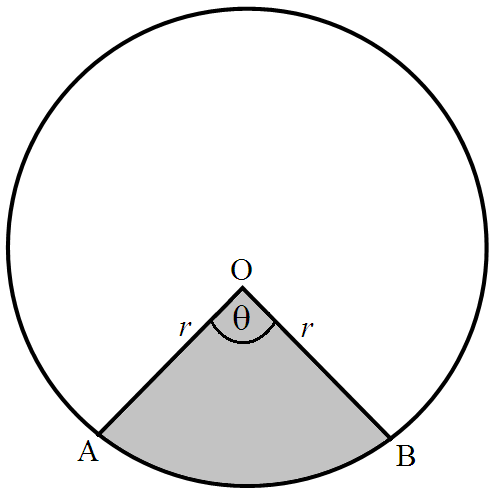
$\therefore$ Let angle at the centre $=\theta$
Then, $2\pi\text{r}=\frac{\theta}{360^\circ}=2\text{r}$
$\Rightarrow\pi=\frac{\theta}{360^\circ}=1\ \dots\text{(i)}$
Now area $\pi\text{r}^2\times\frac{\theta}{360^\circ}=\text{r}^2\Big(\pi\times\frac{\theta}{360^\circ}\Big)$
$=\text{r}^2\times1 \ [$From $(i)]$
$=\text{r}^2\text{(c)}$ View full question & answer→MCQ 1491 Mark
The area of a square that can be inscribed in a circle of radius $10\ cm$ is :
- ✓
$200 \text{ sq. cm}$
- B
$150 \text{ sq. cm}$
- C
$100 \text{ sq. cm}$
- D
$300 \text{ sq. cm}$
AnswerCorrect option: A. $200 \text{ sq. cm}$
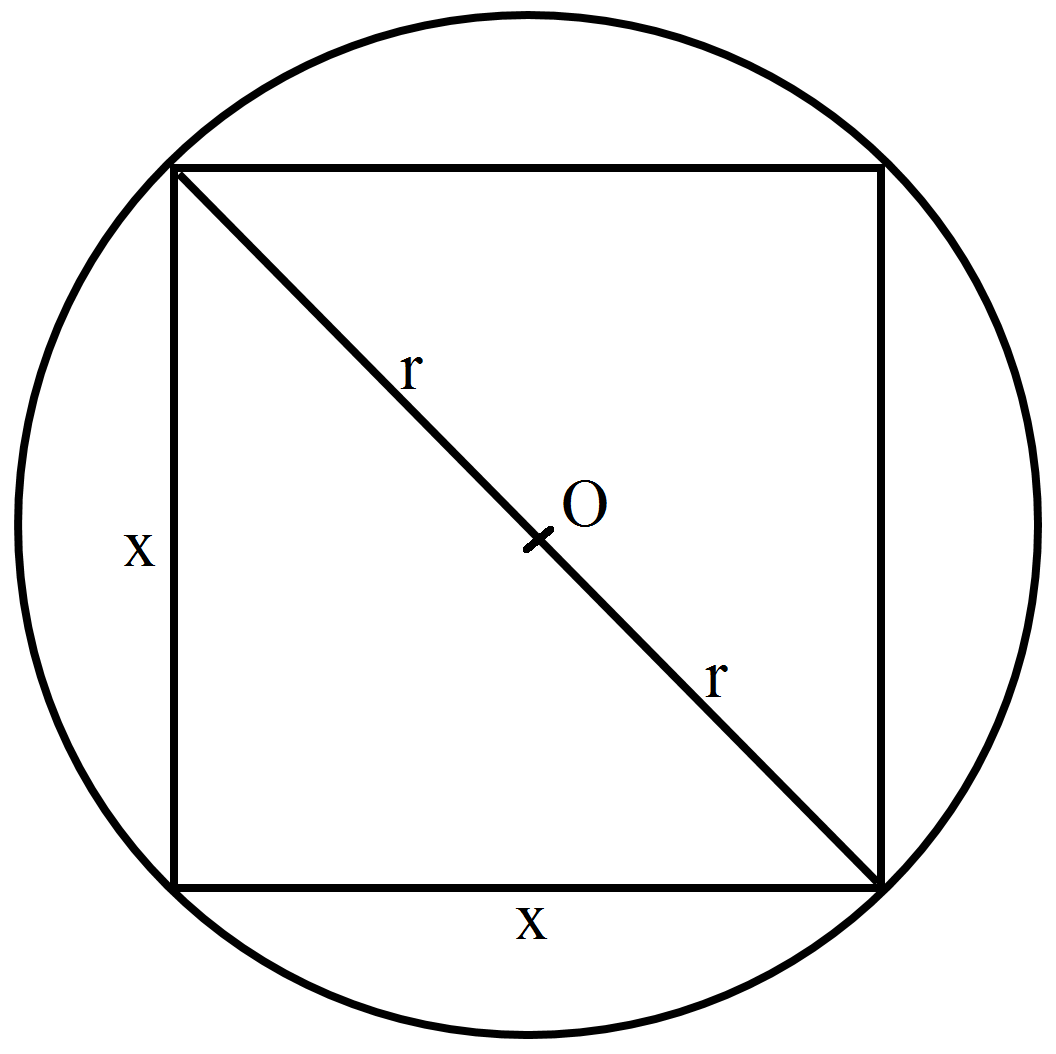
Given : Radius $(r) = 10\ cm$
Let the side of the square be $x \ cm$
Now, using Pythagoras theorem,
$\text{x}^2+\text{x}^2=(2\text{r})^2$
$2\text{x}^2=(20)^2$
$\Rightarrow2\text{x}^2=400$
$\text{x}^2=200\text{ sq.cm}$
Therefore, the area of the square $= 200 \text{ sq. cm}$
View full question & answer→MCQ 1501 Mark
If the perimeter and area of a circle are numerically equal, then the radius of the circle is :
- A
$7$ units.
- ✓
$2$ units
- C
$4$ units
- D
$5$ units
AnswerCorrect option: B. $2$ units
Let the radius of the circle be $r$ units.
Then, the perimeter of the circle $=2\pi\text{ r units}$
The area of the circle $=\pi\text{r}^2\text{ sq. units}$
According to the question,
$2\pi\text{r}=\pi\text{r}^2$
$\Rightarrow\text{r}=2\text{ units}$
View full question & answer→