Questions · Page 2 of 2

M.C.Q (1 Marks)

MCQ 511 Mark
The radius of a wheel is 0.25m. The number of revolutions it will make to travel a distance of 11km will be:
  • A
    2800
  • B
    4000
  • C
    5500
  • 7000
Answer
Correct option: D.
7000
We have given the radius of the wheel that is 0.25cm.
We know that distance covered by the wheel in one revolution$=\frac{\text{Distance moved}}{\text{Number of revolution}}$
Distance covered by the wheel in one revolution is equal to the circumference of the wheel.
$2\pi\text{r}=\frac{\text{Distance moved}}{\text{Number of revolutions}} \dots(1)$
Distance moved is given as 11km so we will first convert it to m.
$\therefore$ 11km = 11000m
Now we will substitute the values in equation (1),
$2\times\pi\times0.25=\frac{11000}{\text{Number of revolutions}}$
Now we will substitute $\pi=\frac{22}{7}$
$2\times\frac{22}{7}\times0.25=\frac{11000}{\text{Number of revolutions}}$
Simplifying equation (1) we get,
Number of revolutions $=\frac{11000\times7}{2\times22\times0.25}$
$\therefore$ Number of revolutions $=\frac{11000\times7}{22\times0.5}$
$\therefore$ Number of revolution $=\frac{1000\times7}{2\times0.5}$
$\therefore$ Number of revolution $=\frac{7000}{1}$
$\therefore$ Number of revolutions = 7000
Therefore, it will make 7000 revolutions to travel a distance of 11km.
Hence, the correct answer is option (d).
View full question & answer
MCQ 521 Mark
If the circumference and the area of a circle are numerically equal, then diameter of the circle is:
  • A
    $\frac{\pi}{2}$
  • B
    $2\pi$
  • C
    $2$
  • $4$
Answer
Correct option: D.
$4$
Let r be the radius of the circle, then Circumference $=2\pi\text{r}$
and area $=\pi\text{r}^2$
But $2\pi\text{r}=\pi\text{r}^2$
$\therefore2\text{r}=\text{r}^2$
$\Rightarrow\text{r}=2$
Diameter $=2\text{r}=2\times2=4\text{(d)}$
View full question & answer
MCQ 531 Mark
If $\pi$ is taken as $\frac{22}{7},$ the distance (in metres) covered by a wheel of diameter 35cm, in onerevolution, is:
  • A
    2.2
  • 1.1
  • C
    9.625
  • D
    96.25
Answer
Correct option: B.
1.1
Diameter of a wheel = 35cm $=\frac{35}{100}\text{m}$Circumference of the wheel $\pi\text{d}$
$=\frac{35}{100}\times\frac{22}{7}$
$=\frac{110}{100}=1.10=1.1\text{m}$
$\therefore$ Distance in one revolution = 1.1m (b)
View full question & answer
MCQ 541 Mark
If the sum of the circumferences of two circles with radii $r_1$ and $r_2$ is equal to the circumference of the circle of radius $r$, then
  • $r_1+r_2=r$
  • B
    $r_1+r_2>r$
  • C
    $r_1+r_2 < r$
  • D
    none of these
Answer
Correct option: A.
$r_1+r_2=r$
(A)$r_1+r_2=r$
It is given that
$
2 \pi r_1+2 \pi r_2=2 \pi r \Rightarrow r=r_1+r_2
$
View full question & answer
MCQ 551 Mark
If the circumference of a circle and the perimeter of a square are equal, then
  • A
    Area of the circle $=$ Area of the square
  • Area of the circle $>$ Area of the square
  • C
    Area of the circle $<$ Area of the square
  • D
    Nothing definite can be said about the relation between the areas of the circle and the square
Answer
Correct option: B.
Area of the circle $>$ Area of the square
(B)Area of the circle $>$ Area of the square
From example 1, we obtain
$\frac{A_1}{A_2}=\frac{11}{14} \Rightarrow A_1<A_2$ i.e. Area of the circle $>$ Area of the square.
View full question & answer
MCQ 561 Mark
If the perimeter of a square is equal to the perimeter of a circle, then the ratio of their areas is
  • $11: 14$
  • B
    $22: 13$
  • C
    $14: 11$
  • D
    $13: 22$
Answer
Correct option: A.
$11: 14$
(A)$11: 14$
Let the length of each side of the square be $a$ units and the radius of the circle be $r$ units. It is given that
$
\begin{array}{l}
\text { Perimeter of the square }=\text { Perimeter of the circle } \Rightarrow 4 a=2 \pi r \Rightarrow a=\frac{\pi}{2} r \\
A_1=\text { Area of the square }=a^2=\frac{\pi^2}{4} r^2, A_2=\text { Area of the circle }=\pi r^2 \\
A_1: A_2=\frac{\pi^2}{4} r^2: \pi r^2=\pi: 4=22: 28=11: 14
\end{array}
$
View full question & answer
MCQ 571 Mark
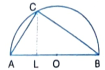
The area of the largest triangle that can be inscribed in a semi-circle of radius $r$ is
Image
  • A
    $2 r$
  • $r^2$
  • C
    $r$
  • D
    $\sqrt{r}$
Answer
Correct option: B.
$r^2$
(B)$r^2$
Area of $\triangle A B C=\frac{1}{2}(A B \times C L)=r \times C L$
Clearly, it is greatest when $C L$ is maximum and the maximum value of $C L$ is $r$ $\therefore \quad$ Greatest area of $\triangle A B C=r \times r=r^2$
View full question & answer
MCQ 581 Mark
The length of an arc of a circle with radius 12 cm is $10 \pi cm$. The angle subtended by the arc at the centre of the circle, is
  • A
    $120^{\circ}$
  • B
    $6^{\circ}$
  • C
    $75^{\circ}$
  • $150^{\circ}$
Answer
Correct option: D.
$150^{\circ}$
(D)$150^{\circ}$
Let the measure of the angle subtended by the arc at the centre of the circle is $\theta^{\circ}$, Then,
Length of the arc $=10 \pi cm$
$
\Rightarrow \quad \frac{\theta}{360} \times 2 \pi \times 12=10 \pi \Rightarrow \theta=150
$
Hence, the measure of the angle is $150^{\circ}$.
View full question & answer
MCQ 591 Mark
The area of the sector of a circle of radius 12 cm is $60 \pi cm^2$. The central angle of this sector is
  • A
    $120^{\circ}$
  • B
    $6^{\circ}$
  • C
    $75^{\circ}$
  • $150^{\circ}$
Answer
Correct option: D.
$150^{\circ}$
(D)$150^{\circ}$
Let the central angle of the sector be of $\theta$ degrees. Then, Area of the sector $=60 \pi cm^2$
$
\Rightarrow \quad \frac{\theta^{\circ}}{360} \times \pi \times 12^2=60 \pi \Rightarrow \theta=150^{\circ}
$
Hence, the central angle of the sector is of $150^{\circ}$.
View full question & answer
MCQ 601 Mark
If the circumferences of tuo circles are in the ratio $4: 5$, then their areas are in the ratio
  • $16: 25$
  • B
    $25: 16$
  • C
    $2: \sqrt{5}$
  • D
    $4: 5$
Answer
Correct option: A.
$16: 25$
(A)$16: 25$
Let $r_1, r_2$ be the radil of the circles whose circumferences are $C_1, C_2$ and areas are $\ A_1, \ A_2$ respectively. Then,
$
C_1=2 \pi r_1, C_2=2 \pi r_2, A_1=\pi r_1^2 \text { and } \ A_2=\pi r_2^2
$
It is given that
$
\begin{array}{l}
C_1: C_2=4: 5 \Rightarrow \frac{C_1}{C_2}=\frac{4}{5} \Rightarrow \frac{2 \pi r_1}{2 \pi r_2}=\frac{4}{5} \Rightarrow \frac{r_1}{r_2}=\frac{4}{5} \\
\frac{\ A_1}{\ A_2}=\frac{\pi r_1^2}{\pi r_2^2}=\left(\frac{r_1}{r_2}\right)^2=\left(\frac{4}{5}\right)^2=\frac{16}{25}
\end{array}
$
Hence, $\ A_1: \ A_2=16: 25$.
View full question & answer
MCQ 611 Mark
The hour hand of a clock is 6 cm long. The angle swept by it between 7:20 AM and 7:55 AM
  • A
    $\left(\frac{35}{4}\right)^{\circ}$
  • $\left(\frac{35}{2}\right)^{\circ}$
  • C
    $35^{\circ}$
  • D
    $70^{\circ}$
Answer
Correct option: B.
$\left(\frac{35}{2}\right)^{\circ}$
(B)$\left(\frac{35}{2}\right)^{\circ}$
The hour hand rotates at the rate of $\left(\frac{1}{2}\right)^{\circ}$ per minute.
Angle swept by hour hand in 35 minutes $=\left(\frac{35}{2}\right)^{\circ}$.
View full question & answer
MCQ 621 Mark
What is the length of the arc of the sector of a circle with radius 14 cm and central angle $90^{\circ}$ ?
  • 22 cm
  • B
    44 cm
  • C
    88 cm
  • D
    11 cm
Answer
Correct option: A.
22 cm
(A) 22 cm
Length of the arc $=\left(\frac{\theta}{360} \times 2 \pi r\right)=\left(\frac{90}{360} \times 2 \times \frac{22}{7} \times 14\right) cm =22 cm$
View full question & answer
MCQ 631 Mark
In Fig. there are three sectors of a circle of radius 7 cm , making angle of $60^{\circ}, 80^{\circ}$ and $40^{\circ}$ at ethe centre. The area of the shaded region (in $\left.cm ^2\right)$ is $\left(U_{ se } \pi=\frac{22}{7}\right)$
Image
  • 77
  • B
    154
  • C
    44
  • D
    22
Answer
Correct option: A.
77
(A)77
Let $A$ be the area of the shaded region. Then,
$A=\left(\frac{40}{360}+\frac{60}{360}+\frac{80}{360}\right) \times \frac{22}{7} \times 7^2 cm^2 \quad\left[\right.$ Using : $\left.A=\left(\frac{\theta_1}{360}+\frac{\theta_2}{360}+\frac{\theta_3}{360}\right) \pi r^2\right]$
$\Rightarrow \quad A=\left(\frac{1}{9}+\frac{1}{6}+\frac{2}{9}\right) \times 154 cm^2=77 cm^2$
View full question & answer
MCQ 641 Mark
Area of a sector of a circle is $\frac{1}{6}$ to the area of the circle. The degree measure of its minor arc is
  • A
    $90^{\circ}$
  • $60^{\circ}$
  • C
    $45^{\circ}$
  • D
    $30^{\circ}$
Answer
Correct option: B.
$60^{\circ}$
(B)$60^{\circ}$
Let the radius of the circle be $r$ and the degree measure of the sector angle be $\theta^{\circ}$. It is given that
$
\frac{\theta}{360} \pi r^2=\frac{1}{6} \times \pi r^2 \Rightarrow \theta=60^{\circ}
$
View full question & answer
MCQ 651 Mark
If the difference between the circumference and the radius of a circle is 37 cm . If $\pi=\frac{22}{7}$. then the circumference (in cm) of the circle is
  • A
    15.4
  • 44
  • C
    14
  • D
    7
Answer
Correct option: B.
44
(B)44
Let the length of the radius of the circle be $r cm$. It is given that
$
\begin{array}{l}
2 \pi r-r=37 \Rightarrow r\left(2 \times \frac{22}{7}-1\right)=37 \Rightarrow r=7 cm \\
\text { Circumference }=2 \pi r=2 \times \frac{22}{7} \times 7 cm=44 cm
\end{array}
$
View full question & answer
MCQ 661 Mark
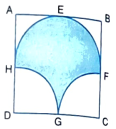
In Fig. ABCD is a square of side 14 cm with $E, F, G$ and $H$ as the mid-points of sides $A B$, $B C, C D$ and $D A$ respectrocly. The area of the shaded portion is
Image
  • A
    $44 cm^2$
  • B
    $49 cm^2$
  • $98 cm^2$
  • D
    $\frac{49}{2} \pi cm^2$
Answer
Correct option: C.
$98 cm^2$
(C)$98 cm^2$
$
\begin{aligned}
\text {  Area of shaded region } & =\text { Area of semi-carcle } F E H F \\
& + \text { Area of rectangle } H D C F \\
& \text { - Area of two quadrants }
\end{aligned}
$
$\begin{aligned} \Rightarrow \quad \text { Area of shaded region } & =\text { Area of semi-circle of radius } 7 cm \\ & +\frac{1}{2}(\text { Area of square } A B C D) \\ & - \text { Area of semi-circle of radius } 7 cm\end{aligned}$
$=\frac{1}{2}($ Area of square $A B C D)=\frac{1}{2} \times 14 \times 14 cm^2=98 cm^2$
View full question & answer
MCQ 671 Mark
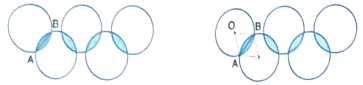
Given below is the picture of the Olympic rings made by taking five congruent circles of radius 1 cm each, intersecting in such a way that the chord formed by joining the point of intersection of two circles is also of length 1 cm . Total area of all the dotted regions assuming the thickness of the rings to be negligible is
Image
  • A
    $4\left(\frac{\pi}{12}-\frac{\sqrt{3}}{4}\right) cm ^2$
  • B
    $\left(\frac{\pi}{6}-\frac{\sqrt{3}}{4}\right) cm ^2$
  • C
    $4\left(\frac{\pi}{6}-\frac{\sqrt{3}}{4}\right) cm ^2$
  • $8\left(\frac{\pi}{6}-\frac{\sqrt{3}}{4}\right) cm ^2$
Answer
Correct option: D.
$8\left(\frac{\pi}{6}-\frac{\sqrt{3}}{4}\right) cm ^2$
(D)$8\left(\frac{\pi}{6}-\frac{\sqrt{3}}{4}\right) cm ^2$
Let $O$ be the centre of the left-most ring which intersects the adjacent ring at two points $A$ and $B$. Then, $O A=O B=A B=1 cm$.
Therefore, $\triangle O A B$ is an equilateral and hence $\angle A O B=60^{\circ}$. We observe that there are 8 segments of a circle of radius 1 cm and sector angle $\theta=60^{\circ}$. Therefore,
Required area $=8 \times$ Area of one segment of a circle of raduus 1 cm and sector angle $\theta=60^{\circ}$
$
=8\left(\frac{60}{360} \times \pi \times 1^2-\frac{\sqrt{3}}{4} \times 1^2\right) cm^2=8\left(\frac{\pi}{6}-\frac{\sqrt{3}}{4}\right) cm^2
$
View full question & answer
MCQ 681 Mark
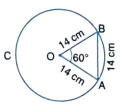
A circle with centre $O$ of diameter 28 cm and a chord $B C$ of length 14 cm is shown below. The length of the major arc of the circle, to the nearest tenth, is
Image
  • A
    14.7 cm
  • 73.3 cm
  • C
    146.7 cm
  • D
    216.3 cm
Answer
Correct option: B.
73.3 cm
(B)73.3 cm
We have, radius of the circle $=14 cm$ and chord $A B=14 cm$. So, $\triangle O A B$ is an equilateral triangle and hence $\angle A O B=60^{\circ}$.
Length of major arc $A C B=2 \pi r-\frac{60^{\circ}}{360^{\circ}} \times 2 \pi r$
$=2 \pi r\left(1-\frac{1}{6}\right)=2 \pi r \times \frac{5}{6}=\frac{5}{3} \pi r$
$=\frac{5}{3} \times \frac{22}{7} \times 14 cm=\frac{220}{3} cm=73.3 cm$
View full question & answer
MCQ 691 Mark
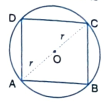
The circumference of a circle is 100 cm . The side of a square inscribed in the circle is
  • A
    $50 \sqrt{2} cm$
  • B
    $\frac{100}{\pi} cm$
  • $\frac{50 \sqrt{2}}{\pi} cm$
  • D
    $\frac{100 \sqrt{2}}{\pi} cm$
Answer
Correct option: C.
$\frac{50 \sqrt{2}}{\pi} cm$
(C)$\frac{50 \sqrt{2}}{\pi} cm$
Let the radius of the circle be $r cm$. It is given that
$
\begin{array}{ll}
2 \pi r=100 \Rightarrow r=\frac{50}{\pi} \\
\therefore \text { Side of the square }=\sqrt{2} r=\frac{50 \sqrt{2}}{\pi} cm \\
\text {  }
\end{array}
$
View full question & answer
MCQ 711 Mark
If $\pi$ is taken $\frac{22}{7}$, the distance (in meters) covered by a wheel of diameter 35 cm , in one rewolution is
  • A
    2.2
  • 1.1
  • C
    9.625
  • D
    96.25
Answer
Correct option: B.
1.1
(B)1.1
We have, diameter of wheel $=35 cm$.
$
\text { Circumference }=\pi \times 35 cm=\frac{22}{7} \times \frac{35}{100} m=1.1 m \quad[\because \text { Circumference }=\pi d]
$
Hence, distance covered in one revolution is 1.1 m .
View full question & answer
MCQ 721 Mark
If the circumference of a circle is dorabled, then its area is
  • A
    halved
  • B
    doubled
  • C
    Iripled
  • quadrupled
Answer
Correct option: D.
quadrupled
(D)quadrupled
Let $r$ be the radius of a circle. Then, its circumference is $2 \pi r$. Let $R$ be the radius of the circle whose circumference is $2(2 \pi r)$. Then,
$
2 \pi R=2(2 \pi r) \Rightarrow R=2 r
$
Let $\Lambda_1$ and $\Lambda_2$ denote the areas of old and new circles respectively. Then,
$
A_1=\pi r^2 \text { and } A_2=\pi R^2 \Rightarrow A_1=\pi r^2 \text { and } A_2=\pi(2 r)^2=4 \pi r^2 \Rightarrow A_2=4 A_1
$
View full question & answer
MCQ 731 Mark
If the areas of two circles are in the ratio $4: 9$, then the ratio of the perimeters of their semi. circle is
  • $2: 3$
  • B
    $3: 2$
  • C
    $1: 2$
  • D
    $1: 3$
Answer
Correct option: A.
$2: 3$
(A)$2: 3$
Let the radii of two circles be $r_1$ and $r_2$. It is given that
$
\pi r_1^2: \pi r_2^2=4: 9 \Rightarrow r_1^2: r_2^2=4: 9 \Rightarrow r_1: r_2=2: 3
$
Let $P_1$ and $P_2$ be the perimeters of two semi-circles. Then,
$
\begin{array}{ll}
& P_1=\pi r_1+2 r_1 \text { and } P_2=\pi r_2+2 r_2 \\
\Rightarrow & P_1=(\pi+2) r_1 \text { and } P_2=(\pi+2) r_2 \\
\Rightarrow & P_1: P_2=r_1: r_2=2: 3
\end{array}
$
View full question & answer
MCQ 741 Mark
If the area of a circle is $64 \pi cm^2$, then its circumference is
  • A
    $7 \pi cm$
  • $16 \pi cm$
  • C
    $14 \pi cm$
  • D
    $21 \pi cm$
Answer
Correct option: B.
$16 \pi cm$
(B)$16 \pi cm$
Let $r$ be the radius of the circle. Then,
$
\begin{array}{l}
\pi r^2=64 \pi \Rightarrow r^2=64 \Rightarrow r=8 \\
\text { Circumference }=2 \pi r=2 \pi \times 8 cm=16 \pi cm
\end{array}
$
View full question & answer
MCQ 751 Mark
The diameter of a circle whose area is equal to the sum of the areas of the two circles of radii 24 cm and 7 cm is
  • A
    31 cm
  • B
    25 cm
  • C
    62 cm
  • 50 cm
Answer
Correct option: D.
50 cm
(D)50 cm
Let $r$ be the radius of the circle whose area is equal to the sum of the areas of two circles of radii 24 cm and 7 cm . Then,
$
\pi r^2=\pi(24)^2+\pi(7)^2 \Rightarrow r^2=576+49 \Rightarrow r=25
$
$\therefore \quad$ Diameter $=2 r=50 cm$.
View full question & answer
MCQ 761 Mark
The radius of a circle whose circumference is equal to the sum of the circumferences of the two circles of radii 36 cm and 20 cm is
  • 56 cm
  • B
    42 cm
  • C
    28 cm
  • D
    16 cm
Answer
Correct option: A.
56 cm
(A)56 cm
Let $r$ be the radius of the circle. Then,
$
2 \pi r=2 \pi \times 36+2 \pi \times 20 \Rightarrow r=(36+20) cm=56 cm
$
View full question & answer