Questions

1 Marks Question

🎯

Test yourself on this topic

25 questions · timed · auto-graded

MCQ 11 Mark
Each side of an equilateral triangle is $6\sqrt3\text{ cm}.$ The altitude of the triangle is :
  • A
    $8\ cm$
  • $9\ cm$
  • C
    $3\sqrt3\text{cm}$
  • D
    $6\ cm.$
Answer
Correct option: B.
$9\ cm$
As, area of an equilateral triangle $=\frac{\sqrt3}{4}\times(\text{side})^2$
$\Rightarrow\frac{1}{2}\times\text{Base}\times\text{Height}=\frac{\sqrt3}{4}\times(6\sqrt3)^2$
$\Rightarrow\frac{1}{2}\times6\sqrt3\times\text{Height}=\frac{\sqrt3}{4}\times36\times3$
$\Rightarrow3\sqrt3\times\text{Height}=27\sqrt3$
$\Rightarrow\text{Height}=\frac{27\sqrt3}{3\sqrt3}$
$\therefore\ \text{Height}=9\text{ cm}$
View full question & answer
MCQ 21 Mark
On increasing the length of a rectangle by $20\%$ and decreasing its breadth by $20\%,$ what is the change in its area?
  • A
    $20\%$ increase
  • B
    $20\%$ decrease
  • C
    No change
  • $4\%$ dcrease.
Answer
Correct option: D.
$4\%$ dcrease.
Let :
Length $= x$
breadth $= y$
Area $ = xy$
Now,
New length $= x + 20\%\ x =\text{x}+\frac{1}{5}\text{x}=\frac{6}{5}\text{x}$
New breadth $= y - 20\%\ y =\text{y}-\frac{1}{5}\text{y}=\frac{4}{5}\text{y}$
New area $=\frac{6}{5}\text{x}\times\frac{4}{5}\text{y}=\frac{24}{25}\text{xy}$
Difference in the areas $=\text{xy}-\frac{24}{25}\text{xy}=\frac{1}{25}\text{xy}$
Difference in percentage $=\bigg[\bigg(\frac{\frac{1}{25}\text{xy}}{\text{xy}}\bigg)\times100\bigg]\%=4\%$
View full question & answer
MCQ 31 Mark
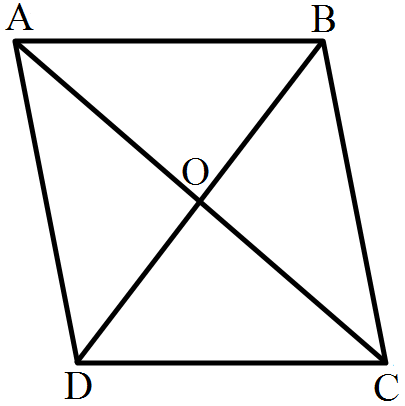
The area of a rhombus is $480\ cm^2$ and the length of one of its diagonals is $20\ cm.$ The length of each side of the rhombus is:
  • A
    $24\ cm$
  • B
    $30\ cm$
  • $26\ cm$
  • D
    $28\ cm.$
Answer
Correct option: C.
$26\ cm$

We have,
$BD = 20\ cm$
$\Rightarrow\text{BO}=\frac{\text{BD}}{2}=\frac{20}{2}=10\text{cm}$
As, area of the rhombus $\text{ABCD} = 480\ cm^2$
$\Rightarrow\frac{1}{2}\times\text{AC}\times\text{BD}=480$
$\Rightarrow\frac{1}{2}\times\text{AC}\times20=480$
$\Rightarrow\text{AC}\times10=480$
$\Rightarrow\text{AC}=\frac{480}{10}$
$\Rightarrow\text{AC}=48\text{cm}$
$\Rightarrow\text{AO}=\frac{\text{AC}}{2}=\frac{48}{2}=24\text{cm}$
Now, in $\triangle\text{AOB},$
Using Pythagoras theorem,
$\text{AB}^2=\text{AO}^2+\text{BO}^2$
$=24^2+10^2$
$=576+100$
$\Rightarrow\text{AB}^2=676$
$\Rightarrow\text{AB}=\sqrt{676}$
$\therefore\text{AB}=26\text{cm}$
View full question & answer
MCQ 41 Mark
The side of an equilateral triangle is equal to the radius of a circle whose area is $154\ cm^{2}$. The area of the triangle is :
  • A
    $49\text{ cm}^2$
  • $\frac{49\sqrt3}{4}\text{ cm}^2$
  • C
    $\frac{7\sqrt3}{4}\text{ cm}^2$
  • D
    $77\text{ cm}^2.$
Answer
Correct option: B.
$\frac{49\sqrt3}{4}\text{ cm}^2$
Area of a circle $=\pi\text{r}^2$
$\Rightarrow154=\pi\text{r}^2$
$\Rightarrow\text{r}=\sqrt{\frac{154\times7}{22}}$
$=\sqrt{7\times7}$
$=7\text{ cm}$
The radius of the circle is equal to the side of the equilateral triangle.
$\therefore r = a($Here, a is the side of the equilateral triangle.$)$
$a = 7cm$
$\therefore$ Area of the equilateral triangle $=\frac{\sqrt3}{4}\text{a}^2$
$=\frac{\sqrt3}{4}\times7\times7$
$=\frac{49\sqrt3}{4}\text{ cm}^2$
View full question & answer
Question 51 Mark
Find the area of an equilateral triangle having each side of length 10cm. $\big[\text{Take}\sqrt3=1.732\big]$
Answer
Area of equilateral triangle $=\frac{\sqrt3}{4}\times\text{side}^2$
$=\frac{\sqrt3}{4}\times10^2$
$=\frac{\sqrt3}{4}\times100$
$=1.732\times25$
$=43.3\text{cm}^2$
View full question & answer
MCQ 61 Mark
The area of an equilateral triangle is $4\sqrt3\text{ cm}^2.$ Its perimeter is :
  • A
    $9\text{ cm}$
  • $12\text{ cm}$
  • C
    $12\sqrt3\text{ cm}$
  • D
    $6\sqrt3\text{ cm}$
Answer
Correct option: B.
$12\text{ cm}$
Area of an equilateral triangle $=\frac{\sqrt3}{4}\text{a}^2 \ ($where a is the length of the side$)$
Thus, we have :
$4\sqrt3=\frac{\sqrt3}{4}\text{a}^2$
$\Rightarrow\text{a}^2=16$
$\Rightarrow\text{a}=4\text{ cm}$
Perimeter of the equilateral triangle $= 3a $
$= 3 \times 4 = 12\ cm.$
View full question & answer
MCQ 71 Mark
The length of the diagonal of a square is $10\sqrt2\text{cm}.$ Its area is:
  • A
    $200\text{cm}^2$
  • $100\text{cm}^2$
  • C
    $150\text{cm}^2$
  • D
    $100\sqrt2\text{cm}^2$
Answer
Correct option: B.
$100\text{cm}^2$
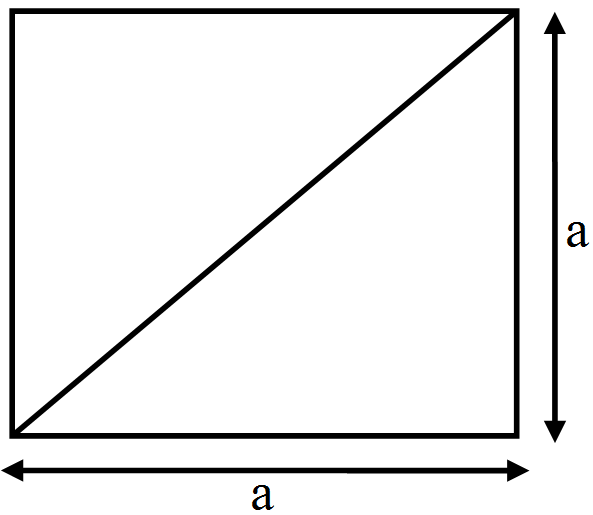
A diagonal of a square forms the hypotenuse of a right$-$angled triangle with base and height equal to side a.
Diagonal $^2=a^2+a^2$
Diagonal ${ }^2=2 a^2$
$\Rightarrow\text{a}=\frac{1}{\sqrt2}\text{Diagonal}$
$=\frac{1}{\sqrt2}\times10\sqrt2$
$=10\text{cm}$
$\therefore$ Area of the square $a2 = 10 \times 10 = 100\ cm^2$.
View full question & answer
MCQ 81 Mark
The height of an equilateral triangle is $3\sqrt3\text{ cm}.$ Its area is :
  • A
    $6\sqrt3\text{ cm}^2$
  • B
    $27\text{ cm}^2$
  • $9\sqrt3\text{ cm}^2$
  • D
    $27\sqrt3\text{ cm}^2.$
Answer
Correct option: C.
$9\sqrt3\text{ cm}^2$
Let the side of the equilateral triangle be $x.$
As, area of the equilateral triangle $=\frac{\sqrt3}{4}\times(\text{side})^2$
$\Rightarrow\frac{1}{2}\times\text{Base}\times\text{height}=\frac{\sqrt3}{4}\times\text{x}^2$
$\Rightarrow\frac{1}{2}\times\text{x}\times3\sqrt3=\frac{\text{x}^2\sqrt3}{4}$
$\Rightarrow\frac{3\text{x}\sqrt3}{2}=\frac{\text{x}^2\sqrt3}{4}$
$\Rightarrow\frac{3\sqrt3}{2}=\frac{\text{x}\sqrt3}{4}$
$\Rightarrow\text{x}=\frac{3\sqrt3\times4}{2\sqrt3}$
$\Rightarrow\text{x}=6\text{ cm}$
Now, the area of the triangle $=\frac{\sqrt3}{4}\times6^2$
$=\frac{\sqrt3}{4}\times36$
$=9\sqrt3\text{ cm}^2$
View full question & answer
MCQ 91 Mark
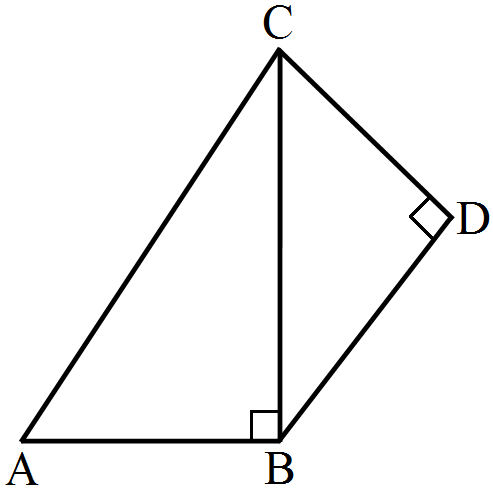
In the given figure $\text{ABCD}$ is a quadrilateral in which $\angle\text{ABC}=90^\circ, AC = 17\ cm, BC = 15\ cm, BD = 12\ cm$ and $CD = 9\ cm$. The area of quad. $\text{ABCD}$ is:
  • A
    $102\ cm^2$
  • $114\ cm^2$
  • C
    $95\ cm^2$
  • D
    $57\ cm^2.$
Answer
Correct option: B.
$114\ cm^2$
In $\triangle\text{ABC},\angle\text{ABC}=90^\circ$
$\Rightarrow AC^2 = BC^2 + AB^2$
$\Rightarrow 17^2 = 15^2 + AB^2$
$\Rightarrow 289 = 225 + AB^2$
$\Rightarrow AB^2 = 64$
$\Rightarrow AB = 8\ cm$
Area of quad. $\text{ABCD}=$ Area of $\triangle\text{ABC} + $ Area of $\triangle\text{BCD}$
$=\frac{1}{2}\times\text{BC}\times\text{AB}+\frac{1}{2}\times\text{BD}\times\text{CD}$
$=\frac{1}{2}\times15\times8+\frac{1}{2}\times12\times9$
$=60+54$
$=114\text{cm}^2$
View full question & answer
MCQ 101 Mark
The length of a rectangular hall is $5m$ more than its breadth. If the area of the hall is $750m^2$, then its length is:
  • A
    $15m$
  • B
    $20m$
  • C
    $25m$
  • $30m.$
Answer
Correct option: D.
$30m.$
Let the length of the rectangle be $x m.$
$\therefore$ Breadth of the rectangle $= (x - 5)m$
$Area = x(x - 5) = x^2 - 5x$
$\Rightarrow x^2 - 5x = 750$
$\Rightarrow x^2 - 5x - 750 = 0$
$\Rightarrow x^2 -30x + 25x - 750 = 0$
$\Rightarrow x(x - 30) + 25(x - 30) = 0$
$\Rightarrow (x + 25)(x - 30) = 0$
$\Rightarrow x + 25 = 0$ and $x - 30 = 0$
$\Rightarrow x = -25$ and $x = 30$
Length cannot be negative.
$\therefore$ Length $x = 30m.$
View full question & answer
MCQ 111 Mark
Each side of an equilateral triangle is $8\ cm$. Its area is :
  • A
    $24\text{ cm}^2$
  • B
    $24\sqrt3\text{ cm}^2$
  • $16\sqrt3\text{ cm}^2$
  • D
    $8\sqrt3\text{ cm}^2.$
Answer
Correct option: C.
$16\sqrt3\text{ cm}^2$
Let the side of the equilateral triangle be a.
Given; $a = 8\ cm$
Now,
Area of the equilateral triangle $=\frac{\sqrt3}{4}\text{a}^2$
$=\frac{\sqrt3}{4}\times8\times8$
$=16\sqrt3\text{ cm}^2$
View full question & answer
MCQ 121 Mark
The length of a rectangular field is $23m$ more than its breadth. If the perimeter of the field is $206m,$ then its area is:
  • A
    $2420m^2$
  • $2520m^2$
  • C
    $2480m^2$
  • D
    $2620m^2$
Answer
Correct option: B.
$2520m^2$
Let the breadth of the field be $x m.$
$\therefore$ Length $= (x + 23)m$
Now,
Perimeter $= 2($ Length $+$ Breadth$) = 2(x + x + 23) = (4x + 46)m$
Thus, we have:
$4x + 46 = 206$
$\Rightarrow 4x = 206 - 46 = 160$
$\Rightarrow\text{x}=\frac{160}{4}=40$
$\therefore$ Breadth $= x = 40m$
Length $= x + 23 = 40 + 23 = 63m$
Area $=$ Length $\times$ Breadth $= 63 \times 40 = 2520m^2.$
View full question & answer
Question 131 Mark
The cost of carpeting a room 15m long with a carpet 75cm wide, at ₹ 70 per metre, is ₹ 8400. The width of the room is:
Answer
  1. 6m
Solution:
We have,
Width of the carpet = 75cm = 0, 75m and length of the room = 15m
Length of the carpet $=\frac{\text{cost}\ \text{of}\ \text{carpeting}}{\text{Rate}\ \text{of}\ \text{carpeting}}=\frac{8400}{70}=120\text{m}$
Now, area of the carpet required for carpeting $= 120 × 0.75m^2$
⇒ area of the floor $= 120 × 0.75m^2$
⇒ 15 × breadth = 120 × 0.75
$\Rightarrow\text{breadth}=\frac{120\times0.75}{15}$
So, breadth = 6m.
View full question & answer
MCQ 141 Mark
The parallel sides of a trapezium are $9.7\ cm$ and $6.3\ cm,$ and the distance between then is $6.5\ cm.$ The area of the trapezium is:
  • A
    $104\ cm^2$
  • B
    $78\ cm^2$
  • $52\ cm^2$
  • D
    $65\ cm^2.$
Answer
Correct option: C.
$52\ cm^2$
Given that the parallel sides are $9.7\ cm$ and $6.3\ cm$ and the distance between them $=$ height $= 6.5\ cm.$
Area of trapezium $=\frac{\text{Sum}\ \text{of}\ \text{parallel}\ \text{sides}}{2}\times\text{height}$
Area of trapezium $=\frac{9.7+6.3}{2}\times6.5$
$=\frac{16}{2}\times6.5$
$=8\times6.5$
$=52\text{cm}^2$
View full question & answer
MCQ 151 Mark
The lengths of the sides of a triangular field are $20m, 21m$ and $29m$. The cost of cultivating the field at $₹ 9\ \text{per}\ m^2$ is:
  • A
    $₹ 2610$
  • B
    $₹ 3780$
  • $₹ 1890$
  • D
    $₹ 1800.$
Answer
Correct option: C.
$₹ 1890$
As, the sides of the triangle are $20m, 21m$ and $29m$
So, the semi$-$perimeter $=\frac{20+21+29}{2}=35\text{m}$
Now, the area of the triangular field
$=\sqrt{35(35-20)(35-21)(35-29)}$
$=\sqrt{35\times15\times14\times6}$
$=\sqrt{7\times5\times5\times3\times7\times2\times2\times3}$
$=2\times3\times5\times7$
$=210\text{m}^2$
$\therefore$ The cost of cultivating the field $= 210 \times 9 = ₹ 1890.$
View full question & answer
Question 161 Mark
Find the area of a parallelogram with base equal to 25cm and the corresponding height measuring 16.8cm.
Answer
solution Area of the $\|^{g gm }=$ (base height) sq. unit
$=(25 \times 16.8) cm ^2=420 cm^2$.
View full question & answer
MCQ 171 Mark
The area of a square field is $0.5$ hectare. The length of its diagonal is:
  • A
    $150\text{m}$
  • B
    $100\sqrt2\text{m}$
  • $100\text{m}$
  • D
    $50\sqrt2\text{m}$
Answer
Correct option: C.
$100\text{m}$
Disclaimer: The length cannot be in hectare so we used is as area of the square.
Area of the square field $= 0.5 \times 10000 = 5000m^2$

The diagonal divides the square into the isoscale right$-$angled triangles.
Using Pythagoras theorem, we have:
Diagonal $^2 = a^2 + a^2 = 2a^2$
Area of a square $= a^2$
$\therefore\ \text{Diagonal}=\sqrt{2\times\text{area}}$
$=\sqrt{2\times5000}$
$=\sqrt{10000}$
$=100\text{m}.$
View full question & answer
MCQ 181 Mark
The length of a rectangle is thrice its breadth and the length of its diagonal is $8\sqrt{10}\text{ cm}.$ The perimeter of the rectangle is :
  • A
    $15\sqrt{10}\text{ cm}$
  • B
    $16\sqrt{10}\text{ cm}$
  • C
    $24\sqrt{10}\text{ cm}$
  • $64\text{ cm}.$
Answer
Correct option: D.
$64\text{ cm}.$
Let the breadth of the rectangle be $x \ cm.$
Length of the rectangle $= 3x \ cm$
We know :
$\text{Diagonal}=\sqrt{(\text{Length})^2+(\text{Breadth})^2}$
$\Rightarrow8\sqrt{10}=\sqrt{\text{x}^2+(3\text{x})^2}$
$\Rightarrow8\sqrt{10}=\sqrt{\text{x}^2+9\text{x}^2}$
$\Rightarrow8\sqrt{10}=\text{x}\sqrt{10}$
$\Rightarrow\text{x}=8$
Now,
Breadth of the rectangle $= x = 8\ cm$
Length of the rectangle $= 3x = 24\ cm$
Perimeter of the rectangle $= 2($Length $+$ Breadth$)$
$= 2(8 + 24) = 64\ cm.$
View full question & answer
MCQ 191 Mark
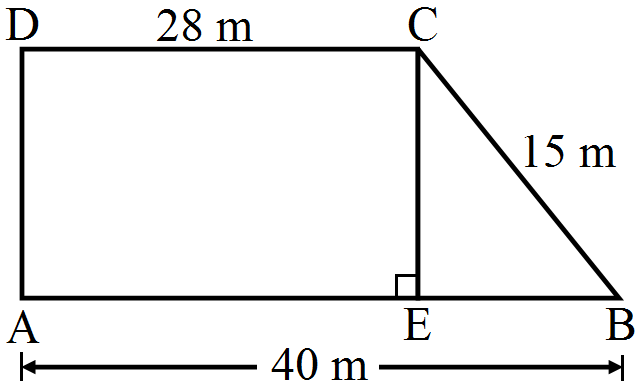
In the given figure $\text{ABCD}$ is a trapizium in which $Ab = 40m, BC = 15m, CD = 28m, AD = 9m$ and $\text{CE}\bot\text{AB}.$ Area of trap. $\text{ABCD}$ is:
  • $306m^2$
  • B
    $316m^2$
  • C
    $296m^2$
  • D
    $284m^2.$
Answer
Correct option: A.
$306m^2$
Since $CD = AE = 28m$,
$EB = AB - AE = 40m - 28m = 12m$
In right $\triangle\text{BEC},$
$CE^2 = BC^2 - EB^2$
$\Rightarrow CE^2 = 15^2 - 12^2$
$\Rightarrow CE^2 = 225 - 144$
$\Rightarrow CE^2 = 81$
$\Rightarrow CE = 9m$
Area of trap. $\text{ABCD} =\frac{\text{DC}+\text{AB}}{2}\times\text{CE}$
$=\frac{28+40}{2}\times9$
$=\frac{68}{2}\times9$
$=34\times9$
$=306\text{m}^2$
View full question & answer
MCQ 201 Mark
The side of a square is equal to the side of an equilateral triangle. The ratio of their areas is:
  • A
    $4 : 3$
  • B
    $2:\sqrt3$
  • $4:\sqrt3$
  • D
    None of these.
Answer
Correct option: C.
$4:\sqrt3$
Let:
Length of the side of the square $=$ Length of the side of the equilateral triangle $=$ a unit
Now,
Area of the square $= a \times a = a^2 \text{unit}^2$
Area of the equilateral triangle $=\frac{\sqrt3}{4}\text{a}^2\text{unit}^2$
Ratio of areas $=\frac{\text{Area}\ \text{of}\ \text{the}\ \text{square}}{\text{Area}\ \text{of}\ \text{the}\ \text{equilateral}\ \text{triangle}}$
$=\frac{\text{a}^2}{\frac{\sqrt3}{4}\text{a}^2}$
$=\frac{4}{\sqrt3}$
View full question & answer
MCQ 211 Mark
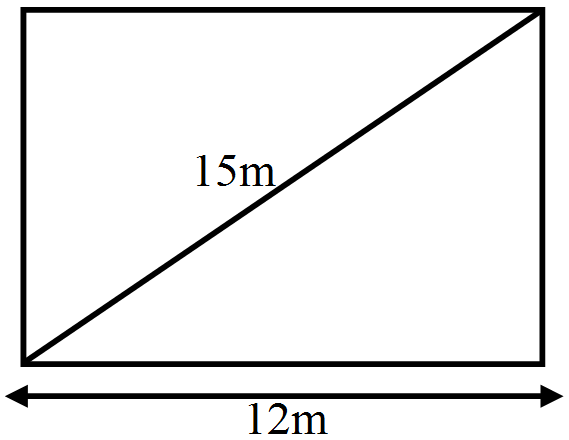
The length of a rectangular field is $12m$ and the length of its diagonal is $15m$. The area of the field is:
  • $108\text{m}^2$
  • B
    $180\text{m}^2$
  • C
    $30\sqrt3\text{m}^2$
  • D
    $12\sqrt{15}\text{m}^2$
Answer
Correct option: A.
$108\text{m}^2$
Length of the rectangular field $12m$
Diagonal $= 15m$


$\text{Diagonal}^2=\text{Length}^2+\text{Breadth}^2$
$\text{Breadth}=\sqrt{\text{Diagonal}^2-\text{Length}^2}$
$=\sqrt{15^2-12^2}$
$=\sqrt{225-144}$
$=9\text{m}$
$\therefore$Area of the field $=$ Length $\times$ Breadth $= 12 \times 9 = 108m^2$.
View full question & answer
MCQ 221 Mark
The base and height of a triangle are in the ratio $3 : 4$ and its area is $216\ cm^2$. The height of the triangle is:
  • A
    $18\ cm$
  • $24\ cm$
  • C
    $21\ cm$
  • D
    $28\ cm.$
Answer
Correct option: B.
$24\ cm$
$24\ cm$
View full question & answer
MCQ 231 Mark
The sides of a triangle are in the ratio $12 : 14 : 25$ and its perimeter is $25.5\ cm$. The largest side of the triangle is:
  • A
    $7\ cm$
  • B
    $14\ cm$
  • $12.5\ cm$
  • D
    $18\ cm.$
Answer
Correct option: C.
$12.5\ cm$
The sides of a triangle are in the ratio $12 : 14 : 25.$
Let the common multiple be $x \ cm.$
$\Rightarrow $ The sides of the triangle are $12x, 14x$ and $25x$
Now,
Perimeter $= 12x + 14x + 25x$
$\Rightarrow 25 .5 = 51x$
$\Rightarrow x = 0.5$
$\Rightarrow $ The sides of the triangle are $12 \times 0.5 = 6\ cm, $
$=14 \times 0.5 = 7\ cm$ and $25 \times 0.5 = 12.5\ cm$
$\Rightarrow $ The largest side of the triangle is $12.5\ cm.$
View full question & answer
MCQ 241 Mark
The area of a square field is $6050m^2$. The length of its diagonal is:
  • A
    $135m$
  • B
    $120m$
  • C
    $112m$
  • $110m$
Answer
Correct option: D.
$110m$
Let the diagonal of the square field be $d m$.
In case of a square field, $d^2=2 a^2$, where a is the side of the square field.
Now,
Area of a square field $=a^2$
$d^2=2 a^2$
$\Rightarrow d^2=2 \times$ Area of the square field
$\Rightarrow d =\sqrt{2 \times \text { Area of the square field }}$
$\therefore d=\sqrt{2 \times 6050}=\sqrt{12100}=110$
View full question & answer
MCQ 251 Mark
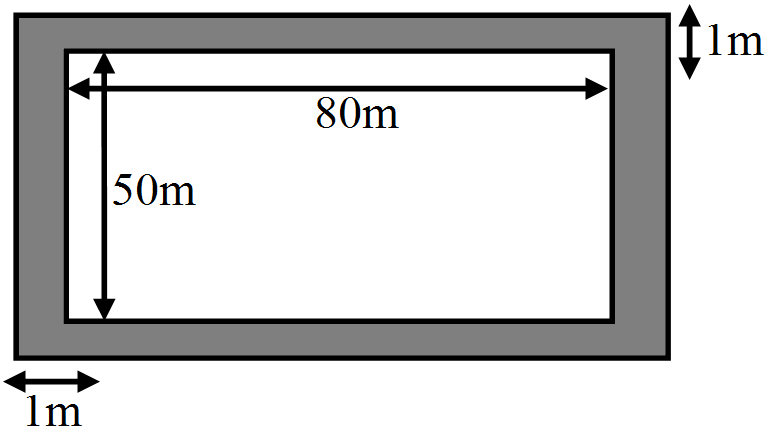
A rectangular ground 8$0m \times 50m$ has a path $1m$ wide outside around it. The area of the path is:
 
  • $264m^2$
  • B
    $284m^2$
  • C
    $400m^2$
  • D
    $464m^2.$
Answer
Correct option: A.
$264m^2$
Length of the ground including the path $= 80 + 2 = 82m$
Breadth of the ground including the path $= 50 + 2 = 52m$

Total area $($including the path$) =$ Length $\times$ Breadth $=82 \times 52=4264 m^2$
Area of the field $=80 \times 50=4000 m^2$
Area of the path $=4264-4000=264 m^2$.
View full question & answer