Questions

[3 Mark Questions]

🎯

Test yourself on this topic

10 questions · timed · auto-graded

Question 13 Marks
A dry pellet of a common base B, when kept in open absorbs moisture and turns sticky. The compound is also a by–product of chloralkali process. Identify B. What type of reaction occurs when B is treated with an acidic oxide? Write a balanced chemical equation for one such solution.
Answer
‘B’ is NaOH. It absorbs moisture from atmosphere because it is hygroscopic in nature. It is obtained by product of chlor-alkali process.$2\text{NaCl}+2\text{H}_2\text{O}\rightarrow2\text{NaOH}+\text{Cl}_2+\text{H}_2\\ \ \ \ \ \ \ \ \ \ \ \ \ \ \ \ \ \ \ \ \ \ \ \ \ \ \ \ \ \ \ \ \ \ \ '\text{B}'$
$2\text{NaOH}+\text{CO}_2\rightarrow\text{Na}_2\text{CO}_3+\text{H}_2\text{O}\\ \ \ \ '\text{B}'$
View full question & answer
Question 23 Marks
What are strong and weak acids? In the following list of acids, separate strong acids from weak acids. Hydrochloric acid, citric acid, acetic acid, nitric acid, formic acid, sulphuric acid.
Answer
Acids which get completely ionized in aqueous solution are called strong acids, e.g. hydrochloric acid, nitric acid and sulphuric acid.
Acids which do not get completely ionized in aqueous solution are called weak acids, e.g. acetic acid, citric acid, and formic acid.
View full question & answer
Question 33 Marks
A sulphate salt of Group 2 element of the Periodic Table is a white, soft substance, which can be moulded into different shapes by making its dough. When this compound is left in open for some time, it becomes a solid mass and cannot be used for moulding purposes. Identify the sulphate salt and why does it show such a behaviour? Give the reaction involved.
Answer
Calcium sulphate is a white and soft substance. It can be molded into different shapes by making its dough. Calcium is a group 2 element. Calcium sulphate is commonly known as Plaster of Paris. When Plaster of Paris is left in open for some time, it becomes a solid mass and cannot be used for molding purposes. Plaster of Paris has half molecule of water of crystallization. When it is left in open for some time, the number of molecules of water of crystallization in it becomes 2 and the substance is then called gypsum.$\text{CaSO}_4.\frac{1}{2}\text{H}_2\text{O}+1\frac{1}{2}\text{H}_2\text{O}\rightarrow\text{CaSO}_4.2\text{H}_2\text{O}$
View full question & answer
Question 43 Marks
For making cake, baking powder is taken. If at home your mother uses baking soda instead of baking powder in cake,
  1. How will it affect the taste of the cake and why?
  2. How can baking soda be converted into baking powder?
  3. What is the role of tartaric acid added to baking soda?
Answer
  1. Baking soda is sodium hydrogen carbonate which decomposes to sodium carbonate, water and carbon dioxide on heating. Baking powder is a mixture of sodium hydrogen carbonate with tartaric acid which readily reacts with sodium carbonate and neutralizes it. Therefore use of baking soda will give a bitter taste to cake due to presence of sodium carbonate.
  2. Baking powder is formed by addition of tartaric acid to baking soda.
  3. Presence of tartaric acid in baking powder neutralizes the effect of sodium carbonate formed during decomposition of baking soda.
View full question & answer
Question 53 Marks
What happens when nitric acid is added to egg shell?
Answer
When nitric acid is added to egg shell, it dissolves egg shell. Egg shell is composed of calcium carbonate which dissolves in nitric acid. The reaction between nitric acid and calcium carbonate yields calcium nitrate and carbon dioxide gas
$CaCO_3(s)+2 HNO_3(aq) \rightarrow Ca\left(NO_3\right)_2(aq)+CO_2(g)+H_2 O(I)$
View full question & answer
Question 63 Marks
Fill in the missing data in the following table.
 
Name of the salt
Formula
Salt obtained from
Base
Acid
1.
Ammonium chloride
$NH_4Cl$
$NH_4OH$
-
2.
Copper sulphate
-
-
$H2SO_4$
3.
Sodium chloride
$NaCl$
$NaOH$
-
4.
Magnesium nitrate
$Mg(NO_{3})_{2}$
-
$HNO_3$
5.
Potassium sulphate
$K2SO_4$
-
-
6.
Calcium nitrate
$Ca(NO_{3})_{2}$
$Ca(OH)_2$
-
Answer
 
Name of the salt
Formula
Salt obtained from
Base
Acid
1.
Ammonium chloride
$NH_4Cl$
$NH_4OH$
$HCl$
2.
Copper sulphate
$CuSO_4$ $Cu(OH)_2$
$H_2SO_4$
3.
Sodium chloride
$NaCl$
$NaOH$
$HCl$
4.
Magnesium nitrate
$Mg(NO_{3})_{2}$
$Mg(OH)_2$
$HNO_3$
5.
Potassium sulphate
$K_2SO_4$
$KOH$ $H_2SO_4$
6.
Calcium nitrate
$Ca(NO_{3})_{2}$
$Ca(OH)_2$
$HNO_3$
View full question & answer
Question 73 Marks
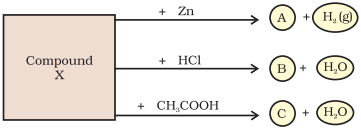
Identify the compound X on the basis of the reactions given below. Also, write the name and chemical formulae of A, B and C.
Answer
X must be a compound which forms water with acids. It means it must be a base which reacts with acids to form salt and water. This base also reacts with zinc metal and releases hydrogen gas. So it must be NaOH (sodium hydroxide).
  1. $2\text{NaOH}\ \ +\ \ \text{Zn}\ \rightarrow\ \text{Na}_2\text{ZnO}_2+\text{H}_2\\\text{Sodium}\ \ \ \ \ \ \ \ \ \ \ \ \ \ \ \ \ \ \ \ \ \ \ \text{Sodium}\\\text{hydroxide(x)}\ \ \ \ \ \ \ \ \ \ \ \ \ \text{zincate(A)}$
  2. $\text{NaOH}\ \ +\ \ \text{H}\ \rightarrow\ \text{NaCl}+\text{H}_2\text{O}\\\text{Sodium}\ \ \ \ \ \ \ \ \ \ \ \ \ \ \ \ \ \text{Sodium}\\\text{hydroxide(x)}\ \ \ \ \ \ \ \text{chloride(B)}$
  3. $\text{NaOH}\ \ +\ \ \text{CH}_3\text{COOH}\ \rightarrow\ \text{CH}_3\text{COONa}\ \ \ +\ \ \ \text{H}_2\text{O}\\\text{Sodium}\ \ \ \ \ \ \ \ \ \ \ \ \ \ \ \ \ \ \ \ \ \ \ \ \ \ \ \ \ \ \ \ \ \text{Sodium acetate(C)}\\\text{hydroxide(x)}$
View full question & answer
Question 83 Marks
In one of the industrial processes used for manufacture of sodium hydroxide, a gas X is formed as by product. The gas X reacts with lime water to give a compound Y which is used as a bleaching agent in chemical industry. Identify X and Y giving the chemical equation of the reactions involved.
Answer
‘X’ is chlorine gas.$2\text{NaCl}+2\text{H}_2\text{O}\xrightarrow{\text{electricity}}2\text{NaOH}+\text{H}_2\text{(g) + Cl}_2\text{(g)}\\ \ \ \ \ \ \ \ \ \ \ \ \ \ \ \ \ \ \ \ \ \ \ \ \ \ \ \ \ \ \ \ \ \ \ \ \ \ \ \ \ \ \ \ \ \ \ \ \ \ \ \ \ \ \ \ \ \ \ \ \ \ \ \ \ \ \ \ \ \ \ \ \ \ \ \ \ \ '\text{X}'$
$\text{Ca(OH)}_2\ +\ \text{Cl}_2\text{(g)}\ \ \rightarrow\ \ \text{CaOCl}_2\ \ \ +\ \ \ \text{H}_2\text{O}\\\text{Limewater}\ \ \ \ \ \ \ \ \ \ \ \ \ \ \ \ \ \ \ \ \ \ \ \ \ \ '\text{Y}'\\ \ \ \ \ \ \ \ \ \ \ \ \ \ \ \ \ \ \ \ \ \ \ \ \ \ \ \ \ \ \ \ \ \ \ \ \ \ \text{Bleaching powder}$
' $X$ ' is $Cl _2$ gas, ' $Y$ ' is $CaOCl _2$.
View full question & answer
Question 93 Marks
When zinc metal is treated with a dilute solution of a strong acid, a gas is evolved, which is utilised in the hydrogenation of oil. Name the gas evolved. Write the chemical equation of the reaction involved and also write a test to detect the gas formed.
Answer
Zinc is a metallic element. Metals react with dilute solutions of strong acids to form respective salts and hydrogen gas. The reaction of zinc with dilute solution of strong acid like HCl forms zinc chloride ($\left( ZnCl _2\right)$ ) and hydrogen gas is evolved.$\text{Zn + 2HCl}\rightarrow\text{ZnCl}_2+\text{H}_2\uparrow$
Hydrogen gas is used in hydrogenation of vegetable oil. It can be tested with the help of burning splinter as it burns with a pop sound.
View full question & answer
Question 103 Marks
Salt A commonly used in bakery products on heating gets converted into another salt B which itself is used for removal of hardness of water and a gas C is evolved. The gas C when passed through lime water, turns it milky. Identify A, B and C.
Answer
Salt which is used in bakery product is baking soda or sodium hydrogen carbonate. On heating of baking soda, sodium carbonate is formed with evolution of carbon dioxide gas.$2\text{NaHCO}_3\rightarrow\text{Na}_2\text{CO}_3+\text{H}_2\text{O + CO}_2\uparrow$
Sodium carbonate is used to remove hardness of water. Another product is carbon dioxide gas that gives lime test in which it turns lime water milky. Thus, $A = NaHCO _3 ; B = Na _2 CO _3$ and $C = CO _2$.
View full question & answer