Questions · Page 2 of 3

[2 Mark Questions]

Question 512 Marks
State difference between the wire used in the element of an electric heater and in a fuse wire.
Answer
In electric heater we use wire which have high resistance light is nichrome wire because they here we want to heat and the wire high resistance will produce high heat. And in fuse wire
we use the wire which have very low resistance such as copper wire because here we want to less electric current and less resistance because if it heat then it will break down because
when short circuiting hokka then it will break easily in less electric current.
View full question & answer
Question 522 Marks
Which uses more energy, a 250 W TV set in 1 hr, or a 1200 W toaster in 10 minutes?
Answer
Energy used by a TV set of power 250 W in 1 hour = P × t = 250 Wh.
Energy used by toaster of power 1200 W in 10 minute (10/60 h)
= P × t = 1200 W × 10/60 h = 200 Wh.
Therefore, TV set will use more energy.
View full question & answer
Question 532 Marks
An electric fan runs from the 230V mains. The current flowing through it is 0.4A. At what rate is electrical energy transferred by the fan?
Answer
Given: V = 230V, I = 0.4 amp
Rate at which electric energy is transformed = Power
Power = V × I
= 230 × 0.4
= 92W = 92J/s
View full question & answer
Question 542 Marks
Explain the role of fuse in series with any electrical appliance in an electric circuit. Why should a fuse with defined rating for an electric circuit not be replaced by one with a larger rating?
Answer
The electrical fuse is a safety device against overloading and short circuiting of any electrical circuit. A fuse is placed in series with the circuit so that the same current flows through the
fuse and the electrical circuit. The rating of a fuse indicates the maximum current which can flow through a fuse without blowing it off. If a fuse of higher rating is used, then it will not
blow off even when the current exceeds the safety limit of the appliance. As a result, the electrical appliances may get damaged.
View full question & answer
Question 552 Marks
Let the resistance of an electrical component remains constant while the potential difference across the two ends of the component decreases to half of its former value. What change will occur in the current through it?
Answer
It is given that resistance R of the electrical component remains constant but the potential difference across the ends of the component decreases to half of its value. Hence, as per Ohm’s law, new current also decreases to half of its original value.
View full question & answer
Question 562 Marks
A battery of 9 V is connected in series with resistors of 0.2 Ω, 0.3 Ω, 0.4 Ω , 0.5 Ω and 12 Ω, respectively. How much current would flow through the 12 Ω resistor?
Answer
There is no current division occurring in a series circuit. Current flow through the component is the same. given by Ohm's law as V = IR I = V/R Where, R is the equivalent resistance of resistances $0.2\Omega , 0.3\Omega , 0.4\Omega , 0.5\Omega\text{ and }12\Omega.$ These are connected in series. Hence, the sum of the resistances will give the value of R.$\text{R}=0.2+0.3+ 0.4 + 0.5 + 12 = 13.4\Omega$
Potential difference, V = 9 V$\text{I} = \frac{9}{13.4} = 0.671 \text{A}$
Therefore. the current that would flow through the $12\Omega$ resistor is 0.671 A.
View full question & answer
Question 572 Marks
What p.d. is needed to send a current of 6A through an electrical appliance having a resistance of $40\Omega$?
Answer
I = 6 amp, R = 40 ohm
We know that
V=IR
V = 6 × 40 = 240V.
View full question & answer
Question 582 Marks
What is the heating effect of electric current?
Answer
When an electric current is passed through a conductor, the conductor becomes hot after some time and produce heat. This happens due to the conversion of some electric energy passing through the conductor into heat energy.
This phenomenon is known as the heating effect of electric current.
The heat $( H )$ produced during the heating effect of electric current is given by the formula:
Heat, $H = I ^2 Rt$
Where, I = Current
$R=$ Resistance of conductor
$t =$ time
The SI unit of the heat produced is Joules (J).
View full question & answer
Question 592 Marks
Define watt-hour. How many joules are equal to 1 watt-hour?
Answer
One watt hour is the amount of electrical energy consumed when an electrical appliance of 1 watt power is used for 1 hour.
1 watt hour = 3600 joules.
View full question & answer
Question 602 Marks
Which is the better way to connect lights and other electrical appliances in domestic wiring: series circuits or parallel circuits? Why?
Answer
Parallel circuits – Because if one electrical appliance stops working due to some defect, then all other appliances in the circuit will keep working properly.
View full question & answer
Question 612 Marks
Define the electric resistivity of material and also write its SI unit.
Answer
Electrical resistivity (also called specific electrical resistance or volume resistivity) and its inverse, electrical conductivity, is a fundamental property of a material that quantifies how strongly it resists or conducts electric current. The SI unit of electrical resistivity is the ohm-metre $(\Omega.\text{m}).$
View full question & answer
Question 622 Marks
Two lamps, one rated 100 W at 220 V, and the other 60 W at 220 V, are connected in parallel to electric mains supply. What current is drawn from the line if the supply voltage is 220 V?
Answer
Both the bulbs are connected in parallel. Therefore, potential difference across each of them will be 220 V, because no division of voltage occurs in a parallel circuit. Current drawn by the bulb of rating 100 W is given by, Power = Voltage × Current
Current = Power/Voltage = 60/220A
Hence, current drawn from the line = 100/220 + 60/220 = 0.727 A
View full question & answer
Question 632 Marks
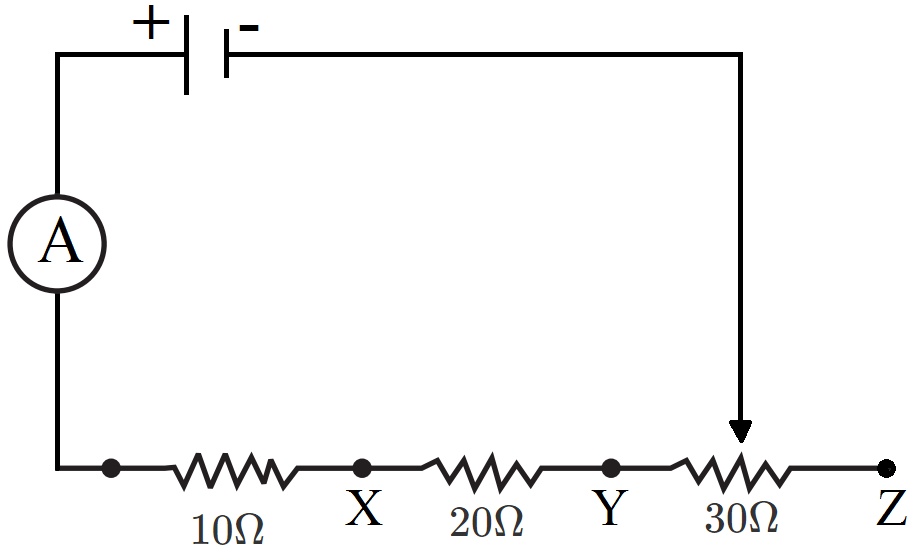
The diagram shows a cell connected in series with an ammeter and three resistors $(10\Omega,20\Omega,30\Omega).$ The circuit can be completed by a movable constant M. When M is connected to x, then ammeter reads 0.6A. what is the ammeter reading when M is connected to y?
Answer
The current when it is connected to x is 0.6A, so net resistance is 10 ohms so the cell voltage is 10 × 0.6 = 6V. Now when M is connected to y the net resistance is sum of the resistance of $10\Omega$ and $20\Omega$$\text{R}_{\text{net}}=10+20=30\Omega$
As we know by ohms law, V=I R Putting the values in the equation, we get$6\text{V}=1\times30\Omega$
$\text{I}=\frac{6}{30}=0.2\text{A}$ Thus, the reading of ammeter is 0.2A.
View full question & answer
Question 642 Marks
Keeping the potential difference constant, the resistance of a circuit is halved. Then, how much does the current changes?
Answer
Current will be doubled$\text{V}=\text{I}_{1}\times\text{R}_{1}$
$\text{V}=\text{I}_{2}\times\text{R}_{2}$
$\text{I}_{1}\times\text{R}_{1}=\text{I}_{2}\times\text{R}_{2}=\text{I}_{2}\times\frac{\text{R}_{1}}{2}$
$\text{I}_{2}\frac{\text{I}_{1}\times\text{R}_{1}}{\frac{\text{R}_{1}}{2}}=2\times\text{I}_{1}$
$\therefore\text{I}=2\text{I}$
Thus, from this we can conclude that if the resistance of the circuit is halved then the current gets doubled.
View full question & answer
Question 652 Marks
A resistance of $25Ω$ is connected to a 12V battery. Calculate the heat energy in joules generated per minute.
Answer
Given: $R=25$ ohms, $V=12 V, H =?, t =60 Sec$
$V=I R$
$12=25 \times I$
$I=0.48 amp$
We have
$H=I^2 R T$
$H=0.48^2 \times 25 \times 60$
$H=345.6 J$
View full question & answer
Question 662 Marks
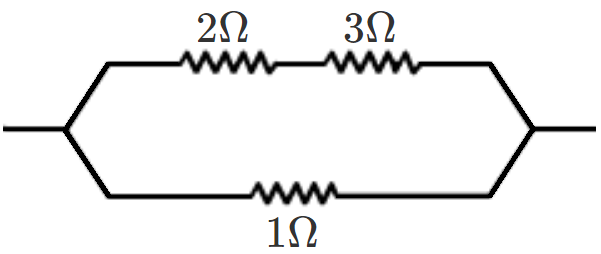
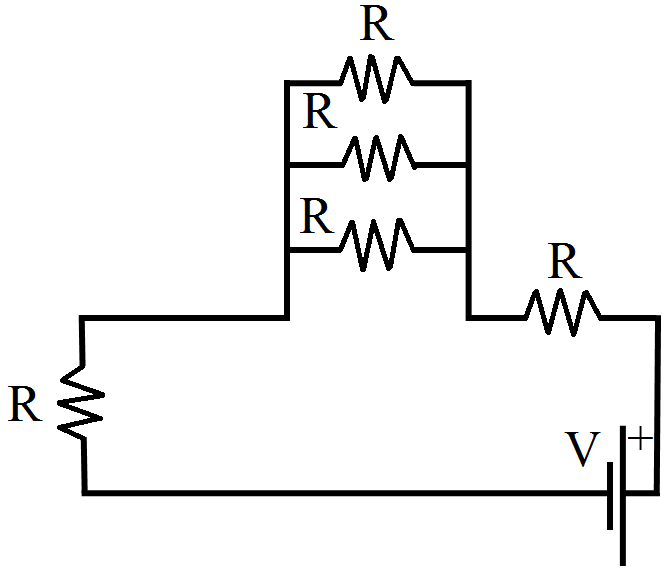
How will you connect three resistors of $2 Ω, 3 Ω$ and $5 Ω$ respectively so as to obtain a resultant resistance of $2.5 Ω$ ? Draw the diagram to show the arrangement.
Answer
Given: Three resistance of 2 ohm, 3 ohms, 5 ohms.
Their resultant, R = 2.5 ohm

Resistance of first line = 2 + 3 = 5 ohm
So, $\frac{1}{\text{R}}=\frac{1}{5}+\frac{1}{5}$
On solving we get that
R = 2.5 ohms.
View full question & answer
Question 672 Marks
How much heat will an instrument of 12W produce in one minute if it is connected to a battery of 12V?
Answer
Given: $P=12 W, V=12 V, t=60 Sec$
$P=V I$
$I=\frac{P}{V}=\frac{12}{12}=1 A$
$V=I R$
$R=\frac{V}{I}=\frac{12}{1}=12 \Omega$
$H=I^2 R t$
$H=1^2 \times 12 \times 60$
$H=720 J$
View full question & answer
Question 682 Marks
Show how you would connect three resistors, each of resistance 6 Ω, so that the combination has a resistance of (i) 9 Ω, (ii) 4 Ω.
Answer
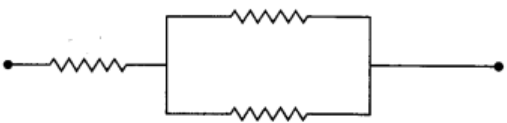
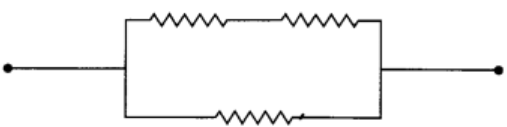
  1. When two 6 $\Omega$ resistances are in parallel and the third is in combination to this, the equivalent resistance will be 9 $\Omega$.
  1. When two 6 $\Omega$ resistances are in series and the third is in parallel to them, then it will be 4 $\Omega$.
View full question & answer
Question 692 Marks
How does use of a fuse wire protect electrical appliances?
Answer
An electric fuse is a safety device used to protect circuits and appliances by stopping the flow of any unduly high electric current. It works on the principle of the heating effect of electric current.
It is made up of material having low melting point and connected in series with the circuit. When current passing through the fuse exceeds a certain limit then it melts. Due to which the circuit breaks and current stops flowing.
View full question & answer
Question 702 Marks
What is the conventional direction of the flow of electric current? How does it differ from the direction of flow of electrons?
Answer
Conventional direction of flow of electric current is from positive terminal of a battery to the negative terminal, through the outer circuit. The direction of flow of electrons is opposite to the direction of conventional current, i.e. from negative terminal to positive terminal.
View full question & answer
Question 712 Marks
What is meant by the “resistance of a conductor”? Write the relation between resistance, potential difference and current.
Answer
The property of a conductor due to which it opposes the flow of current through it is called resistance of the conductor.$\text{R}=\frac{\text{V}}{\text{I}}$
View full question & answer
Question 722 Marks
How does the resistance of a wire vary with its:
  1. Area of cross-section?
  2. Diameter?
Answer
  1. By increasing the area of cross section, the resistance will decrease.
  2. By increasing the diameter, the resistance will decrease.
View full question & answer
Question 732 Marks
Find the effective resistance of the combination.

Answer
$\text{R}_1=4\Omega$$\text{R}_2=8\Omega$
Potential sifference = V
$\text{I}_1=\frac{\text{V}_1}{\text{R}_1}=\frac{\text{V}}{4\Omega}$
$\text{I}_2=\frac{\text{V}}{\text{R}_2}=\frac{\text{V}}{8\Omega}$
$\frac{\text{I}_1}{\text{I}_2}=\frac{\text{V}}{\text{V}}=\frac{4\Omega}{8\Omega}$
$\Rightarrow\frac{\text{I}_1}{\text{I}_2}= \frac{8}{4}$
$\Rightarrow\frac{\text{I}_1}{\text{I}_2}= \frac{2}{1}$
$\therefore \text{I}_1:\text{I}_?=2:\text{I}$
View full question & answer
Question 742 Marks
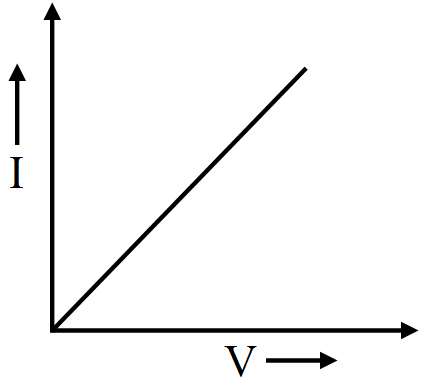
What kind of graph is obtained by plotting values of V and I Why?
Answer
T​he V - I graph (at constant temperature) for a conductor following the Ohm’s law is a straight line with a positive slope.

The slope of the graph with current on the vertical axis and potential difference on the horizontal axis represents the Resistance of the material of the conductor.
View full question & answer
Question 752 Marks
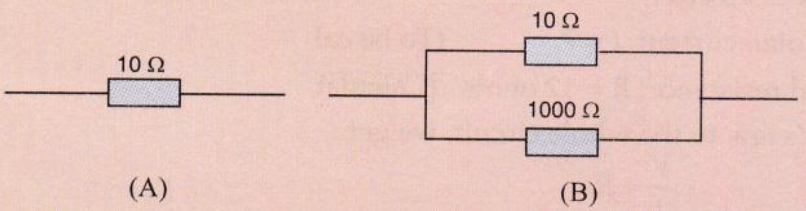
Which of the following resistor arrangement, A or B, has the lower combined resistance?
Answer
Resistance of arrangement A is 10 ohm. Combined resistance of arrangement B is caculated as follows:$\frac{1}{\text{R}}=\frac{1}{10}+\frac{1}{1000}=\frac{(100+1)}{1000}$
$\text{R}=\frac{1000}{101}=9.9\ \text{ohm}$
View full question & answer
Question 762 Marks
Calculate the number of electrons constituting one coulomb of charge.
Answer
Charge on one electron $=1.6 \times 10^{-19}$ coulomb.
No of electron in one coulomb of charge $=1 / 1.6 \times 10^{-19}=6.25 \times 10^{18}$ electrons.
View full question & answer
Question 772 Marks
A wire of resistance $20\Omega$ is bent to form a closed square. What is the resistance across a diagonal of the square?
Answer
On bending 20 ohms resistance into the square. At the ends of the opposite vertexes/ diagonal, thise two points will devide the resistance into 2 equal resistances of 10 ohms each. These are the now in the parallel order. The total/ final resistance will be 5 ohms. $\frac{1}{\text{R}}=\frac{1}{\text{R}1}+\frac{1}{\text{R}1}$
$=\frac{1}{10}+\frac{1}{10}$
$=\frac {2}{10} \text{ohms,}$
$\text{R} = 5 \text{ohms.}$
View full question & answer
Question 782 Marks
Keeping the potential difference constant, the resistance of a circuit is doubled. By how much does the current change?
Answer
V = R$\text{I}=\frac{\text{V}}{\text{R}}$
keeping V constant, $\text{I}\propto\frac{1}{\text{R}}$ So, when R is double I becomes half.
View full question & answer
Question 792 Marks
What do you understand by the term “electric potential”? (or potential) at a point? What is the unit of electric potential?
Answer
The electric potential (or potential) at a point in an electric field is defined as the work done in moving a unit positive charge from infinity to that point.Unit of electric potential is volt.
View full question & answer
Question 802 Marks
An electric motor takes 5 amperes current from a 220 volt supply line. Calculate the power of the motor and electrical energy consumed by it in 2.
Answer
I = 5amp, V = 220 Volt, t = 2h
P = ?, E = ?
P = V × I
= 220 × 5
= 1100 watt
= 1.1KW
Energy consumed, E = P × t
= 1.1 × 2
= 2.2KWh
View full question & answer
Question 812 Marks
Three V-I graphs are drawn individually for two resistors and their series combination. out of A, B, C which one represents the graph for series combination of the other two? Give reason for your answer.
Answer
We Know that $\text{V} = \text{IR}$ And resis tan ce $\text{R} = \frac{\text{V}}{\text{I}}$$\frac{1}{\text{R}}= \frac{\text{dI}}{\text{dV}}=$ slop, which is ,maximum for C
So the resis tan ce will maximum for A, so A show the series combination of the B and C because the net resi tan in series combination is always greater than the individual resistors.
View full question & answer
Question 822 Marks
What current will be taken by a 920W appliance if the supply voltage is 230V?
Answer
P = 920W, V = 230V, I = ?
We know that
P = V × I,
920 = 230 x II = $\frac{920}{230}$ = 4amp
View full question & answer
Question 832 Marks
An electric heater of resistance $500\Omega$ is connected to a mains supply for 30min. If 15A current flows through the filament of the heater, then calculate the heat energy produced in the heater.
Answer
solution We know that the formula of heat is given by:
Heat, $H=I^2 R t$
Where;
$t=30 min=30 \times 60 sec=1800 sec$
$I=15 A$
$\therefore H=(15)^2 \times 500 \times 1800 J$
$H=225 \times 500 \times 1800 J$
$\therefore H=20.25 \times 10^7 J$
Thus Total heat produced by the heater is $20.25 \times 10^7 J$ in 30 min due to flow of 15 A current
View full question & answer
Question 842 Marks
Define electric current. What is the SI unit of electric current.
Answer
Electric current is the flow of electric charges (electrons) in a conductor such as a metal wire.
SI unit of electric current is ampere.
View full question & answer
Question 852 Marks
In the movie Tang and Cash, Kurt Russell and Sylvester Stallone escape from a prison by jumping off the top of a tall wall through the air and onto a high voltage power line. Before the jump, Stallone objects to the idea, telling Russell respond with “You did not take high school Physics. Did you? As long as you are only touching one wire. And your feet are not touching the ground, you do not get electrocuted. ”Is this a correct statement?
Answer
The statement is correct if the weather is very dry and wire is not carrying very high voltage. Because dry air is very bad conductor of electricity and hence current will not flow through your body, since circuit is incomplete. But if humidity is high then current can leak through air from your body, so it will be bad idea to do it in rainy season. Also if the wire carrying very high voltage, then there is also a possibility that the air can break down you may be electrocuted.
View full question & answer
Question 862 Marks
The resistance of a metal wire of length 1m is $26 Ω$ at 20°C. If the diameter of the wire is 0.3mm, what will be the resistivity of the metal at that temperature?
Answer
I = 1m R = 26 ohm$\text{r}=\frac{\text{d}}{2}=\frac{0.3}{2}\text{mm}=0.15\text{mm}=0.15\times10^{-3}\text{m}$
$\rho=\frac{\text{R}\times\text{A}}{\text{I}}=\frac{\text{R}\times\pi\text{r}^2}{\text{I}}$
$\frac{26\times3.14\times(0.15\times10^{-3})^2}{1}$
$-1.83\times10^{-6}\Omega\text{m}$
View full question & answer
Question 872 Marks
State the law which governs the amount of heat produced in a metallic conductor when current is passed through it for a given time. Express this law mathematically.
Answer
Joule’s law of heating states that when a current ‘i' passes through a conductor of resistance ‘r’ for time ‘t’ then the heat developed in the conductor is equal to the product of the square of the current, the resistance and time.$\text{H}=\text{i}^{2}\text{rt}$
The reason behind the heat produced is the collision of the free electrons with the lattice ions or atoms while accelerating in presence of the external electric field.
View full question & answer
Question 882 Marks
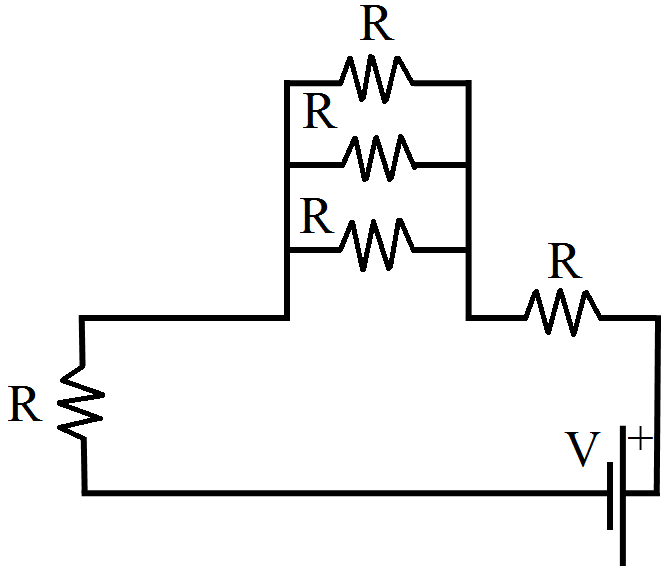
What do you understand by a mixed combination of resistances?
Answer
Mixed combination of resistance means when two or more than two resistors are connected in series and parralel simultaneously. Resistor circuits that combines series and parallel resistors networks together are generally known as resistor combination or mixed resistor circuits. These type of combination are known as Mixed combination.
View full question & answer
Question 892 Marks
The charge on an electron is $1.6 \times 10^{-19} C$. Find the number of electrons that will flow per second to constitute a current of 2 A .
Answer
We know that; Q = ne Were, n is an integral multiple can take values 1, 2, 3…. e- is the charge on the electron. And, $\text{I}=\frac{\text{Q}}{\text{t}}$$\therefore\text{I}=\frac{\text{ne}}{\text{t}}$
Thus, $\text{n}=\frac{\text{I}\times\text{t}}{\text{e}}$$\text{n}=\frac{2\times1}{1.6\times10^{-19}}$
$\therefore\text{n}=1.25\times10^{19}$
View full question & answer
Question 902 Marks
Which has more resistance:
  1. A long piece of nichrome wire or a short one?
  2. A thick piece of nichrome wire or a thin piece?
Answer
  1. A long piece of nichrome wire.
  2. A thin piece of nichrome wire.
View full question & answer
Question 912 Marks
100 joules of heat is produced per second in a 4 ohm resistor. What is the potential difference across the resistor?
Answer
Given: $H =100 J, t =1 sec , R =4 ohms$,
We know that
$H=I^2 R T$
$100=I^2 \times 4 \times 1$
$\frac{100}{4}=I^2$
$I=5 amp$
$V=I R$
$V=5 \times 4$
$=20 V$
View full question & answer
Question 922 Marks
When a 12V battery is connected across an unknown resistor, there is a current of 2.5mA in the circuit. Calculate the value of the resistance of the resistor.
Answer
V = 12 volt, I = 2.5 × 10 - 3A We know that V = IR$\text{R}=\frac{\text{V}}{\text{I}}$
$\text{R}=\frac{12}{(2.5\times10^{-3})}$
R = 4.8 × 10³ ohm = 4800 ohm.
View full question & answer
Question 932 Marks
Define watt. Write down an equation linking watts, volts and amperes.
Answer
When an electrical appliance consumes electrical energy at the rate of 1 joule per second, its power is said to be 1 watt.
1 watt = 1 volt × 1 ampere.
View full question & answer
Question 942 Marks
Give the law of combination of resistances in series.
Answer
According to the law of combination of resistances in series, the combined resistance of any number of resistances connected in series is equal to the sum of the individual resistances.
View full question & answer
Question 952 Marks
An electric heater of resistance $8Ω,$ takes a current of 15A from the mains supply line. Calculate the rate at which heat is developed in the heater.
Answer
 Given: $R =8$ ohms, $I =15 amp , t =1 sec$
We know that
$H=I^2 RT$
$H=15^2 \times 8 \times 1$
$H=1800 J / s$
View full question & answer
Question 962 Marks
How is a voltmeter connected in the circuit to measure the potential difference between two points?
Answer
A voltmeter is connected in parallel across any two points in a circuit to measure the potential difference between them with its +ve terminal to the point at higher potential and -ve terminal to the point at lower potential of the source.
View full question & answer
Question 972 Marks
What is the potential difference between the terminals of a battery if 250 joules of work is required to transfer 20 coulombs of charge from one terminal of battery to the other?
Answer
Given: Work done = 250J, Charge moved = 20C.we know that,Potential difference $= \frac{\text{Work done}}{\text{Charge\ moved}}$
$=\frac{250}{20}=12.5$
View full question & answer
Question 982 Marks
What is meant by “electric power”? Write the formula for electric power in terms of potential difference and current.
Answer
The rate at which electrical work is done or the rate at which electrical energy is consumed is known as electrical power.
It is given by P = VI = Watt
P = VI = Watt
View full question & answer
Question 992 Marks
An electric heater of resistance 8 Ω draws 15 A from the service mains 2 hours. Calculate the rate at which heat is developed in the heater.
Answer
$\text{R}=8 \ \Omega, \ \text{I}=15 \ \text{A}, \ \text{t}=2 \ \text{h}$
Rate of heat developed $=\frac{\text{H}}{\text{t}}=\frac{\text{I}^2\text{Rt}}{\text{t}}$
$=15^2 \times 8=225 \times 8=1800 Js ^{-1}$.
View full question & answer
Question 1002 Marks
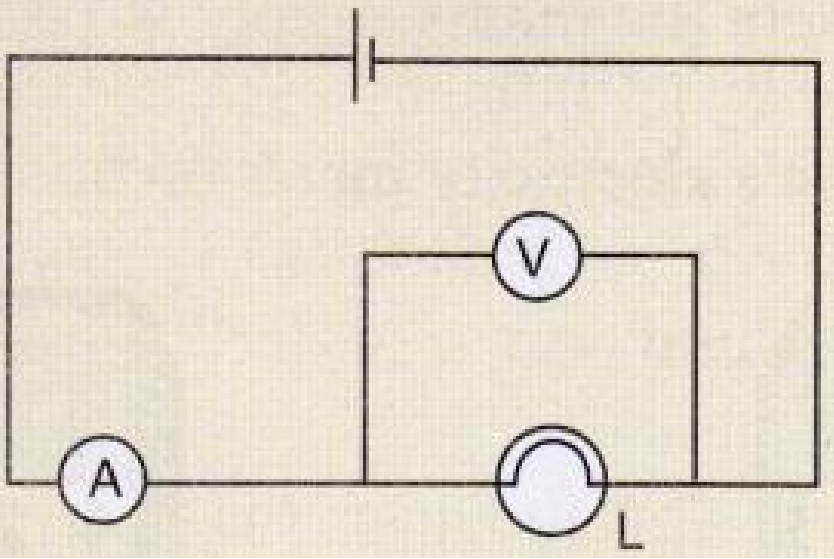
The diagram below shows a circuit containing a lamp L, a voltmeter and an ammeter. The voltmeter reading is 3V and the ammeter reading is 0.5A
  1. What is the resistance of the lamp?
  2. What is the power of the lamp?
Answer
Given: V = 3V, I = 0.5 amp
  1. R = ?
we know that V = IR

3 = 0.5R

R = 6 ohms
  1. Power of lamps = VI
3 × 0.5

= 1.5 watt
View full question & answer
[2 Mark Questions] - Page 2 - Science STD 10 Questions - Vidyadip