Questions · Page 2 of 2

[2 Mark Questions]

Question 512 Marks
State the law of combination of resistances in parallel.
Answer
According to the law of combination of resistance in parallel, the reciprocal of the combined resistance of a number of resistances connected in parallel is equal to the sum of the reciprocals of all the individual resistances.
View full question & answer
Question 532 Marks
What is the maximum power in kilowatts of the appliance that can be connected safely to a 13A ; 230V mains socket?
Answer
I = 13 amp, V = 230V
Power = VI
= 230 × 13
= 2990W
P = 2.99KW
View full question & answer
Question 542 Marks
Define resistivity. Write an expression for the resistivity of a substance. Give the meaning of each symbol which occurs in it.
Answer
Resistivity, $\rho=\frac{\text{R}\times\text{A}}{\text{I}}$
Where, R is the resistance of the conductor.
A is the area of cross section of the conductor.
I is the length of the conductor.
View full question & answer
Question 552 Marks
If 3 resistances of 3 ohm each are connected in parallel, what will be their total resistance?
Answer
$\text{R}_1=\text{R}_2=\text{R}_3=3\Omega$
$\frac{1}{\text{R}}=\frac{1}{\text{R}_1}+\frac{1}{\text{R}_2}+\frac{1}{\text{R}_3}$
$=\frac{1}{3}+\frac{1}{3}+\frac{1}{3}=\frac{3}{3}=1$
$\therefore\text{R}=1\Omega$
View full question & answer
Question 562 Marks
Give two reasons why nichrome alloy is used for making the heating elements of electrical appliances.
Answer
Nichrome alloy is used for making the heating elements of electrical appliances because:
  1. Nichrome has very high resistivity.
  2. Nichrome does not undergo oxidation (or burn) easily even at high temperature.
View full question & answer
Question 572 Marks
The potential difference between the terminals of an electric iron is 240V and the current is 5.0A. What is the resistance of the electric iron?
Answer
V = 240 volt, I = 5 amp
We know that
V = IR
240 = 5 x R
$\text{R}=\frac{240}{5}=48\text{ohm}.$
View full question & answer
Question 582 Marks
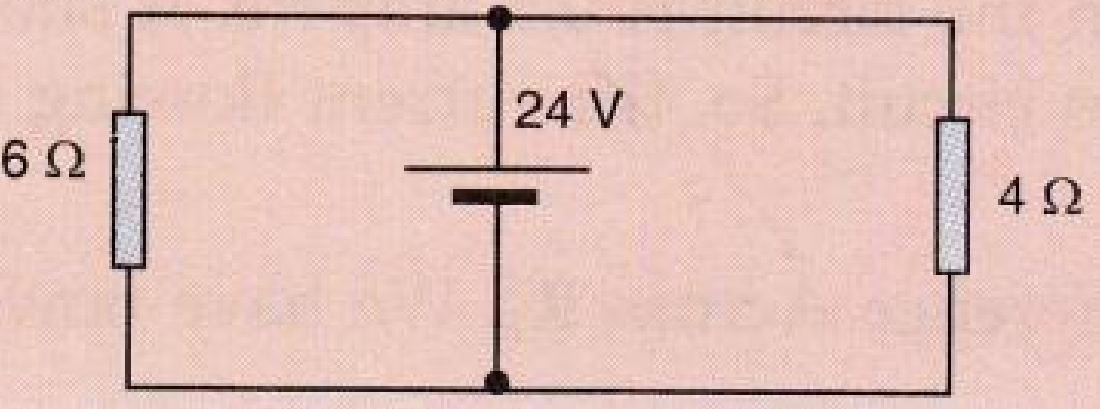
Find the current in each resistor in the circuit shown below:
Answer
$R _1=6$ ohm, $R _2=4$ ohm $V =24 V$
The two resistances are connected in parallel.
Current across $\text{R}_1=\text{I}_1=\frac{\text{V}}{\text{R}_1}=\frac{24}{6}=4\text{amp}$
Current across $\text{R}_2=\text{I}_2=\frac{\text{V}}{\text{R}_2}=\frac{24}{4}=6\ \text{amp}$
View full question & answer
Question 592 Marks
You are supplied with a number of $100 Ω$ How could you combine some of these resisters to make a $250 Ω$ resistor?
Answer
For obtaining 250 ohms, connect two 100 ohm in series with a parallel combination of two 100 ohms.
View full question & answer
Question 602 Marks
If current flows through two lamps arranged: (a) in series, (b) in parallel, and the filament of one lamps breaks, what happens to the other lamp ? Explain your answer.
Answer
  1. In case of series connection, if filament of one lamp breaks, the other wil stop glowing.
  2. In case of parallel connection, if filament of one lamp breaks, the other will keep glowing.
View full question & answer
Question 612 Marks
An electric kettle connected to the 230V mains supply draws a current of 10A. Calculate:
  1. The power of the kettle.
  2. The energy transferred in 1 minute.
Answer
Given V = 230V, I = 10 amp
P = VI
P = 230 × 10
P = 2300 Watt = 2300 J/s
Energy consumed in min $=\text{P}\times\text{T}=2300\ \text{J}/\text{s}\times60\text{s}=138000\text{J}$
View full question & answer
Question 622 Marks
Why does the connecting cord of an electric heater not glow hot while the heating element does?
Answer
The connecting cord of the heater made of copper does not glow because negligible heat is produced in it by passing current (because of its extremely low resistance); but the heating element made of nichrome glows because it becomes red-hot due to the large amount of heat produced on passing current (because of its high resistance).
View full question & answer
Question 632 Marks
If you were going to connect two light bulbs to one battery, would you use a series or a parallel arrangement? Why? Which arrangement takes more current from the battery?
Answer
Parallel arrangement because if one electrical bulb stops glowing due to some defect the other will keep glowing. Parallel arrangement takes more current from the battery due to its lesser equivalent resistance.
View full question & answer
Question 642 Marks
Classify the following into good conductors, resistors and insulators:
Rubber, Mercury, Nichrome, Polythene, Aluminium, Wood, Manganin, Bakelite, Iron, Paper, Thermocol, Metal coin.
Answer
Conductor: Mercury, Aluminum, Iron, Metal Coin.
Resistor: Manganin, Nichrome.
Insulator: Rubber, Polythene, Wood, Bakelite, Paper, Thermocol.
View full question & answer
Question 652 Marks
A bulb is rated as 250V; 0.4A. Find its : (i) power, and (ii) resistance.
Answer
$V=250 V, I=0.4 amp$
We know that
Power = VI $=250 \times 0.4=100$ watt we have
$P=I^2 R$
$100=0.4^2 \times R$
$R=625 \text { ohm }$
View full question & answer
Question 662 Marks
What is an electric current? What makes an electric current flow in a wire?
Answer
An electric currrent is a flow of electric charges (electrons) through a conductor. Potential difference between the ends of the wire makes electric current to flow in the wire.
View full question & answer
Question 672 Marks
Why is a series arrangement not used for connecting domestic electrical appliances in a circuit?
Answer
A series arrangement is not used for connecting domestic electrical appliances in a circuit because if one electrical appliance stops working due to some defect, then all other appliance also stop working as the whole circuit is broken.
View full question & answer
Question 682 Marks
On what factors does the resistance of a conductor depend?
Answer
Resistance of a conductor depends on the following factors:-
Length of the conductor, area of cross section of the conductor, nature of material of the conductor and temperature of the conductor.
View full question & answer
Question 692 Marks
How much energy is transferred by a 12V power supply to each coulomb of charge which it moves around a circuit?
Answer
Given: Potential difference = 12V, Charge moved = 1CWe know that,
Work done = Potential difference × charge moved
= 12 × 1 = 12 joules
Since work done on each coulomb of charge is 12 joules, the energy given to each coulomb of charge is also 12 joules.
View full question & answer
Question 702 Marks
Define kilowatt-hour. How many joules are there in one kilowatt-hour?
Answer
One kilowatt hour is the amount of electrical energy consumed when an electrical appliance having a power rating of 1 Kilowatt is used for 1 hour.
$1 KWh =3.6 \times 10^6 J$
View full question & answer
Question 712 Marks
An electric kettle rated at 220V, 2.2kW, works for 3 hours. Find the energy consumed and the current drawn.
Answer
V = 220V, P = 2.2kW = 2200W, t = 3h
We know that
Electrical energy consumed = P × t = 2.2 × 3 = 6.6kWh
We have, P = V × I
2200 = 220 × I
I = 10amp
View full question & answer
Question 722 Marks
What do you understand by the “resistivity” of a substance?
Answer
Resistivity is the characteristic property of a substance which depends on the nature of the substance and its temperature. It is numerically equal to the resistance between the opposite faces of a 1m cube of the substance.
View full question & answer
Question 732 Marks
Name two factors on which the resistivity of a substance depends and two factors on which it does not depend.
Answer
Resistivity of a substance on the nature of the substance and its temper. it does not depend the length or thickness of the conductor.
View full question & answer
Question 742 Marks
Which of the following are conductors and which are insulators? Sulphur, Silver, Copper, Cotton, Aluminium, Air, Nichrome, Graphite, Paper, Porcelain, Mercury, Mica, Bakelite, Polythene, Manganin.
Answer
Conductor: Silver, Copper, Aluminum, Nichrome, Graphite, Mercury, Manganin.Insulators: Sulphur, Cotton, Air, Paper, Porcelain, Mica, Bakelite, Polythene.
View full question & answer
Question 752 Marks
Define the unit of resistance (or Define the unit “ohm”).
Answer
1 ohm is the resistance of a conductor such that when a potential difference of 1 volt is applied to its ends, a current of 1 ampere flows through it.
View full question & answer
Question 762 Marks
A wire that has resistance R is cut into two equal pieces. The two parts are joined in parallel. What is the resistance of the combination?
Answer
Resistance of each part is $\frac{\text{R}}{2}.$
Resultant resistance R’ is given by
$\frac{1}{\text{R}'}=\frac{2}{\text{R}} +\frac{2}{\text{R}}$
$\text{R’}=\frac{\text{R}}{4}.$
View full question & answer
[2 Mark Questions] - Page 2 - Science STD 10 Questions - Vidyadip