Questions · Page 2 of 2

[3 Mark Questions]

Question 513 Marks
What is, highest, and lowest, resistance which can be obtained by combining Com resistors having the following resistances?
$4 Ω, 8 Ω, 12 Ω, 24 Ω$
Answer
For obtaining the highest resistance by combining the given resistance, we must connect them in series.
We get,
R = 4 + 8 + 12 + 24 = 48 ohms
For obtaining the lowest resistance by combining the given resistance, we must connect them parallel.
We get,
$\frac{1}{\text{R}}=\frac{1}{4}+\frac{1}{8}+\frac{1}{12}+\frac{1}{24 }$
On solving we get, R = 2 ohms.

View full question & answer
Question 523 Marks
An electric heater is connected to the 230V mains supply. A current of 8A flows through the heater.
  1. How much charge flows around the circuit each second?
  2. How much energy is transferred to the heater each second?
Answer
P.d. = 230V, I = 8A
$\text{I}=\frac{\text{Q}}{\text{t}}$
$8=\frac{\text{Q}}{1}$
Q = 8 × 1 = 8C
So, 8C of charge flows around the circuit each secound.
Energy transfred = Work done
$\text{P.d}.=\frac{\text{Work done}}{\text{Charge moved}}$
$230=\frac{\text{Work done}}{8}$
Work done = 230 × 8 = 1840J
Energy trandferred = 1840J.
View full question & answer
Question 533 Marks
State and explain Joule’s law of heating.
Answer
Joule's law of heating states that heat produced in joule when a current of I amphere flows in a wire of resistance $R$ ohms for time $t$ secounds is
Given by $H = I ^2 Rt$
Thus the heat produced in a wire is directly proportional to:
i. Square of current.
ii. Resistance of wire.
iii. Time for which current is passed.
View full question & answer
Question 543 Marks
If a potential difference of 10V causes a current of 2A to flow for 1 minute, how much energy is transferred?
Answer
Given: p.d. = 10V, I = 2amp, t = 1 min = 60s.
We know that:
$\text{I} = \frac{\text{Q}}{\text{T}}$
Thus, Q = I × t.
Q = × 60.
Q = 120C.
Work done = p.d. × charge moved
Work done = 120 × 10J
Work done = 1200J.
View full question & answer
Question 553 Marks
Ten bulbs are connected in a series circuit to a power supply line. Ten identical bulbs are connected in a Parallel circuit to an identical power supply line.
  1. Which circuit would have the highest voltage across each bulb?
  2. In which circuit would the bulbs be brighter?
  3. In which circuit, if one bulb blows out, all others will stop glowing
  4. Which circuit would have less current in it?
Answer
  1. Parallel Circuit
because all will have same voltage across them i.e. voltage of battery.
  1. Parallel Circuit
because all have higher voltage across them.
  1. Series Circuit
because if one bulb goes out current won't reach the next bulb.
  1. Series Circuit
because Equivalent Resistance will be less and more current will be drawn in parallel circuit.
View full question & answer
Question 563 Marks
Draw circuit symbols for:
  1. Fixed resistance.
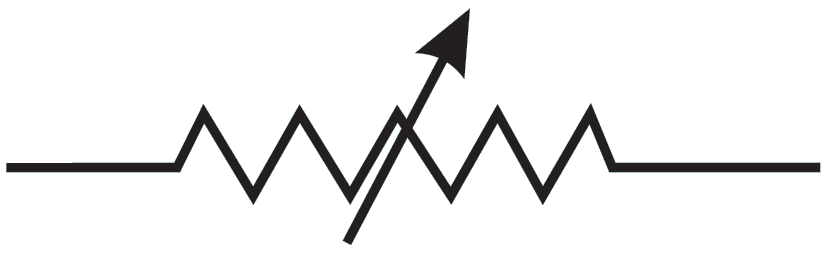
  2. Variable resistance.
  3. A cell.
  4. A battery of three cells.
  5. An open switch.
  6. A closed switch.
Answer
  1. Fixed resistance
  1. Variable Resistance.
  1. Cell.
  1. Battery of three cells.
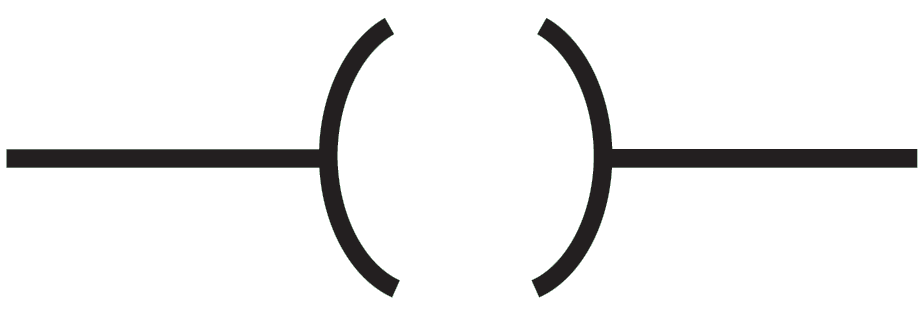
  1. Open Switch.
  1. Closed Switch.
View full question & answer
Question 573 Marks
The electrical resistivities of three materials P, Q and R are given below:$\begin{matrix}\text{P}&2.3\times10^{3}\Omega\text{ m}\\\text{Q}&2.63\times10^{-8}\Omega\text{ m}\\\text{R}&1.0\times10^{15}\Omega\text{ m}\end{matrix}$
Which material will you use for making:
  1. Electric wires.
  2. Handle for soldering iron, and
  3. Solar cells?
Give reasons for your choices.
Answer
  1. Material Q with resistivity 2.63 × 10⁻⁸ ohm-m can be used for making electric wires because it has very low resistivity.
  2. Material R with resistivity 1.0 × 10¹⁵ ohm-m can be used for making handle of soldering iron because it has very high resistivity.
  3. Material P with resistivity 2.3 × 10³ ohm-m can be used for making solar cell because it is a semiconductor.
View full question & answer
Question 583 Marks
In 10s, a charge of 25C leaves a battery, and 200j of energy are delivered to an outside circuit as a result.
  1. What is the p.d. across the battery?
  2. What current flows from the battery?
Answer
t = 10s
Q = 25C,
Energy deliverd = work done = 200J
$\text{p}.\text{d}.=\frac{\text{Work done}}{\text{Charge moved}}=\frac{200}{25}=8\text{V}$
$\text{I}=\frac{\text{Q}}{\text{t}}=\frac{25}{10}=2.5\text{A}$
View full question & answer
Question 593 Marks
A resistor has a resistance of 176 ohms. How many of these resistors should be connected in parallel so that their combination draws a current of 5 amperes from a 220 volt supply line?
Answer
I = 5A
V = 220V
$\text{R}=\frac{\text{V}}{\text{I}}=\frac{220}{5}=44\Omega$
Required resistance is less that $176\Omega,$ so the resistor should be connected in parallel.
Let the required no. be n.
$\text{R}_\text{eq}=\frac{176}{\text{n}}=44$
$\text{n}=\frac{176}{44}=4$
View full question & answer
Question 603 Marks
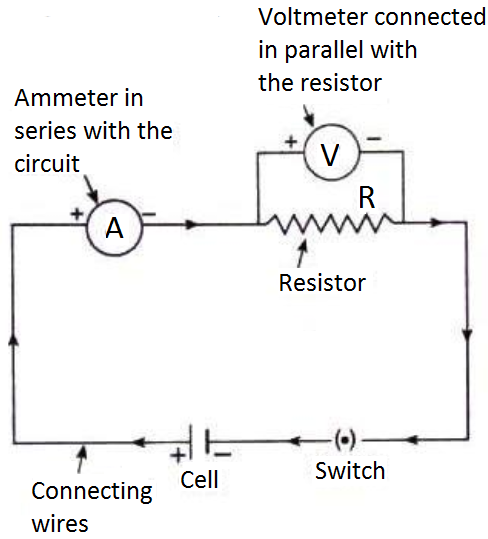
What is a circuit diagram? Draw the labelled diagram of an electric circuit comprising of a cell, a resistor, an ammeter, a voltmeter and a closed switch (or closed plug key). Which of the two has a large resistance: an ammeter or a voltmeter?
Answer
A diagram which indicates how different components in a circuit have been connected by using the electrical symbols for the components is called a circuit diagram.

A voltmeter has a large resistance.
View full question & answer
Question 613 Marks
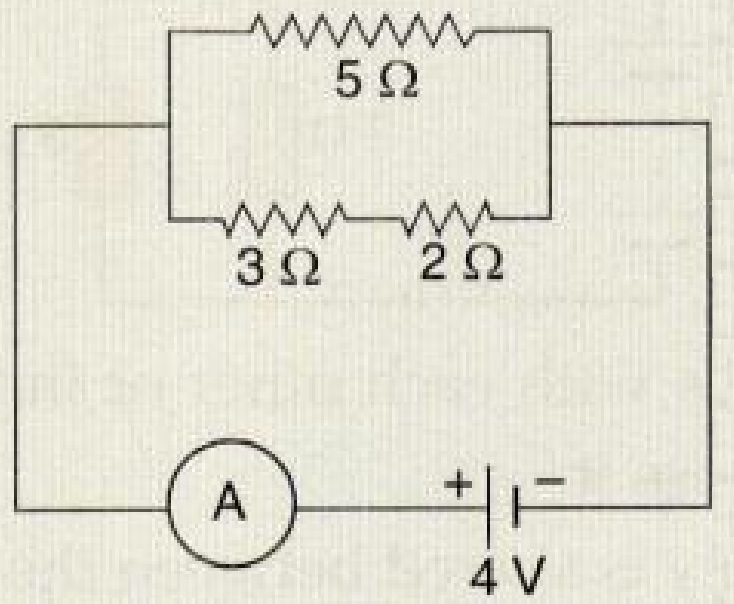
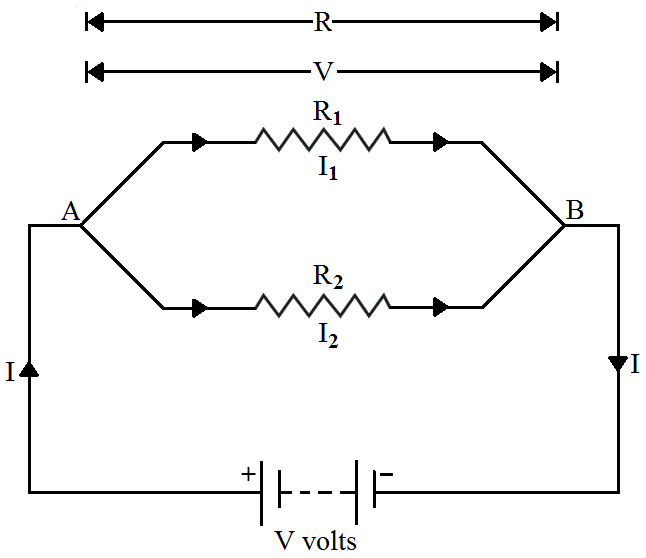
With the help of a circuit diagram, obtain the relation for the equivalent resistance of two resistances connected in parallel. In the circuit diagram shown below, find:
  1. Total resistance.
  2. Current shown by the ammeter A
Answer

  1. a. Suppose total current flowing the circuit is I then the current passing through resistance $R _1$ will be $I _1$ and current passing through resistance $R _2$ will be $I _2$

    Total current $= I = I _1+ I _2$
Let resultant resistance of this parallel combination is R. By applying the ohm's law to each resistance we get that,

$\text{I}_1=\frac{\text{V}}{\text{R}_1}$

$\text{I}_2=\frac{\text{V}}{\text{R}_2}$

putting these eq in the above one, we get that

$\frac{\text{V}}{\text{R}}=\frac{\text{V}}{\text{R}_1}+\frac{\text{V}}{\text{R}_2}$

$\frac{1}{\text{R}}=\frac{1}{\text{R}_1}+\frac{1}{\text{R}_2}$

If two resistance are connected in parallel than the resultant resistance will be

$\frac{1}{\text{R}}=\frac{1}{\text{R}_1}+\frac{1}{\text{R}_2}$
  1. Total resistance = R
$\frac{1}{\text{R}}=\frac{1}{\text{R}_1}+\frac{1}{\text{R}_2}$

$R _2=3+2=5 ohms$

$R _1=5 ohm$

$\frac{1}{\text{R}}=\frac{1}{5}+\frac{1}{5}$

$\frac{1}{\text{R}}=\frac{2}{5}$

R = 2.5 ohm

Current flows through the circuit

$\text{I}=\frac{\text{V}}{\text{R}}=\frac{4}{2.5}$

= 1.6 amps
View full question & answer
Question 623 Marks
An electric iron is connected to the mains power supply of 220V. When the electric iron is adjusted at ‘minimum heating’ it consumes a power of 360W but at ‘maximum heating’ it takes a power of 840W. Calculate the current and resistance in each case.
Answer
Given: $V =220 V, P _{\min }=360 W, P _{\max }=840 W$
For minimum heating case:
We know that
$P _{\min } = VI$
360 = 220XI
I = 1.63 amp
$\text{R}=\frac{\text{V}}{\text{I}}$
$\text{R}=\frac{220}{1.63}$
R = 134.96 ohms
For maximum heating case:
We know that
P = VI
840 = 220XI
I = 3.81 amp
$\text{R}=\frac{\text{V}}{\text{I}}$
$\text{R}=\frac{220}{3.81}$
R = 57.74 ohms
View full question & answer
[3 Mark Questions] - Page 2 - Science STD 10 Questions - Vidyadip