Questions · Page 1 of 3

[2 Mark Questions]

🎯

Test yourself on this topic

50 questions · timed · auto-graded

Question 12 Marks
State the post-fertilisation changes that lead to fruit formation in plants.
Answer
→ After fertilisation, the zygote divides several times to form an embryo within the ovule.
→ The ovule develops a tough coat and is gradually converted into a seed.
→ The ovary grows rapidly and ripens to form a fruit.
→ The petals, sepals, stamens, style and stigma may shrivel and fall off.
View full question & answer
Question 22 Marks
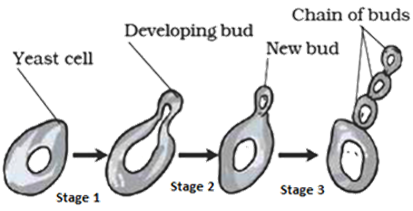
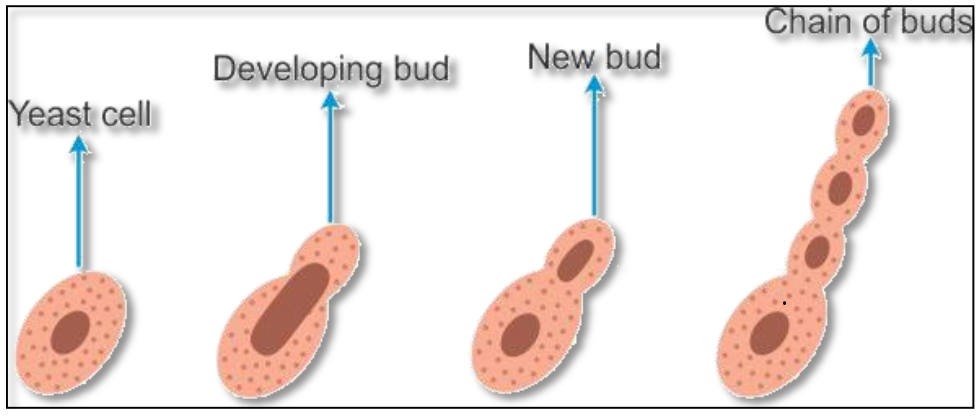
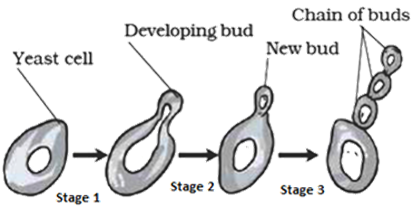
Students were asked to observe the permanent slides showing different stages of budding in yeast under high power of a microscope.
  1. Which adjustment screw (coarse/ fine) were you asked to move to focus the slides?
  2. Draw three diagrams in correct sequence showing budding in yeast.
Answer
  1. A fine screw is used to focus the slides of budding in yeast under high power of a microscope.
  2. Sequence showing budding in yeast:
View full question & answer
Question 52 Marks
A student is observing a permanent slide showing sequentially the different stages of asexual reproduction taking place in yeast. Name this process and draw diagrams, of what he observes, in a proper sequence.
Answer
Yeast uses an asexual method of reproduction known as budding. Here a small bud known as bleb or daughter cell is formed on the parent cell. The nucleus of parent cell splits into a daughter nucleus migrates into the daughter cell.
View full question & answer
Question 62 Marks
What is the main difference between sperms and eggs of humans? Write the importance of this difference.
Answer
The main difference between sperms and eggs of humans is as follows: A sperm or a male gamete has XY chromosomes i.e. half of them are of a male and other half are of female i.e. Y chromosomes and an egg or female gamete has XX chromosomes. Importance:
  1. If a sperm carrying X chromosome from male gets combined with the X chromosome from female, then the combination will be XX and child will be a baby girl.
  2. If a sperm carrying Y chromosome from male gets combined with the X chromosome from female, then the combination will be XY, and the child will be a baby boy.
View full question & answer
Question 72 Marks
State the importance of chromosomal difference between sperms and eggs of humans.
Answer
A male has one X chromosome and One Y chromosome. Thus half the sperms will have X chromosomes and the other half will have Y chromosome. A female has two X chromosomes. So all the female gametes will have only X chromosomes. If a sperm carrying X chromosome fertilises an ovum then the child bom will be a girl. If a sperm carrying Y chromosome fertilises an ovum then the child bom will be a boy.
Thus the chromosomal difference between sperms and eggs of humans determines the sex of the child.
View full question & answer
Question 82 Marks
Name an organism which reproduces by spore formation. List three conditions favourable for spores to germinate and grow.
Answer
Rhizopus is an organism which reproduces by spore formation.
Three conditions favorable for spores to germinate and grow are:
  1. Moist climate.
  2. Suitable temperature.
  3. Good nutrition.
View full question & answer
Question 92 Marks
State the role of placenta in the development of embryo.
Answer
  • Placenta transfers nutrients from mother's blood to the embryo.
  • Provides large surface area for glucose and oxygen to pass from the mother to the embryo.
  • Remove waste substance generated by embryo.
View full question & answer
Question 102 Marks
Describe the role of fallopian tubes in the female reproductive system.
Answer
The fallopian tube is responsible for carrying the egg to the uterus. The finger like processes or fimbriae of the tube reach out into the pelvic cavity and picks up the released egg. The fallopian tubes are not only crucial for the transport of the egg from the ovary to the uterus, they are also the location where the sperm meets the egg cell and fertilizes the egg.
View full question & answer
Question 112 Marks
Describe the role of the following in human beings:
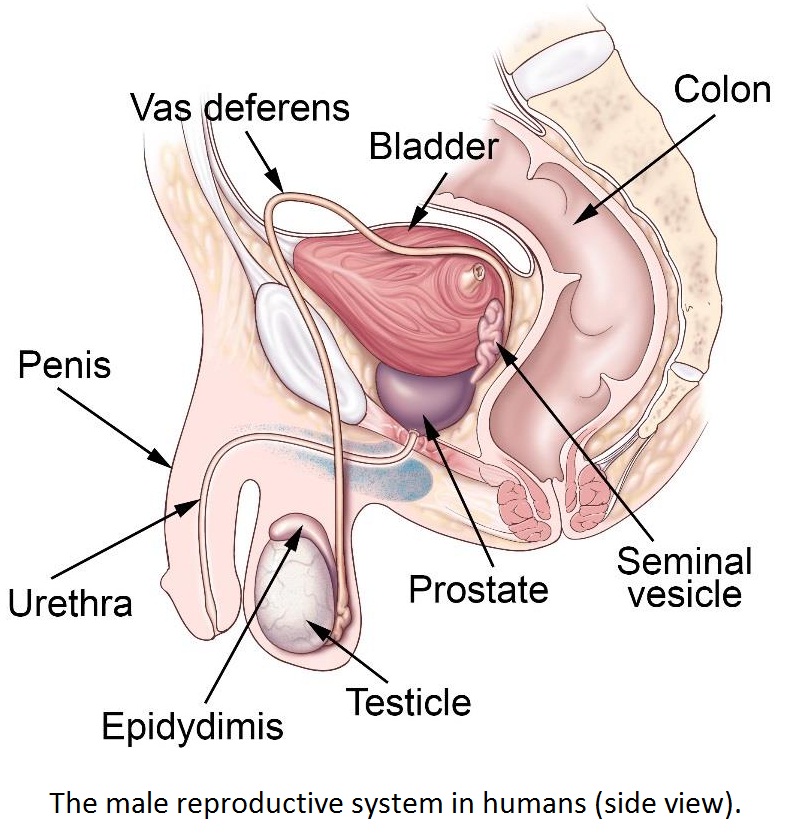
  1. Seminal vesicles.
  2. Prostate gland.
Answer
  1. Seminal vesicles: They secrete an alkaline and sugary fluid into the ejaculatory duct. This fluid is called seminal fluid which nourishes the sperms.
  2. Prostate gland: It secretes a thin, milky alkaline fluid into urethra. This fluid keeps the sperms alive and helps in them to move actively.
View full question & answer
Question 122 Marks
Name one sexually transmitted disease each caused due to bacterial infection and viral infection. How can these be prevented?
Answer
AIDS (Acquired Immune Deficiency Syndrome) caused by the HIV(Human Immunodeficiency​ virus is a sexually transmitted disease caused due to viral infection. Likewise, gonorrhea is a bacterial infection. These diseases are almost impossible to cure but can be prevented easily by using
Some contraception are given below:
  1. Use of new latex condoms.
  2. Take vaccination of hepatitis B.
View full question & answer
Question 132 Marks
You have to perform the experiment, ‘‘To identify the different parts of an embryo of a gram seed.’’ Describe the procedure that you would follow.
Answer
  1. Soak a few seeds of gram/Bengal gram/chana/kidney beans/etc and leave them overnight.
  2. Drain the excess water.
  3. Cover the seeds with a wet cloth and leave them for a day.
  4. Cut open the seed carefully and observe the different parts.
View full question & answer
Question 142 Marks
List four modes of asexual reproduction other than fission in the living organisms.
Answer
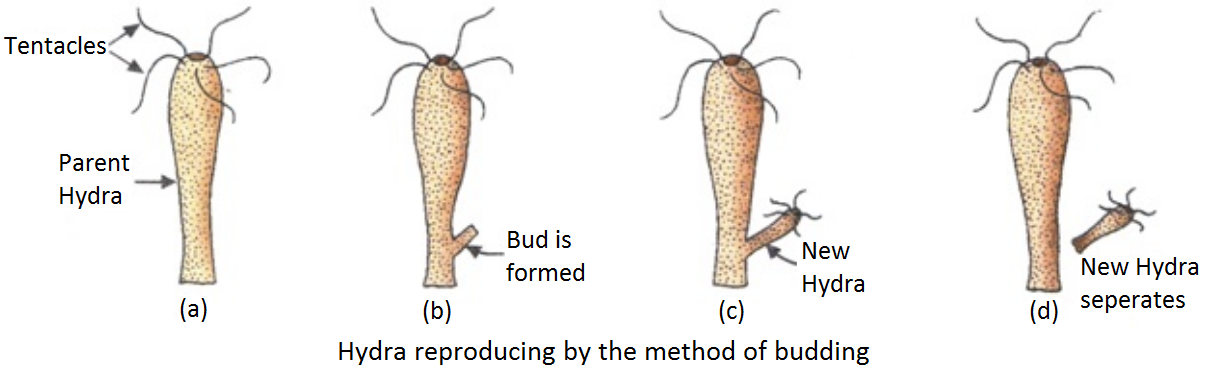
  1. Budding: It involves the formation of a new individual from a protrusion called a bud. It is very common in plants, yeasts and lower level animals such as Hydra.
In Hydra, cells divide rapidly at a specific site and develop as an outgrowth called a bud. This bud, while attached to the parent plant, develops into a small individual. When this individual becomes large enough, it detaches itself from the parent body to exist independently.
  1. Fragmentation: Fragmentation is the unintentional cutting up of the body of an organism in which each part grows into a different organism. It is most commonly seen in some annelids and fungi.
  2. Spore formation: Spores are asexual reproductive bodies enclosed in a thick-walled structure called sporangium, which can tide over unfavourable conditions such as extreme heat, dryness, acidity, and so on. Spore formation is a common method of asexual reproduction in many lower forms of life such as algae, bacteria and fungi.
  3. Vegetative Propagation in Plants: Vegetative Propagation in Plants: The vegetative parts of a plant such as the root, stem, leaf, etc., can produce new plants. You must have seen gardeners taking cuttings from the stem of a rose plant and planting them in the soil. Under suitable conditions, the cuttings grow into new rose plants.
Vegetative propagation is common in plants like orchids, ornamental plants and grasses. Plants such as banana, rose, jasmine, etc., which do not produce seeds, can be grown by vegetative methods. The new plants are genetically similar to and bear the characteristics of the parent plant.
View full question & answer
Question 152 Marks
Write two differences between binary fission and multiple fission in a tabular form.
Answer
Binary fission
Multiple fission
Parent nucleus divides into two and moves to two daughter cells.
Parent nucleus divides into many daughter nuclei, each surrounded by cytoplasm.
No protective covering is formed.
A protective cyst is formed.
View full question & answer
Question 162 Marks
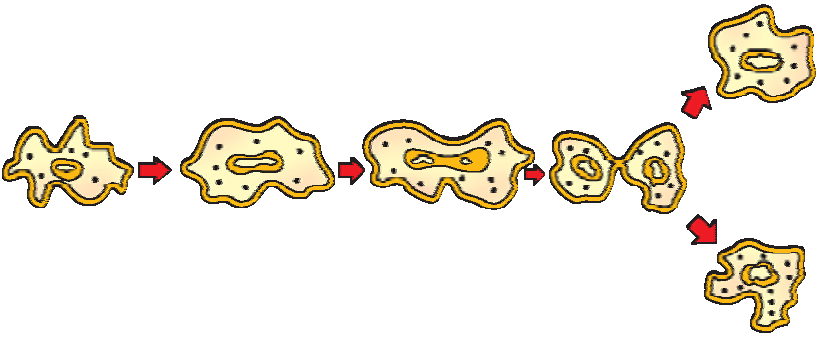
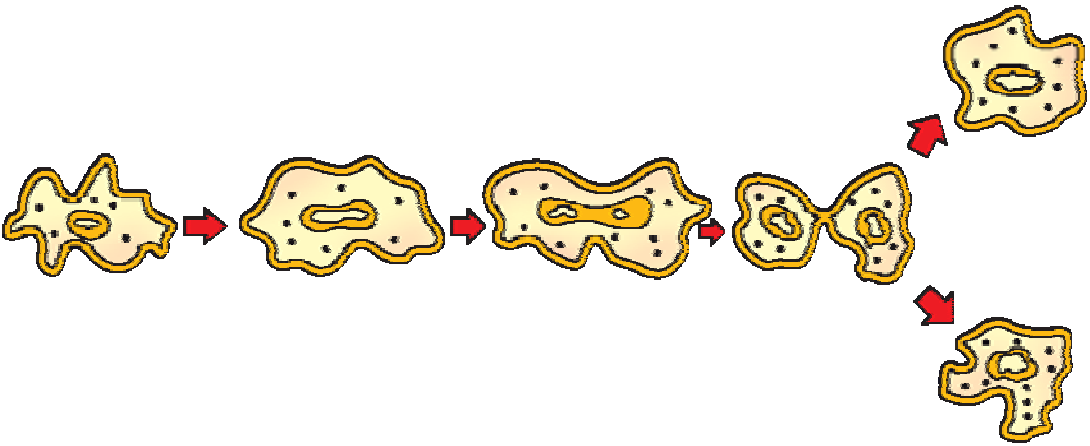
Name the type of asexual reproduction in which two individuals are formed from a single parent and the parental identity is lost. Draw the initial and the final stages of this type of reproduction. State the event with which this reproduction starts.
Answer
Binary fission is the type of asexual reproduction in which two individuals are formed from a single parent and the parental identity is lost.

Binary fission starts with karyokinesis, the phenomenon of division of nucleus.
View full question & answer
Question 172 Marks
Name the type of asexual reproduction in which two individuals are formed from a single parent and the parental identity is lost. Write the first step from where such a type of reproduction begins. Draw first two stages of this reproduction.
Answer
Binary fission is the type of asexual reproduction in which two individuals are formed from a single parent and the parental identity is lost.
View full question & answer
Question 182 Marks
Draw a labelled diagram to show that particular stage of binary fission in amoeba in which its nucleus elongates and divide into two and a constriction appears in its cell membrane.
View full question & answer
Question 192 Marks
List four advantages of vegetative propagation.
Answer
Four advantages of vegetative propagation:
  1. Plants grown by vegetative propagation grow much faster than those grown from seeds.
  2. A large number of plants can be produced by the method of vegetative propagation.
  3. The plants grown by vegetative propagation usually need attention in their early years than the plants grown from seeds.
  4. Seedless plants can also grown from seeds.
View full question & answer
Question 202 Marks
"The chromosomes number of the sexually reproducing parents and their offspring is the same.” Justify this statement.
Answer
In sexually reproducing parents, the germ cells have half the number of chromosomes and DNA as compared to the other non-reproductive cells of the body. When these germ cells, i.e. sperms and ova combine with each other at the time of sexual reproduction, the original chromosome number is attained in the zygote. This zygote further develops into a complete individual having the same chromosome number as present in the parents.
View full question & answer
Question 212 Marks
List two advantages of vegetative reproduction practised in case of an orange plant.
Answer
Advantage of vegetative reproduction practiced in case on an orange plant is:
  1. Orange plant which has lost the capacity to produce viable seeds can be propagated by the method of vegetative reproduction.
  2. All plants produced are genetically similar to parent plant and have all its characteristics.
View full question & answer
Question 222 Marks
State one genetically different feature between sperms and eggs of humans. What is its consequence?
Answer
In humans, sperms have XY sex chromosomes while females have XX. The consequence of this is that sperm play a role in deciding the sex of child. As females are XX they can only contribute X but sperms are XY so they can either contribute X or Y to the offspring. If sperm contributes X then the offspring will be female and if contributes Y then the offspring would be a male.
View full question & answer
Question 232 Marks
Write any two differences between binary fission and multiple fission in a tabular form as observed in cells of organisms.
Answer
Binary Fission Multiple Fission
  • Cells divide into two daughter cells.
  • No cyst (protective covering) is formed around the parent cell.
  • It occurs during normal conditions
  • Cells divide into Several daughter cells.
  • A cyst is formed around the parent cell.
  • It takes place during unfavorable conditions (Encysted stage),
View full question & answer
Question 242 Marks
Explain giving one example of each, the unisexual and the bisexual flowers.
Answer
Uni-sexual FlowersThe flowers in which either the male or female reproductive organs are present only are called unisexual flowers. They are called incomplete flowers. They undergo cross pollination in order to reproduce.
Example: Papaya, Watermelon, Corn etc
Bisexual Flowers
The flowers in which both the male and female reproductive organs are present are known as complete or bisexual flowers. they are capable of self pollination.
Example: Mustard, Rose, Lily, Hibiscus etc.
View full question & answer
Question 262 Marks
List any two differences between pollination and fertilisation.
Answer
Differences between pollination and fertilisation:
 
Pollination
Fertilisation
1
Pollination is transfer of pollen grains from anther to stigma of a flower.
Fertilisation is a process of fusion of male and female gametes.
2
Pollination occurs by various agents such as wind, insect, water etc.
The fertilization is initiated from within the ovule; the ovule attracts the pollen tube towards the embryo sac.
3
Pollination occurs only in flowering plants.
Fertilization is followed by almost in every living being present on the planet earth, including plants, animals, birds, insects, humans, etc.
4
It is a physical process.
It is a genetic and biochemical process.
View full question & answer
Question 272 Marks
What is ‘reproduction’? Mention the importance of DNA copying in reproduction.
Answer
Reproduction is a process in which new individuals of the same species are produced by existing organisms./It is a process in which organisms produce their own kinds.Importance of DNA copying:
  • DNA copying helps to maintain same body design among newly formed individuals as that of their parents.
  • Transmission of characters from parents to the offsprings/Leads to variation/Evolution.
  • The genetic information from generation to generation is carried by DNA. It is therefore possible for the organism to produce organism of its own type due to DNA copying only.
  • For the inheritance of traits of the parent,DNA copying is a must.
  • DNA copying also brings about variation ,which forms the basis for the origin of new species.
View full question & answer
Question 282 Marks
A student is viewing under a microscope a permanent slide showing various stages of asexual reproduction by budding in yeast. Draw diagrams of what he observes. (in proper sequence)
Answer
Yeast reproduces asexually by the process of budding. In this method, a bud develops from the body of yeast which gives rise to a new organism.
View full question & answer
Question 292 Marks
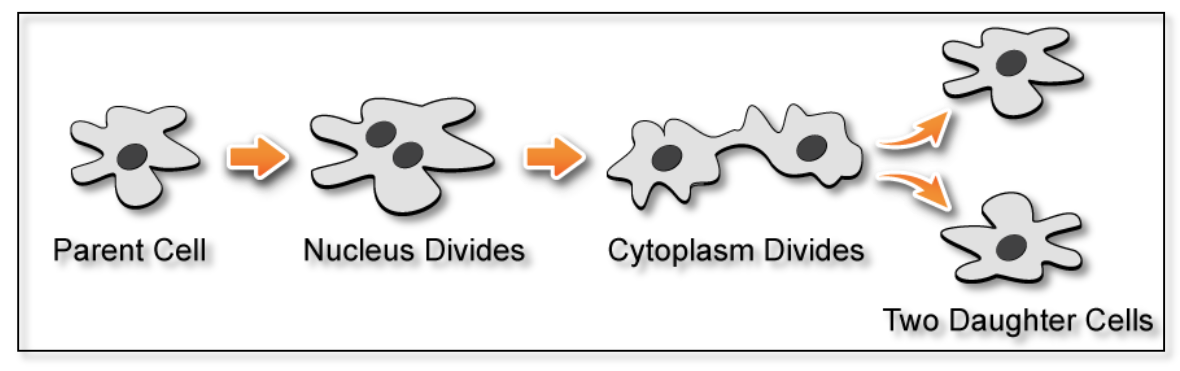
Name the process by which an amoeba reproduces. Draw the various stages of its reproduction in a proper sequence.
Answer
Amoeba reproduces by the process of binary fission. In this method, a single parent cell splits and gets divided into two daughter cells.
View full question & answer
Question 312 Marks
What is made in:
  1. Anther.
  2. Ovary, of a flower?
Answer
  1. Male gametes(insides pollen).
  2. Female gametes (inside ovum).
View full question & answer
Question 322 Marks
How do the insects help in cross-pollination?
Answer
When an insect sits on the flower of a plant for sucking nectar, then the pollen grains from the anther of this flower sticks to its body. And when this insect sits on another flower of another similar plant, then the pollen grains sticking to its body are transferred to the stigma of this second flower. In this way, the insect transfers the pollen grains from the anther of flower in one plant to the stigma of flower in another plant and causes cross pollination.
View full question & answer
Question 332 Marks
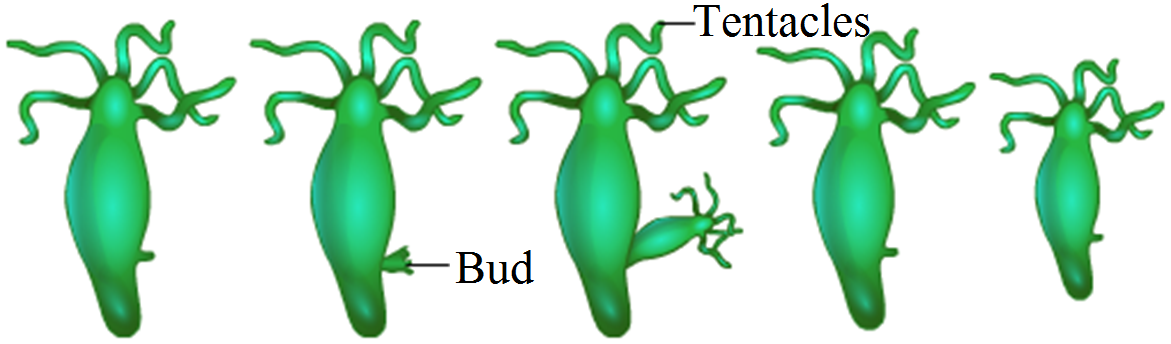
Describe the process of reproduction in Hydra with the help of labelled diagrams. What is the name of this process of reproduction?
Answer

Hydra reproduces by budding. In hydra, first a small outgrowth called bud is formed on the side of its body by repeated mitotic divisions of its cells. This bud then grows gradually to form a small hydra by developing a mouth and tentacles. The tiny new hydra detaches itself from the parent body and develops into a separate organism.
View full question & answer
Question 342 Marks
What is meant by ‘unisexual flowers’ and ‘bisexual flowers’ ? Give two examples of each.
Answer
The flowers which contain only one sex organ, either stamens or carpels are called unisexual flowers like Papaya and watermelon plants. The flowers which contain both the sex organs i.e. both the stamen and the carpel are called bisexual flowers like Hibiscus and Mustard plant.
View full question & answer
Question 352 Marks
What is meant by contraception? What are the different methods of contraception?
Answer
The prevention of pregnancy in women (by preventing fertilisation) is called contraception. There are 3 methods of contraception:
  1. Barrier method.
  2. Chemical method.
  3. Surgical method.
View full question & answer
Question 362 Marks
What are the benefits of using mechanical barriers during sexual act?
Answer
  1. It serves a barrier to prevent arrival of sperm to egg and thus avoids unwanted pregnancy.
  2. It also protects a person from sexually transmitted diseases.
View full question & answer
Question 372 Marks
Reproduction is linked to stability of population of a species. Justify the statement.
Answer
Every organism faces a lot of competition for survival. Barring a very few, most of the organisms end up being food for some other organism. Competition and predation result in drastic reduction in population of a species. But reproduction ensures that population of a species is maintained at optimum level. So, it can be said that reproduction is linked to stability of population of a species.
View full question & answer
Question 382 Marks
‘The seed contains the future plant.’ Why is it said so?
Answer
The seed has an embryo in it , which under suitable conditions of temperature, moisture and air undergoes growth (germination) the portion penetrative underground is coleoptile (radical) and the one piercing out to form aerial portion is plumule cotyledon(s) provide nourishment to the growing embryonic till it is capable to absorb nutrition from the soil and photosynthesize.
View full question & answer
Question 392 Marks
What is the role of seminal vesicles and prostrate gland in human male reproductive system?
Answer
The secretions of seminal vesicles and prostrate gland provide nutrition to the sperms and also make their transportation easier by secreting a thick liquid.
View full question & answer
Question 402 Marks
What is responsible for attainment of sexual maturity in both males and females?
Answer
Main lyhormonesare respinsible for attaining sexual meturityin both males and females.
The hormone which is responsible for male smaturity is testosterone.
The hormone which is responsible for female smaturity are oestrogen and Progesterone.
View full question & answer
Question 412 Marks
What is a seed? How does it help in reproduction in plants?
Answer
Seed is under developing reproducing part of a plant which will lead to a part of plant. A seed is nothing but an embryonic plant, well covered and protected by a coat known as seed coat. The embryo or the baby plant gets the food from the cotyledons present inside the seed itself. After getting its requirements such as air, water, soil and sunlight it turns into a seedling. It is called GERMINATION.
View full question & answer
Question 422 Marks
What changes are observed in the uterus subsequent to implantation of young embryo?
Answer
Endometrium thickens, becomes glandular and highly vascular. The contact region between embryo and uterine wall grows into placenta. Placenta helps the embryo in obtaining nourishment and oxygen from blood sinuses of the uterus. It also helps in transfer of wastes from embryo to the blood of the mother.
View full question & answer
Question 432 Marks
Name the organ responsible for secreting seminal fluid.
Answer
The seminal vesicles, the prostate gland and the bulbourethral glands is the organ responsible for secreting seminal fluid.
View full question & answer
Question 442 Marks
Explain how, offspring and parents of organisms reproducing sexually have the same number of chromosomes?
Answer
The parents are diploid (2n) as each of them has two sets of chromosomes (DNAs). They form haploid (In) male and female gametes through the process of meiosis. The haploid gametes have one set of chromosomes (DNAs). During fertilization, one male gamete fuses with one female gamete. It restores the diploid (2n) chromosome/ DNA number in the offspring that is formed from fusion product or zygote (2n).
View full question & answer
Question 452 Marks
What is the importance of DNA copying in reproduction? Explain with an example.
Answer
  1. The chromosomes in the nucleus of a cell contains information for the inheritance of features from the parents to the next generation in the form of DNA molecules so the characteristics of a parent organism are transmitted to their offsprings.
  2. When the DNA already present in the nucleus of a parent cell is copied by making more of DNA by certain biochemical reactions, then slight variations come in the two copies formed. Thus, variations are produced in the offspring’s during reproduction which form the basis of evolution. Example: Offspring’s produced by asexual reproduction have slight variations from their parents.
View full question & answer
Question 462 Marks
In a bisexual flower inspite of the young stamens being removed artificially, the flower produces fruit. Provide a suitable explanation for the above situation.
Answer
The open flowers are generally cross pollinated. Removal of stamens of a bisexual flower will not affect pollination of its intact pistil and formation of fruit.
View full question & answer
Question 472 Marks
Delivery of sperms from where they are produced to the urethra is facilitated by which part?
Answer
The formation of germ-cells or sperms takes place in the testes. The sperms formed are delivered through the vas deferens which unites with a tube coming from the urinary bladder. Along the path of the vas deferens, prostate glands and the seminal vesicles add their secretions so that the sperms are now in a fluid which makes their transport easier and this fluid also provides nutrition to the sperms.
View full question & answer
Question 482 Marks
Which of the following organisms reproduce by sexual method and which by asexual method?
Amoeba, Cats, Humans, Hydra, Birds.
Answer
  1. Sexual Method: Cats, Humans, birds.
  2. Asexual method: Amoeba, Hydra.
View full question & answer
Question 492 Marks
Name the blueprint responsible for making all basic body designs.
Answer
DNA (Deoxyribonucleic acid) is considered as the blueprint for making all basic design of an organism. Deoxy rhibo nucleic acid which is responsible for the whole character chromosomal content all kinds of compositions related to a human being . it determines the basic character of a living organism.
View full question & answer
Question 502 Marks
What is puberty? Who attains puberty at an earlier age in human beings: male or female (boy or girl)?
Answer
The age at which the sex hormones begin to be produced and the boy and girl become sexually mature (able to reproduce) is called puberty. Females attain puberty at an age of 10- 12 years.
View full question & answer
[2 Mark Questions] - Science STD 10 Questions - Vidyadip