Questions · Page 1 of 2

[2 Mark Questions]

🎯

Test yourself on this topic

50 questions · timed · auto-graded

Question 12 Marks
What is made in:
  1. Anther.
  2. Ovary, of a flower?
Answer
  1. Male gametes(insides pollen).
  2. Female gametes (inside ovum).
View full question & answer
Question 22 Marks
How do the insects help in cross-pollination?
Answer
When an insect sits on the flower of a plant for sucking nectar, then the pollen grains from the anther of this flower sticks to its body. And when this insect sits on another flower of another similar plant, then the pollen grains sticking to its body are transferred to the stigma of this second flower. In this way, the insect transfers the pollen grains from the anther of flower in one plant to the stigma of flower in another plant and causes cross pollination.
View full question & answer
Question 32 Marks
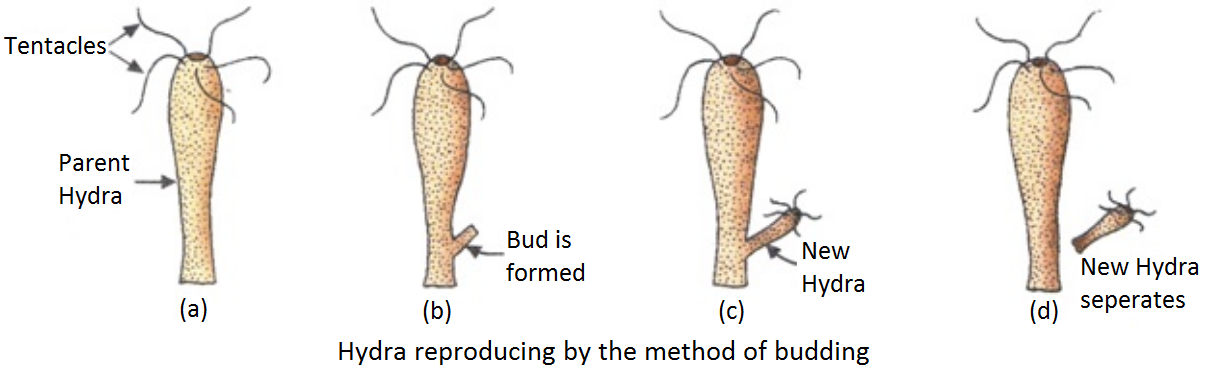
Describe the process of reproduction in Hydra with the help of labelled diagrams. What is the name of this process of reproduction?
Answer
Hydra reproduces by budding. In hydra, first a small outgrowth called bud is formed on the side of its body by repeated mitotic divisions of its cells. This bud then grows gradually to form a small hydra by developing a mouth and tentacles. The tiny new hydra detaches itself from the parent body and develops into a separate organism.
View full question & answer
Question 42 Marks
What is meant by ‘unisexual flowers’ and ‘bisexual flowers’ ? Give two examples of each.
Answer
The flowers which contain only one sex organ, either stamens or carpels are called unisexual flowers like Papaya and watermelon plants. The flowers which contain both the sex organs i.e. both the stamen and the carpel are called bisexual flowers like Hibiscus and Mustard plant.
View full question & answer
Question 52 Marks
What is meant by contraception? What are the different methods of contraception?
Answer
The prevention of pregnancy in women (by preventing fertilisation) is called contraception. There are 3 methods of contraception:
  1. Barrier method.
  2. Chemical method.
  3. Surgical method.
View full question & answer
Question 62 Marks
How does reproduction help in providing stability to populations of species?
Answer
The process of reproduction introduces some variations in the individual organisms of a species which enables them to survive even in adverse environmental conditions such as excessive heat or cold, etc. In this way, the introduction of variations during reproduction provides stability to the populations of various species.
View full question & answer
Question 72 Marks
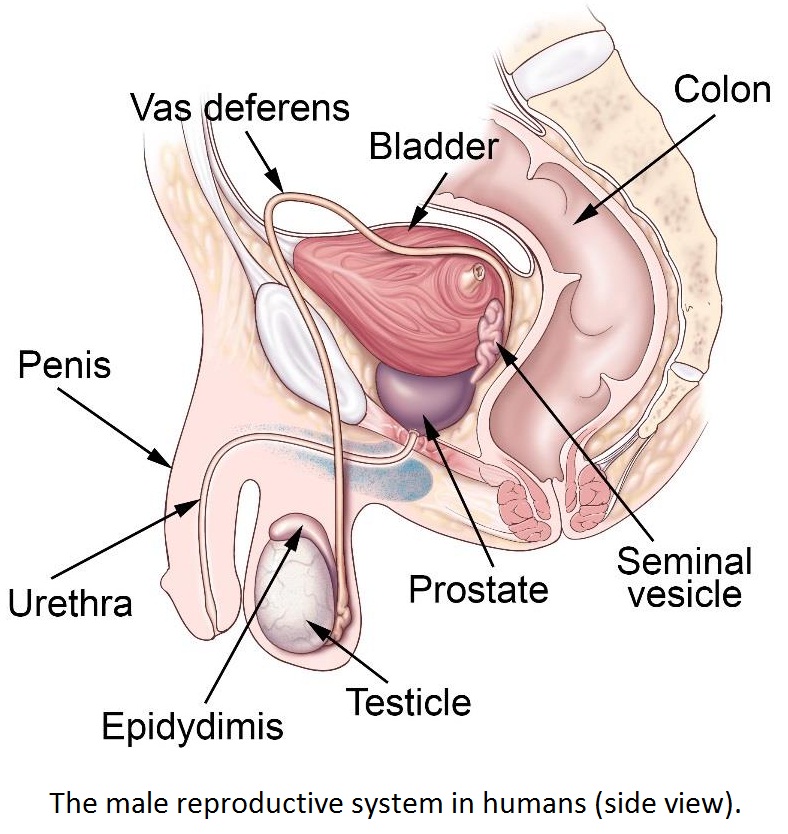
What is the role of seminal vesicles and prostrate gland in human male reproductive system?
Answer
The secretions of seminal vesicles and prostrate gland provide nutrition to the sperms and also make their transportation easier by secreting a thick liquid.
View full question & answer
Question 82 Marks
What is the importance of DNA copying in reproduction? Explain with an example.
Answer
  1. The chromosomes in the nucleus of a cell contains information for the inheritance of features from the parents to the next generation in the form of DNA molecules so the characteristics of a parent organism are transmitted to their offsprings.
  2. When the DNA already present in the nucleus of a parent cell is copied by making more of DNA by certain biochemical reactions, then slight variations come in the two copies formed. Thus, variations are produced in the offspring’s during reproduction which form the basis of evolution. Example: Offspring’s produced by asexual reproduction have slight variations from their parents.
View full question & answer
Question 92 Marks
Which of the following organisms reproduce by sexual method and which by asexual method?
Amoeba, Cats, Humans, Hydra, Birds.
Answer
  1. Sexual Method: Cats, Humans, birds.
  2. Asexual method: Amoeba, Hydra.
View full question & answer
Question 102 Marks
What is puberty? Who attains puberty at an earlier age in human beings: male or female (boy or girl)?
Answer
The age at which the sex hormones begin to be produced and the boy and girl become sexually mature (able to reproduce) is called puberty. Females attain puberty at an age of 10- 12 years.
View full question & answer
Question 112 Marks
In a bisexual flower, inspite of the young stamens being removed artificially, the flower produces fruit. Explain.
Answer
The ovary of a flower develops into a fruit after fertilisation. The ovary is a part of the carpel. Thus, in spite of the young stamens being removed artificially, the flower produces fruits.
View full question & answer
Question 122 Marks
Name two plants which are usually propagated by artificial propagation methods. Name the method of artificial propagation used in each case.
Answer
  1. Rose grows by means of cutting.
  2. Jasmine grows by layering.
View full question & answer
Question 132 Marks
The yeast cells fail to multiply in water but they multiply rapidly in sugar solution. Give one reason for it.
Answer
Water does not provide any energy to the yeast cells. So, yeast cells fail to multiply in water due to inadequate energy in its cells. Sugar provides energy to them to carry out reproduction by multiplying rapidly.
View full question & answer
Question 142 Marks
What name is given to:
  1. All the petals of a flower.
  2. All the sepals of a flower?
Answer
  1. Corolla.
  2. Calyx.
View full question & answer
Question 162 Marks
Name two plants which reproduce by sexual reproduction method and two plants which reproduce by asexual reproduction methods.
Answer
Sexual reproduction: Wheat plant and sunflower plant; Asexual reproduction: Ferns and mosses.
View full question & answer
Question 172 Marks
Write the names of:
  1. Male sex hormone.
  2. Female sex hormones.
Answer
  1. Testosterone.
  2. Oestrogen and Progesterone.
View full question & answer
Question 182 Marks
In what ways is fertilisation in a plant:
  1. Similar to fertilisation in a human?
  2. Different from fertilisation in a human?
Answer
  1. The process of fertilisation is similar in plants and humans as both involve male and female gametes and show internal fertilisation.
  2. Fertilisation in plants
    Fertilisation in animals
    External agents are required for pollination.
    External agents are not required.
    The seed is formed after fertilisation.
    The human baby is formed after fertilisation.
View full question & answer
Question 192 Marks
Why do green grass plants spring up in dry fields on their own after the rains?
Answer
The fields have dry stems of the old grass plants all over them. These dry stems have buds which are in the inactive state. By getting rainwater, the buds present on the dry grass stems get activated and grow to produce new grass plants.
View full question & answer
Question 202 Marks
Explain how, offsprings and parents of organisms reproducing sexually have the same number of chromosomes.
Answer
The offsprings and parents of organisms reproducing sexually have same number of chromosomes due to reduction division (meiosis) during gamete formation which reduces the number of chromosomes into half in both male and female gametes. During fertilisation when male and female gametes fuse the original numbers of chromosomes as in parents is restored in the offspring.
View full question & answer
Question 212 Marks
Name any four types of ornamental plants which are being produced by tissue culture technique.
Answer
Orchids, dahlia, carnation, chrysanthemum.
View full question & answer
Question 222 Marks
State two advantages of grafting method of artificial propagation of plants.
Answer
Advantages of grafting method:
  1. It enables us to combine the most desirable characteristics of the two plants in its flowers and fruits.
  2. It can be used to produce varieties of seedless fruits.
View full question & answer
Question 252 Marks
A woman uses a device X made of a common metal for preventing pregnancy. This device works by preventing the implantation of fertilised egg cell (or embryo) in the female organ Y.
  1. What are the two names of device X?
  2. Name the organ Y.
  3. Can this method of contraception protect a woman from acquiring a STD?
Answer
  1. The name of the device Y is copper-T or IUCD.
  2. The organ Y is the uterus.
  3. This method cannot protect a woman from acquiring STDs.
View full question & answer
Question 262 Marks
What are sexually transmitted diseases? Give two examples of sexually transmitted diseases.
Answer
The diseases which are spread by sexual contact with an infected person are called Sexually Transmitted Diseases. Example: Aids, Syphilis.
View full question & answer
Question 272 Marks
Write the full forms of the following as they occur in biology:
  1. STD.
  2. AIDS .
  3. HIV.
Answer
  1. STD – Sexually Transmitted Diseases.
  2. AIDS – Acquired Immune Deficiency Syndrome.
  3. HIV – Human Immunodeficiency virus.
View full question & answer
Question 282 Marks
Name the part of a seed which:
  1. Contains stored food.
  2. Grows into root.
  3. Grows into shoot.
Answer
  1. Cotyledons.
  2. Radicle.
  3. Plumule.
View full question & answer
Question 292 Marks
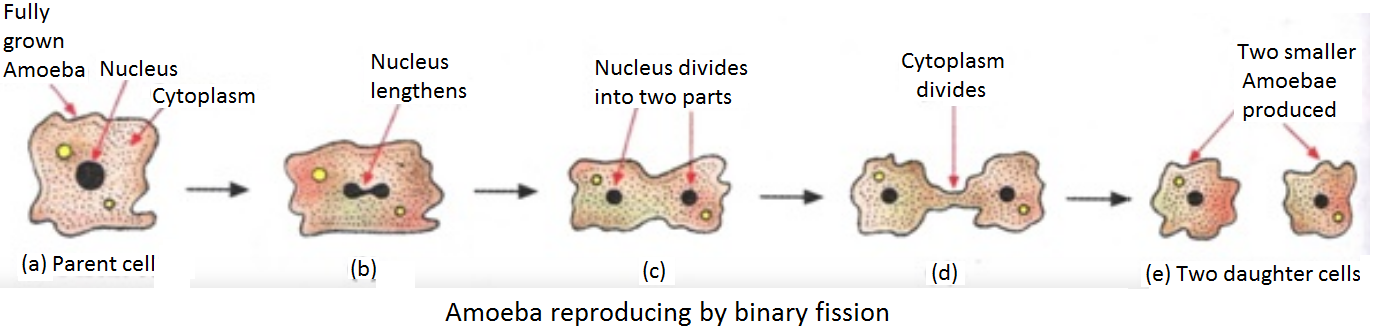
How does an Amoeba reproduce? Describe the process of reproduction in Amoeba with the help of labelled diagrams of different stages in its reproduction process.
Answer
Amoeba reproduces by binary fission by dividing its body into two parts. When the amoeba cell reaches its maximum size, the nucleus of amoeba lengthens and divides into two parts. After that the cytoplasm of amoeba divides into two parts, one part around each nucleus. In this way one parent amoeba divides to form two smaller amoebae.
View full question & answer
Question 302 Marks
Explain vegetative propagation with the help of two examples. List two advantages of vegetative propagation.
Answer
In vegetative propagation, new plants are obtained from the parts of old plants (stems, roots and leaves), without the help of reproductive organs. Example? Bryophyllum plant reproduces from its leaves and money plant grows from its stem. Advantages of vegetative propagation:
  1. Plants grow faster by the process of vegetative propagation.
  2. They need less care.
View full question & answer
Question 312 Marks
In tobacco plant, the male gametes have 24 chromosomes.
  1. What is the number of chromosomes in the female gamete?
  2. What is the number of chromosomes in the zygote?
Answer
  1. 24.
  2. 48.
View full question & answer
Question 322 Marks
What is the difference between the two asexual methods of reproduction: fission and fragmentation?
Answer
Fission:
  1. It is a process in which an organism splits to form two or more new organisms.
  2. Fission occurs in unicellular organisms.
Example : Amoeba.
Fragmentation:
  1. It is a process in which the body breaks up into two or more pieces on maturing, each of which subsequently grows to form a complete new organism.
  2. It takes place in multicellular organisms.
Example : Spirogyra.
View full question & answer
Question 332 Marks
What changes take place in the flower after fertilisation which lead to the formation of seeds and fruit?
Answer
The fertilised egg divides several times to form an embryo within the ovule which develops a tough coat around it and is gradually converted into a seed. The ovary of the flower develops and becomes a fruit with seeds inside it.
View full question & answer
Question 342 Marks
What is the basic difference between asexual reproduction and sexual reproduction?
Answer
Asexual Reproduction:
  1. The offspring arises from a single parent.
  2. The production of new organism does not involve gametes
Example: Amoeba, Yeast.
Sexual Reproduction:
  1. The offspring arises from two parents of different sexes.
  2. The production of new organisms involves the use of gametes.
Example: Fish, Frogs, etc.
View full question & answer
Question 352 Marks
What is pollination? How does pollination occur?
Answer
The transfer of pollen grains from the anther of a stamen to the stigma of a carpel is called pollination. It takes place when pollen grains are carried from the anther to the stigma of the flower.
View full question & answer
Question 362 Marks
Why does bread mould grow profusely on a moist slice of bread but not on a dry slice of bread?
Answer
Moisture is necessary for the growth of bread mould. The moist slice of bread provides both moisture and nutrients due to which bread mould grows profusely. On the other hand, the dry slice of bread provides nutrients but no moisture. So, in the absence of moisture, bread mould does not grow on the dry slice of bread.
View full question & answer
Question 372 Marks
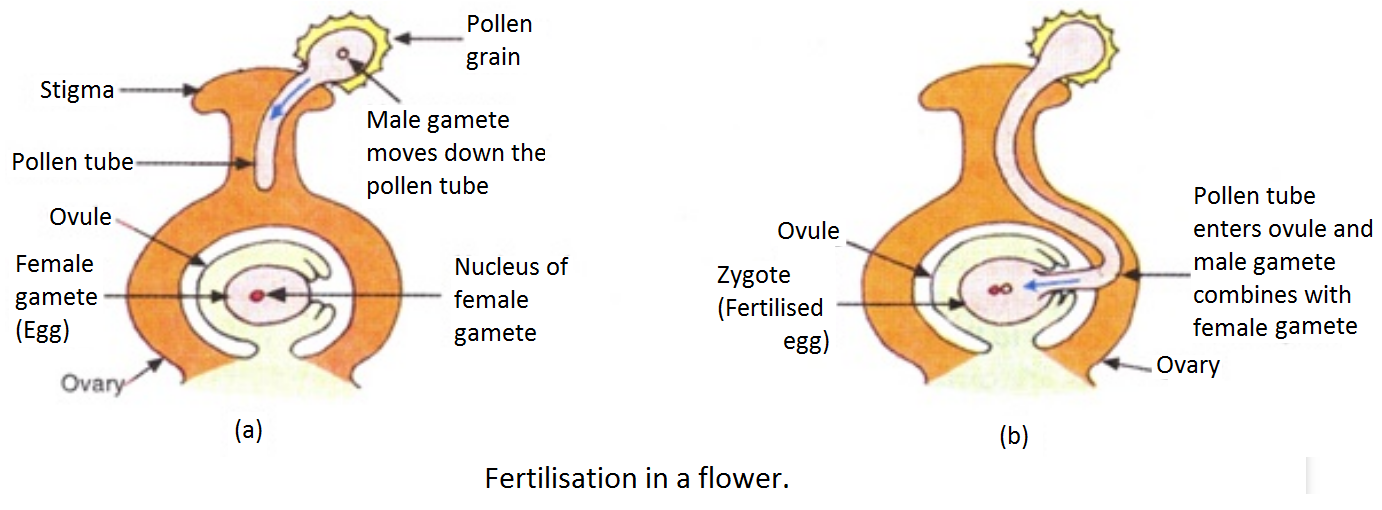
Describe the process of fertilisation in a flower with the help of labelled diagrams.
Answer
When a pollen grain falls on the stigma of the carpel, it bursts open and grows into a pollen tube downwards through the style towards the female gamete in the ovary. A male gamete moves down the pollen tube and enters the ovule in the ovary. The tip of the pollen tube bursts open and male gamete comes out of the pollen tube which combines with the nucleus of the female gamete present in the ovule to form a fertilised egg called zygote.
View full question & answer
Question 382 Marks
Name three common methods which are used for the artificial propagation of plants.
Answer
The methods used for artificial propagation of plants are:
  1. Cutting.
  2. Layering
  3. Grafting
View full question & answer
Question 392 Marks
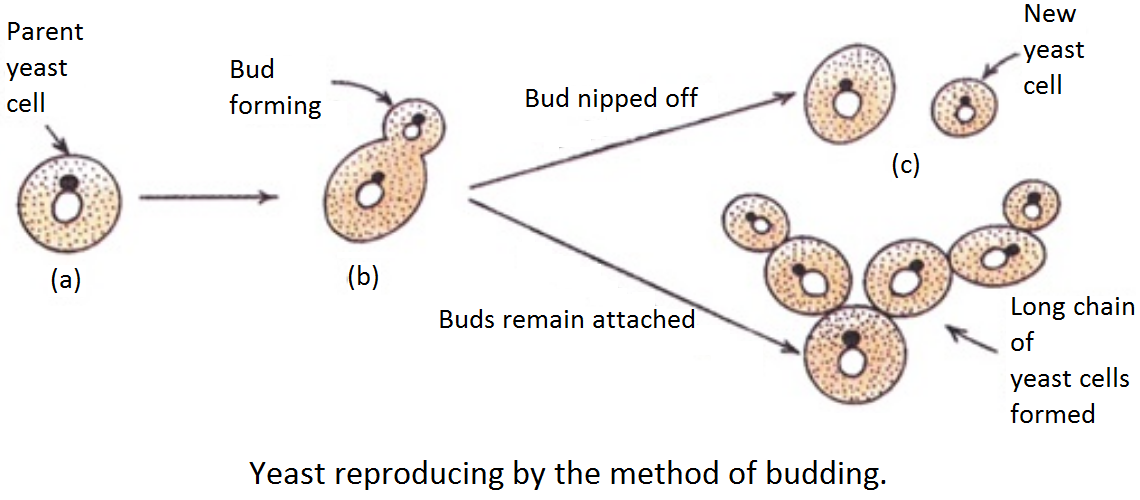
What is yeast? Describe the process of reproduction in yeast with the help of labelled diagrams.
Answer
Yeast is tiny, unicellular non green plant which reproduces by budding. In yeast, first a bud appears on the outside of the cell wall. The nucleus of the parent yeast cell divides into two parts and one part of the nucleus moves into the bud. Ultimately, the bud separates off from the parent yeast cell and forms a new yeast cell.
View full question & answer
Question 402 Marks
Why is it an advantage for the testes to be situated in the scrotal sac outside the main body cavity? Can you think of one disadvantage?
Answer
The testes are situated in the scrotal sac outside the main body cavity because the formation of sperms requires a lower temperature than the normal body temperature. Its disadvantage of being outside the main body cavity is that it is more prone to injury.
View full question & answer
Question 412 Marks
What is the difference between the cuttings method and grafting method for the artificial propagation of plants?
Answer
Cutting:
  1. A small part of the plant which is removed by making a cut with a sharp knife is called cutting.
  2. The new plant formed is exactly similar to the parent plant.
Grafting:
  1. It is a method in which the cut stems of two different plants (one with roots and other without roots) are joined together in such a way that the stems join and grow as a single plant.
  2. The new plant produced has the characteristics of both the parent plants
View full question & answer
Question 422 Marks
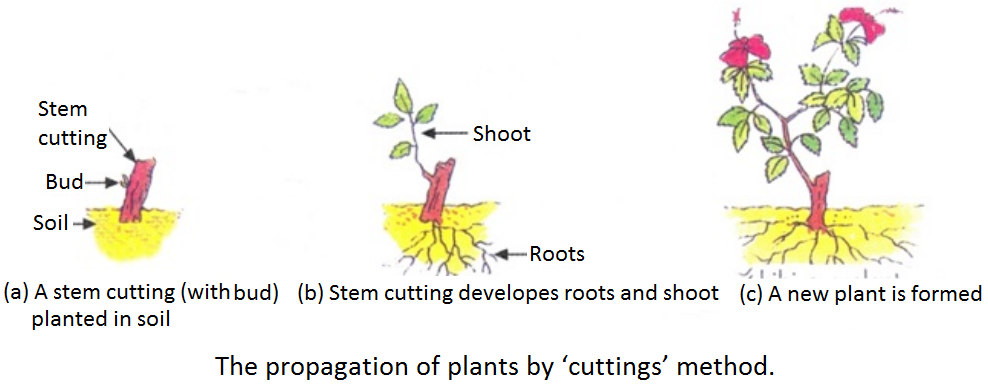
Describe the cuttings method for the artificial propagation of plants. Illustrate your answer with the help of labelled diagrams.
Answer
In this method, a cutting of the parent plant having some buds on it is taken and its lower part is buried in the moist soil. After few days, the cutting develops roots and shoot, and grows into a new plant which is exactly similar to the parent plant.
View full question & answer
Question 432 Marks
How is the process of pollination different from fertilization?
Answer
Pollination
Fertilisation
In polination, the pollens are transferred from anther to the stigma of carpel
In fertilisation, the male gamate fuses with the female gamate present in ovule inside the ovary of flower to from a fertilisation egg or zygote.
View full question & answer
Question 442 Marks
Distinguish between a gamete and a zygote.
Answer
Gamete Gamete represents the sex cell or germ cell in sexual reproduction and it is of two types: Male gametes (Sperm) and Female gamete (Eee). Zygote It is the product of fertilization in which a male and a female gamete fuse with each other.
View full question & answer
Question 452 Marks
What is a tuber? Name one stem tuber and one root tuber.
Answer
A tuber is the thickened, underground stem (or root) of a plant which is swollen with stored food.
Stem tuber: Potato.
Root tuber: Sweet potato.
View full question & answer
Question 462 Marks
Name any two plants which are usually propagated by the cuttings method.
Answer
Rose and Bougainvillea.
View full question & answer
Question 472 Marks
Explain the terms ‘self pollination’ and ‘cross-pollination’?
Answer
  1. Self pollination? When the pollen grains from the anther of a flower are transferred to the stigma of the same flower (or another flower on the same plant), it is called self pollination.
  2. When the pollen grains from the anther of a flower on one plant are transferred to the stigma of a flower on another similar plant, it is called cross pollination.
View full question & answer
Question 482 Marks
Mention two functions each of:
  1. Human testes.
  2. Human ovaries.
Answer
  1. The function of testes is to make sex cells called sperms and to make sex hormone called testosterone.
  2. The function of the ovaries is to make mature female sex cell called ova or egg and also to make female sex hormones called oestrogen and progesterone.
View full question & answer
Question 492 Marks
What is the name of surgical method of birth control (or preventing pregnancy) which is carried out:
  1. In men.
  2. In women?
Answer
  1. Vasectomy.
  2. Tubectomy.
View full question & answer
Question 502 Marks
Which structures in human female are equivalent to the following structures in the male?
  1. Testes.
  2. Vas deferens.
  3. Penis.
In each case say in what respect the structures are equivalent?
Answer
  1. Ovaries in female; Both make gametes.
  2. Oviducts in females; Both transport gametes.
  3. Vagina in female; Both are copulatory organs.
View full question & answer
[2 Mark Questions] - Science STD 10 Questions - Vidyadip