Questions

[5 marks Questions]

🎯

Test yourself on this topic

33 questions · timed · auto-graded

Question 15 Marks
What is done in the contraception method known as:
  1. Vasectomy.
  2. Tubectomy?
Answer
  1. Vasectomy: In males, a small portion of the sperm duct (Vasdeferens) is removed by surgical operation and both the cut ends are ligated properly. This prevents the sperms from coming out.
  2. Tubectomy: In females, a small portion of the oviducts is removed by surgical operation and the cut ends are ligated. This prevents the ovum from entering into the oviducts.
View full question & answer
Question 25 Marks
The human males use a device X made of a very thin rubber sheet as a covering on the male organ to prevent pregnancy. This device traps the gametes Y in it. In order to prevent pregnancy, the human females use a device Z which is a circle of rubber with a metal spring around it. The device Z is put inside the vagina to cover the cervix. It stops Y from going into the uterus.
  1. What is device X?
  2. What are Y?
  3. Name the device Z.
  4. What is the general name of these methods of birth control (or preventing pregnancy)?
  5. The use of which contraceptive device, X or Z, can protect the persons from sexually transmitted diseases?
Answer
  1. The device X is condom.
  2. Y represents sperms.
  3. The device Z is copper-T.
  4. The general name of these methods of birth control is called barrier method or IUCD (Intrauterine Contraceptive Device).
  5. Using condoms (X) during sexual intercourse can protect a person from sexually transmitted disease.
View full question & answer
Question 35 Marks
When an insect sits on the flower of a plant then some particles A present in the top of little stalks in the flower attach to its body hair. When this insect now sits on the flower of another similar plant, then particles A attached to the hair of insect are put on the top of a flask-shaped organ at the centre of flower. The particle A grows a long tube b from the top of flask-shaped organ through which C moves down and reaches the bottom part of flask-shaped organ. Here C fuses with the nucleus of d contained in structure E. the fusion of C and D forms a new cell f which grows and develops into a seed of the plant.
  1. What are particles A? What is the process of transferring A from one flower to another flower of similar plant by the insect known as?
  2. What is the name of tube B?
  3. What is C which moves down through the tube B?
  4. Name D and E.
  5. What is F?
Answer
  1. Represents pollen grains. The process of transferring pollen grains from one flower to another flower of the similar plant by insects is known as cross pollination.
  2. B represents the pollen tube.
  3. C is the male gamete which moves down through the pollen tube (B).
  4. D is the female gamete (or egg). The structure E represents the ovule.
  5. F is the zygote.
View full question & answer
Question 45 Marks
In the surgical method of birth control available for males, the structures A in the reproductive system are cut and ligated (tied up) at both ends. This prevents the reproductive cells B from coming out from the organs C where they are made in the male body. Since B cannot come out from the male body, they cannot fuse with cell D in the body of a female and hence pregnancy is prevented.
  1. What are structures A?
  2. What are cells B?
  3. Name the organs C.
  4. What is cell D?
  5. What is the name of this surgical procedure for birth control available to males?
Answer
  1. A represents the vas deferens.
  2. B represents sperms.
  3. C represents the testes.
  4. The cell D is the egg or ova.
  5. The surgical method of birth control available to males is called vasectomy.
View full question & answer
Question 55 Marks
A worm X found in freshwater and slow-moving streams has been accidently cut into three pieces. It was observed that in due course of time, each cut piece of the worm develops to become a complete worm by growing all the missing parts.
  1. Name the worm X which can exhibit this phenomenon of making complete worm from its cut body parts.
  2. Name another organism Y which possesses the same characteristic of growing fully from its cut body parts.
  3. What is the name of this process in which a complete organism is formed from its cut body part.
  4. State whether X and Y are unicellular and/or multicellular organisms.
  5. Can a dog be produced completely form its cut body part (say, a cut tail) just like organisms X and Y? Why?
Answer
  1. The worm X is Planaria.
  2. The organism Y which posses the same characteristic as of X is Hydra.
  3. The process in which a complete organism is formed from a lost body part of its parent is regeneration.
  4. X and Y are multicellular organisms.
  5. A dog cannot be produced from a lost body part like its tail, as this animal has a high degree of organisation in its body.
View full question & answer
Question 65 Marks
A, B and C are three common STDs. A and C are caused by bacteria whereas B is caused by a virus D. The virus D reduces the immunity of the infected person to such a low level that the person can die of even very mild diseases.
  1. What could A and C be?
  2. What is B?
  3. Name the virus D?
  4. How can A, B and C be caused?
  5. Out of A, B and C, which one does not have a definite cure as yet?
Answer
  1. A is gonorrhoea and C is syphilis.
  2. B is AIDS.
  3. The virus D is Human Immunodeficiency Virus (HIV).
  4. A, B and C can be caused by sexual contact with an infected person.
  5. AIDS (B) does not have a definite cure as yet.
View full question & answer
Question 75 Marks
A filamentous alga X is found in ponds, lakes and slow-moving streams. The filament of this alga simply breaks into two (or more) pieces on maturing and each piece then grows to become a complete new alga.
  1. Name an alga which X is likely to be.
  2. What is the colour of X?
  3. What is the method of forming new algae by the breaking of parent alga known as?
  4. An Amoeba also breaks up to form two daughter Amoebae. What is the difference in the splitting of Amoeba and splitting of this alga as a method of reproduction?
  5. Name one marine animal which reproduces in the same way as alga X.
Answer
  1. The alga X is likely to be Spirogyra.
  2. The alga is green in colour.
  3. This mode of forming new alga from the breaking-up of the parent alga is termed as fragmentation.
  4. The splitting of Amoeba is termed as fission, which occurs only in unicellular organisms. The splitting of alga is termed as fragmentation, which occurs only in multicellular organisms.
  5. Sea anemone reproduces in the same way as the alga X.
View full question & answer
Question 85 Marks
Two very small organisms X and Y both reproduce by the method of budding. Organism X is industrially very important because it is used in making alcohol from sugar. It is also used in making bread. Organism Y Lives in freshwater. If organism Y gets cut into a number of parts accidently, each cut part can grow to form complete organism.
  1. What are organisms X and Y?
  2. What is the name of the process in which X converts sugar into alcohol?
  3. To which class of organisms does X belong?
  4. Name an important body feature of organism Y.
  5. Which organism is multicellular and which one is unicellular?
Answer
  1. The organism X is yeast and organism Y is Hydra.
  2. The process by which the organism X converts sugar into alcohol is fermentation.
  3. Organism X is a fungus; hence, it belongs to the category of non-green plants.
  4. Organism Y is a multicellular organism and comprises tentacles at one end.
  5. Organism X is unicellular, and the organism Y is multicellular.
View full question & answer
Question 95 Marks
When a fertilised egg E formed in the oviduct of a human female divides repeatedly to form an embryo, the embryo gets implanted in the thick and soft lining of the uterus. After this a disc-like special tissue T develops between the uterus wall and embryo through which all the requirements of the developing embryo (and foetus) are met from the mother's body, The embryo is connected to the tissue T through a string like structure S.
  1. What is the other name of fertilised egg cell E?
  2. What is the name of tissue T?
  3. Name the string-like structure S.
  4. Name two substances which pass from mother's blood to embryo through tissue T and, one type of substance which passes from embryo to mother's blood.
  5. What happens to S when the baby is born? Why?
Answer
  1. The fertilised egg cell E is also called the zygote.
  2. The tissue T is the placenta.
  3. The string-like structure S is the umbilical cord.
  4. Oxygen and nutrients pass from the mother's blood to the embryo and carbon dioxide passes from the embryo to the mother's blood through the placenta (T).
  5. When a baby is born, the umbilical cord is still attached to the baby. It is cut and tied to separate the baby from the mother.
View full question & answer
Question 105 Marks
The germ cell A produced by a person X is round in shape and it fuses with another germ cell B having a long tail and produced by a person Y. The fusion of A and B produces a new cell C. The cell C divides repeatedly and grows inside the organ D of person X to form E in which the body features of the unborn baby are not much developed. E grows further to form F in which the various body features of the unborn baby (like hands, legs, head, eyes, and ears, etc.) can be identified. F grows further and ultimately forms a baby. What are A, B, C, D, E and F? Out of the two persons X and Y, which one is male and which one female?
Answer
  • A is the ovum.
  • B is sperm.
  • C is the zygote.
  • D is the uterus.
  • E is the embryo.
  • F is the foetus.
The person X is a female and Y is a male.
 
View full question & answer
Question 115 Marks
A scientist removed some cells from the growing point of a plant and placed it in a suitable medium leading to the formation of a shapeless lump of mass X. X is then transferred to another medium which stimulates it to develop roots. When X with developed roots is placed in a yet another medium, then it develops shoots to form tiny plantlets. These plantlets can then be transplanted in pots or soil where they can grow to form mature plants.
  1. What is the shapeless lump of mass X known as?
  2. What name is given to this method of producing new plants?
  3. The growth medium used in this method contains plant nutrients in the form of a 'jelly'. Name this jelly.
  4. What is the general name of chemicals used to stimulate the growth of plant cells and development of roots and shoots?
  5. Name any two plants which are produced by this method.
  6. State any two advantages of this method of producing plants.
  7. What is the other name of this method [other then that given in (b) above]?
Answer
  1. The shapeless lump of mass X is known as callus.
  2. This method of producing new plants is known as tissue culture.
  3. The jelly is called agar.
  4. The chemicals used to stimulate the growth of plant cells and fasten the development of roots and shoots are called plant hormones.
  5. Orchids and dahlia are two flowering plants that are propagated by this method.
  6. The main advantage of this technique is that it is extremely fast, and the plantlets are obtained in a few weeks. Secondly, this method produces disease-free plantlets.
  7. The other name of this technique is micropropagation.
View full question & answer
Question 125 Marks
X and Y are two human beings. The organ A in the reproductive system of X releases a mature gamete B once a month which goes into a tube-like structure C through a funnel-like opening. The organ D in the reproductive system of Y makes and releases gametes E which pass through a duct F and are introduced by an organ of Y, into the body of X. B and E fuse together in C to form a new cell G. The cell G divides repeatedly to form a ball of cells H which gets embedded in the lining of organ I of reproductive system of X where it grows and develops into a baby.
  1. Name (i) organ A, and (ii) gamete B.
  2. Write two names of tube-like structure C.
  3. Name (i) organ D, and (ii) gamete E.
  4. Write two names of duct F.
  5. Name (i) cell G (ii) ball of cells H, and (iii) organ I.
  6. Out of X and Y, which one is (i) male, and (ii) female?
Answer
  1.  
  1. The organ A is the ovary.
  2. The gamete B is an egg.
  1. The tube-like structure C is the oviduct or the fallopian tube.
  2.  
  1. D represents the testes.
  2. The gamete E represents sperm.
  1. The duct F is the sperm duct or the vas deferens.
  2.  
  1. The cell G is the zygote.
  2. The ball of cells H is the embryo.
  3. the organ I is the uterus.
  1. ​​​​​​​
  1. X represents female.
  2. Y represents male.
View full question & answer
Question 135 Marks
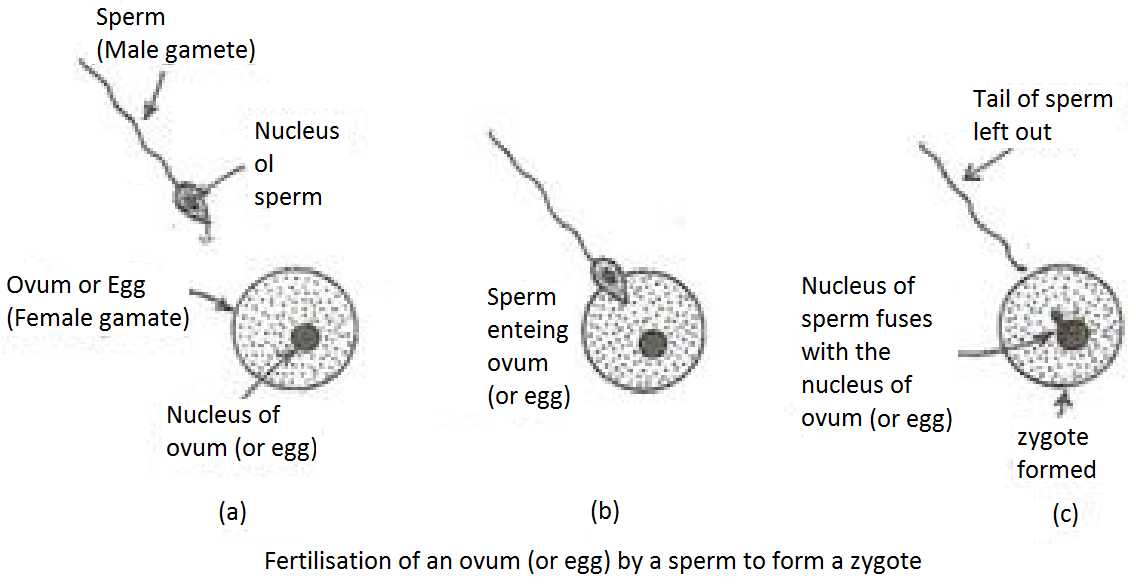
Describe the various steps involved in the sexual reproduction in animals. Draw labelled diagrams to show the fertilisation of an ovum (or egg) by a sperm to form a zygote.
Answer
The sexual reproduction in animals takes place in the following steps:
  1. The male parent produces male gamete called sperms. The sperm is a small cell with a long tail (flagellum) for movement.
  2. The female parent produces female gamete called ova which is much bigger cell than the sperm, having a lot of cytoplasm.
  3. The sperm enters into the ovum and fuses with it to form a new cell called zygote and this process is called fertilisation.
  4. The zygote then divides again and again to form a large number of cells and ultimately the zygote grows and develops to form a baby.
View full question & answer
Question 145 Marks
When a moist slice of bread was kept aside for a few days then some organism grew on it to form a white cottony mass which later turned black. When this slice of bread was observed through a magnifying glass, then fine thread-like projections and thin stems having bulb-like structures at the top were seen.
  1. What is the common name and scientific name of the organism which grew on the moist slice of bread?
  2. How did this organism grow on the moist slice of bread automatically?
  3. What are the fine, thread-like projections on the surface of slice of bread known as?
  4. What name is given to the knob-like structures and what do they contain?
  5. What is the name of this method of reproduction?
  6. Name one unicellular organism which reproduces by this method.
  7. Name tow non-flowering plants which reproduce by this method.
Answer
  1. The common name of the organism is bread mould, and its scientific name is Rhizopus.
  2. Spores of fungus are present in the air in their inactive form. When these spores get the favourable condition like a moist bread, they germinate and grow into new organisms.
  3. The fine, thread-like projections on the surface of the bread are known as hyphae.
  4. The knob-like structures are sporangium, which contain the spores.
  5. This method of reproduction is known as spore formation.
  6. Mucor fungus reproduces by the method of spore formation.
  7. Ferns and mosses are two non-flowering plants which reproduce by this method.
View full question & answer
Question 155 Marks
The flask-shaped organ A at the centre of a flower is surrounded by a number of little stalks B having swollen tops which lie just inside the ring of petals.
  1. Name A. What are the various parts of A?
  2. Which part of A contains gametes?
  3. Name B. What is the swollen top of B known as?
  4. What does the swollen top of b contain?
  5. Out of A and B, which one is (i) male part, and (ii) female part of the flower?
Answer
  1. A represents the carpel. The carpel is composed of the stigma, style and ovary.
  2. The ovary contains gametes in the form of ovules.
  3. B represents the stamen. The swollen tip of the stamen is the anther.
  4. The anther has pollen grains.
  5. The stamen (B) is a male part and the carpel (A) is a female part.
View full question & answer
Question 165 Marks
When the branches of a plant growing in the field are pulled towards the ground and a part of them is covered with moist soil (leaving the tips of the branches exposed above the ground), then after some time new roots develop from the parts of branches buried in the soil. On cutting these branches from the parent plant, new plants are produced from the cut parts of branches which had developed roots.
  1. What is this method of propagation of plants known as?
  2. What type of branches should a plant have to be able to be propagated by this method?
  3. Name any two plants which are grown for their flowers and propagated by this method.
  4. Name any two plants which are grown for their fruits and propagated by this method.
  5. Name one plant which gets propagated by this method naturally by forming runners (soft horizontal stems running above the ground).
Answer
  1. This method of propagating plants is known as layering.
  2. To get propagated by this method, a plant should have soft horizontal branches.
  3. Jasmine and China rose are the two plants that are propagated by this method for their flowers.
  4. Guava and lemon are the two plants that are propagated by this method for their fruits.
  5. Strawberry gets propagated naturally by this method by forming runners.
View full question & answer
Question 175 Marks
When a broken piece of the stem of a plant X is planted in the soil, a new plant grows from it in a week's time. The leaves of plant X also have many small entities Y in their margins which can fall to the ground alone or alongwith leaves and grow into new plants.
  1. Name a plant which X could be.
  2. What are the entities Y present on the leaves of X known as?
  3. Name a plant other than X which can be reproduced from its leaves.
  4. Name a common plant grown in many homes which can be propagated from its broken stems like plant X.
  5. Name a kind of dormant organs present in dry stems of old grass plants lying in the fields which get activated and produce green grass plants after the rains.
Answer
  1. The plant X is Bryophyllum.
  2. The entities, Y, present on the leaves of X are known as buds.
  3. Other than X, Begonia can also be reproduced by its leaves.
  4. Money plant can be propagated from its broken stem similar to plant X.
  5. Buds are present in the dry stems of the old grass lying in the fields. These buds get activated after a spell of shower, and start producing new grasses.
View full question & answer
Question 185 Marks
A thickened underground stem X of a plant which is swollen with stored food has a number of points Y on its surface. When the old stem X is planted in the soil of a field in the next growing season, then each point Y present on its surface grows into a new plant.
  1. What is the general name of the underground stems like X?
  2. Give one example of X.
  3. What are points Y present on X known as?
  4. Is it necessary to plant the whole of stem X in the ground to obtain its new plants? Explain your answer.
  5. What is the name of this method of reproduction of plants?
  6. What is the advantage of growing new plants from the underground stems like X?
Answer
  1. Tuber is the general name of those underground stems like X.
  2. Potato is an example of X.
  3. The points Y present on X are known as buds.
  4. No, it is not necessary to plant the entire stem X in the ground. This stem has many buds (Y) on it that form the vegetative organ of reproduction.
  5. This method of reproduction is termed as vegetative propagation.
  6. The main advantage of this method is that it is comparatively faster to growing plants from seeds.
View full question & answer
Question 195 Marks
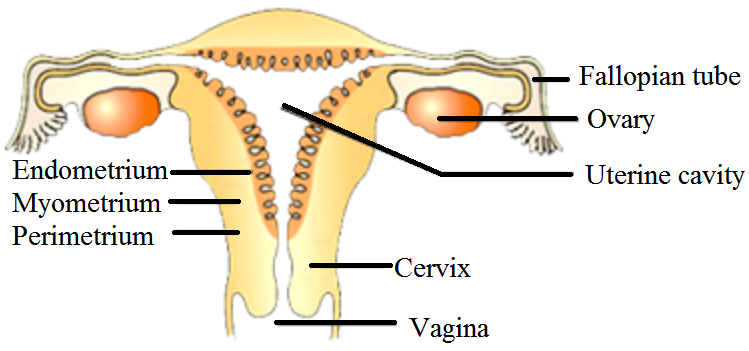
Draw a labelled diagram of the human female reproductive system. With the help of this diagram, explain the working of human female reproductive system.
Answer
Ovaries are the primary reproductive organs in females, which produce ovum or egg. Above the ovary lies the oviducts, or fallopian tubes, which are connected to the uterus. The eggs move into the oviduct from the ovaries, where it gets fertilised by a sperm. The fertilised ovum develops into a baby in the uterus. The uterus is connected to the vagina by the cervix. The vagina opens outside the body and receives sperms.
View full question & answer
Question 205 Marks
When a female child is born, her ovaries already contain thousands of immature eggs (or ova) contained in immature structures A. On maturing, A bursts open and an egg shoots out of the ovary in a process called B. The process B starts in the females at puberty and occurs again and again after a time period x. Before every occurrence of process B, the inner lining of uterus becomes thick and soft with lots of blood vessels in it. When the egg cell gets fertilised by a sperm, then an event C occurs in the life of mature human female which lasts for time period y leading to the birth of baby. If, however, the egg cell released by the ovary does not get a sperm to fuse with, then the thick and soft inner lining of uterus breaks down and comes out of the female's body in an event called D. The occurrence of event D is controlled by chemical substances E.
  1. What are A?
  2. What is process B?
  3. What is the time period x?
  4. Name the event C.
  5. How much is the time period y?
  6. What is the name of process D?
  7. Name the chemical substances E.
Answer
  1. A represents immature follicles.
  2. B represents the process of ovulation.
  3. The time period x is 28 days.
  4. The event C is pregnancy.
  5. The time period y is the gestation period, i.e., 9 months.
  6. D represents the process of menstruation.
  7. The chemical substance E is the hormone oestrogen.
View full question & answer
Question 215 Marks
Describe the process of fertilisation in humans and development of embryo briefly.
Answer
In humans, fertilisation is internal. Sperms are introduced in the vagina by the penis during copulation. The sperms move up through the cervix, enter the uterus and pass into the oviducts. In the oviducts, the egg gets fertilised by one of the sperms. Zygote is formed by the fusion of a sperm and an egg. This zygote divides multiple times to form a hollow ball of the cells called embryo.
View full question & answer
Question 225 Marks
Why is variation during reproduction beneficial to the species but not necessarily for the individual?
Answer
Variation is useful for the survival of species even in adverse environmental conditions. This happens as follows: There may be some drastic changes like excessive heat or cold etc in the habitat of a species of organisms. If all the organisms of a population living in that habitat are exactly identical, then there is a danger that all of them may die and no one would survive under these conditions. This will eliminate the species from that habitat completely however, if some variations are present in some individual organisms to tolerate these drastic changes then there is a chance for them to survive and flourish even in adverse environment. Example: Certain bacteria living in temperate water – If the temperature of water increases too much due to global warming most of them will not be able to tolerate excessive heat and would die however, if there are bacteria with variation then there is a chance for them to survive.
View full question & answer
Question 235 Marks
The stem of a fruit tree X fixed in soil is cut in a slanting way. The upper part of stem of another fruit tree Y of different variety of same species is also cut in a slanting way. The cut stem of tree Y, without roots but having some leaves, is placed over the rooted cut stem of tree X in such a way that their cut surfaces fit together properly. While joining the two cut stems, care is taken to make sure that the layer Z of one cut stem is in contact with layer Z of the other cut stem. The joint of cut stem is The stem of a fruit tree X fixed in soil is cut in a slanting way. The upper part of stem of another fruit bound tightly with a piece of cloth and covered properly with polythene. Soon the cut heals and the two stems grow together and become one fruit tree producing leaves, flowers and fruits.
  1. What is the name of this method of producing plants or trees?
  2. What name is given to the cut stem of tree X having roots?
  3. What name is given to the cut stem of tree Y which has no roots but has some leaves?
  4. Name the layer Z.
  5. Why should the layer Z of one cut stem be in contact with the layer Z of the other cut stem?
  6. Name any four fruit trees which are usually bred by this technique.
  7. State any one advantage of producing fruit trees by this technique.
Answer
  1. This method of propagating plants or trees is known as grafting.
  2. The segregated stem of tree X is termed as stock.
  3. The segregated stem of tree Y that is devoid of roots is termed as scion.
  4. The layer Z is called the cambium layer.
  5. The cambium layer of both the stems should be joined, as they are responsible for the growth of a new tree.
  6. Four trees which are propagated by this method are apple, pineapple, orange and grapes.
  7. The main advantage of cultivating plants in this method is that the graft will have the most desirable features of both the parts, i.e. the stock and the scion.
View full question & answer
Question 245 Marks
There are four tiny organisms A, B, C and D. The organism A is a parasitic protozoan which causes a disease known as kala-azar. The organism B is a microscopic single-celled animal which causes malaria disease in human beings. The organism C is a unicellular animal which can change its body shape according to need, it has no fixed shape. The organism D is also a unicellular animal which is slipper-shaped having a large number of tiny hair all around its body.
  1. Name the organisms A, B, C and D.
  2. Name one characteristic body feature of organism A.
  3. Name the insect which carries organism B and transmits it from one person to another.
  4. What name is given to the asexual method of reproduction of (i) organism A, and (ii) organism B?
  5. Where do organisms C and D live?
Answer
  1. The organism A is Leishmania, B is Plasmodium, C is Amoeba and D is Paramecium.
  2. One body feature of organism A is that it has a whip-like structure called flagellum at one end.
  3. Female Anopheles mosquito carries the organism B and transmits it from one person to another.
  4.  
  1. Organism A reproduces by binary fission.
  2. Organism B reproduces by multiple fission.
  1. Organisms C and D are found in ponds.
View full question & answer
Question 255 Marks
A woman uses pills A as a method of birth control (or preventing pregnancy). The pills A stop the ovaries from releasing ovum into oviducts. Another woman uses pills B as a method of birth control. The pills B kill the sperms and prevent pregnancy.
  1. What do the pills A contain?
  2. What is the common name of pills A?
  3. What do the pills B contain?
  4. What is the common name of pills B?
  5. What is the general name of these methods of birth control?
Answer
  1. The pills A contain hormones.
  2. The common name of pills A is oral pills.
  3. The pills B contain spermicides.
  4. The common name of pills B is vaginal pills.
  5. The general name of these methods of birth control is called chemical method.
View full question & answer
Question 265 Marks
When a human female reaches a certain age then vaginal bleeding occurs for a few days after regular time intervals.
  1. What is this process known as (i) in scientific terms, and (ii) in everyday language?
  2. At what approximate age this process starts in human females? When is the human female said to have attained at this stage?
  3. After how much time is this process repeated? For how many days does this process usually last?
  4. What does the onset of this process in human females signify?
  5. At which particular event in the life of a human female does this process stop temporarily but start again?
  6. At which approximate age of human female does this process stop permanently?
Answer
  1. The process is termed as (i) menstruation scientifically and (ii) periods in everyday language.
  2. The approximate age for a girl to undergo her first period is between 10 and 12 years. A human female usually attains puberty or sexual maturity at this stage.
  3. This process is repeated after every 28 days and usually lasts for 3 to 5 days.
  4. The onset of this process signifies sexual maturity in human females.
  5. During pregnancy, this process stops temporarily but starts again eventually.
  6. At the age of about 45–50, this process stops permanently.
View full question & answer
Question 275 Marks
In the surgical method of birth control available for human females, the structures P in the reproductive system are cut and ligated (tied up) properly at both ends. This prevents the reproductive cell Q released by an organ R from entering the structures P so that Q is not available to fuse with another reproductive cell S coming from the male reproductive system. In this way, pregnancy is prevented.
  1. What are structures P?
  2. What is cell Q?
  3. Name the organ R.
  4. What is the reproductive cell S?
  5. What is the name of this surgical method of birth control available to females?
Answer
  1. The structure P is the oviduct.
  2. The cell Q is the eggs or ovum.
  3. The organ R is oviduct.
  4. The reproductive cell S is sperm.
  5. The surgical method of birth control available to females is tubectomy.
View full question & answer
Question 285 Marks
A small part of the shoot of a plant is removed with a sharp knife. When the lower end of this small part of the shoot is buried in moist soil, it gradually develops roots and shoots and grows to become a new plant.
  1. What is the name of this method of propagating plants?
  2. What care should be taken while removing a small part of the shoot from the parent plant with a knife?
  3. Name any two plants which provide us with food directly or indirectly and are grown by this method.
  4. Give one advantage of this method of producing new plants.
  5. State whether it is a sexual method of reproduction or an asexual method. Why?
  6. What special name can be given to the genetically identical new plants produced by this technique?
Answer
  1. This method of propagating plant is known as cutting.
  2. While removing a small part of the shoot from the parent plant using a knife, one has to be careful about the fact that the shoot has some buds on it.
  3. Sugarcane and banana are those two plants which are propagated by this method, and are consumed as food.
  4. Using this method, many new plants can be produced from one plant. This is one of the advantages of this method.
  5. This is an asexual method of reproduction, as it involves only one parent and no gamete formation.
  6. The genetically identical plants produced by this method are called clones.
View full question & answer
Question 295 Marks
Write the various steps involved in the sexual reproduction in plants.
Answer
The sexual reproduction in plants takes place in the following steps:
  1. The male organ of flower called ‘stamen’ makes the male gametes of the flower. These male gametes are present in pollen grains.
  2. The female organ of a flower called ‘carpel’ makes the female gametes present in the ovules and are called ova or egg.
  3. The male gametes present in the pollen grains fertilises the female gametes or egg cells present in the ovules.
  4. The fertilised egg cells grow within ovules and become seeds.
  5. The seeds produce new plants on germination.
View full question & answer
Question 305 Marks
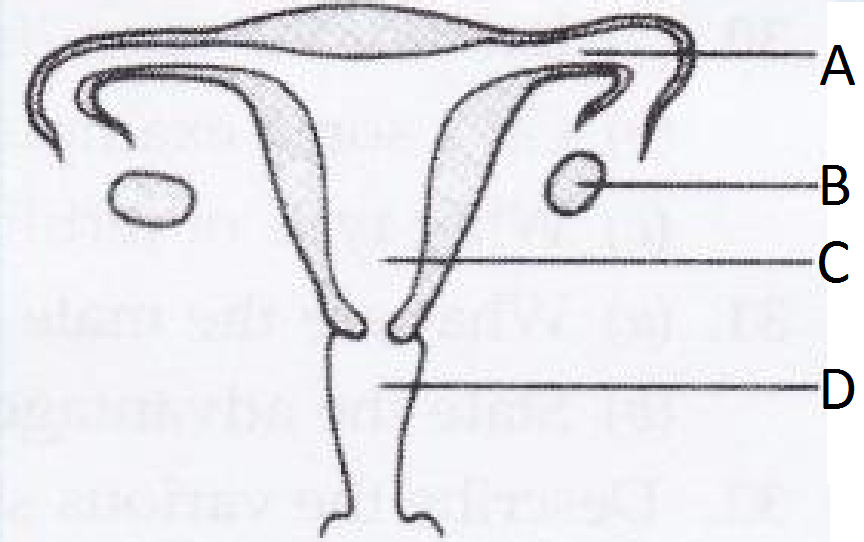
The diagram shows female reproductive system. Name the parts labelled A to D.
  1. In which part do the sperms enter?
  2. Which part releases the egg?
  3. In which part does fertilisation take place?
  4. In which part does the foetus develop?
Answer
Oviduct (Fallopian tube).
Ovary.
Uterus (Womb).
Vagina.
  1. Part D – (Vagina).
  2. Part B – (Ovary).
  3. Part A – Oviduct.
  4. Part C – Uterus.
View full question & answer
Question 315 Marks
Why does menstruation occur? Describe the menstrual cycle in human females (or women).
Answer
  1. Since the ovary of female release one egg every month, therefore, the uterus also prepares every month to receive a fertilised egg. The inner lining of the uterus becomes soft and thick with lots of blood capillaries in it. This preparation is necessary as in case the egg is fertilised by the sperm, it helps to keep the egg and nourish it. If however, the egg is not fertilised, then the thick lining of the uterus is not required and the uterus lining breaks down and comes out through the vagina in the form of blood and mucous. This is called menstruation.
  2. Menstruation cycle in females:
  1. When a girl reaches puberty at the age of 10? 12 years, the sex hormones released it her blood cause some of the ova in the ovaries to become mature.
  2. Usually one mature egg is released from the ovary into the oviduct once every 28 days. This is called ovulation.
  3. Before ovulation, the inner lining of the uterus becomes thick and spongy, and full of blood capillaries, and prepares itself to receive the fertilised egg.
  4. If the ovum does not get fertilised, then the thick and soft inner lining of the uterus is no longer needed and hence it breaks and the dead ovum comes out from vagina in the form of bleeding called menstruation.
  5. Menstruation usually occurs 14 days after ovulation and usually lasts for 3 to 5 days.
  6. After menstruation is over, the inner lining of the uterus starts building up again so that it becomes ready to receive the next ovum in case it gets fertilised.
  7. If the ovum does not get fertilised even now, then the menstruation takes place again and this cycle goes on repeating.
View full question & answer
Question 325 Marks
Draw a labelled diagram of the human male reproductive system. With the help of this diagram, describe the working of human male reproductive system?
Answer
Working of human male reproductive system: The human male reproductive system consists of:
  1. Testes: Are the primary reproductive organs in males which are in pair. These are oval shaped organs which lie outside the abdominal cavity. It makes the male sex cells called sperms and produces male sex hormones called testosterone.
  2. Scrotum: Is a muscular pouch which houses the testes. It is present outside the abdominal cavity and maintains a lower temperature than the normal body temperature.
  3. Epididymis: The sperms formed in the testes goes into a coiled tube called epididymis which stores the sperms temporarily.
  4. Vas Deferens (sperm duct): It is a long tube which carries the sperms from epididymis to another tube called urethra.
  5. Seminal vesicles and prostrate gland: Both these glands are present along the path of vas deferens and add their secretions to sperms which allows them to transport easily.
  6. Penis: It is an organ which pass?s the sperms from the man’s body into the vagina in the women’s body during mating.
View full question & answer
Question 335 Marks
Match the organisms given in column I with the methods of reproduction/propagation given in column II:
 
Column I
 
Column II
(i)
Plasmodium
(a)
Spore formation
(ii)
Spirogyra
(b)
Leaves
(iii)
Jasmin
(c)
Regeneration
(iv)
Apple tree
(d)
Budding
(v)
Bryophyllum
(e)
Binary fission
(vi)
Potatoes
(f)
Layering
(vii)
Rhizopus
(g)
Fragmentation
(viii)
Hydra
(h)
Tubers
(ix)
Planaria
(i)
Cutting
(x)
Leishmania
(j)
Multiple fission
(xi)
Sugar cane
(k)
Grafting
(xii)
Rose
 
 
Answer
  Column I   Column II
(i) Plasmodium (j) Multiple fission
(ii) Spirogyra (g) Fragmentation
(iii)
Jasmin
(f)
Layering
(iv)
Apple tree
(k)
Grafting
(v)
Bryophyllum
(b)
Leaves
(vi)
Potatoes
(h)
Tubers
(vii)
Rhizopus
(a)
Spore formation
(viii)
Hydra
(d)
Budding
(ix)
Planaria
(c)
Regeneration
(x)
Leishmania
(e)
Binary fission
(xi)
Sugar cane
(i)
Cutting
(xii)
Rose
(i)
Cutting
View full question & answer
[5 marks Questions] - Science STD 10 Questions - Vidyadip