Questions · Page 2 of 4

[1 Mark Questions]

Question 531 Mark
What is glomerulus?
Answer
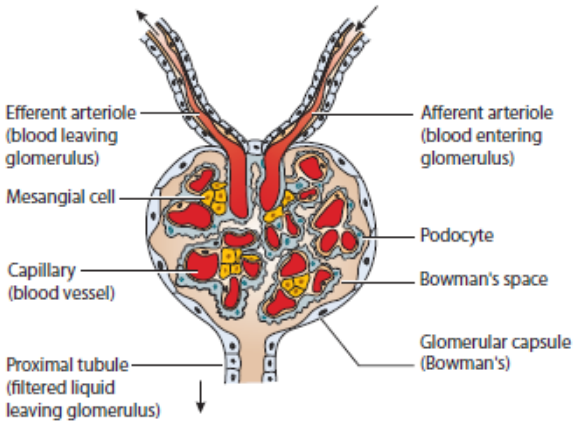
"Glomerulus" is the diminutive of the Latin "glomus" meaning "ball of yarn." Glomerulus In the kidney, a tiny ball-shaped structure composed of capillary blood vessels actively involved in the filtration of the blood to form urine. The glomerulus is one of the key structures that make up the nephron, the functional unit of the kidney.
View full question & answer
Question 541 Mark
Name the following:
An enzyme secreted by gastric glands in stomach which acts on proteins.
Answer
Pepsin.
View full question & answer
Question 591 Mark
Why do veins have thin walls as compared to arteries?
Answer
Blood flow through vein does not exert pressure on the walls of veins. Due to this, they do not need thick walls. Hence, veins have thin walls as compared to arteries.
View full question & answer
Question 601 Mark
Why and how does water enter continuously into the root xylem?
Answer
When soil moisture is high, movement of water and dissolved minerals from soil into root hair and finally to the root xylem cells build up root pressure which in turn pushes the water up the xylem vessels. The increased soil moisture and the high root pressure causes increased rate of water absorption which in turn forces water droplets to come out from stomata. Stomatal transpiration creates transpiration pull which in turn carry the water and minerals up in stem thereby decreasing root pressure.
View full question & answer
Question 611 Mark
What will happen if mucus is not secreted by the gastric glands?
Answer
Mucus protects the stomach from corrosion by HCl and pepsin of gastric juice. In the absence of mucus, the lining layer of stomach wall will be corroded forming gastric ulcers. There will be excessive acidity and extreme discomfort.
View full question & answer
Question 631 Mark
In following situation what happens to the rate of photosynthesis?No rainfall in the area.
Answer
No Rainfall: Rate of photosynthesis decreases due to wilting of leaves, closure of stomata and reduced availability of hydration.
View full question & answer
Question 641 Mark
Two similar green plants are kept separately in oxygen free containers, one in dark and the other in continuous light. Which one will live longer? Give reasons.
Answer
Plant kept in continuous light will live longer because it will be able to produce oxygen required for its respiration by the process of photosynthesis.
View full question & answer
Question 661 Mark
  1. Which side of the heart pumps blood into the lungs?
  2. Which side of the heart pumps blood into entire body (except the lungs)?
Answer
  1. Right side.
  2. Left side.
View full question & answer
Question 681 Mark
Which chamber of the human heart receives deoxygenated blood?
Answer
The Right Atrium is the chamber of human heart which receives de-oxygenated blood.
View full question & answer
Question 721 Mark
All the animals can be divided into three groups on the basis of their eating habits. Name the three groups.
Answer
  1. Herbivores.
  2. Carnivores.
  3. Omnivores.
View full question & answer
Question 731 Mark
What is normal breathing rate in an adult man at rest?
Answer
The normal respiration rate for an adult at rest is 12 to 20 breaths per minute. Arespiration rate under 12 or over 25 breaths per minute while resting is considered abnormal.
View full question & answer
Question 771 Mark
Name the following:
The process in plants that links light energy with chemical energy.
Answer
Photosynthesis.
View full question & answer
Question 781 Mark
Why does the heart need valves?
Answer
Heart needs valves to prevent the backflow of blood so that the blood flows only in one direction.
View full question & answer
Question 791 Mark
Name the substance whose build up in the muscles during vigorous physical exercise may cause cramps.
Answer
Lactic acid.
View full question & answer
Question 801 Mark
Why do the walls of trachea not collapse when there is less air in it?
Answer
Trachea does not collapse even when there is no air in it because it is supported by rings of soft bones called cartilage.
View full question & answer
Question 811 Mark
How does gaseous exchange take place in Amoeba?
Answer
Amoeba has no special organs for exchange of gases. It breathes due to diffusion through the surface.
View full question & answer
Question 821 Mark
What is the special name of the contraction and expansion movement which pushes the food further in our digestive tract (or alimentary canal)?
Answer
Peristaltic movements.
View full question & answer
Question 831 Mark
Describe one way in which the small intestine is adapted for the absorption of digested food.
Answer
The walls of small intestine has finger like projections like villi which increases the surface area for absorption.
View full question & answer
Question 841 Mark
Name a waste gas released by the plants:
  1. Only during the day time.
  2. Only during the night time.
Answer
  1. Oxygen.
  2. Carbon-dioxide.
View full question & answer
Question 851 Mark
Plants have low energy needs as compared to animals. Explain.
Answer
Plants remain fixed at a place because they do not need to move in search of food. As a result, plants do not need to have locomotion, the way animals do. Moreover, most of the movements of substances in plants happen through passive transport; which does not need energy. Due to this, the energy requirement in plants is low as compared to animals.
View full question & answer
Question 861 Mark
Where is the urine produced by kidneys gets stored?
Answer
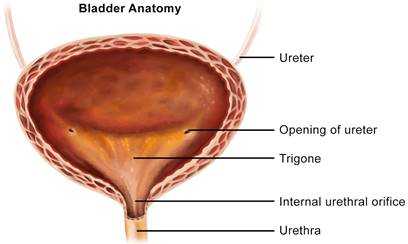
Urine is formed in the kidneys through a filtration of blood. Theurine is then passed through the ureters to the bladder, where it isstored. During urination, the urine is passed from the bladder through the urethra to the outside of the body.
View full question & answer
Question 871 Mark
Why is transpiration important for plants?
Answer
Significance of transpiration:
  1. It creates transpiration pull to facilitate ascent of sap.
  2. Ascent of sap is necessary to make water available for photosynthesis.
  3. It helps a plant to get rid of excess water.
View full question & answer
Question 881 Mark
Which substance is used to remove chlorophyll from a green leaf during photosynthesis experiments?
Answer
Alcohol.
View full question & answer
Question 891 Mark
Is 'nutrition' a necessity for an organism? Discuss.
Answer
Nutrition is required by every organism for various purposes. An organism needs energy to carry out various metabolic activities, and this energy comes from nutrients present in food, which is the most potential source of nutrition.
View full question & answer
Question 901 Mark
What is the color of lymphatic vessels?
Answer
Lymph is a colorless liquid which is released out of the tissues. It is so because lymph contains only WBCs and not RBCs. Since the WBCs are colorless, lymph is also colorless. It has the same mineral composition as that of the plasma.
View full question & answer
Question 911 Mark
Name an energy rich carbohydrate stored in large quantities in liver and muscle cells.
Answer
Glycogen is an energy rich carbohydrate stored in large quantities in liver and muscle cells.
View full question & answer
Question 921 Mark
Name the type of cells that helps in blood clotting.
Answer
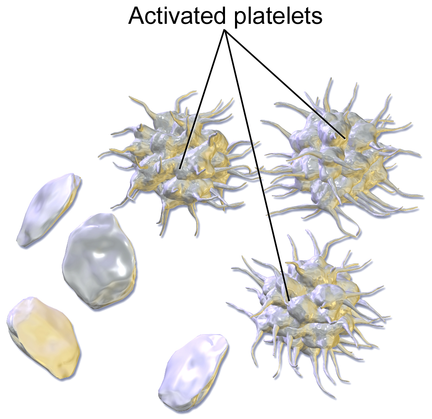
Platelets are the cells which help in coagulation clotting of blood. Platelets are also known as thrombocytes. Platelets in the blood are small sticky cells that gather when a blood vessel is injured and form a sticky plug to quell the bleeding. instead of being proper cells they are the cell fragments which are produced by megakaryocytic. They are 1.5 lakh to 3.5 lakh per cubic millimeter of blood.
View full question & answer
Question 931 Mark
Name the areas in a woody stem through which respiratory exchange of gases takes place.
Answer
Lenticels.
View full question & answer
Question 941 Mark
What happens to the glucose which enters the nephron tubule alongwith the filtrate?
Answer
Glucose passes through the glomerulus alongwith the filtrate and gets collected in the Bowman’s capsule.
View full question & answer
Question 961 Mark
What causes movement of food inside the alimentary canal?
Answer
Peristalsis is rhythmic contraction of muscular wall of alimentary canal which in turn pushes the food along the alimentary canal. Peristalsis begins in the esophagus and continues in all the organs of the alimentary canal.
View full question & answer
Question 971 Mark
Name the blood vessel that brings deoxygenated blood to the human heart.
Answer
The Vena Cava (the main vein) brings back the whole de-oxygenated blood to the heart from the parts of the body.
View full question & answer
Question 981 Mark
Name the final product/ products obtained in the anaerobic respiration, if it takes place:
In an animal tissue (like muscles).
Answer
Lactic acid.
View full question & answer
Question 991 Mark
How do leaves of plants help in excretion?
Answer
  1. Stomatal transpiration removes the gaseous waste of respiration and photosynthesis.
  2. Most of waste products are stored in large central vacuoles. Shedding of old senescing leaves help eradication of these wastes from the plant body.
View full question & answer
[1 Mark Questions] - Page 2 - Science STD 10 Questions - Vidyadip