Questions · Page 2 of 2

[3 Mark Questions]

Question 513 Marks
Why is blood circulation in human heart called double circulation?
Answer
Blood circulation in human heart is called double circulation as blood passes twice through the heart in order to complete one cycle-once through right side as deoxygenated blood and once through left side as oxygenated blood. Deoxygenated blood passes to lungs. It returns to left side as oxygenated blood. Oxygenated blood is supplied to different parts of the body. It returns to right side of the heart as deoxygenated blood.
View full question & answer
Question 523 Marks
Stomata of desert plants remain closed during the day. Explain how and when they take up $CO _2$ to perform photosynthesis?
Answer
Such plants undergo CAM photosynthesis as they open up their stomata during night and take in $CO _2$ Stomata remains close during the day time to prevent the loss of water by transpiration. They store the $CO _2$ in their cells until the sun comes out and they can carry on with photosynthesis during the day time.
View full question & answer
Question 533 Marks
What are the differences between aerobic and anaerobic respiration? Name some organisms that use anaerobic mode of respiration.
Answer
  1. Aerobic respiration.
  1. Aerobic respiration takes place in the presence of oxygen.
  2. Complete breakdown of food occurs in aerobic respiration.
  3. The end products in aerobic respiratin are carbon dioxide and water.
  4. Aerobic respiration produces a considerable amount of energy.
Anaerobic respiration.
  1. Anaerobic respiration takes place in the absence of oxygen.
  2. Partial break down of food occurs in anaerobic respiration.
  3. The end products in anaerobic respiration are ethanol and carbon dioxide (in yeast) and lactic and (in animal muscles).
  4. Much less energy is produced in anaerobic respiration.
  1. Yeast and some bacteria.
View full question & answer
Question 543 Marks
What substances are contained in gastric juice? What are their functions?
Answer
The gastric juice contains three substances hydrochloric acid, the enzyme pepsin and mucus.
Functions:
Hydrochloric acid: It makes the medium of gastric juice acidic so that the enzyme pepsin can digest the proteins properly and also kills any bacteria that might have entered the stomach with food.
Pepsin: The enzyme pepsin digests the proteins present in the food and converts them into smaller molecules.
Mucus: The mucus helps to protect the stomach wall from its own secretions of hydrochloric acid.
View full question & answer
Question 553 Marks
The end product of a process is ethanol and carbon dioxide with the release of energy. Name this process and write the pathway involved in the reaction.
Answer
During aerobic respiration, the product is $CO _2 \& H _2 O$. While during anaerobic respiration, the product can be either lactic acid or ethanol $+ CO _2$ on the basis of enzyme involved.
If the product is ethanol $\& CO _2$, the process is termed as Fermentation.
Initially glucose gets converted into pyruvic acid (by the process of glycolysis-common in both aerobic \& anaerobic respiration). In fermentation, this pyruvic acid produces ethanol \& carbon-dioxide in the presence of enzyme alcohol dehydrogenase. This fermentation process is also used for industrial production of alcohol.
View full question & answer
Question 563 Marks
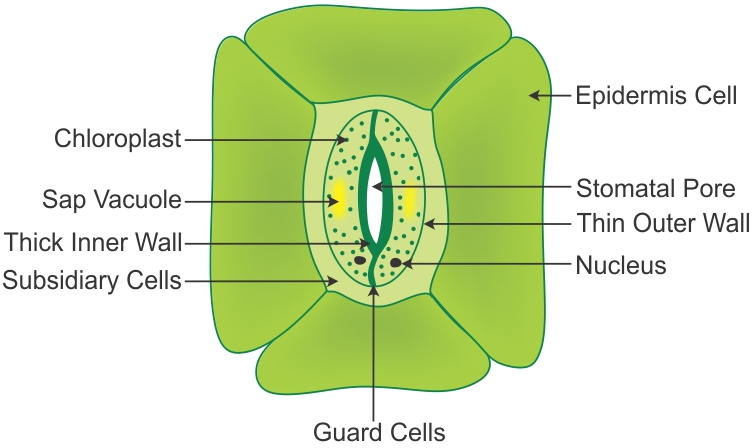
Draw a labelled diagram of stomata. List two functions of stomata.
Answer
Two functions of stomata:
  1. It facilitates the exchange of gases between plant and its surroundings. It is through stomata that plant release oxygen and take up carbon dioxide.
  2. It helps the plant to get rid of excess water through transpiration. The stomata also close down to prevent loss of water. Thus, it regulates the water content in plant cells.
Diagram of stomata:
View full question & answer
Question 573 Marks
What is meant by the terms ‘single circulation’ and ‘double circulation’?
Answer
Single circulation is a type of circulatory system in which the blood passes through the heart only once in one complete cycle of the body. Double circulation is a circulatory system in which the blood travels twice through the heart in one complete cycle of the body.
View full question & answer
Question 593 Marks
What would happen if green plants disappear from earth?
Answer
Green plants are autotrophs are that use light as source of energy, carbon dioxide as chief carbon source and water as electron donor to fix the atmospheric carbon dioxide into organic compounds (carbohydrates). The carbohydrates which are not immediately consumed by plants are stored as starch.Since autotrophs are the only organisms that can fix the atmospheric carbon dioxide into organic compounds, these organisms occupies first trophic level in food chain and serve as source of food and energy for all other organisms of higher trophic levels (heterotrophs/ consumers).
Hence, in absence of these plants, whole functioning of whole ecosystem will come to hault due to lack of food and energy source for consumers (herbivores, carnivores and omnivores)
View full question & answer
Question 603 Marks
Compare the functioning of alveoli in the lungs and nephrons in the kidneys with respect to their structure and functioning.
Answer
Comparison between alveoli and nephron:
Alveoli Nephron
They have thin-walled balloon-like structure. The alveoli provide a surface extensively supplied with blood capillaries for exchange of gases in lungs. Carbon dioxide released in the cavity of alveoli and oxygen is taken by hemoglobin present in RBC of blood. Nephron is a cluster of very thin walled blood capillaries found in Kidney. Each capillaries cluster remains associated with the cup-shaped end of a tube called Bowman's capsule that collects the filtered urine, at the same time the useful substance are reabsorbed.
View full question & answer
Question 613 Marks
Describe the process of respiration in the following parts of a plant:
  1. Root.
  2. Stem.
  3. Leaves.
Answer
  1. Respiration in roots: The roots of a plant take the oxygen required for respiration from the air present in - between the soil particles by the process of diffusion. The roots have extensions of epidermal cells of a root called root hair which are in contact with the air in the soil. Oxygen diffuses from root hairs and reaches all the other cells of the root for respiration. Carbon-dioxide gas produced in the cells of the root during respiration moves out through the root hairs by the process of diffusion. Thus, the respiration in roots occurs by diffusion of respiratory gases through the root hairs.
  2. Respiration in stems: The stems of herbaceous plants takes place through stomata. The oxygen from the air diffuses into the stem of a herbaceous plant through stomata and reaches all the cells for respiration. The carbon-dioxide produced diffuses out through stomata. In woody stems, the bark has lenticels for the exchange of gases.
  3. Respiration in leaves: The leaves of a plant has tiny pores called stomata through which the exchange of respiratory gases takes place by diffusion. Oxygen from air diffuses into a leaf through stomata and reaches all the cells, where it is used for respiration and the carbon-dioxide produced diffuses out from the leaf into the air through stomata.
View full question & answer
Question 623 Marks
Where do plants get each of the raw materials required for photosynthesis?
Answer
The following raw materials are required for photosynthesis:
  1. Carbon Dioxide: Plants get $CO _2$ from atmosphere through stomata.
  2. Water: Plants absorb water from soil through roots and transport to leaves.
  3. Sunlight: Sunlight, which is absorbed by the chlorophyll and other green parts of the plant.
View full question & answer
Question 633 Marks
Name the type of respiration in which the end products are:
a. $C _2 H _3 OH$ and $CO _2$.
b. $CO _2$ and $H _2 O$.
c. Lactic acid.
Give one example of each case where such a respiration can occur.
Answer
  1. Anaerobic respiration in yeast.
  2. Aerobic respiration in humans.
  3. Anaerobic respiration in muscle tissue of animals.
View full question & answer
Question 643 Marks
What is meant by human circulatory system? Name the organs of the circulatory system in humans.
Answer
Human circulatory system is a system which is responsible for the transport of materials inside the body. The various organs of the circulatory system in humans are:
Heart, Arteries, Veins and Capillaries.
View full question & answer
Question 653 Marks
Describe the process of respiration in State whether it is anaerobic respiration or aerobic respiration.
Answer
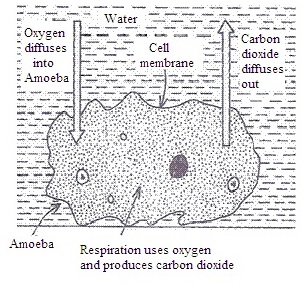
  1. Respiration in amoeba: Amoeba depends on simple diffusion of gases for breathing. The diffusion of gases takes place through the thin cell membrane of amoeba. Amoeba lives in water which contains dissolved oxygen. The oxygen from water diffuses into the body of amoeba through its cell membrane. The oxygen spreads quickly into the whole body and is used for respiration inside the amoeba cell. The process of respiration produces carbon-dioxide which diffuses out through its cell membrane into the surrounding water.
  1. It is aerobic respiration.
View full question & answer
Question 663 Marks
What are the differences between autotrophic nutrition and heterotrophic nutrition?
Answer
 
Autotrophic nutrition
Heterotrophic nutrition
(i)
Food is synthesised from simple inorganic raw material such as $CO _2$ and water.
Food is obtained directly or indirectly from autotrophs. This food is broken down with the help of enzymes.
(ii)
Presence of green pigment(chlorophyll) is necessary.
No pigment is required in this type of nutrition.
(iii)
Food is generally prepared during day time.
Food can be prepared at all times.
(iv)
All green plants and some bacteria have this type of nutrition.
All animals and fungi have this type of nutrition.
View full question & answer
Question 673 Marks
Explain the principle of haemodialysis.
Answer
Hemodialysis, also spelled haemodialysis, or simply dialysis, is a process of purifying the blood of a person whose kidneys are not working normally. This type of dialysis achieves the extracorporeal removal of waste products such as creatinine and urea and free water from the blood when the kidneys are in a state of kidney failure. Hemodialysis is one of three renal replacement therapies (the other two being kidney transplant and peritoneal dialysis). An alternative method for extracorporeal separation of blood components such as plasma or cells is apheresis.
View full question & answer
[3 Mark Questions] - Page 2 - Science STD 10 Questions - Vidyadip