Questions · Page 2 of 4

[1 Mark Questions]

Question 511 Mark
A ray of light going towards the focus of a convex mirror becomes parallel to the principal axis after reflection from the mirror. Draw a labelled diagram to represent this situation
Answer
diagram 47.
View full question & answer
Question 521 Mark
State the relation between object distance, image distance and focal length of a spherical mirror (concave mirror or convex mirror).
Answer
$\frac{1}{\text{image distance}}+\frac{1}{\text{object distance}}=\frac{1}{\text{focal lenght}}$Or
$\frac{1}{\text{v}}+\frac{1}{\text{u}}=\frac{1}{\text{f}}$
v = distance of image from mirror.
u = distance of object from mirror.
f = focal length of mirror.
View full question & answer
Question 531 Mark
Which typie of lens has (a) a positive power, and (b) a negative power?
Answer
  1. Positive power: Convex lens.
  2. Negative power: Concave lens.
View full question & answer
Question 541 Mark
What is the name of the phenomenon in which the right side of an object appears to be the left side of the image in a plane mirror?
Answer
Lateral inversion.
View full question & answer
Question 551 Mark
When do an object and its image coincide in a convergent mirror?
Answer
When the object is placed at centre of the curvature of the concave mirror, the object and its image coincides.
View full question & answer
Question 561 Mark
What is the power of a convex lens of focal length 0.5m?
Answer
$\text{f}=0.5\text{m}$$\text{p}=\frac{1}{\text{f}}=\frac{1}{0.5}=+2\text{D}$
View full question & answer
Question 571 Mark
Which phenomenon of light makes the water to appear shallower than it really is?
Answer
Refraction of light.
View full question & answer
Question 581 Mark
Where should an object be placed in order to use a convex lens as a magnifying glass?
Answer
Object should be placed at a distance less than focal length.
View full question & answer
Question 591 Mark
What is convex mirror?
Answer
A convex mirror or diverging mirror is a curved mirror in which the reflective surface bulges towards the light source. Convex mirrors reflect light out wards, therefore they are not used to focus light.
View full question & answer
Question 601 Mark
A diverging lens has a focal length of 3cm. Calculate the power.
Answer
Here, $\text{f}=-3\text{cm}=0.03\text{m}$ (Diverging lens)$\text{p}=\frac{1}{\text{f}}=\frac{1}{(-0.03)}=-33.33\text{D}$
View full question & answer
Question 611 Mark
Name the phenomenon due to which a swimming pool appears less deep than it really is.
Answer
This is due to refraction of light.
View full question & answer
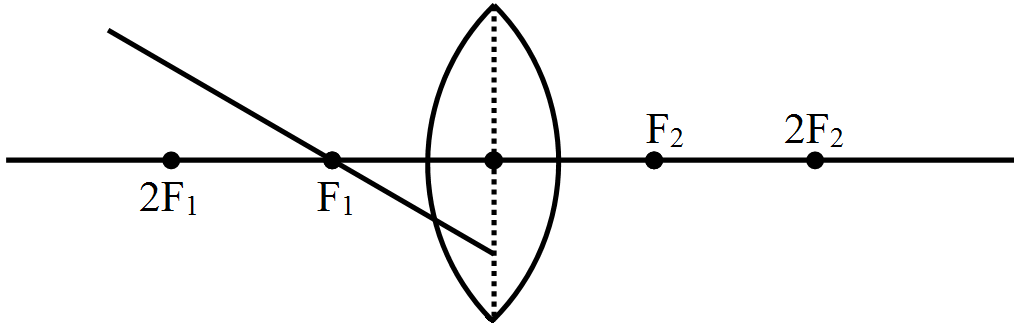
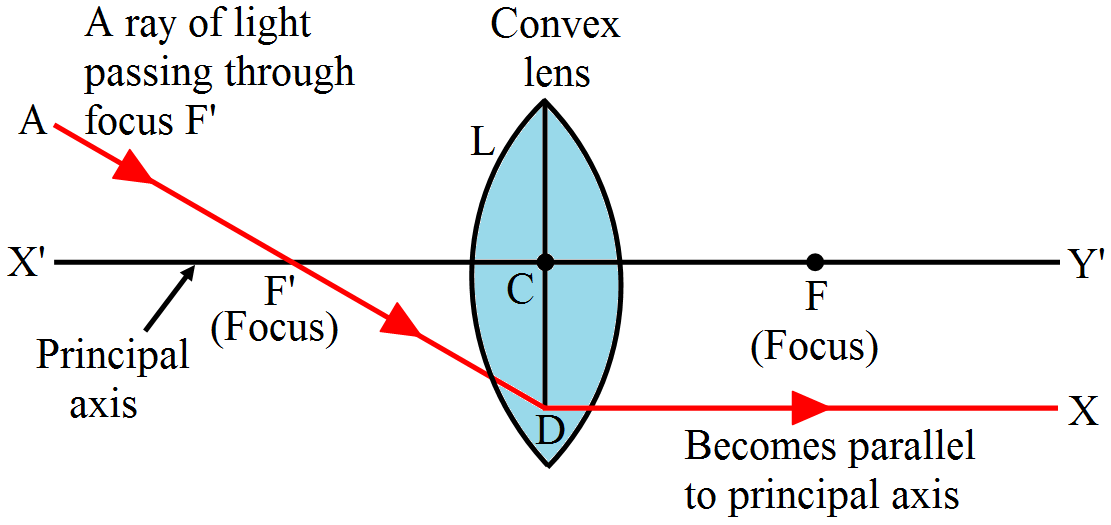
Question 621 Mark
Redraw the ray diagram given below in your answer book and completer the path of ray.
Answer
When this point light source is placed at the focus of convex lens then after falling on convex lens it will become parallel to the principal axis.
View full question & answer
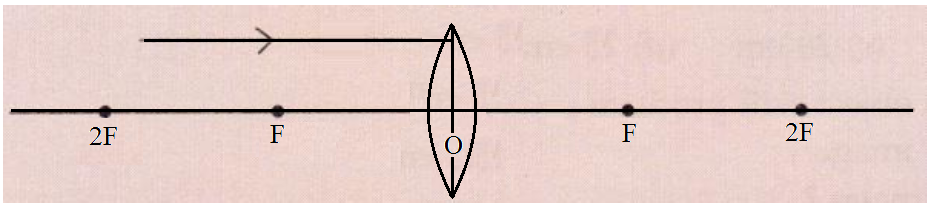
Question 631 Mark
Draw the given diagram in your answer book and complete it for the path of a ray of light after passing through the lens.
View full question & answer
Question 641 Mark
For what position of an object, a concave mirror forms a real image equal in size to the object?
Answer
At the centre of curvature.
View full question & answer
Question 671 Mark
Name the phenomenon due to which a pencil partly immersed in water and held obliquely appears to be bent at the water surface.
Answer
Refraction of light.
View full question & answer
Question 681 Mark
How can we find the (rough) focal length of a concave mirror?
Answer
To find the focal length of the concave mirror, use a similar procedure as you did with the convex lens. Arrange your mirror, meter stick, and screen. Point the mirror at distant (greater than 10m) object and move the screen along the meter stick until you obtain a sharp image of the distant object on the screen. The distance between the mirror and the screen is the approximate focal length of the mirror.
View full question & answer
Question 691 Mark
Name two factors on which the focal length of a lens depends.
Answer
Focal length of a lens depends on the refractive index of the glass from which it is made, and on the curvature of its two surfaces.
View full question & answer
Question 721 Mark
Out of convex mirror and concave mirror, whose focus is situated behind the mirror?
Answer
Convex mirror.
View full question & answer
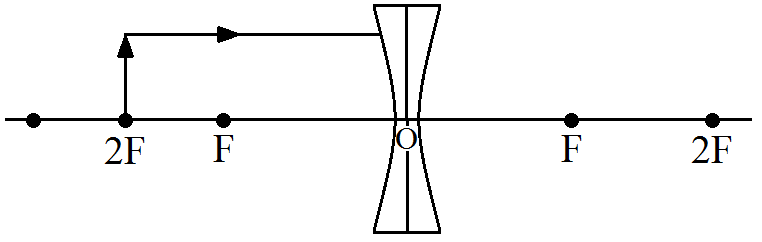
Question 731 Mark
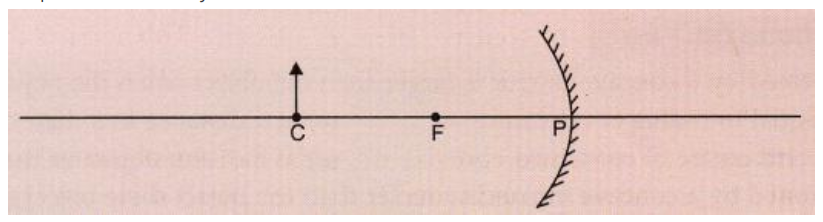
Draw the following diagram in your answer book and show the formation of image of the object AB with the help of suitable.
View full question & answer
Question 741 Mark
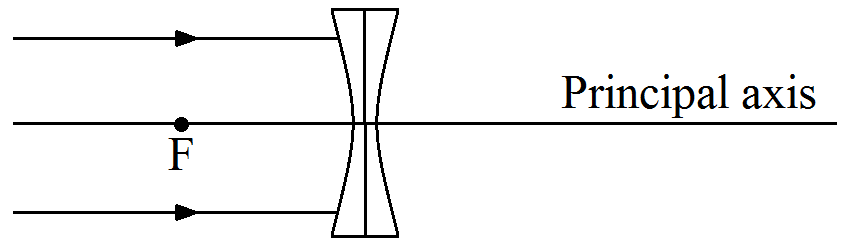
Copy and complete the diagram below to show what happens to the rays of light when they pass through the concave lens:
View full question & answer
Question 761 Mark
A ray of light strikes a plane mirror such that its angle of incidence is 30°. What angle does the reflected ray make with the mirror surface?
Answer
According to the second law of reflection, angle of incidence is equal to the angle of reflection.
Given angle of incidence = 30°
Therefore, angle of reflection = 30°
Angle made by the reflected ray with mirror surface = 90° - 30° = 60°
View full question & answer
Question 771 Mark
A lens is cut into two equal halves:
Perpendicular to principal axis. What will be the focal length of each half?
Answer
If lens is cut along Perpendicular to principal axis then focal length will be twice the original one.
View full question & answer
Question 781 Mark
A ray of light is incident normally on a plane mirror. What will be the:
  1. Angle of incidence?
  2. Angle of reflection?
Answer
View full question & answer
Question 791 Mark
Which mirror always produces a virtual, erect and diminished image of an object?
Answer
Convex mirror always produces a virtual, erect and diminished image.
View full question & answer
Question 801 Mark
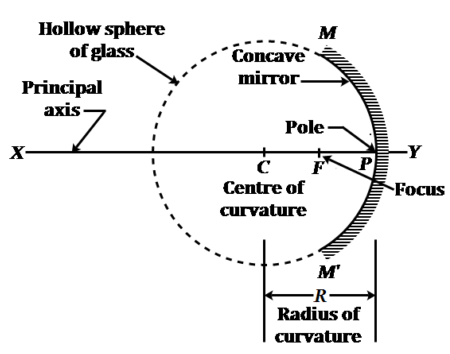
Define:centre of curvature.
Answer

Centre of curvature: Centre of curvature of a spherical mirror is the centre of the hollow sphere of glass of which the mirror is a part.
View full question & answer
Question 811 Mark
If the refractive index for light going from air to diamond be 2.42, what will be the refractive index for light going from diamond to air?
Answer
$^\text{diamond }{\eta}_\text{ air}=2.42$$^\text{air }{\eta}_\text{ diamond}=\frac{1}{2.42}=0.41$
View full question & answer
Question 821 Mark
Complete the following sentence:
All the distances are measured from the _______ of a spherical mirror.
Answer
All the distances are measured from the Pole of a spherical mirror.
View full question & answer
Question 831 Mark
A ray of light strikes a plane mirror at an angle of 40° to the mirror surface. What will be the angle of reflection?
Answer
Angle to the mirror surface = 40°Therefore, angle of incidence = 90° - 40° = 50°
According to the second law of reflection, angle of incidence is equal to the angle of reflection.
Therefore, angle of reflection = 50°
View full question & answer
Question 851 Mark
What is the radius of curvature of a plane mirror?
Answer
The focal length of plane mirrors is considered to be infinite, as the radius of curvature is infinite.
View full question & answer
Question 861 Mark
Find the focal length of a concave mirror whose radius of curvature is 32cm.
Answer
Radius of curvature (R) = 32cmFocal length (f) = ?
We know that
$\text{f}=\frac{\text{R}}{2} $
$=\frac{32}{2}$
$\text{f}=16\text{cm}$
View full question & answer
Question 871 Mark
Define:radius of curvature.
Answer

Radius of curvature: Radius of curvature of a spherical mirror is the radius of the hollow sphere of glass of which the mirror is a part.
View full question & answer
Question 881 Mark
If an object is placed at a distance of 10cm in from of a plane mirror, how far would it be from its image?
Answer
The image is formed behind the mirror at the same distance as the object is kept in front of the mirror.
Given distance between object and mirror = 10cm.
Distance between mirror and image = 10cm.
Therefore, the distance between object and image = 10 + 10 = 20cm.
View full question & answer
Question 891 Mark
What is the value of $n_2 \times{ }_2 n_1$ ?
Answer
The value is 1 , because both the refractive indicies $n_2$ and ${ }_2 n_1$ are reciprocals of each other.
View full question & answer
Question 901 Mark
What is the nature of the image formed by a convex lens if the magnification produced by the lens is, -0.5?
Answer
The image will be real and inverted, since the magnification has negative value.
View full question & answer
Question 911 Mark
When a ray of light passes from air into glass, is the angle of refraction greater than or less than the angle of incidence?
Answer
Angle of refraction is less than the angle of incidence.
View full question & answer
Question 921 Mark
Find the focal length of a convex mirror whose radius of curvature is 32 cm.
Answer
Radius of curvature, R = 32 cm Radius of curvature = 2 × Focal length (f) R = 2f$\text{F}=\frac{\text{R}}{2}$
$=\frac{32}{2}$
$\text{F}=16$
Hence, the focal length of the given convex mirror is 16 cm.
View full question & answer
Question 931 Mark
The power of a lens is +0.2D. Calculate its focal length.
Answer
$\text{P}=+0.2\text{D}$$\text{P}=\frac{1}{\text{f}}$
$\text{f}=\frac{1}{\text{P}}=\frac{1}{0.2}=+5\text{m}$
View full question & answer
Question 941 Mark
It is desired to obtain an erect image of an object, using concave mirror of focal length of 12cm.
What should be the range of distance of a object placed in front of the mirror?
Answer
The range of the object distance when placed in front of the mirror is from 0 to 12cm i.e. when object is placed between pole and focus of the mirror. The nature of the Image formed will be magnified, i.e., larger than the size of the object.
View full question & answer
Question 951 Mark
Define 1 dioptre of power of a lens.
Answer
One dioptre of is defined as the power of lens having a focal length of 1 m.
View full question & answer
Question 961 Mark
If a driver has one convex and one plane rear-view mirror, how would the images in each mirror appear different?
Answer
The images formed in the convex rear-view mirror will be smaller than those formed in the plane rear-view mirror.
View full question & answer
Question 971 Mark
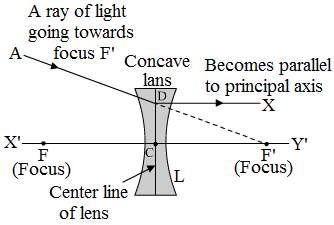
A ray of light is going towards the focus of a concave lens. Draw a ray diagram to show the path of this ray of light after refraction through the lens.
Answer

Ray of light going towards the focus of a concave lens.
View full question & answer
Question 981 Mark
Which type of lenses are:
  1. Thinner in the middle than at the edges?
  2. Thicker in the middle than at the edges?
Answer
  1. Concave lenses.
  2. Convex lenses.
View full question & answer
Question 991 Mark
What kind of mirror is required for obtaining a virtual image of the same size as the object?
Answer
Plane mirror.
View full question & answer
Question 1001 Mark
What happens to the image when the object is moved away from the mirror gradually?
Answer
Virtual and erect; real and inverted.
View full question & answer
[1 Mark Questions] - Page 2 - Science STD 10 Questions - Vidyadip