Questions · Page 2 of 2

[2 Mark Questions]

Question 512 Marks
If all the waste we generate is biodegradable, will this have no impact on the environment?
Answer
If all the waste generated would be biodegradable this will also create problem. As the numbers of decomposers will be quite low so wastes cannot be broken down into harmless simpler substance at right time. It will became breeding ground for flies causing spread of diseases. It will also emits foul smell which makes the life of people miserable.
View full question & answer
Question 522 Marks
List the biotic and abiotic components of an ecosystem.
Answer
Biotic component: The biotic components of the ecosystem is a community of organisms which is made up of many different inter-dependent populations. It includes – producers, consumers and decomposers.
Abiotic components: The abiotic components of the ecosystem (non living components) include the physical environment like soil, water and air alongwith the in organic substances like carbon dioxide, nitrogen, water and phosphorous.
View full question & answer
Question 532 Marks
Consider the food chain:
Grass → Deer → Lion
What will happen if all the lions are removed from the above food chain?
Answer
If all the lions are removed, then there will be no predator control over the population of deer due to which its populations will greatly increase and deer will eat all grass. Over grazing will eliminate the grass and other green plants completely and turn the lush green forest into a desert area having no vegetation at all.
View full question & answer
Question 542 Marks
Why is improper disposal of waste a curse to environment?
Answer
An improper disposal of wastes means addition of pollutants into environment - air, water, soil. They will harm living beings, human assets and human beings. For example, passage of sewage into water body will cause eutrophication, stink, development of sludge, killing of animals and source of water borne pathogens.
View full question & answer
Question 552 Marks
“To discard the household waste we should have two separate dust-bins, one for the biodegradable waste and the other for the non-biodegradable waste.” Justify this statement suggesting the proper way of disposal of these wastes.
Answer
Biodegradable wastes are broken down by microorganisms and can also contribute to soil fertility. Therefore they could be used in vermicomposts and can be utilised as manure.
But, non-biodegradable wastes are harmful for the soil. They have to be segregated and those recyclable have to be recycled.
View full question & answer
Question 562 Marks
Differentiate between biodegradable and non-biodegradable substances. Cite examples.
Answer
Substances that are broken down into simpler substances by biological processes are said to be biodegradable. Examples, wood, paper.
Substances that cannot be broken down into simpler ones by biological processes are said to be non-biodegradable. Examples, plastic, DDT.
Biodegradable
Non-biodegradable
They are decomposed by microbes.
They cannot be decomposed.
They are environment friendly.
They are not environment friendly.
Examples: fruit peels, jute bags, stale food.
Examples: plastic bags, glass, aluminium cans.
View full question & answer
Question 572 Marks
We often observe domestic waste decomposing in the bylanes of residential colonies. Suggest ways to make people realise that the improper disposal of waste is harmful to the environment.
Answer
Some of the ways to make people realise that the improper disposal of waste is harmful to the environment are:
  1. Improper disposal of waste will serve as a breeding ground for mosquitoes and will create favorable conditions for the spread of various diseases.
  2. Improper disposal of waste will release harmful gases in the environment. It will make the environment unclean and unhygienic for normal living of the organisms.
  3. The waste will flow to water bodies along with the rain water and become a threat to aquatic organisms.
View full question & answer
Question 582 Marks
Why is Government of India imposing a ban on the use of polythene bags? Suggest two alternatives to these bags and explain how this ban is likely to improve the environment.
Answer
Plastic bags are non-biodegradable which can not be broken down into non-poisonous substances in nature.
Plastic bags are the main cause of sewer blockages a plastic bags are not decomposed by micro organisms.
Plastic bags if eaten by stray animals (like cows) can block their alimentary canal.
Two alternatives:
  1. We should take our own jute or cloth bags while going for purchasing articles from the market.
  2. Disposable paper cubs should be used for serving tea in trains instead of plastic cubs.
  3. Shopkeepers can use paper bags instead of plastic bags.
View full question & answer
Question 592 Marks
Explain the terms ‘producer’ and ‘consumer’. Give two examples of producers and two of consumers.
Answer
Producers are the organisms which can be prepare their own food from simple inorganic substances like carbon dioxide and water by using sunlight energy in the presence of chlorophyll.
Example: Green plants and certain blue-green algae.
Those organisms which consume food (eat food) prepared by producers are called consumers.
Example: Lion and Tiger.
View full question & answer
Question 602 Marks
List two environment friendly practices or habits which need to be followed by every member of a family/community. Explain how these practices will support the "Save the Environment" mission.
Answer
Two environment friendly practices to help save the environment are:
  1. Disposal of wastes after separating them into biodegradable and non-biodegradable waste material.
  2. Use of unleaded petrol and alternate sources of energy, keeping the car engines properly tuned and serviced and tyres inflated to the right pressure, so that the vehicle runs smoothly.
View full question & answer
Question 612 Marks
‘If we excessively use pesticides to protect the crops from diseases, then it may cause longterm damage to mankind’. Justify this statement.
Answer
Pesticides are non – biodegradable chemicals, so they get accumulated at each trophic level. Since humans occupy the top level in any food chain, so the maximum amount of harmful chemical pesticides gets accumulated in our bodies. This damages our health gradually.
View full question & answer
Question 622 Marks
"Burning of fossil fuels results in global warning''. Give reasons to justify this statement.
Answer
Burning of fossil fuels causes global warming as when they are burnt, they generates various gases such $CO _2, CO$, water vapours, $SO _2$, oxides of nitrogen. Carbon dioxide traps sun's heat energy falling of the surface of Earth and results in green house effect leading to global warming.
View full question & answer
Question 632 Marks
Name the various modes of waste disposal.
Answer
The various modes of waste disposal are:
  1. Recycling.
  2. Preparation of compost.
  3. Incineration.
  4. Landfill.
  5. Sewage treatment.
View full question & answer
Question 642 Marks
What are decomposers? List two important roles they play in the environment.
Answer
  1. Decomposers are microorganisms that break down complex organic substances (dead remains waste products of organisms) into simpler inorganic substances that go into the soil and are used up once more by the plants.
  2. Decomposing play an important role in the cycling or material in the biosphere.
  3. By decomposing dead bodies of plants and animals they help in cleaning the environment. Example, Bacteria and fungi are examples of decomposers.
View full question & answer
Question 652 Marks
Why herbivores also known as first order consumers?
Answer
The rest of the food is preserved for animals. Thus the plants are known as the producers while animals are known as the consumers. The plant-eating or herbivorous animals eat the food preserved by the plants. So the herbivorous animals are the first order consumers.
View full question & answer
Question 662 Marks
What are decomposers? What will be the consequence of their absence in an ecosystem?
Answer
The microorganisms, comprising bacteria and fungi, break-down the dead remains and waste products of organisms. These microorganisms are the decomposers as they break-down the complex organic substances into simple inorganic substances that go into the soil and are used up once more by the plants.
This decomposer acts as cleaning agents of environment by decomposing the dead bodies of plants and animals and help in recycling of materials, replenishment of soil’s nutrients etc.
Following are the consequence of their absence in an ecosystem:
Dead bodies and plants would keep lying and their number will keep on increasing. Their accumulation will cause land and water pollution. Also, substances from which these bodies are made such as soil and water will never be recycled.
View full question & answer
Question 672 Marks
List two reasons to show that the existence of decomposers is essential in an ecosystem.
Answer
Decomposers include microorganisms such as bacteria and fungi that obtain nutrients by breaking down the remains of dead plants and animals.

Role of Decomposers:
  • They help in the breakdown of organic matter or biomass of dead plants and animals into simple inorganic raw materials such as $CO _2, H _2 O$ and nutrients.
  • They help in the natural replenishment of soil.
  • They help in keeping the environment clean.
View full question & answer
Question 682 Marks
State two problems caused by the non-biodegradable waste that we generate in our daily life.
Answer
  1. Non-biodegradable pesticides and fertilizer run off with rain water to bodies cause water pollution and affect the soil by making it either acidic or alkaline.
  2. Some of the non-biodegradable pesticides like DDT enter the food chain and cause bio magnification in humans and other animals.
View full question & answer
Question 692 Marks
Give any two ways in which non-biodegradable substances would affect the environment.
Answer
Non-biodegradable substances affect the environment by:
  • They contaminate soil and water resources as they cannot be decomposed by micro-organisms.
  • These substances, when accidentally eaten by stray animals, can harm them and can even cause their death.
View full question & answer
Question 702 Marks
Why are bacteria and fungi called decomposers? List advantages of decomposers to the environment.
Answer
Bacteria and fungi are called decomposers because bacteria and fungi break down the dead and decaying organic matter into simpler substances and provide the nutrients back to the soil. Advantages of decomposers to the environment:
  • They act as natural scavengers.
  • They help in recycling of nutrients.
View full question & answer
Question 712 Marks
Which part of the waste is changed into an agricultural resource?
Answer
The major inputs of heavy metals (e.g. lead, cadmium, arsenic, mercury) into agricultural systems are fertilizers, organic wastes such as manures, and industrial byproduct wastes. Some farming techniques, such as irrigation, can lead to accumulation of selenium (Se) that occurs naturally in the soil.
View full question & answer
Question 722 Marks
In some states of our country there is a ban on the use of polythene bags for shopping. Why? List three advantages of using jute or cloth bags over polythene bags.
Answer
There is a ban on the use of polythene bags for shopping in some states of our country because they cannot be degraded naturally by the action of microorganisms. Because of their non-biodegradability, they stay in the soil for a long time and continue to poison it with toxic by-products that keep leaching from them. Also, they do not allow water to seep in, as they are waterproof. These polythene bags when accidentally eaten by stray animals can harm them and can even cause their death.
The three advantages of using jute or cloth bags over polythene bags are as follows:
  1. Cloth or jute bags are environment-friendly; they are biodegradable.
  2. They are renewable and can be easily recycled.
  3. They have more strength than polythene bags because they are thick and can be used again and again.
View full question & answer
Question 732 Marks
What can best method be used for the safe disposal of hospital wastes?
Answer
The primary methods of treatment and disposal of medical waste are:
  • Incineration.
  • Autoclaves.
  • Mechanical/ Chemical Disinfection.
  • Microwave.
  • Irradiation.
  • Vitrification.
View full question & answer
Question 742 Marks
Give a method for the disposal of household wastes such as left-over food, fruit and vegetable peels, and leaves of potted plants.
Answer
Preparation of compost is a method in which the disposal of household wastes such as leftover food, fruit and vegetable peels and leaves of potted plants can be converted into compost by burying in a pit dug into the ground and is used as manure.
View full question & answer
Question 762 Marks
What would happen to the number of grass plants and foxes if the number of rabbits:
  1. Increased?
  2. Decreased?
Answer
  1. If the number of rabbits increases, it will lead to rabbits consuming more grass plants, and hence grass plants will become sparser. As foxes consume rabbits, any increase in the number of rabbits will lead to an increase in the number of foxes.
  2. If the number of rabbits decreases, then there will be less food for foxes. Hence, they will not be able to survive, because of the shortage of food, and their number will decrease. A decrease in the number of rabbits will lead to an increase in the density of grass plants, as there will be fewer rabbits to consume them.
View full question & answer
Question 772 Marks
What term is given to the phenomenon where a harmful chemical enters a food chain and starts accumulating?
Answer
The process in which the harmful chemical enters the food chain is Bio magnification.
Explanation:
Bio magnification is a process in which substance such as harmful chemical increases in a food chain in progressive manner with greater concentration.
The contaminants include heavy metals such as arsenic, mercury, and chemicals like pesticides, insecticides, DDT, etc. As a result the substance concentration increases in tissues or internal organs.
This process occurs in tropic level. This process is also known as Bio amplification or Biological magnification.
View full question & answer
Question 782 Marks
Write the aquatic organisms in order of who eats whom starting from producer and form a chain of at least three steps. What name is given to such a chain in an ecosystem and what name is given to each stage?
Answer
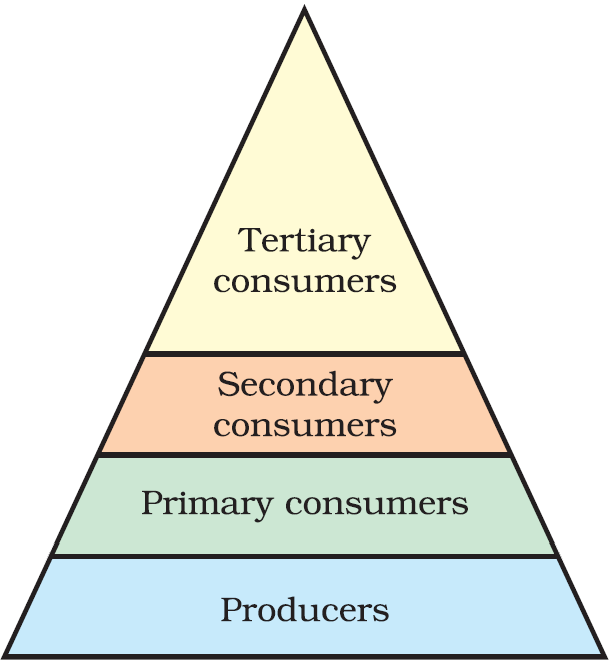
Phytoplankton (Producer) → Zooplankton (Primary Consumer) → Small Fish (Secondary Consumer) → Big fish (Tertiary Consumer).
'Lentic' type of fresh water ecosystem which means 'ecosystem in slowly moving water' example in pond, lake.
View full question & answer
Question 792 Marks
Why is straight line food chain not common in the natural ecosystem?
Answer
Straight line food chain is not common in natural ecosystems because one organism may act as source of food for one or more organism.
Explanation:
Consider a food chain from grassland ecosystem. In this plant are considered as producers. They produce food which is consumed by bees, grass hoppers, cows, goats, Rabbit etc who are called as primary consumers.
Then these primary consumers are consumed by different types of secondary consumers. From this it can be understood that straight line food chain not common in natural ecosystems.
View full question & answer
Question 802 Marks
What are the causes of depletion of ozone layer? Which diseases are likely to be caused if the ozone layer will become thinner?
Answer
The depletion of ozone layer is due to the use of chemicals called chlorofluorocarbons. Skin cancer is caused if the ozone layer will become thinner.
View full question & answer
Question 812 Marks
Write the harmful effects of ozone depletion?
Answer
Harmful effects of ozone depletion are:
  1. It can cause skin cancer.
  2. It damages the eyes by causing the eye disease called cataract.
  3. It damages the immune system by lowering the body’s resistance to diseases.
View full question & answer
Question 822 Marks
What are the problems caused by the non-biodegradable wastes that we generate?
Answer
  1. Non-biodegradable wastes persist in the environment for a long time and cause greater harm to the various members of the ecosystem by causing biological magnification.
  2. Non-biodegradable waste such as fertilizers, pesticides, weedicides, etc., changes the soil chemistry. in turn affects the fertility of soil and subsequently reduces the crop yield.
View full question & answer
Question 832 Marks
Name the process in which wastes are burned at high temperature.
Answer
Incineration is a waste treatment process that involves the combustion of organic substances contained in waste materials. Incineration and other high-temperature waste treatment systems are described as "thermal treatment". Incineration of waste materials converts the waste into ash, flue gas and heat.
View full question & answer
Question 842 Marks
Describe an activity to show that while paper is biodegradable but plastic (say, polythene) is non-biodegradable.
Answer
We take a piece of paper and a plastic bag (Polythene Bag). Now dig the ground to about 15 centimeters depth and place the piece of paper and plastic bag in the dug up ground separately. After a month, we dig up the buried material and observe them. We will find that the piece of paper has been partially eaten up but the plastic bag has been remained unaffected. This means that the paper have been decomposed by the micro-organisms present in the soil. So paper is biodegradable. On the other hand, the plastic bag has not been decomposed by the micro? organisms present in the soil, therefore It is non-biodegradable.
View full question & answer
Question 852 Marks
Explain how, harmful ultraviolet radiations of sunlight are prevented from reaching the earth’s surface.
Answer
Ozone layer absorbs most of the harmful ultra violet radiations coming from the sun and prevents them from reaching the earth.
View full question & answer
Question 862 Marks
Why are some substances biodegradable and some non-biodegradable?
Answer
Substances which can be acted upon by micro-organism (decomposer) are called biodegradable. For example- vegetable wastes, paper, cotton etc.On the other hand, materials which are not acted upon by decomposers are called non biodegradable. For example- plastic, glass, polyethene etc.
View full question & answer
Question 872 Marks
What is meant by bioconcentration of pesticides? Which common pesticide has accumulated in human body in considerable amounts?
Answer
The accumulation of harmful chemicals such as pesticides in the living organisms like plants, animals and humans (men) through the food chain is called bio-concentration of pesticides. DDT has accumulated in human body through food chains.
View full question & answer
Question 882 Marks
We do not clean ponds or lakes but an aquarium needs to be cleaned periodically. Why?
Answer
Pond is a complete eco system having decomposer organisms which are the cleansing agents themselves. Aquarium is an incomplete ecosystem and does not have decomposer organisms for cleansing purposes.
View full question & answer
Question 892 Marks
How does ozone layer protect us from harmful effects in the environment?
Answer
Ozone layer protect us from harmful effects as it absorbs most of the ultraviolet radiations coming from the sun and prevents them from reaching the earth.
View full question & answer
[2 Mark Questions] - Page 2 - Science STD 10 Questions - Vidyadip