Enzymes that catalyse inter$-$conversion of optical, geometrical or positional isomers are:
A
Ligases
B
Lyases
C
Hydrolases
✓
Isomerases
Answer
Correct option: D.
Isomerases
Ligases are the enzymes which catalyze joining together of two $\text{DNA}$ segments.
Lyases catalyze the breaking of chemical bonds without hydrolysis while hydrolases catalyze hydrolytic cleavage of bonds.
Isomerases catalyze interconversion of optical, geometrical or positional isomers of a particular enzyme.
Which one of the following pair is wrongly matched:
A
Detergents $-$ lipase
✓
Alcohol $-$ nitrogenase
C
Fruit juice $-$ pectinase
D
Textile $-$ amylase
Answer
Correct option: B.
Alcohol $-$ nitrogenase
This question relates to the industrial applications of enzymes.
Alcohol is not produced by the use of nitrogenase.
Nitrogenase performs complex functions of nitrogen fixation by bacteria.
Alcohol is produced by the fermentation process of sugars carried out by Yeast.
Which of the following enzyme digests other enzymes:
A
Dehydrogenases
B
Lipases
✓
Peptidases
D
Aldolases
Answer
Correct option: C.
Peptidases
Most of the enzymes are proteins.Proteins are biological macromolecules made up of amino acids joined together by peptide bonds.
Peptidases are enzymes, which cleave or break peptide bonds.
The action of peptidase enzymes will cleave or break peptide bonds, thus breaking the primary structure of enzymes or digestion of enzyme.
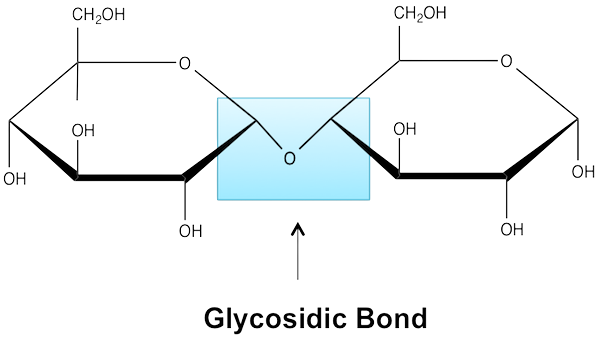
Glycosidic bonds are the bonds formed between hemiacetal or hemiketal group of carbohydrates and hydroxyl group of another molecule.
It is a condensation reaction which leads to release of water molecules.
The function of enzymes in the living system is to:
A
Transport oxygen
B
Provide immunity
✓
Catalyse biochemical reaction
D
Provide energy
Answer
Correct option: C.
Catalyse biochemical reaction
The function of enzymes in the living system is to catalysed biochemical reactions without involving in the reaction.
It means enzymes speed up the rate of reaction by lowering activation energy, so the reaction proceeds faster and at the end same enzymes can are obtained without any changes in it.
Aminoacids, have both an amino group and a carboxyl group in their structure. Which one of the following is an amino acid?
A
Formic acid.
B
Glycerol.
C
Glycolic Acid.
✓
Glycine.
Answer
Correct option: D.
Glycine.
Glycine is the simplest amino acid with hydrogen as $R$ group. Formic acid is simplest carboxylic acid molecule. It is chemically $\text{HCOOH.}$ Glycerol is a polyol compound, which is chemically propane$-1, 2, 3-$triol and glycolic acid is chemically, $2-$hydroxyethanoic acid.
Which of the following is capable of self replication:
A
A protein molecule
B
A carbohydrate molecule
C
A water molecule
✓
A nucleic acid
Answer
Correct option: D.
A nucleic acid
Miescher discovered nucleic acids from pus cells in discarded surgical bands.
He observed that these were acidic in nature.
The two types of nucleic acid were $\text{DNA}$ and $\text{RNA.}$
These are considered as the hereditary unit of the cell.
These carry characters from one generation to the other.
A nucleic acid molecule can act as genetic material because nucleic acids possess the ability of self$-$replication,
i.e., capacity to generate their own copies.
Nucleic acids are polymers of nucleotides.
They are formed by joining together of long chains of nucleotides.
$\text{RNA} ($ribonucleic acid$)$ is a polymer of ribonucleotides and is made up of ribonucleotides joined together by phosphodiester bonds.
$\text{DNA} ($deoxyribonucleic acid$)$ is a polymer of deoxyribonucleotides and is made up of deoxyribonucleotides joined together by phosphodiester bonds.
Proteins are the linear chain of amino acids formed by joining together of a number of amino acids through peptide bonds.
The peptide bond between two amino acids is formed by a condensation reaction between amino group of one amino acid and carboxylic group of another amino acid.
The amino acids are amphoteric compounds having both basic $($amino$)$ as well as acidic $($carboxylic$)$ groups.
The amino acids are rich in nitrogen because of the amino group. Protein contains $16\%$ of nitrogen.
In $\text{RNA,}$ uracil binds to adenine via two hydrogen bonds.
In $\text{DNA,}$ the uracil nucleobase is replaced by thymine.
Uracil could be considered a demethylated form of thymine.
Each nucleotide in $\text{RNA}$ contains a ribose sugar, with carbons numbered $1'$ through $5'$. A base is attached to the $1'$ position, in general, adenine $(A),$ cytosine $(C),$ guanine $(G),$ or uracil $(U).$
Adenine and guanine are purines, cytosine and uracil are pyrimidines.
Transfer of amino group from amino acid to keto acid
B
Oxidation of ammonia
C
Amino-acid destruction
D
None of the above
Answer
Correct option: A.
Transfer of amino group from amino acid to keto acid
Transamination reaction is the transfer of amino groups from an amino acid to a keto acid.
The enzyme is transaminase.
It helps in formation of different amino acids which are not formed by reductive amination.
The plant proteinases or endopeptidases enzyme is:
A
Urease
✓
Papain
C
Pepsin
D
Trypsin
Answer
Correct option: B.
Papain
Papain is the only protein that is not found in humans.
It is found in plants like papaya and the main function of papain is breakdown of peptide bonds in protein.
One of the common methods of protein denaturation is heat.
For example, boiling of egg denatures egg white.
A denatured protein can no longer perform its normal biological role.
Prosthetic groups are cofactors that bind tightly to proteins or enzymes.
It is a specific non$-$polypeptide required for the biological function of some proteins.
The prosthetic group may be organic $($such as vitamin, sugar or lipid$)$ or inorganic $($such as metal ion$),$ but is not composed of amino acids.
Which one of the following is body building material:
✓
Protein
B
Sugar
C
Mineral salts
D
Fat
Answer
Correct option: A.
Protein
Proteins are building blocks of life.Sugar $($meaning carbohydrate$)$ is required for energy.
Mineral salts can be used for various functions like building strong bones, etc.
Fats are also required for energy.
Fats can be stored in the body and can be used when carbohydrates are exhausted.
When you take cells or tissue pieces and grind them with an acid in a mortar and pestle, all the small biomolecules dissolve in the acid. Proteins, polysaccharides and nucleic acids are insoluble in mineral acid and get precipitated. The acid soluble compounds include aminoacids, nucleosides, small sugars etc. When one adds a phosphate group to a nucleoside, one gets another acid soluble biomolecule called.
A
Nitrogen base.
B
Adenine.
C
Sugar phosphate.
✓
Nucleotide.
Answer
Correct option: D.
Nucleotide.
When a phosphate group is added to a nucleoside, it becomes a nucleotide.