Questions · Page 1 of 3

1 Marks Question

🎯

Test yourself on this topic

50 questions · timed · auto-graded

Question 11 Mark
Describe the events taking place during interphase.
Answer
The interphase is divided into three further phases:
i. $\mathbf{G}_1$ phase (Gap 1): The $G_1$ phase corresponds to the interval between mitosis and initiation of DNA replication. During the $G_1$ phase, the cell is metabolically active and continuously grows but does not replicate its DNA. The cells which divide frequently have a shorter $G_1$ phase, whereas the cells which divide infrequently have a longer $G_1$ phase.
ii. S phase (Synthesis): The S or synthesis phase marks the period during which DNA synthesis or replication takes place. During this time, the amount of DNA per cell doubles. If the initial amount of DNA is denoted as 2 C , then it increases to 4 C . However, there is no increase in the chromosome number. If the cell had diploid or 2 n number of chromosomes at $\mathrm{G}_1$, even after the S phase, the number of chromosomes remains the same, i.e. 2 n . The S phase in most eukaryotic cells lasts for 6 to 8 hours. When the $S$ phase begins, the cell must undergo mitosis.
iii. $\mathbf{G}_2$ phase (Gap 2): In animal cells, during the S phase, DNA replication begins in the nucleus, and the centriole duplicates in the cytoplasm. During the $G_2$ phase, proteins are synthesised in preparation for mitosis while cell growth continues. The $\mathrm{G}_2$ phase in most cells lasts for 2 to 5 hours. Some proteins formed in $\mathrm{G}_2$ phase cause condensation of chromosomes to initiate mitosis.
View full question & answer
Question 21 Mark
What is Go (quiescent phase) of cell cycle?
Answer
$\mathrm{G}_0$ phase is the phase of inactivation of cell cycle due to non-availability of mitogens and energy rich compounds. Cells in this stage remain metabolically active but no longer proliferate i.e., do not grow or differentiate unless called on to do so depending on the requirement of the organism. E.g., Nerve and heart cells of chordates are in permanent $\mathrm{G}_0$ phase.
View full question & answer
Question 31 Mark
Name the stage of cell cycle at which one of the following events occur: Pairing between homologous chromosomes takes place.
Answer
Zygotene of meiosis I
View full question & answer
Question 41 Mark
What is the average cell cycle span for a mammalian cell?
Answer
The average cell cycle span for a mammalian cell is approximately 24 hours.
View full question & answer
Question 51 Mark
Why is mitosis called equational division?
Answer
During mitosis, the genetic constitution of the daughter cells is identical to that of parent cells. A diploid cell produces four diploid cells. Since, the chromosome number of the daughter cells remains identical to that of the parent cell, it is called as Equational division.
View full question & answer
Question 61 Mark
Name the stage of cell cycle at which one of the following events occur: Chromosomes are moved to spindle equator.
Answer
Metaphase
View full question & answer
Question 71 Mark
Name the stage of cell cycle at which one of the following events occur: Crossing over between homologous chromosomes takes place.
Answer
Pachytene of meiosis I
View full question & answer
Question 81 Mark
Name the stage of cell cycle at which one of the following events occur: Centromere splits and chromatids separate.
Answer
Anaphase
View full question & answer
Question 101 Mark
Substance W is a chemical that inhibits spindle formation during cell division. If a meristematic sd plant cell were exposed to substance W, which BU process will not be able to occur in that plant cell?
Answer
When a meristematic plant cell were exposed to the substance W, the separation of sister chromatids will be inhibited.
View full question & answer
Question 121 Mark
How would you analyse that the cell's entire energy is devoted to the process of division in the M-phase?
Answer
Gene expression, protein synthesis, secretion, motility etc, do not happen during M-phase.
View full question & answer
Question 131 Mark
What do you meant by 9 +2 pattern of organisation?
Answer
It means that 9 microtubule doublets surround two single microtubules.
View full question & answer
Question 141 Mark
What is the major difference between leucoplasts and chromoplasts?
Answer
Leucoplasts are colourless plastids while, chromoplast are coloured plastids.
View full question & answer
Question 151 Mark
Given that, average duplication time of E. coli is 20 minutes. How much time will two E. coli cells take to become 32 cells?
Answer
2 nehours $(\because2^{n}=2^{5}=2\times2\times2\times2\times2=32 $ gerations).
View full question & answer
Question 161 Mark
It is said that one cell cycle of cell division in human cells (eukaryotic cells) takes 24 h. Which phase of the cycle, do you think occupies the maximum part of the cell cycle.
Answer
Interphase.
View full question & answer
Question 171 Mark
Which stage of cell division will you select to study the morphology of chromosomes and why?
Answer
Metaphase; because, at this stage the chromosomes are the shortest and are clearly visible under a microscope.
View full question & answer
Question 201 Mark
What indicates the beginning of diplotene?
Answer
The dissolution of synaptonemal complex and the tendency of the recombined homologous chromosomes to separate from each other.
View full question & answer
Question 211 Mark
What is the term given to multinucleated condition? Explain briefly.
Answer
Syncytium is the term given to multinucleated condition of the cell.
View full question & answer
Question 221 Mark
What percentage of duration of cell cycle does interphase take?
Answer
About 90-96% of total time duration of cell cycle taken by interphase.
View full question & answer
Question 241 Mark
Where is glycocalyx been found?
Answer
Glycocalyx is found as a thick outer most covering of cell either as a capsule or a slime layer.
View full question & answer
Question 251 Mark
Which layer of cell envelope is sticky in nature? Also give another name for this layer.
Answer
The sticky layer of cell envelope is called glycocalyx. It is also known as mucilage sheath.
View full question & answer
Question 261 Mark
Give one difference between the characteristic feature of Gram positive and Gram negative bacteria.
Answer
Gram positive bacteria retain crystal violet dye and stain blue in colour, while Gram negative bacteria loose colour on washing.
View full question & answer
Question 271 Mark
In which stage of prophase-I of meiosis, homologous chromosomes lie side by side in pairs.
Answer
Zygotene.
View full question & answer
Question 291 Mark
It is said that the one cycle of cell division in human cells (eukaryotic cells) takes 24 hours. Which phase of the cycle, do you think occupies the maximum part of cell cycle?
Answer
$\mathrm{G}_1$ phase of interphase is of longest duration. It takes about 10 hours in 24 hour cell cycle.
View full question & answer
Question 301 Mark
Which cell organelles are referred to as suicide bags? Why are they given this name?
Answer
Lysosomes are the organelle known as suicide bags. They consist of a single membrane surrounding powerful digestive enzymes. If the membrane of a lysosome breaks, the enzymes released may also destroy the cell itself, giving lysosomes the name suicide bag.
View full question & answer
Question 311 Mark
The second meiotic division is similar to 1 mitosis as it results in the separation of the sister chromatids. However, it also differs from mitosis. Explain how?
Answer
The main reason for the difference between the two is that the separating sister chromatids during the meiosis-II differ genetically due to crossing over that had occurred during prophase-I.
View full question & answer
Question 341 Mark
Two key events take place, during S phase in animal cells, DNA replication and duplication of centriole. In which parts of the cell do events occur?
Answer
In animal cells, during the S phase, DNA replication begins in the nucleus, and the centriole duplicates in the cytoplasm.
View full question & answer
Question 351 Mark
Which layer is referred to as cementing layer and why?
Answer
Middle lamellae is referred to as cementing layer because it holds the primary cell wall of adjacent cells together.
View full question & answer
Question 371 Mark
Name the last stage of prophase I. What marks this stage?
Answer
Diakinesis, the terminalisation of chiasmata marks this phase.
View full question & answer
Question 381 Mark
Name a stain commonly used to colour chromosomes.
Answer
Gentian violet, Safranin and Giemsa stain are commonly used to colour chromosomes.
View full question & answer
Question 391 Mark
What is the advantage of phospholipid bilayers fluidity?
Answer
Interaction of molecules within the membrane, intercellular functions, secretion, endocytosis are the advantages of lipid bilayer fluidity.
View full question & answer
Question 401 Mark
The following statements describe the four main stages in the process of mitosis.
  1. The spindle fibres breakdown and the nuclear membrane forms.
  2. The chromosomes arrange themselves on the equator of the cell.
  3. The spindle forms and the nuclear membrane disintegrates.
  4. The centromere splits and the sister.
chromatids migrate to the opposite poles of the cell. Write the correct sequence of the stages in mitosis and also name the each stage.
Answer
(iii) (prophase) → (ii) (metaphase) → (iv) (anaphase) →(i) (telophase).
View full question & answer
Question 411 Mark
Does mitosis occur before or after the interphase?
Answer
Yes, mitosis can occur before or after the interphase, as dividing phase (meiosis or mitosis) and interphase is the only major phase of a cell cycle.
View full question & answer
Question 421 Mark
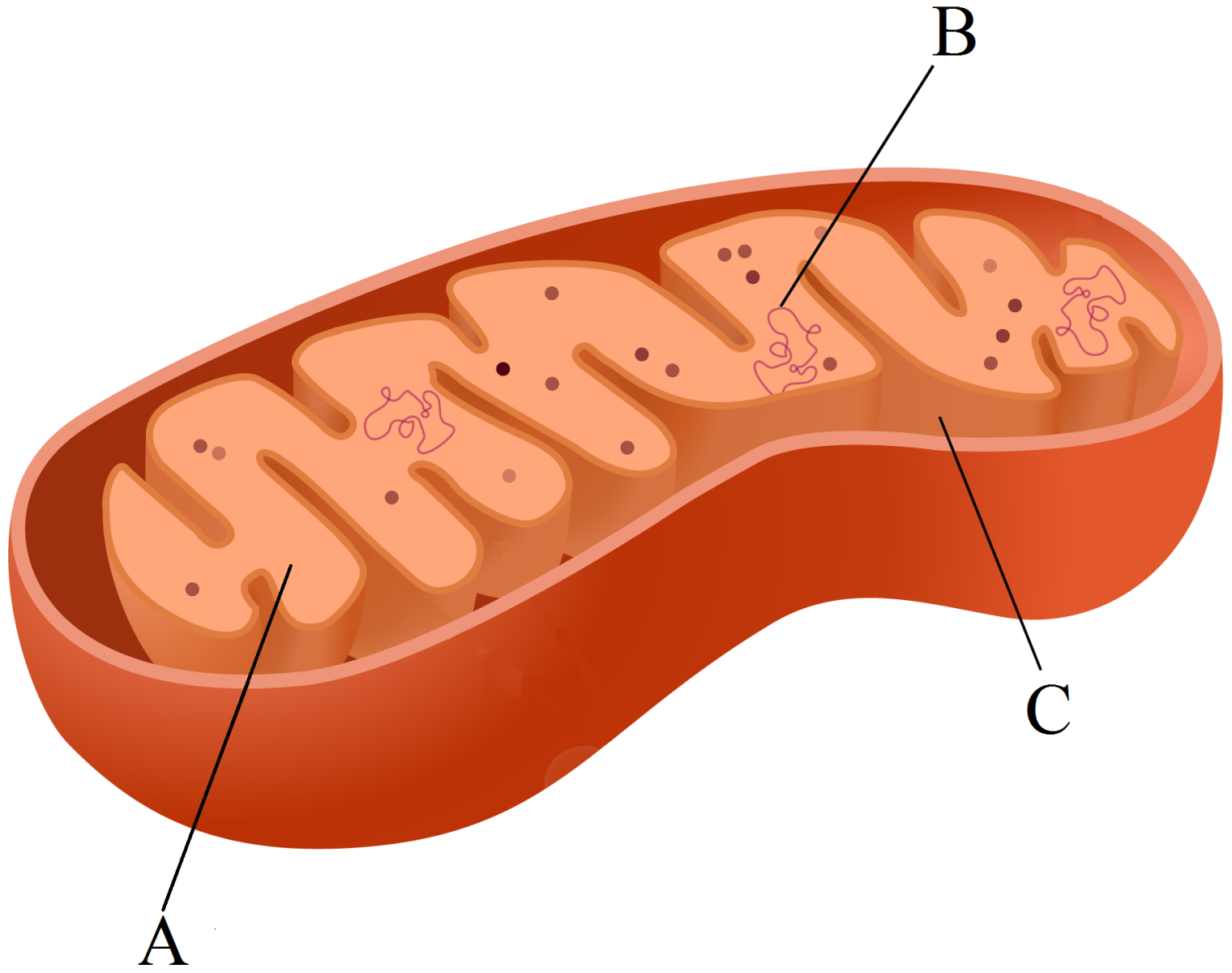
Fill in the blanks at A, B, and C as shown in diagram.
Answer
A - Inner membrane, B - Crista, C - Matrix.
View full question & answer
Question 431 Mark
If a tissue has at a given time 1024 cells, how many cycles of mitosis had the original parental single cell undergone?
Answer
$1024=(2)^n$
$n=$ No. of cycles
$1024=2^{10}=2^n \rightarrow n=10$
Thus, 10 cycles of mitosis are there in the original parental single cell.
View full question & answer
Question 441 Mark
At what stage of meiosis, formation of tetrads occurs Name it.
Answer
Tetrads are formed during pachytene of prophase-I (meiosis-I) At this stage crossing over occurs.
View full question & answer
Question 461 Mark
  1. During cell division in apical meristem, the nuclear membrane appears in which phase?
  2. At which point the polytene chromosomes appear to be attached?
Answer
  1. Mitosis cell division takes place in apical meristem.
  2. The nuclear membrane appears in telophase stage of mitosis.
View full question & answer
Question 471 Mark
Why are gas vacuoles named so?
Answer
Gas vacuoles are named so, because these are permeable to atmospheric gases and not to water.
View full question & answer
Question 481 Mark
Discuss about the synaptonemal complex?
Answer
It is a protein complex, visible with the electron microscope, that is the physical basis of the pairing of homologous chromosomes (synapsis) during meiosis. It assembled during zygotene as homologous chromosomes pair up, and it is unpaired during diplotene as homologous chromosomes separate.
View full question & answer
Question 501 Mark
There occurs a process in which two divisions of nucleus take place. Identify the process and also write about its different phases.
Answer
Karyokinesis is a series of uninterrupted changes before forming two daughter nuclei. Though karyokinesis is a continuous process, it has been divided into four phases. They are prophase, metaphase, anaphase and telophase.
View full question & answer
1 Marks Question - BIOLOGY STD 11 Science Questions - Vidyadip