Questions · Page 1 of 4

M.C.Q (1 Marks)

🎯

Test yourself on this topic

50 questions · timed · auto-graded

MCQ 11 Mark
The structural and functional unit of nerve tissue is:
  • A
    Nephron
  • Neuron
  • C
    Axon
  • D
    Cyton
Answer
Correct option: B.
Neuron
View full question & answer
MCQ 21 Mark
Potential difference across resting membrane is negative. This is due to differential distribution of the following ions :
  • $Na^+$ and $K^+$ions.
  • B
    $CO^{3++}$ and $CI$ ions.
  • C
    $Ca^{++}$ and $Mg^{++}$ ions.
  • D
    $Ca^{++}4$ and $CI^-$.
Answer
Correct option: A.
$Na^+$ and $K^+$ions.
Potential difference across resting membrane is negatively charged. This is due to differential distribution of $Na^+$ and $K^+$ions.
View full question & answer
MCQ 31 Mark
Longest cell in the human body is:
  • Nerve cell
  • B
    Leg muscle cell
  • C
    Bone cell
  • D
    Heart muscle cell
Answer
Correct option: A.
Nerve cell
View full question & answer
MCQ 41 Mark
Which of the following prevents internal reflection of light within the eye?
  • A
    Cornea
  • Choroid
  • C
    Sclera
  • D
    Conjunctiva
Answer
Correct option: B.
Choroid
View full question & answer
MCQ 51 Mark
Which one of the following does not act as a neurotransmitter?
  • Cortisone
  • B
    Epinephrine
  • C
    Acetylcholine
  • D
    Norepinephrine
Answer
Correct option: A.
Cortisone
View full question & answer
MCQ 61 Mark
During excited stage the axonal membrane is more permeable to which ion?
  • A
    Potassium.
  • B
    Calcium.
  • Sodium.
  • D
    Magnesium.
Answer
Correct option: C.
Sodium.
View full question & answer
MCQ 71 Mark
One function of parasympathetic nervous system is:
  • A
    Contraction of hair muscles.
  • B
    Stimulation of sweat glands.
  • C
    Acceleration of heart beat.
  • Constriction of pupil.
Answer
Correct option: D.
Constriction of pupil.
View full question & answer
MCQ 81 Mark
Function of iris is to:
  • A
    Move lens forward and backward.
  • B
    Refract light rays.
  • C
    Bring about movements of eye lids.
  • Alter the size of pupil.
Answer
Correct option: D.
Alter the size of pupil.
View full question & answer
MCQ 91 Mark
Unidirectional transmission of a nerve impulse through nerve fibres is due to the fact that:
  • A
    Nerve fibre is insulated by myelin sheath.
  • B
    Sodium pump starts operating only at the cyton and then continues into the nerve fibre.
  • Neurotransmitters are released by the axon endings and not by dendrites.
  • D
    Neurotransmitters are released by dendrites and not by axons.
Answer
Correct option: C.
Neurotransmitters are released by the axon endings and not by dendrites.
View full question & answer
MCQ 101 Mark
The part of internal ear responsible for hearing is:
  • A
    Cochlea.
  • B
    Semicircular canal.
  • C
    Utriculus.
  • Sacculus.
Answer
Correct option: D.
Sacculus.
View full question & answer
MCQ 111 Mark
Which of the following contains both afferent and efferent axon?
  • A
    Sensory nerves
  • B
    Motor nerves
  • Mixed nerves
  • D
    All of the above
Answer
Correct option: C.
Mixed nerves
View full question & answer
MCQ 121 Mark
The outermost layer of the brain is called:
  • A
    Piamater
  • Duramater
  • C
    Pericardium
  • D
    Grey matter
Answer
Correct option: B.
Duramater
View full question & answer
MCQ 131 Mark
$\text{CNS}$ is mostly made of:
  • A
    Motor neurons and sensory neurons.
  • B
    Sensory neurons and association neurons.
  • Association neurons.
  • D
    Motor neurons and association neurons.
Answer
Correct option: C.
Association neurons.
View full question & answer
MCQ 141 Mark
Coloured $($pigmented$)$ layer of eye is:
  • Choroid
  • B
    Sclerotic
  • C
    Retina
  • D
    All of the above
Answer
Correct option: A.
Choroid
View full question & answer
MCQ 151 Mark
During resting stage the axonal membrane is more permeable to which ion?
  • Potassium.
  • B
    Calcium.
  • C
    Sodium.
  • D
    Magnesium.
Answer
Correct option: A.
Potassium.
View full question & answer
MCQ 161 Mark
Which of the following is not controlled by medulla oblongata?
  • A
    Cardiovascular reflexes.
  • B
    Breathing.
  • C
    Gastric Reflexes.
  • Reflex Action.
Answer
Correct option: D.
Reflex Action.
View full question & answer
MCQ 171 Mark
A touch on the right hand stimulates neurons in:
  • Left somatic sensory area
  • B
    Right somatic sensory area
  • C
    Both $(a)$ and $(b)$
  • D
    None of these
Answer
Correct option: A.
Left somatic sensory area
View full question & answer
MCQ 191 Mark
The purplish red pigment rhodopsin contained in the rods type of photoreceptor cells of the human eye, is a derivative of:
  • Vitamin $A.$
  • B
    Vitamin $B_1$.
  • C
    Vitamin $D.$
  • D
    Vitamin $C.$
Answer
Correct option: A.
Vitamin $A.$
View full question & answer
MCQ 201 Mark
White matter consists of:
  • Nerve fibres with myelinated sheath
  • B
    Nerve fibres without myelinated sheath
  • C
    Scattered areolar tissue
  • D
    Nerve fibre with blood vessels
Answer
Correct option: A.
Nerve fibres with myelinated sheath
View full question & answer
MCQ 211 Mark
The function of vagus nerve innervating the heart is to:
  • A
    Initiate the heart beat.
  • Reduce the heart beat.
  • C
    Accelerate the heart beat.
  • D
    Maintain constant heart beat.
Answer
Correct option: B.
Reduce the heart beat.
View full question & answer
MCQ 221 Mark
The sympathetic nerves, in mammals arise from:
  • A
    Sacral nerves.
  • B
    Cervical nerves.
  • Thoraco$-$lumbar nerves.
  • D
    $\text{III, VII, IX}$ and $\text{X}$ cranial nerves.
Answer
Correct option: C.
Thoraco$-$lumbar nerves.
View full question & answer
MCQ 231 Mark
Third ventricle of brain is also known as:
  • A
    Metacoel
  • B
    Rhinocoel
  • C
    Paracoel
  • Diacoel
Answer
Correct option: D.
Diacoel
View full question & answer
MCQ 241 Mark
The nerve transmitter, produced at the synapse and neuromuscular junction, is:
  • A
    $\text{GTP}$
  • B
    $\text{ATP}$
  • Acetylcholine
  • D
    Phosphokinase
Answer
Correct option: C.
Acetylcholine
View full question & answer
MCQ 251 Mark
Chemicals which are released at the synaptic junction are called:
  • A
    Hormones.
  • Neurotransmitters.
  • C
    Cerebrospinal fluid.
  • D
    Lymph.
Answer
Correct option: B.
Neurotransmitters.
View full question & answer
MCQ 261 Mark
Iris is part of:
  • A
    Sclerotic.
  • B
    Choroid$/$ uvula.
  • Choroid and retina.
  • D
    Sclerotic and choroid.
Answer
Correct option: C.
Choroid and retina.
View full question & answer
MCQ 271 Mark
An area in the brain which is associated with strong emotions is:
  • A
    Cerebral cortex.
  • B
    Cerebellum.
  • Limbic system.
  • D
    Medulla.
Answer
Correct option: C.
Limbic system.
View full question & answer
MCQ 281 Mark
When we migrate from dark to light, we fail to see for some time but after a time visibility becomes normal. It is an example of:
  • A
    Accommodation
  • Adaptation
  • C
    Mutation
  • D
    Photoperiodism
Answer
Correct option: B.
Adaptation
View full question & answer
MCQ 291 Mark
The size of pupil is controlled by the:
  • A
    Ciliary muscles
  • B
    Suspensory ligaments
  • C
    Cornea
  • Iris muscles
Answer
Correct option: D.
Iris muscles
View full question & answer
MCQ 301 Mark
The layer of actively dividing cells of skin is termed as:
  • A
    Stratum compactum.
  • B
    Stratum corneum.
  • Stratum Malpighi$/$ stratum germinativum.
  • D
    Stratum lucidum.
Answer
Correct option: C.
Stratum Malpighi$/$ stratum germinativum.
View full question & answer
MCQ 311 Mark
Human eyeball consists of three layers and it encloses:
  • A
    Lens, iris, optic nerve.
  • Lens, acquous humor and vitreous humor.
  • C
    Cornea, lens, iris.
  • D
    Cornea, lens, optic nerve.
Answer
Correct option: B.
Lens, acquous humor and vitreous humor.
Human eye ball consist of three$, i.e.,$ layers sclera, choroid and retina and these layer enclose lens, aqueous humor and vitreous humor.
View full question & answer
MCQ 321 Mark
The cutaneous plexus and the papillary plexus consist of:
  • A
    Specialized cells for cutaneous sensations.
  • B
    A network of arteries to provide dermal supply.
  • A network of nerves to provide dermal sensation.
  • D
    Gland cells that release cutaneous secretions.
Answer
Correct option: C.
A network of nerves to provide dermal sensation.
View full question & answer
MCQ 341 Mark
Nissl's granules are characteristically found in the?
  • A
    Nephrons
  • B
    Neurons
  • Cytons
  • D
    Dendrites
Answer
Correct option: C.
Cytons
View full question & answer
MCQ 351 Mark
Myelin sheath is produced by $..........:$
  • A
    Neurons
  • B
    Nissl's granules
  • Schwann cells
  • D
    None of the above
Answer
Correct option: C.
Schwann cells
View full question & answer
MCQ 361 Mark
Outermost part of eye is called as:
  • Cornea
  • B
    Pupil
  • C
    Lris
  • D
    Lens
Answer
Correct option: A.
Cornea
Cornea is the Outermost part of the eye . It lies in front of the iris, the coloured part of the eye.
View full question & answer
MCQ 371 Mark
Frequency of sound is discriminated by:
  • A
    The type of fluid $-$ perilymph or endolymph.
  • The site at the cochlear coi.
  • C
    The intensity of movement of basilar fibres of cochlea.
  • D
    All of these.
Answer
Correct option: B.
The site at the cochlear coi.
View full question & answer
MCQ 381 Mark
Ecdysis is shedding of:
  • Stratum corneum.
  • B
    Epidermis.
  • C
    Dermis.
  • D
    Stratum Malpighi.
Answer
Correct option: A.
Stratum corneum.
View full question & answer
MCQ 391 Mark
Saltatory conduction of nerve impulse takes place through.
  • Myelinated fibre.
  • B
    Non$-$myelinated fibre.
  • C
    Grey fibres.
  • D
    None of these.
Answer
Correct option: A.
Myelinated fibre.
View full question & answer
MCQ 401 Mark
The threshold of a neuron is:
  • A
    The amount of excitatory neurotransmitter required to elicit an action potential.
  • B
    The membrane voltage at which an axon potential will be suppressed.
  • The membrane voltage at which the membrane potential develops into an action potential.
  • D
    The amount of inhibitory neurotransmitter required to inhibit an action potential.
Answer
Correct option: C.
The membrane voltage at which the membrane potential develops into an action potential.
View full question & answer
MCQ 411 Mark
Bipolar nerve cells and ganglion cells are found in the:
  • A
    Sclera
  • B
    Cochlea
  • Retina
  • D
    Cristae
Answer
Correct option: C.
Retina
View full question & answer
MCQ 421 Mark
The whitish part of eye mainly:
  • A
    Provides characteristic colour to the eye
  • Acts as protective layer for the eye
  • C
    Regulates the amount of light entering into the eye
  • D
    Perceives the sensations
Answer
Correct option: B.
Acts as protective layer for the eye
View full question & answer
MCQ 431 Mark
Which portion of the brain is responsible for various emotions such as pleasure, fear, and happiness?
  • A
    Thalamus.
  • B
    Reticular formation.
  • C
    Hypothalamus.
  • Limbic system.
Answer
Correct option: D.
Limbic system.
View full question & answer
MCQ 441 Mark
Which one of the followings is the function of parasympathetic nervous system?
  • A
    Stimulates oil and sweat glands in the skin
  • Pupil constriction.
  • C
    Acceleration of heart beat.
  • D
    Contraction of hair muscles.
Answer
Correct option: B.
Pupil constriction.
View full question & answer
MCQ 451 Mark
The gelatinous membrane covering the sensorys hair cells of the ear is known as:
  • A
    Reissner's membrane.
  • B
    Basilar membrane.
  • Tectorial membrane.
  • D
    Neuro$-$sensory membrane.
Answer
Correct option: C.
Tectorial membrane.
View full question & answer
MCQ 461 Mark
Nerve cells do not divide because they do not have:
  • A
    Mitochondria.
  • Centrosome.
  • C
    Nucleus.
  • D
    Golgi body.
Answer
Correct option: B.
Centrosome.
View full question & answer
MCQ 481 Mark
The black pigment in the eye which reduces the internal reflection is located in:
  • A
    Cornea
  • B
    Iris
  • C
    Sclerotic
  • Retina
Answer
Correct option: D.
Retina
View full question & answer
MCQ 491 Mark
Which of the following carry the pulses from the brain or spinal cord to the muscles?
  • A
    Mixed nerves
  • Motor nerves
  • C
    Sensory nerves
  • D
    All of the above
Answer
Correct option: B.
Motor nerves
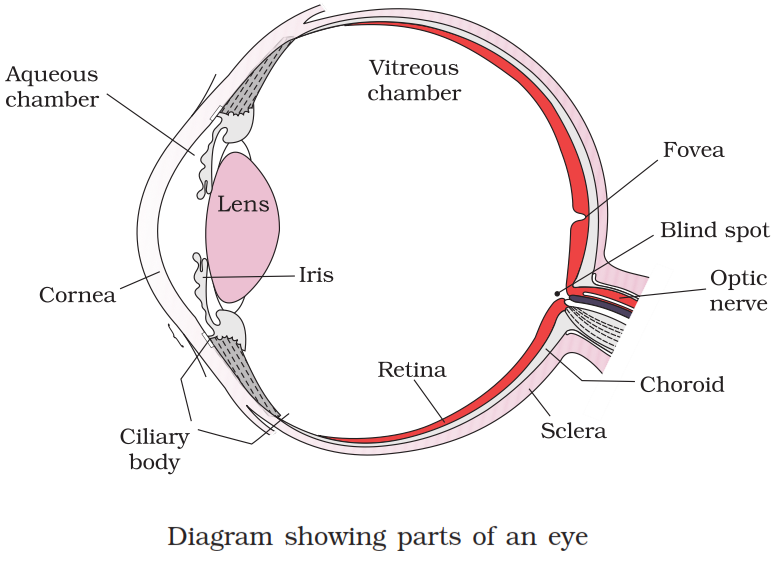
A motor nerve is a nerve that carries information from central nervous system or spinal nerves to the effector organ or gland to give response to the stimulus.
View full question & answer
MCQ 501 Mark
There are $...........$ pairs of cranial nerves arising from the brain.
  • A
    $8$
  • $12$
  • C
    $18$
  • D
    $25$
Answer
Correct option: B.
$12$
View full question & answer
M.C.Q (1 Marks) - BIOLOGY STD 11 Science Questions - Vidyadip