Question 11 Mark
Write Lewis dot symbols for atoms of the following elements: Na.
Answer
Na: There is only one valence electron in an atom of sodium. Hence, the Lewis dot structure is:

View full question & answer→Question 21 Mark
Which hybrid orbitals are used by carbon atoms in the following molecules?
$\mathrm{CH}_3 \mathrm{COOH}$
Answer
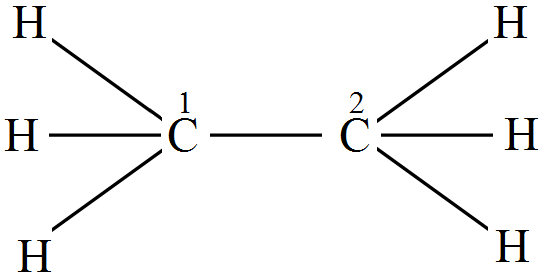
$\mathrm{C}_1$ is $\mathrm{sp}^3$ hybridized and $\mathrm{C}_2$ is $\mathrm{sp}^2$ hybridized. View full question & answer→Question 31 Mark
Write the resonance structures for$\text{NO}^-_3$
AnswerThe resonance structures are:$\text{NO}^-_2$
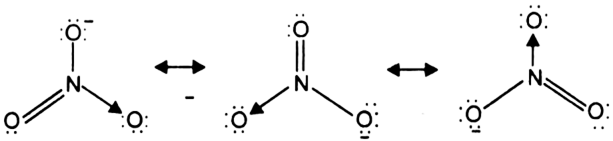
View full question & answer→Question 41 Mark
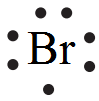
Write Lewis dot symbols for atoms of the following elements: Br.
Answer
Br: There are seven valence electrons in bromine. Hence, the Lewis dot structure is:
View full question & answer→Question 51 Mark
Discuss the shape of the following molecules using the VSEPR model:
$\text{AsF}_5$
Answer
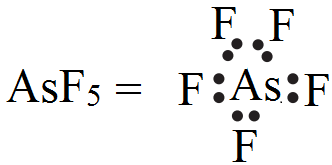
Bond pairs $=5$, lone pairs $=0$, i.e., it is of the type $A B_5$. Hence, shpe is trigonal bipyramidal. View full question & answer→Question 61 Mark
Write the resonance structures for
$\mathrm{NO}_2$.
AnswerThe resonance structures are:
$\mathrm{NO}_2$

View full question & answer→Question 71 Mark
What is the total number of sigma and pi bonds in the following molecules?
$\mathrm{C}_2\mathrm{H}_2$
View full question & answer→Question 81 Mark
Which hybrid orbitals are used by carbon atoms in the following molecules?
$\mathrm{CH}_3-\mathrm{CH}=\mathrm{CH}_2$;
Answer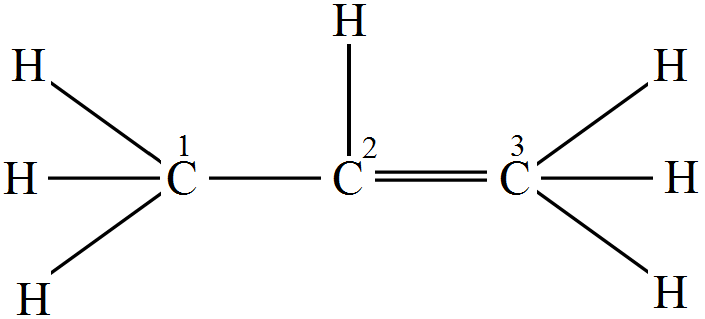
$C_1$ is $s p^3$ hybridized, while $C_2$ and $C_3$ are $s p^2$ hybridized. View full question & answer→Question 91 Mark
Which hybrid orbitals are used by carbon atoms in the following molecules?
$\mathrm{CH}_3-\mathrm{CHO}$
Answer
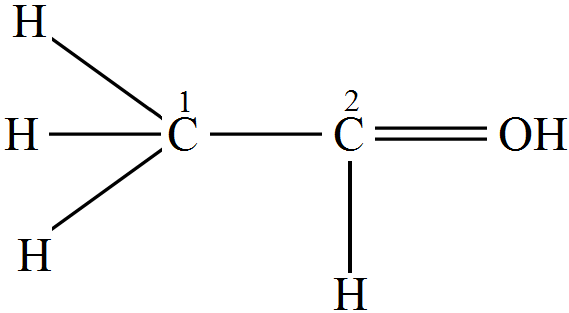
$\mathrm{C}_1$ is $\mathrm{sp}^3$ hybridized and $\mathrm{C}_2$ is $\mathrm{sp}^2$ hybridized. View full question & answer→Question 101 Mark
Considering x -axis as the internuclear axis which out of the following will not form a sigma bond and why? (a) 1 s and 1 s (b) 1 s and $2 \mathrm{p}_{\mathrm{x}}$ (c) $2 \mathrm{p}_{\mathrm{y}}$ and $2 \mathrm{p}_{\mathrm{y}}(\mathrm{d}) 1 \mathrm{~s}$ and 2 s .
AnswerIt will not form a s-bond because taking x -axis as the intemuclear axis, there will be lateral overlap between the two $2 p_y$ orbitals forming a $\Pi$-bond.
View full question & answer→Question 111 Mark
Discuss the shape of the following molecules using the VSEPR model:PH ${ }_3$
Answer
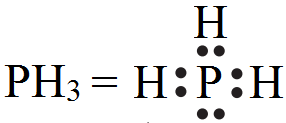
Bond pairs $=3$, lone pair $=1$, i.e., it is of the type $A B_3 L$. Hence shape is Trihonal. View full question & answer→Question 121 Mark
Write the resonance structures for
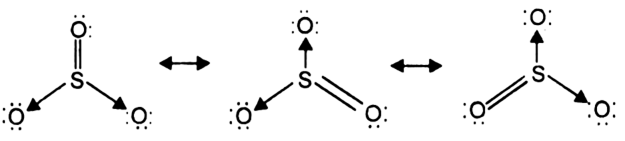
$\mathrm{SO}_3$
AnswerThe resonance structures are:
$\mathrm{SO}_3$
View full question & answer→Question 131 Mark
Write Lewis dot symbols for atoms of the following elements: B.
Answer
B: There are 3 valence electrons in Boron atom. Hence, the Lewis dot structure is:

View full question & answer→Question 141 Mark
Write Lewis dot symbols for atoms of the following elements: Mg.
Answer
Mg: There are two valence electrons in Mg atom. Hence, the Lewis dot symbol for Mg is:

View full question & answer→Question 151 Mark
Write Lewis dot symbols for atoms of the following elements: N.
Answer
N: There are five valence electrons in an atom of nitrogen. Hence, the Lewis dot structure is:

View full question & answer→Question 161 Mark
Discuss the shape of the following molecules using the VSEPR model: $\mathrm{SiCl}_4$
Answer
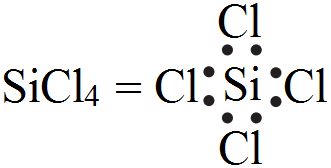
Bond pairs $=4$, lone pairs $=0$, i.e., it is of the type $A B_4$. Hence, shape is tetrahedral. View full question & answer→Question 171 Mark
Discuss the shape of the following molecules using the VSEPR model: $\mathrm{H}_2 \mathrm{S}$
Answer
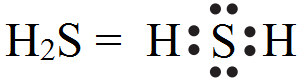
Bond pairs $=2$, Ione pairs $=$, i.e., it is of the type $A B_2 L_2$. Hence, shape is bent $/ V$ - shaped. View full question & answer→Question 181 Mark
Which hybrid orbitals are used by carbon atoms in the following molecules?
$\mathrm{CH}_3-\mathrm{CH}_2-\mathrm{OH} $;
Answer
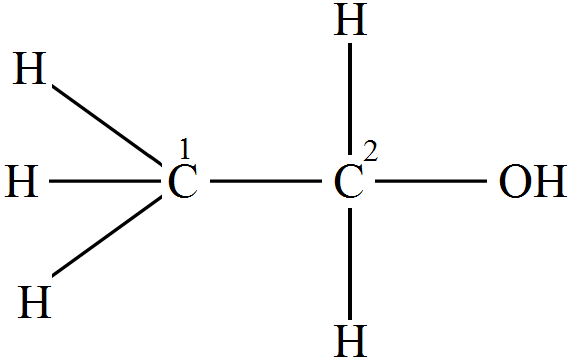
Both $\mathrm{C}_1$ and $\mathrm{C}_2$ are $\text{sp}^3$ hybridized. View full question & answer→Question 191 Mark
Write the significance of a plus and a minus sign shown in representing the orbitals.
AnswerPlus and minus sign is used to identify the nature of electrons wave. Plus (+ve) sign denotes crest, while (-ve) sign denotes trough.
View full question & answer→Question 201 Mark
What is the total number of sigma and pi bonds in the following molecules?
$\mathrm{C}_2\mathrm{H}_4$
View full question & answer→Question 211 Mark
Which hybrid orbitals are used by carbon atoms in the following molecules?
Answer
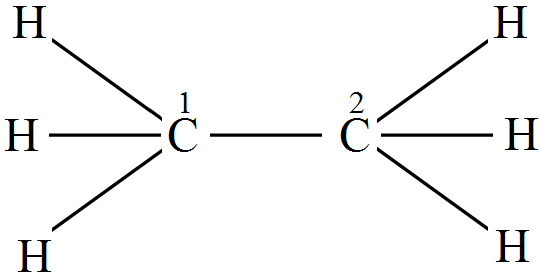
Both $\mathrm{C}_1$ and $\mathrm{C}_2$ are $\mathrm{sp}^3$ hybridized. View full question & answer→Question 221 Mark
Discuss the shape of the following molecules using the VSEPR model:
$\mathrm{BCl}_3$
Answer
The centar atom has only 3 bond pairs and no lone pair, i.e, it is type $\mathrm{AB}_3$ Hence, shape is triangular palnar. View full question & answer→Question 231 Mark
Write Lewis dot symbols for atoms of the following elements:O.
Answer
O: There are six valence electrons in an atom of oxygen. Hence, the Lewis dot structure is:

View full question & answer→Question 241 Mark
Discuss the shape of the following molecules using the VSEPR model:
$\mathrm{BeCl}_2$
Answer
the central atom has only two bond pairs and thre is no lone pair, i.e, it is of the type $\mathrm{AB}_2$. Hence,shape is linear. View full question & answer→Question 251 Mark
Why $\mathrm{KHF}_2$ exists but $\mathrm{KHCl}_2$ does not?
AnswerDue to H-bonding in HF, we have
$\text{H}-\text{F}\cdots\text{H}-\text{F}\cdots\text{H}-\text{F}\cdots$
This can dissociate to give $\text{HF}^-_2$ ion and hence, $\mathrm{KHF}_2$ exists but there is no H-bonding in $\text{H}-\text{Cl}.$ So, $\text{HCl}^-_2$ ion does not exist and hence, $\mathrm{KHCl}_2$ also does not exist.
View full question & answer→Question 261 Mark
Amongst the following elements whose electronic configurations are given below, which one has the highest ionisation enthalpy?
$[\text{Ne}]\text{3s}^2\text{3p}^1,[\text{Ne}\text{3s}^2\text{3p}^3,[\text{Ne}]\text{3s}^2\text{3p}^2,[\text{Ar}]\text{d}^{10}4\text{s}^2\text{4}\text{p}^3$
Answer$[\mathrm{Ne}] 3 \mathrm{s}^2 ~3 \mathrm{p}^3$, it is due to smaller size and stable electronic configuration.
View full question & answer→Question 271 Mark
ICl is more or less reactive than $\mathrm{C}_1$ ? Why?
AnswerIt is due to lower bond dissociation energy due to longer bond length and more polarity in ICl than $\mathrm{Cl}_2$ and less effective overlapping between 5 p orbital of I and 3 p orbital of Cl.
View full question & answer→Question 281 Mark
What is the state of hybridisation of each carbon atom in $\mathrm{C}_6 \mathrm{H}_6$?
AnswerEach 'C' is $\mathrm{sp}^2$ hybridized because each 'C' is attached to double bond.
View full question & answer→Question 291 Mark
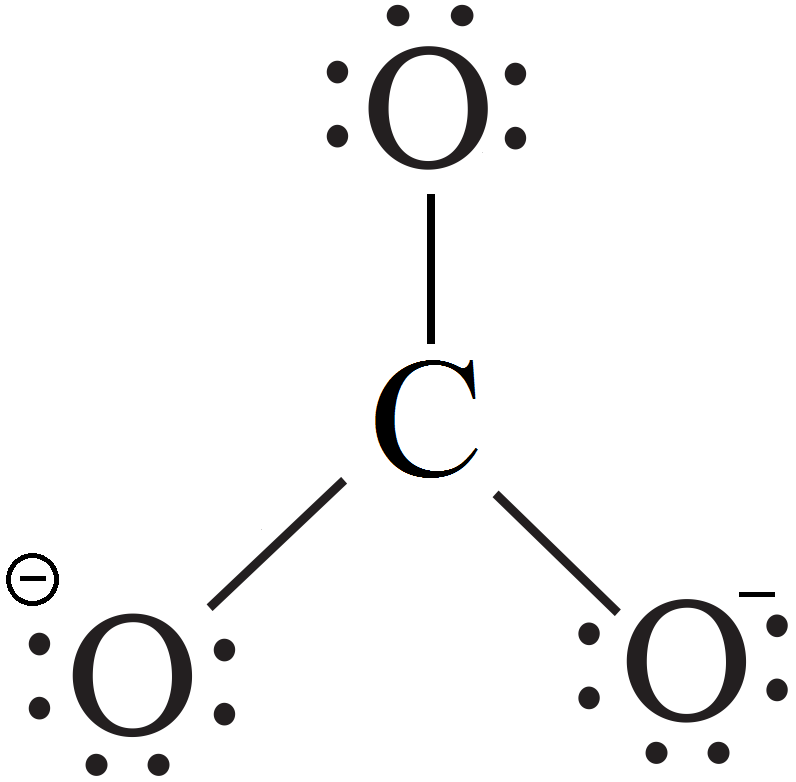
Which of the following does not show resonance and why? $\text{CO}^{2-}_3,\text{BO}^-_3,\text{SO}^{2-}_4$
Answer
$\text{BO}^{-}_3$because it does not have π-bond whereas others have $\pi-$bonds.
View full question & answer→Question 301 Mark
Why is solid NaCl non-conductor of electricity?
AnswerIn solid $\mathrm{NaCl}, \mathrm{Na}^{+}$and $\mathrm{Cl}^{-}$are not free to move, therefore, ions will not be able to carry current.
View full question & answer→Question 311 Mark
Can we have a diatomic molecule with its ground state molecular orbitals full with electrons? Give a reason for your answer.
AnswerNo, because bond order becomes zero, e.g. in case of $\mathrm{He}_2, \mathrm{Be}_2, \mathrm{Ne}_2$, etc. Note that in $\mathrm{H}_2, \sigma 1 \mathrm{s}$ molecular orbital is full but $\sigma 1 \mathrm{s}$ is empty.
View full question & answer→Question 321 Mark
Out of $\text{H}-\text{H}$ and $\text{Cl}-\text{Cl}$ bonds, which is expected to have higher bond enthalpy and why?
Answer$\text{H}-\text{H}$ bond has higher bond enthalpy because it has smaller bond length and higher bond dissociation enthalpy due to more extent of overlapping as compared to $\text{Cl}_2$.
View full question & answer→Question 331 Mark
What type of hybridisation is involved in $\mathrm{SF}_6$ ?
Answer$\mathrm{SF}_6, \mathrm{~S}$ is the central atom with six valence electrons.
$\therefore$ Number of hybrid orbitals $=\frac{1}{2}[6+6-0+0]=6$
Hence, the hybridisation involved in $\mathrm{sp}^3 \mathrm{~d}^2$.
View full question & answer→Question 341 Mark
What will be the molecular formula of the compound formed from B and C?
Answer$\text{BC}_3$ will be molecular formula.
View full question & answer→Question 351 Mark
$\text{NH}_3$ and $\text{NH}^+_4$ have what covalencies?
Answer$\text{NH}_3$ has covalency 3 because it forms 3 covalent bonds whereas in $\text{NH}^+_4$ 'N' has covalency 4 because it forms 4 covalent bodns.
View full question & answer→Question 361 Mark
What type of atomic orbitals can overlap to form molecular orbitals?
AnswerAtomic orbitals with comparable energies and proper orientation overlap to form molecular orbitals.
View full question & answer→Question 371 Mark
What type of hybridisation is present in C-atoms of $\text{C}_{60}$ allotrope called fullerene?
Answer$\text{sp}^2$, each C-atom is linked to two other C-atoms.
View full question & answer→Question 381 Mark
Why does $\mathrm{BF}_3$ behave as Lewis acid?
AnswerIn $\mathrm{BF}_3$ there are six electrons around Boron after sharing with fluorine atoms and hence Boron is electron deficient. B in $\mathrm{BF}_3$ can accept lone pair of electrons in the vacant 2 p orbital of Boron and so behaves as Lewis acid as its octet is not complete.
View full question & answer→Question 391 Mark
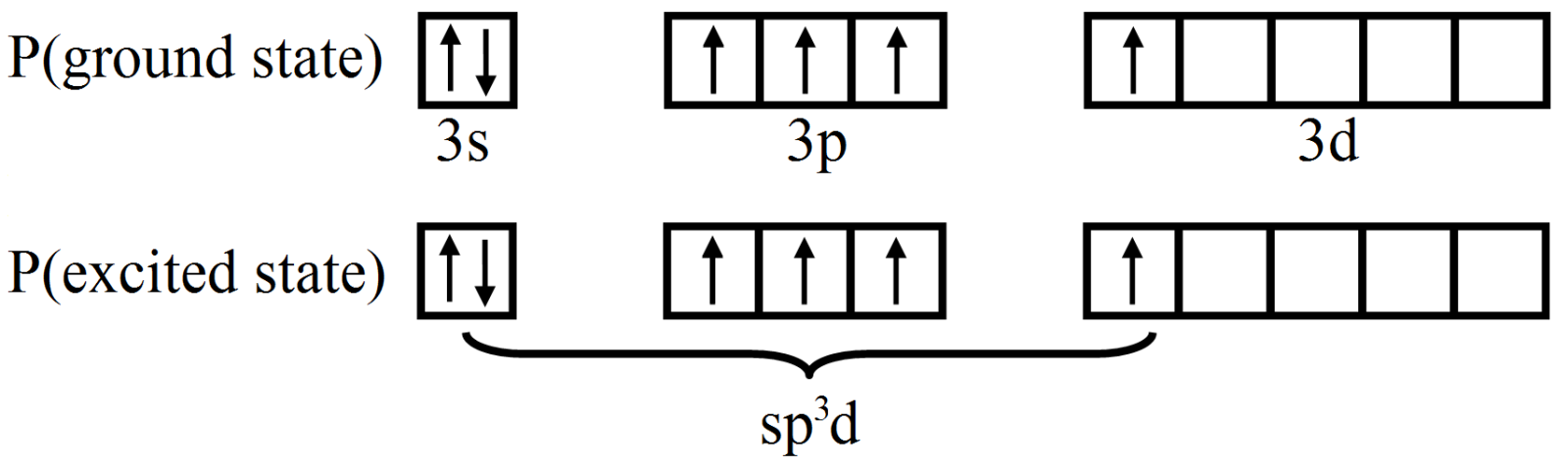
Explain why $\mathrm{PCl}_5$ is trigonal bipyramidal whereas $\mathrm{IF}_5$ is square pyramidal.
Answer$\mathrm{PCl}_5$ The ground state and the excited state outer electronic configurations of phosphorus (Z = 15) are represented below:
View full question & answer→Question 401 Mark
Which molecule/ ion out of the following does not contain unpaired electrons?
$\text{N}^+_2,\text{O}_2,\text{O}^{2-}_2,\text{B}_2$
Answer$\text{O}^{2-}_2$ does not contain unpaired electron.
View full question & answer→Question 411 Mark
Which of the following molecules show super octet?
$\mathrm{CO}_2, \mathrm{ClF}_3, \mathrm{SO}_2, \mathrm{IF}_5$
Answer$\mathrm{ClF}_3$, and $\mathrm{IF}_5$, are super octet molecules.
View full question & answer→Question 421 Mark
$\text{BH}^-_4{}$ and $\text{NH}^+_4$ are iso structural. Explain.
AnswerBoth have tetrahedral shape, i. e. four lobes of $\text{sp}^3$ hybridised orbitals so called iso structural.
View full question & answer→Question 431 Mark
What is the total number of sigma and pi bonds in the following molecules?
$\text{C}_2\text{H}_4$
View full question & answer→Question 441 Mark
Why are $\text{NH}_3$, glucose, and alcohol soluble in water, although they are covalent compounds?
AnswerThey can form H-bonds with water because they are polar covalent compounds and have 'H' attached to ‘N' and O.
View full question & answer→Question 451 Mark
In which of the following molecule/ ion all the bonds are not equal? $\text{XeF}_4,\text{BF}^-_4,\text{C}_2\text{H}_4,\text{SiF}_4$
AnswerIn $\mathrm{C}_2\mathrm{H}_4$ all bonds are not equal.
View full question & answer→Question 461 Mark
Indicate whether the following statement is true or false. Justify your answer in not more than three lines. The dipole moment of $\mathrm{CH}_3 \mathrm{F}$ is greater than that of $\mathrm{CH}_3 \mathrm{CL}$.
AnswerTrue. Explanation: This is because $\text{C}-\text{F}$ bond is more polar than $\text{C}-\text{Cl}$ bond due to larger electronegativity of F than Cl. As a result, the resultant dipole moment of $\mathrm{CH}_3 \mathrm{F}$ is more.
View full question & answer→Question 471 Mark
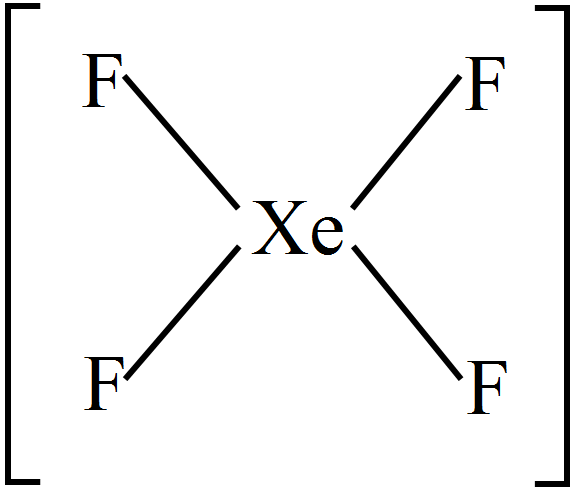
Predict the geometry of $\mathrm{XeF}_4$ molecule.
Answer$\mathrm{XeF}_4=4 \mathrm{bp}+2 \mathrm{lp}$ (This is because Xe contains 8 valence electrons) = square planar geometry.
View full question & answer→Question 481 Mark
Account for the following. The experimentally determined $\text{N}-\text{F}$ bond length in $\mathrm{NF}_3$ is greater than the sum of the single covalent radii of N and F.
AnswerThis is because both N and F are small and hence, have high electron density. So, they repel the bond pairs thereby making the N-F bond length larger.
View full question & answer→Question 491 Mark
Although very useful in a large number of cases, the octet rule has many exceptions. Give two examples to support this statement.
AnswerIn $\mathrm{BCl}_3$ and $\mathrm{PCl}_5$, after sharing, there are 6 and 10 electrons respectively.
In $\mathrm{BCl}_3$ 'B' has 3 valence electrons, it shares 3 electron with Cl and has 6 electrons after sharing. In $\mathrm{PCl}_5 \mathrm{P}$ has 5 valence electrons, it shares 5 with chlorine atoms and has 10 electrons.
View full question & answer→Question 501 Mark
Isostructural species are those which have the same shape and hybridisation. Among the given species identify the isostructural pairs.
$\text{NH}_3,\ \text{BF}_3,\ \text{BF}^-_4,\ \text{NH}^+_4,\ \text{BCl}_3,\ \text{BrCl}_3,\ \text{NH}_3,\ \text{NO}^-_3$
Answer$\text{BF}^-_4$ and $\text{Nh}^+_4$ both are $\text{sp}^3$ hybridized and tetrahedral shape.
View full question & answer→