Questions · Page 2 of 2

2 Marks Questions

Question 512 Marks
Find the equation of a circle with centre $(2, 2)$ and passes through the point $(4, 5).$
Answer
The equation of circle is
$(x - h)^2 + (y - k)^2 = r^2 . . . (i)$
Since the circle passes through point $(4, 5)$ and co-ordinates of centre are $(2, 2).$
$\therefore$ radius of circle $= \sqrt {{{(4 - 2)}^2} + {{(5 - 2)}^2}} = \sqrt {4 + 9} = \sqrt {13}$
Now the equation of required circle is
$(x - 2)^2 + (y - 2)^2 = (\sqrt{13})^2$
$\Rightarrow x^2 + 4 - 4x + y^2 + 4 - 4y = 13$
$\Rightarrow x^2 + y^2 - 4x - 4y - 5 = 0$
View full question & answer
Question 522 Marks
Find the equation of the circle passing through $(0, 0)$ and making intercepts a and b on the coordinate axes.
Answer
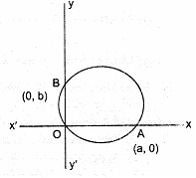
The circle makes intercepts a with $x-$axis and b with $y-$axis.
\therefore $OA = a$ and $OB = b$
So the co-ordinates of $A$ are $(a, 0)$ and $B$ are $(0, b)$
Now the circle passes through three points $O(0, 0), A (a, 0)$ and $B(0, b)$
Putting the co-ordinates of three points in the equation of circle.
$x^2 + y^2 + 2gx + 2fy + c = 0. . . (i)$
$c = 0$
$a^2 + 2ga = 0 \Rightarrow a(a + 2 g) = 0 \Rightarrow g = \frac{{ - 1}}{2}a$
$b^2 + 2fb = 0 \Rightarrow b (b + 2 f ) = 0 \Rightarrow f = \frac{{ - 1}}{2}b$
Putting these values of $g, f$ and c in $(i)$ we have
${x^2} + {y^2} + 2 \times \frac{{ - 1}}{2}ax + 2 \times \frac{{ - 1}}{2}by + 0 = 0$
$\Rightarrow x^2 + y^2 - ax - by = 0$
which is required equation of circle.
View full question & answer
Question 532 Marks
Find the equation of the circle with centre $(0, 2)$ and radius $2$
Answer
Here $h = 0, k = 2$ and $r = 2$
The equation of circle is
$(x - h)^2 + (y - k)^2 = r^2$ 
$\therefore (x - 0)^2 + (y - 2)^2 = (2)^2$
$\Rightarrow x^2 + y^2 + 4 - 4y = 4$
$x^2 + y^2 - 4y = 0$
Which is required equation of circle.
View full question & answer
Question 542 Marks
Find the equation of the parabola which is symmetric about the y-axis, and passes through the point $(2, -3).$
Answer
Since the parabola is symmetric about the y-axis and has its vertex at the origin, the equation is of the form $x^2 = 4ay$ or $x^2 = -4ay,$
But the parabola passes through $(2,–3)$ which lies in the fourth quadrant, it must open downwards.
Thus the equation is of the form $x^2 = -4ay$
Since the parabola passes through $( 2, -3),$ we have
$2^{2}=-4 a(-3), \text { i.e., } a=\frac{1}{3}$
Therefore, the equation of the parabola is
$x^{2}=-4\left(\frac{1}{3}\right) y, $ i.e., $3 x^2 = -4y$
View full question & answer
Question 552 Marks
Find the equation of the parabola with vertex at $(0, 0)$ and focus at $(0, 2).$
Answer
Given, the vertex is $(0, 0)$ and focus is at $(0, 2)$ which lies on Y-axis.
The Y axis is the axis of parabola.
Therefore, equation of parabola is of the form
$x^2 = 4ay$
$x^2 = 4(2)y$ i.e., $x^2 = 8y$
View full question & answer
Question 562 Marks
Find the equation of the parabola with focus $(2, 0)$ and directrix $x = – 2.$
Answer
Given that the directrix is $x = – 2$ and the focus is $(2, 0),$
Since the focus $(2, 0)$ lies on the x-axis, the x-axis itself is the axis of the parabola.
Hence the equation of the parabola is of the form either $y^2 = 4ax$ or $y^2 = -4ax.$
Since the directrix is $x = – 2$ and the focus is $(2, 0),$
the parabola is to be of the form $y^2 = 4ax$ with $a = 2.$
Hence the required equation is $y^2= 4(2)x = 8x$
View full question & answer
Question 572 Marks
Find the coordinates of focus, axis, the equation of directrix and latus rectum of parabola $y^2 = 8x.$
Answer
We have, equation of parabola is $y^2 = 8x.$
The given equation involves $y^2,$ so the axis of symmetry is along $X-$axis. The coefficient of $x$ is positive, so the parabola opens to right.
On comparing with the given equation $y^2 = 4ax,$ we get,
$a = 2$
Thus, focus $= (2, 0)$
Equation of directrix, $x = - 2$
Length of latus rectum is $4a = 4 \times 2 = 8.$
View full question & answer
Question 582 Marks
Find the equation of the circle which passes through the points $(2, - 2)$ and $(3, 4)$ and whose centre lies on the line $x + y = 2.$
Answer
Let the equation of circle with centre $(h, k)$ and radius $r$ be $(x - h)^2 + (y - k)^2 = r^2 ...(i)$
Since, circle passes through the points $(2, - 2)$ and $(3, 4),$ so the points $(2, - 2)$ and $(3, 4)$ will lie on Eq. $(i).$
$\therefore (2 - h)^2 + (- 2 - k)^2 = r^2 ...(ii)$
and $(3 - h)^2 + (4 - k)^2 = r^2...(iii)$
Now, from Eqs. $(ii)$ and $(iii),$ we get
$(2 - h)^2 + (- 2 - k)^2 = (3 - h)^2 + (4 - k)^2$ 
$\Rightarrow 4 + h^2 - 4h + 4 + k^2 + 4k = 9 + h^2 - 6h + 16 + k^2- 8k$
$\Rightarrow 2h + 12k = 17 ...(iv)$
Also, given that centre $(h, k)$ lies on $x + y = 2.$ So, it will satisfy it.
$\therefore h + k = 2 ...(v)$
On solving Eqs. $(iv)$ and $(v)$, we get
$h = 0.7, k = 1.3$
Now, $r^2 = (2 - 0.7)^2 + (- 2 - 1.3)^2 = 1.69 + 10.89 = 12.58$
On putting $h = 0.7, k = 13$ and $r^2 = 12.58$ in Eq. (i), we get
$(x - 0.7)^2 + (y - 1.3)^2 = 12.58$
which is the required equation of circle.
View full question & answer
Question 592 Marks
Find the centre and the radius of the circle: $x^2 + y^2 + 8x + 10y – 8 = 0$
Answer
The given equation is $(x^2 + 8x) + (y^2 + 10y) = 8$
Now, completing the squares within the parenthesis, we get
$(x^2 + 8x + 16) + (y^2 + 10y + 25) = 8 + 16 + 25$
i.e. $(x + 4)^2 + (y + 5)^2 = 49$
i.e. $\{x – (– 4)\}^2 + \{y – (–5)\}^2 = 49 [$comparing with $\{x – (h)\}^2 + \{y – (k)\}^2 = r^2,$ centre$(-h, -k)$ and $r$ radius$]$
Therefore, the given circle has centre at $(– 4, –5)$ and radius $7.$
View full question & answer
Question 602 Marks
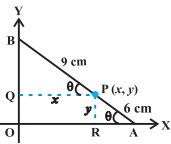
$A$ rod $AB$ of length $15\ cm$ rests in between two coordinate axes in such a way that the end point $A$ lies on x-axis and end point $B$ lies on y-axis. $A$ point $P(x, y)$ is taken on the rod in such a way that $AP = 6\ cm.$ Show that the locus of $P$ is an ellipse.
Answer
Let $AB$ be the rod making an angle $\theta $ with $OX$ as shown in figure and $P (x, y)$ the point on it such that $AP = 6$ cm
Since $AB = 15$ cm, we have

$PB = 9$ cm.
From $P$ draw $PR$ and $PQ$ perpendiculars on $x-$axis and $y-$axis, respectively.
From $\Delta \mathrm{PBQ}, \cos \theta=\frac{x}{9}$
From $\Delta \mathrm{PRA}, \sin \theta=\frac{y}{6}$
Since $\cos^2 \theta + \sin^2 \theta = 1$
$\left(\frac{x}{9}\right)^{2}+\left(\frac{y}{6}\right)^{2}=1$
or $\frac{x^{2}}{81}+\frac{y^{2}}{36}=1$
Therefore, locus of $P$ is an ellipse.
View full question & answer
Question 612 Marks
Find the equation of the hyperbola with foci $(0, \pm 3)$ and vertices $\left(0, \pm \frac{\sqrt{11}}{2}\right)$
Answer
Since the foci is on the y-axis, the equation of the hyperbola is of the form $\frac{y^{2}}{a^{2}}-\frac{x^{2}}{b^{2}}=1$given,
foci $(0, \pm 3)$ and vertices $\left(0, \pm \frac{\sqrt{11}}{2}\right)$
Since vertices are $\left(0, \pm \frac{\sqrt{11}}{2}\right), \quad a=\frac{\sqrt{11}}{2}$
Also, since foci are $(0, ± 3); c= ae = 3$ and $b^2 = c^2 – a^2 =  \frac{25}{4}$
Therefore, the equation of the hyperbola is $\frac{y^{2}}{\left(\frac{11}{4}\right)}-\frac{x^{2}}{\left(\frac{25}{4}\right)} = 1,$
​​​​​​​ i.e., $100 y^2 – 44 x^2 = 275$
View full question & answer
2 Marks Questions - Page 2 - MATHS STD 11 Science Questions - Vidyadip