Questions · Page 4 of 4

M.C.Q (1 Marks)

MCQ 1511 Mark
The domain of definition of $\text{f(x)}=\sqrt{\frac{\text{x}+3}{(2-\text{x})(\text{x}-5)}}$ is:
  • $(-\infty,-3]\cup(2,5)$
  • B
    $(-\infty,-3]\cup(2,5)$
  • C
    $(-\infty,-3]\cup[2,5]$
  • D
    None of these.
Answer
Correct option: A.
$(-\infty,-3]\cup(2,5)$
$\text{f(x)}=\sqrt{\frac{\text{x}+3}{(2-\text{x})(\text{x}-5)}}$
For $f(x)$ to be defined,
$(2-\text{x})(\text{x}-5)\neq0$
$\Rightarrow\text{x}\neq2,5\ ...(\text{i})$
Also, $\frac{(\text{x}+3)}{(2-\text{x})(\text{x}-5)}\geq0$
$\Rightarrow\frac{(\text{x}+3)(2-\text{x})(\text{x}-5)}{(2-\text{x})^2(\text{x}-5)^2}\geq0$
$\Rightarrow(\text{x}+3)(\text{x}-2)(\text{x}-5)\leq0$
$\Rightarrow\text{x}\in\big(-\infty,-3\big]\cap(2,5)\ ...(\text{ii})$
From $(i)$ and $(ii)$
$\text{x}\in\big(-\infty,-3\big]\cup(2,5)$
View full question & answer
MCQ 1521 Mark
If $A \times B = \{(1, a), (1, b), (1, c), (2, a), (2, b), (2, c)\}$ then find set $A:$
  • A
    $\{1\}$
  • $\{1, 2\}$
  • C
    $\{1, a\}$
  • D
    $\{a, b, c\}$
Answer
Correct option: B.
$\{1, 2\}$
In each ordered pair of $A \times B$, first element belongs to set $A$ and second element belongs to set $B.$
$1, 2 \in \text{A}$
so, $\text{A} = {1, 2}.$
View full question & answer
MCQ 1531 Mark
If $f(x) = ex$ and $g(x) = \log ex$ then the value of $fog(1)$ is:
  • A
    $0$
  • $1$
  • C
    $-1$
  • D
    None of these
Answer
Correct option: B.
$1$
Given, $f(x) = e^x$
and $g(x) = \log x$
$fog(x) = f(g(x))$
$= f(\log x)$
$= e^{\log x}$
$= x$
So, $fog(1) = 1$
View full question & answer
MCQ 1541 Mark
If $f(x) = (x - 1)(x - 3)(x - 4)(x - 6) + 19$ for all real value of $x$ is:
  • positive
  • B
    negative
  • C
    zero
  • D
    none of these
Answer
Correct option: A.
positive
View full question & answer
MCQ 1551 Mark
The function $f(x) = x - [x]$ has period of:
  • $1$
  • B
    $2$
  • C
    $3$
  • D
    $4$
Answer
Correct option: A.
$1$
Let $T$ is a positive real number.
Let $f(x)$ is periodic with period $T.$
Now, $f(x + T) = f(x),$ for all $\text{x} \in \text{R}$
$\Rightarrow x + T - [x + T] = x - [x],$ for all $ \text{x} \in \text{R}$
$\Rightarrow [x + T] - [x] = T,$ for all $ \text{x} \in \text{R}$
Thus, there exist $T > 0$ such that $f(x + T) = f(x)$ for all $\text{x} \in \text{R}$
Now, the smallest value of $T$ satisfying $f(x + T) = f(x)$ for all $\text{x} \in \text{R}$ is $1$
So, $f(x) = x - [x]$ has period $1$
View full question & answer
MCQ 1561 Mark
If $f(x) = 3x^4 - 5x^2 + 9,$ then value of $f (x - 1)$ is:
  • A
    $3x^4 + 12x + 13x + 2x + 7$
  • B
    $3x^4 - 12x - 13x - 2x - 7$
  • $3x^4 - 12x + 13x - 2x + 7$
  • D
    $3x^4 - 12x - 13x + 2x + 7$
Answer
Correct option: C.
$3x^4 - 12x + 13x - 2x + 7$
View full question & answer
MCQ 1571 Mark
If $(a, b) = (x, y)$ then$............$
  • A
    $a = x$
  • B
    $a = y$
  • C
    $a = y$ and $b = x$
  • $a = x$ and $b = y$
Answer
Correct option: D.
$a = x$ and $b = y$
Two ordered pairs are said to be equal if and only if their corresponding elements are equal
i.e. $a = x$ and $b = y.$
View full question & answer
MCQ 1581 Mark
If $\text{x}\neq1$ and $\text{f(x)}=\frac{\text{x}+1}{\text{x}-1}$ is a real function, then $\text{f}(\text{f}(\text{f(2)}))$ is:
  • A
    $1$
  • B
    $2$
  • $3$
  • D
    $4$
Answer
Correct option: C.
$3$
$\text{f(x)}=\frac{\text{x}+1}{\text{x}-1}$
$\text{f}(\text{f}(\text{f(2)}))$
$=\text{f}\Big(\text{f}\Big(\frac{2+1}{2-1}\Big)\Big)$
$=\text{f}(\text{f}(3))$
$=\text{f}\Big(\frac{3+1}{3-1}\Big)$
$=\text{f}(2)=3$
View full question & answer
MCQ 1591 Mark
Let $R$ be a relation from a set $A$ to a set $B,$ then:
  • A
    $\text{ R} = \text{A}∪\text{B}$
  • B
    $\text{ R} = \text{A}\cap\text{B}$
  • $ ​​\text{R} \subseteq \text{A}\times{\text{B}}$
  • D
    $ ​​\text{R} \subseteq \text{B}\times{\text{A}}$
Answer
Correct option: C.
$ ​​\text{R} \subseteq \text{A}\times{\text{B}}$
View full question & answer
MCQ 1601 Mark
The domain of definition of the function $\text{f(x)}=\sqrt{\text{x}-1}+\sqrt{3-\text{x}}$ is:
  • A
    $[1,\infty)$
  • B
    $\big(-\infty,3\big)$
  • C
    $(1,3)$
  • $\big[1,3\big]$
Answer
Correct option: D.
$\big[1,3\big]$
$\text{f(x)}=\sqrt{\text{x}-1}+\sqrt{3-\text{x}}$
For $f(x)$ to be defined,
$(\text{x}-1)\geq0$
$\Rightarrow\text{x}\geq1\ ...(\text{i})$
and $(3-\text{x})\geq0$
From $(i)$ and $(ii),$
$\text{x}\in[1,3]$
View full question & answer
MCQ 1611 Mark
If $n$ is the smallest natural number such that $n + 2n + 3n + …. + 99n$ is a perfect square, then the number of digits in square of $n$ is:
  • A
    $1$
  • B
    $2$
  • $3$
  • D
    $4$
Answer
Correct option: C.
$3$
Given that $n + 2n + 3n + …. + 99n$
$ =\text{ n} \times (1 + 2 + 3 + …….. + 99)$
$=\frac{\text{n} \times99 \times100}{2}$
$=\text{n} \times 99 \times 50$
$= \text{n} \times 9 \times 11 \times 2 \times 25$
To make it perfect square we need $2 \times 11$
So $n = 2 \times 11 = 22.$
Now $n^2 = 22 \times 22 = 484$
So, the number of digit in $n^2 = 3.$
View full question & answer
MCQ 1621 Mark
Which of the following is not a function?
  • $\{(1, 2), (2, 4), (3, 6)\}$
  • B
    $\{(-1, 1), (-2, 4), (2, 4)\}$
  • C
    $\{(1, 2), (1, 4), (2, 5), (3, 8)\}$
  • D
    $\{(1, 1), (2, 2), (3, 3)\}$
Answer
Correct option: A.
$\{(1, 2), (2, 4), (3, 6)\}$
A relation from a set $A$ to a set $B$ is said to be a function if every element of set $A$ has one and one image in set $B.$
In $\{(1, 2), (1, 4), (2, 5), (3, 8)\},$
since element $1$ has two images $2$ and $4$ which is not possible in a function.
so, it is not a function.
Rest all have one and only one image so they can be called a function.
View full question & answer
MCQ 1631 Mark
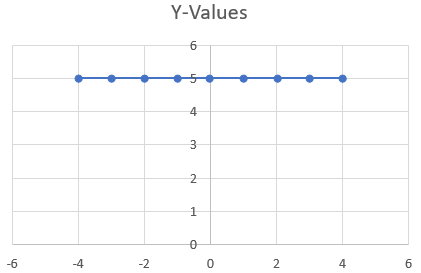
Which function is shown in graph?
Image
  • Constant
  • B
    Modulus
  • C
    Identity
  • D
    Signum function
Answer
Correct option: A.
Constant
$\{(-1, 1), (1, 1), (-2, 2), (2, 2), (-3, 3), (3, 3), ……\}.$ This function involves relation $\{(x, y), y = |x|\}$ which is involved in modulus function.
So, above function is modulus function.
View full question & answer
MCQ 1641 Mark
Let a relation $R$ be defined by $R = \{(4, 5), (1, 4), (4, 6), (7, 6), (3, 7)\},$ then $\text{ROR}$ is equal to:
  • $\{(1, 5), (1, 6), (3, 6)\}$
  • B
    $\{(1, 4), (1, 5), (3, 6)\}$
  • C
    $\{(1, 5), (1, 6), (3, 7)\}$
  • D
    $\{(1, 4), (1, 5), (3, 7)\}$
Answer
Correct option: A.
$\{(1, 5), (1, 6), (3, 6)\}$
View full question & answer
MCQ 1651 Mark
If $R$ is a relation on a finite set having $n$ elements, then the number of relations on $A$ is:
  • A
    $2^{\text{n}}$
  • $2^{\text{n}^2}$
  • C
    $\text{n}^2$
  • D
    $\text{n}^\text{n}$
Answer
Correct option: B.
$2^{\text{n}^2}$
Given, $A$ finite set with n elements
Its Cartesian product with itself will have $n^2$ elements.
$\therefore$ Number of relations on $\text{A}=2^{\text{n}^2}$
View full question & answer
M.C.Q (1 Marks) - Page 4 - MATHS STD 11 Science Questions - Vidyadip