Questions · Page 2 of 2

2 Marks Questions

Question 512 Marks
Draw the lines x = -3, x = 2, y = -2, y = 3 and write the coordinates of the vertices of the square so formed.
Answer
The figure with the line $\text{x}=-3,\text{x}=2,\text{y}=-2,\text{y}=3$ is as follows:
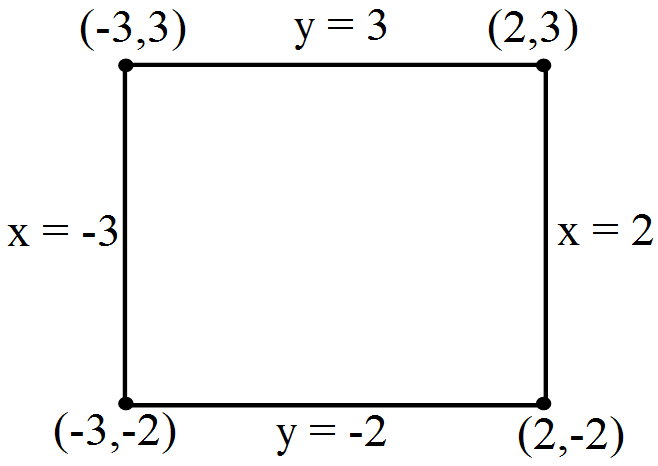
From the figure, the coordinates of the vertices of the square are $(2,3),(-3,3),(-3,-2),(2,-2).$
View full question & answer
Question 522 Marks
Without using Pythagoras theorem, show that the points A(0, 4), B(1, 2) and C(3, 3) are the vertices of a right angled triangle.
Answer
Slope of $\text{AB}=\frac{2-4}{1-0}=-2$
Slope of $\text{BC}=\frac{3-2}{3-1}=\frac{1}{2}$
slope of AB × slope of BC $=-2\times\frac{1}{2}=-1$
$\therefore$ Anlgle between AB and BC $=\frac{\pi}{2}$
$\therefore$ ABC are the vertices of a right angled triangle.
View full question & answer
Question 532 Marks
Find the equation to the straight line which cuts off equal positive intercepts on the axes and their product is 25.
Answer
Let the intercepts on the axes be (a, 0) and (0, a).Then,
$\text{a}\times\text{a}=25$
$\text{a}^2=25$
$\text{a}=25$
(Ignoring negative sign because it is given that the intercepts are positive)
⇒ a = b = 5 (given the intercepts are equal)
$\therefore$ Putting in equation of straight line
$\frac{\text{x}}{\text{a}}+\frac{\text{y}}{\text{b}}=1$
$\frac{\text{x}}{5}+\frac{\text{y}}{5}=1$
$\text{x}+\text{y}=5$
View full question & answer
Question 542 Marks
Reduce the equation $\sqrt{3}\text{x}+\text{y}+2=0$ to:
slope-intercept form and find slope and y-intercept;
Answer
Slope intercept from (y = mx + c)$\sqrt3\text{x}+\text{y}+2=0$
$\Rightarrow\text{y}=-\sqrt3\text{x}-2$
$\Rightarrow\text{m}=-\sqrt3,\ \text{c}=-\sqrt2$
y-intercept = -2, slope = $-\sqrt3$
View full question & answer
Question 552 Marks
State whether the two lines in the following are parallel, perpendicular or neither.
Through $(5, 6)$ and $(2, 3);$ through $(9, -2)$ and $(6, -5)$
Answer
Slope of line joining $(5, 6)$ and $(2, 3)$
$\text{m}_1=\frac{\text{y}_2-\text{y}_1}{\text{x}_2-\text{x}_1}=\frac{3-6}{2-5}=\frac{-3}{-3}=1$
Slope of line joining $(9, -2)$ and $(6, -5)$
$\text{m}_2=\frac{\text{y}_2-\text{y}_1}{\text{x}_2-\text{x}_1}=\frac{-5-(-2)}{6-9}=\frac{-5+2}{-3}=1$
Here $m_1 = m_2$
$\therefore$ The two lines are parallel.
View full question & answer
Question 562 Marks
Reduce the equation $\sqrt{3}\text{x}+\text{y}+2=0$ to:
Intercept form and find intercept on the axes;
Answer
Intercept from $\Big(\frac{\text{x}}{\text{a}}+\frac{\text{y}}{\text{b}}=1\Big)$$\sqrt3\text{x}+\text{y}+2=0$
$\Rightarrow\sqrt3\text{x}+\text{y}=-2$
$\Rightarrow\frac{\sqrt3\text{x}}{-2}+\frac{\text{y}}{-2}=1$
$\Rightarrow\frac{\text{x}}{\frac{-2}{\sqrt3}}+\frac{\text{y}}{-2}=1$
⇒ x intercept $=\frac{-2}{\sqrt3},$ y intercept = -2
View full question & answer
Question 572 Marks
Find the equation of the line on which the length of the perpendicular segment from the origin to the line is 4 and the inclination of the perpendicular segment with the positive direction of x-axis is 30°.
Answer
Given inclination of perpendicular line (L) passing through origin is 30° ⇒ Slope $=\tan30^\circ=\frac{1}{\sqrt3}$Slope of perpendicular line (M) which is perpendicularn to line L is $-\sqrt3$
So equation of line M is $\text{y}=-\sqrt{3\text{x}}+\text{c}$
Given perpendicular distance from origin to line M is 4
$4=\frac{\text{c}}{2}\Rightarrow\text{c}=8$
So, equation of line M is $\text{y}=-\sqrt{3\text{x}}+8$
View full question & answer
Question 582 Marks
By using the concept of slope, show that the points (-2, -1), (4, 0), (3, 3) and (-3, 2) are the vertices of a parallelogram.
Answer
Let the vertices be A(-2, -1), B(4, 0), C(3, 3) and D(-3, 2).
Using slope formula, $\text{m}=\frac{\text{y}_2-\text{y}_1}{\text{x}_2-\text{x}_1},$ we get:
Slope of $\text{AB}(\text{m}_1)=\frac{0-(-1)}{4-(-2)}=\frac{1}{6}$
Slope of $\text{CD}(\text{m}_2)=\frac{2-3}{-3-3}=\frac{-1}{-6}=\frac{1}{6}$
$\Rightarrow\text{m}_1=\text{m}_2\Rightarrow\text{AB}||\text{CD}$
Also
Slope of $\text{AD }(\text{m}_2)=\frac{2-(-1)}{-3-(-2)}=\frac{3}{-1}=-3$
Slope of $\text{BC }(\text{m}_4)=\frac{3-0}{3-4}=\frac{3}{-1}=-3$
$\Rightarrow\text{m}_3=\text{m}_4\Rightarrow\text{AD}||\text{BC}$
Hence, ABCD is a parallelogram.
View full question & answer
2 Marks Questions - Page 2 - MATHS STD 11 Science Questions - Vidyadip