Questions · Page 2 of 2

3 Marks Question

Question 513 Marks
Find the distance of the point (1, 2) from the straight line with slope 5 and passing through the point of intersection of x + 2y = 5 and x - 3y = 7.
Answer
On solving x + 2y = 5 and x - 3y = 7 we get a point $\text{A}\Big(\frac{29}{5},\frac{-2}{5}\Big)$
The line passing through $\text{A}\Big(\frac{29}{5},\frac{-2}{5}\Big)$ and slope 5 is
$\text{y}+\frac{2}{5}=5\Big(\text{x}-\frac{29}{5}\Big)$
$5\text{y}+2=25\text{x}-145$
$25\text{x}-5\text{y}-147=0$
The distance of (1, 2) from 25x -5y - 147 = 0 is
$\Rightarrow\Big|\frac{25(1)-5(2)-147}{\sqrt{25^2+5^2}}\Big|$ [using distance formula]
$\Rightarrow\Big|\frac{-132}{\sqrt{650}}\Big|$
$\Rightarrow\Big|\frac{132}{\sqrt{650}}\Big|$
View full question & answer
Question 523 Marks
Find the equation of the right bisector of the line segment joining the points A(1, 0) and B(2, 3).
Answer
The right bisector PQ of AB bisects AB at C and is also perpendicular to AB.Slope of $\text{AB}=\frac{3-0}{2-1}=3$
Now,
(slope of AB) × (slope of PQ)= -1
$\therefore$ slope of $\text{PQ}=\frac{-1}{3}$
co-ordinates of C are = $\Big(\frac{1+2}{2},\frac{3+0}{2}\Big)=\Big(\frac{3}{2},\frac{3}{2}\Big)$
$\therefore$ Equation of right bisector PQ is
$\Big(\text{y}-\frac{3}{2}\Big)=\frac{-1}{3}\Big(\text{x}-\frac{3}{2}\Big)$
$6\text{y}-9=-2\text{x}+3$
$\text{x}+\text{3y}=6$
View full question & answer
Question 533 Marks
Reduce the following equations to the normal form and find p and $\alpha$ in each case:
$\text{y}-2=0$
Answer
$\text{y}-2=0$
$\text{y}=3$
Comparing with $\text{x}\cos\alpha+\text{y}\sin\alpha=\text{p}$
$\sin\alpha=1$
$=\cos0$
$\Rightarrow\alpha=\frac{\pi}{2},$
$\text{p}=2$
View full question & answer
Question 543 Marks
Find the equation of the straight line which passes through the point $P (2, 6)$ and cuts the coordinate axes at the point $A$ and $B$ respectively so that $\frac{\text{AB}}{\text{BP}}=\frac{2}{3}.$
Answer
$P(2, 6)$ let A be the point on $x$ axis $(x, y)\Rightarrow A(a, 0)$
$(x_1, y_1)$
B be a point on y axis
$\Rightarrow B(0, b)$
$(x_2, y_2)$
Using section formula $\text{x}=\frac{\text{lx}_2+\text{mx}_1}{\text{l}+\text{m}},\frac{\text{ly}_2+\text{my}_1}{\text{l}+\text{m}}$
$l : m = 2 : 3$
$2=\frac{2(\text{a}) + 3(0)}{2+3 }$
$\Rightarrow10=3\text{a}$
$\Rightarrow\text{a}=\frac{10}{3}$
$6=\frac{2(\text{b})+3(0)}{2+3}$
$\Rightarrow30=2\text{b}$
$\text{b}=15$
$\therefore$ Point A is $\Big(\frac{10}{3},0\Big),(0,15)$
equation of line AB is
$\text{y}-\text{y}_1=\frac{\text{y}_2-\text{y}_1}{\text{x}_2-\text{x}_1}(\text{x}-\text{x}_1)$
$\text{y}-0=\frac{15-0}{0-\frac{10}{3}}\Big(\text{x}-\frac{10}{3}\Big)$
$\text{y}=\frac{-15\times3}{10}\Big(\text{x}-\frac{10}{3}\Big)$
$\text{2y}=-\text{9x}+\frac{90}{3}$
$\text{9x}+\text{2y}=30$
View full question & answer
Question 553 Marks
Find the equation of a line equidistant from the lines $y = 10$ and $y = -2.$
Answer
A line is equidistant from two other lines, must have the same slope.
The slope of $y = 10$ and $y = -2$ is $0$, ie line parallel to x axis.
The required line is also parallel to $y = 10$ and $y = -2$
$\therefore$ $m = 0$
Also the required line will be pass from the mid point of the line joining $(0, 2)$ and $(0, 10)$
coordinates of this point will be $\Big(0,\frac{10-2}{2}\Big)=\Big(0,\frac{8}{2}\Big)=(0,4)$
$\therefore$ The equation of require line is:
$y - 4 = 0(x - x_1)$
$\Rightarrow y = 4$
View full question & answer
Question 563 Marks
Find the equation to the straight line which passes through the point (5, 6) and has intercepts on the axes Equal in magnitude and both positive,Equal in magnitude but opposite in sign.
Answer
Intercepts are equal positive⇒ a = b = k
The equation of straight line is
$\frac{\text{x}}{\text{a}}+\frac{\text{y}}{\text{b}}=1 \ ...(\text{i})$
Since this line passes through (5, 6) and a = b = k, we get:
$\frac{5}{\text{k}}+\frac{6}{\text{k}}=1$
$\text{k}=1$
$\therefore\frac{\text{x}}{11}+\frac{\text{y}}{11}=1$
$\Rightarrow\text{x}+\text{y}=11$
Intercepts are equal but opposite in sing
Let, a = k, b = -k
Putting in (i), we get,
$\frac{5}{\text{k}}+\frac{6}{-\text{k}}=1$
$\frac{5}{\text{k}}-\frac{6}{\text{k}}=1$
$\Rightarrow\text{k}=-1$
thus from (i)
$\text{x}-\text{y}=-1$
View full question & answer
Question 573 Marks
Find the distance of the point (3, 5) from the line 2x + 3y = 14 measured parallel to a line having slope $\frac{1}{2}.$
Answer
Equation of the required line is $\frac{\text{x}-3}{\cos\alpha}=\frac{\text{y}-5}{\sin\alpha}=\text{r}\dots(1)$
$\tan\alpha=\frac{1}{2}\ \Rightarrow\ \cos\alpha=\frac{2}{\sqrt5}$ and $\sin\alpha=\frac{1}{\sqrt5}$
$\therefore$ equation is
$\frac{\text{x}-3}{\frac{2}{\sqrt5}}=\frac{\text{y}-5}{\frac{1}{5}}=\text{r}$
or $\text{x}=\frac{2}{\sqrt5}\text{r}+3,\ \text{y}=\frac{1}{\sqrt5}\text{r}+5$
$\text{p}\Big(\frac{2\text{r}}{\sqrt5}+3,\ \frac{\text{r}}{\sqrt5}+5\Big)$ lie on $2\text{x}+3\text{y}=14$
$\therefore\frac{4\text{r}}{\sqrt5}+6+\frac{3\text{r}}{\sqrt5}+15=1\pm14$
$\frac{7\text{r}}{\sqrt5}=\pm17$
$\text{r}=\pm\sqrt5$
$\text{r}=\sqrt5\ (\text{r}\neq-\sqrt5)$
$\therefore$ Distance of (3, 5) from 2x + 3y = 14 is $\sqrt5$ units.f
View full question & answer
Question 583 Marks
Find the equation of the line whose perpendicular distance from the origin is 4 units and the angle which the normal makes with the positive direction of x-axis is 15°.
Answer
Here,$\text{P}=4$ and $\alpha=15^\circ$
The equation of line is
$\text{x}\cos\alpha +\text{y}\sin\alpha=\text{p}\dots(1)$
$\text{x}\cos15^\circ+\text{y}\sin15^\circ=4$
$\cos15^\circ=\cos(45-30)=\cos45\cos30+\sin45\sin30$
$(\because \cos(\theta-\phi)=\cos\theta\cos\phi+\sin\theta\sin\phi)$
$=\frac{1}{\sqrt2}\times\frac{\sqrt3}{2}\times\frac{1}{\sqrt2}\times\frac{1}{2}$
$=\frac{1}{2\sqrt2}(\sqrt3+1)$
$\sin15^\circ=\sin(45-30)=\sin45\cos30+\cos45\sin30$
$=\frac{1}{\sqrt2}\times\frac{\sqrt3}{2}-\frac{1}{\sqrt2}\times\frac{1}{2}$
$=\frac{1}{2\sqrt2}(\sqrt3-1)$
Putting in (1)
$\text{x}\times\frac{1}{2\sqrt2}(\sqrt3+1)+\text{y}\times\frac{1}{2\sqrt2}(\sqrt3-1)=4$
$\text{x}(\sqrt3+1)+\text{y}(\sqrt3-1)=8\sqrt2$
View full question & answer
Question 593 Marks
The length L (in centimeters) of a copper rod is a linear function of its celsius temperature C. In an experiment, if L = 124.942 when C = 20 and L = 125.134 when C = 110, express L in terms of C.
Answer
$\text{L}_1=124.942, \text{C}_1=20 $$\text{L}_1=125.134,\text{C}_2=110$
Equation of line passing through
$(\text{L}_1,\text{C}_1)$ and $(\text{L}_2,\text{C}_2)$
$\text{L}-\text{L}_1=\Bigg(\frac{\text{L}_2-\text{L}_1}{\text{C}_2-\text{C}_1}\Bigg)\Big(\text{C}-\text{C}_1\Big)$
$\text{L}-124.942=\Big(\frac{125.134-124.942}{110-20}\Big)(\text{C}-20)$
$\text{L}-124.942=\frac{0.192}{90}(\text{C}-20)$
$\text{L}-124.92=\frac{192}{90000}(\text{C}-20)$
$\text{L}-124.942=\frac{4}{1875}(\text{C}-20)$
$\text{L}=\frac{4}{1875}\text{C}+124.942-4\times\frac{20}{1875}$
$\Rightarrow\text{L}=\frac{4}{1875}\text{C}+124.899$
View full question & answer
Question 603 Marks
The slope of a line is double of the slope of another line. If tangents of the angle between them is $\frac{1}{3},$ find the slopes of the other line.
Answer
Let $\text{m}_{1}=\text{x, }\text{m}_2=\text{2x}$ $\tan\theta=\Big|\frac{\text{m}_1-\text{m}_2}{1+\text{m}_1\text{m}_2}\Big|$ $\frac{1}{3}=\Big|\frac{\text{x}-\text{2x}}{1+\text{2x}^2}\Big|$Case I:
$\frac{1}{3}=\frac{\text{x}-\text{2x}}{1+\text{2x}^2}$ $\text{2x}^2+1=-\text{3x}$ $\text{2x}^2+3\text{x}+1=0$ $2\text{x}^2+\text{2x}+\text{x}+1=0$ $\text{2x}(\text{x}+1)+1(\text{2x}+1)=0$ $(\text{x}+1)(\text{2x}+1)=0$ $\text{x}=-1,-\frac{1}{2}$Case II:
$\frac{1}{3}=\Big(\frac{\text{-x}}{1+\text{2x}^2}\Big)$ $\frac{1}{3}=\frac{\text{x}}{\text{1}+\text{2x}^2}$ $\text{2x}^2+1=3\text{x}$ $\text{2x}^2-\text{3x}+1=0$ $\text{2x}^2-\text{2x}-\text{x}+1=0$ $\text{2x}(\text{x}-1)-1(\text{x}-1)=0$ $(\text{x}-1)(\text{2x}-1)=0$ $\text{x}=1,\frac{1}{2}$ Slope of the line is $1,\frac{1}{2}$ or $-1,-\frac{1}{2}$
View full question & answer
Question 613 Marks
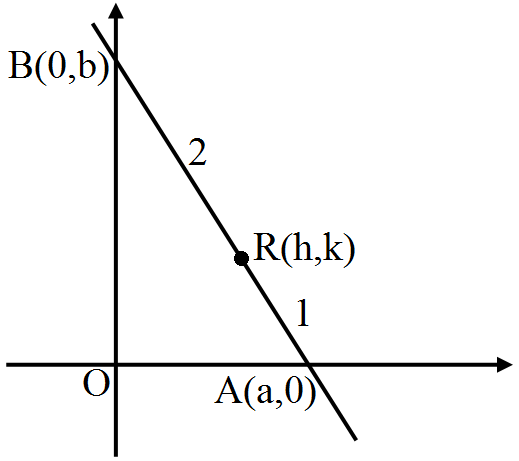
Point R (h, k) divides a line segment between the axes in the ratio 1 : 2. Find the equation of the line.
Answer

Point (h, k) divides the line segment in the ratio 1 : 2
Thus, using section point formula, we have
$\text{h}=\frac{2\times\text{a}+1\times0}{1+2}$
and
$\text{k}=\frac{2\times0+1\times\text{b}}{1+2}$
Therefore, we have,
$\text{h}=\frac{2\text{a}}{3}$ and $\text{k}=\frac{\text{b}}{3}$
$\Rightarrow\text{a}=\frac{3\text{h}}{2}$and $\text{b}=\text{3k}$
Thus, the correspoinding point of A and B are $\Big(\frac{\text{3h}}{2},0\Big)$ and (0, 3k)
Thus, the equation of line joining the points A and B is
$\frac{\text{y}-\text{3k}}{\text{3k}-0}=\frac{\text{x}-0}{0-\frac{3\text{h}}{2}}$
$\Rightarrow-\frac{3\text{h}}{2}(\text{y}-\text{3k})=\text{x}\times\text{3k}$
$\Rightarrow-3\text{hy}+\text{9hk}=\text{6kx}$
$\Rightarrow2\text{kx}+\text{hy}=\text{3kh}$
View full question & answer
Question 623 Marks
Find the distance of the point (2, 5) from the line 3x + y + 4 = 0 measured parallel to a line having slope $\frac{3}{4}.$
Answer
Slope of the line $=\tan\alpha=\frac{3}{4}$
$\therefore\sin\alpha=\frac{3}{5}$ and $\cos\alpha=\frac{4}{5}$
$\therefore$ Equation of line is
$\frac{\text{x}-2}{\cos\alpha}=\frac{\text{y}-5}{\sin\alpha}=\text{r}$
$\Rightarrow\ \frac{\text{x}-2}{\frac{4}{5}}=\frac{\text{y}-5}{\frac{3}{5}}=\text{r}$
or $\text{x}=\frac{4\text{r}}{5}+2$ and $\text{y}=\frac{3\text{r}}{5}+5$
then $\text{p}\Big(\frac{4\text{r}}{5}+2,\ \frac{3\text{r}}{5}+5\Big)$ lie on $3\text{x}+\text{y}+4=0$
$\therefore3\Big(\frac{4\text{r}}{5}+2\Big)+\Big(\frac{3\text{r}}{5}+5\Big)+4=0$
$\frac{15}{5}\text{r}=\pm15$
$\text{r}=\pm\frac{15\times5}{15}$
= 5 units.
View full question & answer
Question 633 Marks
Find the equation of the line passing through the intersection of the lines 2x + y = 5 and x + 3y + 8 = 0 and parallel to the line 3x + 4y = 7.
Answer
2x + y = 5 and x + 3y + 8 = 0
Intersection point of above lines is $\Big(\frac{23}{5},\frac{-21}{5}\Big)$
Required line is parallel to 3x + 4y = 7 and passing through above point
So required line equation is
$\text{y}+\frac{21}{5}=\frac{-3}{4}\Big(\text{x}-\frac{23}{5}\Big)$
20y + 84 = -15x + 69
15x + 20y + 15 = 0
3x + 4y + 3 = 0
View full question & answer
Question 643 Marks
If the straight line $\frac{\text{x}}{\text{a}}+\frac{\text{y}}{\text{b}}=1$ passes through the point of intersection of the lines $x + y = 3$ and $2x - 3y = 1$ and is parallel to $x - y - 6 = 0$, find $a$ and $b$.
Answer
If point of intersection of lines $x + y = 3$ and $2x - 3y = 1$ is
$x = 3 - y$
$2(3 - y) - 3y = 1$
$6 - 2y - 3y = 1$
$-5y = - 5$
$y = 1$
$\Rightarrow x = 3 - 1 = 2$
$\therefore$ Point is $(2,1)$
Any line parallel to $x - y - 6 = 0$
Will have the same slope $= 1$
$\therefore$ Equation of line parring through $(2, 1)$ and having slope $= 1$
is $y - y_1= m(x - x_1)$
$y - 1 = 1(x - 2)$
$y - 1 = x - 2$
$y - x = -2 + 1$
$y - x = -1$
$x - y = 1$
$\therefore$ $a = 1, b = -1$ $\Big($ Comparring with $\frac{\text{x}}{\text{a}}+\frac{\text{y}}{\text{b}}=1\Big)$
View full question & answer
Question 653 Marks
Find the equation of the straight lines passing through the origin and making an angle of 45° with the straight line $\sqrt{3}\text{x}+\text{y}=11.$
Answer
Let the required equation be ax + by = c but here it passes through origin (0, 0)
$\therefore$ c = 0
$\therefore$ Equation is ax + by = 0
Slope of the line $(\text{m}_1)=\frac{\text{-a}}{\text{b}}$ and $\text{m}_2=\frac{-\sqrt3}{1}$
⇒ Angle between $\sqrt3\text{x+y}=11$ and $\text{ax+by}=0$ is 45°
$\therefore\ \tan45^\circ=\frac{\text{m}_1\pm\text{m}_2}{1\pm\text{m}_1\text{m}_2}$
$1=\frac{\frac{\text{-a}}{\text{b}}\pm(-\sqrt3)}{1\mp\frac{\text{a}}{\text{b}}\times\sqrt3}$
$1-\frac{\sqrt3\text{a}}{\text{b}}=\frac{-\text{a}}{\text{b}}-\sqrt{3}$ and $1+\frac{\text{a}}{\text{b}}\sqrt3=\frac{-\text{a}}{\text{b}}+\sqrt3$
$\text{b}-\sqrt3\text{a}=-\text{a}-\sqrt{3}\text{b}$ and $\text{b}+\text{a}\sqrt{3}=-\text{a}+\text{b}\sqrt3$
$\text{a}(1-\sqrt{3})=\text{b}(-\sqrt3-1)$ and $\text{a}(\sqrt{3+1})=\text{b}(\sqrt{3-1})$
$\frac{\text{a}}{\text{b}}-\frac{1-\sqrt3}{\sqrt3-1}=\frac{(\sqrt3-1)^2}{2}=2-\sqrt3$
or
$\frac{\text{a}}{\text{b}}=\frac{\sqrt3-1}{\sqrt3-1}=-2-\sqrt3$
$\therefore$ Required lines are $ \frac{\text{y}}{\text{x}}=\sqrt3\pm2\text{ or y}=(\sqrt3\pm2)\text{x}$
View full question & answer
Question 663 Marks
Find the equation of the straight line passing through $(-2, 3)$ and inclined at an angle of $45^\circ$ with the x-axis.
Answer
Let the required equation of the line be
$y - y_1 = m(x - x_1)$
Now,
The line is inclined at an angle of $45^\circ$ with the x-axis
$\therefore \text{m}=\tan45^\circ=1$
$(x_1y_1) = (-2, 3)$
$\therefore$ $y - y_1 = m(x - x_1)$
$\Rightarrow y - 3 = 1(x - (-2))$
$\Rightarrow y - 3 = x + 2$
$\Rightarrow x - y = -5$
$\therefore$ Equation of required line is $x - y + 5 = 0$
View full question & answer
Question 673 Marks
Find the equation of the straight line passing through the point $(6, 2)$ and having slope $-3.$
Answer
Let the required equation of the line be
$y - y_1 = m(x - x_1)$
Now,
m = slope $= -3$
$(x_1y_1) = (6, 2)$
$\therefore$ $y - y_1 = m(x - x_1)$
$\Rightarrow y - 2 = -3(x - 6)$
$\Rightarrow y - 2 = -3x + 18$
$\Rightarrow 3x + y = +20$
$\Rightarrow 3x + y - 20 = 0$
$\therefore$ The eqution of the given line is $3x + y -20 = 0.$
View full question & answer
Question 683 Marks
Find the equation of the straight line which passes through the point (-3, 8) and cuts off positive intercepts on the coordinate axes whose sum is 7.
Answer
Let equation of line be$\frac{\text{x}}{\text{a}}+\frac{\text{y}}{\text{b}}=1$
then a + b = 7 and $\text{a}\ge0$ and $\text{b}\ge0$
$\therefore\frac{\text{x}}{\text{a}}=\frac{\text{y}}{7-\text{a}}=1\dots(1)$
The line passes through (-3, 8)
$\Rightarrow\frac{-3}{\text{a}}+\frac{8}{7-\text{a}}=1$
$\Rightarrow-21+\text{3a}+8\text{a}=\text{7a}-\text{a}^2$
$\Rightarrow-21+11\text{a}=\text{7a}-\text{a}^2$
$\Rightarrow\text{a}^2+\text{4A}-21=0$
⇒ A = 3 or -7
$\text{a}\neq-7($as $\text{a}\ge0)$
$\therefore$ a = 3 and b = 4
$\therefore$ Equation of line is
$\frac{\text{x}}{3}+\frac{\text{y}}{4}=1$
or $\text{4x}+\text{3y}=12$
View full question & answer
Question 693 Marks
Find the equation of the straight line passing through $(3, -2)$ and making an angle of $60^\circ$ with the positive direction of y-axis.
Answer
The required equation of the line is
$y - y_1 = m(x - x_1)$
Since the lline makes an angle $60^\circ$ with the positive direction of y-axis, it makes $30^\circ$ with the positive direction of x-axis.
$\therefore\text{m}=\tan{30}^\circ=\frac{1}{\sqrt{3}}$ (angle with y-axis)
A point on the line is $(x_1y_1) = (3, -2)$
Therefore, the equation of the line is:
$y - y_1 = m(x - x_1)$
$\text{y}-(-2)=\frac{1}{\sqrt{3}}(\text{x}-3)$
$\text{x}-\sqrt{3}\text{y}-3-2\sqrt{3}=0$
View full question & answer
Question 703 Marks
Find the length of the perpendicular from the origin to the straight line joining the two points whose coordinates are $(\text{a} \cos \alpha, \text{a} \sin \alpha)$ and $(\text{a} \cos \beta, \text{a} \sin\beta).$
Answer
Line formed from joining $(\text{a} \cos \alpha, \text{a} \sin \alpha)$ and $(\text{a} \cos \beta, \text{a} \sin\beta)$$\Rightarrow\text{y}-\text{a}\sin\beta=\frac{\text{a}\sin\beta-\text{a}\sin\alpha}{\text{a}\cos\beta-\text{a}\cos\alpha}\times\text{x}-\cos\beta$
$\Rightarrow\text{y}-\text{a}\sin\beta=\frac{2\sin\Big(\frac{\beta-\alpha}{2}\Big)\cos\Big(\frac{\beta+\alpha}{2}\Big)}{-2\sin\Big(\frac{\beta-\alpha}{2}\Big)\sin\Big(\frac{\beta+\alpha}{2}\Big)}\times(\text{x}-\text{a}\cos\beta)$
$\Rightarrow\text{y}-\text{a}\sin\beta=-\cot\Big(\frac{\beta+\alpha}{2}\Big)(\text{x}-\text{a}\cos\beta)$
$\Rightarrow\text{y}+\cot\Big(\frac{\alpha+\beta}{2}\Big)\text{x}-\text{a}-\cos\beta\cot\Big(\frac{\beta+\alpha}{2}\Big)-\text{a}\sin\beta=0$
The, the length of perpendicular
$\Rightarrow\Bigg|\frac{0(\text{y})+0-\text{a}\cos\beta\cot\Big(\frac{\beta+\alpha}{2}\Big)-\text{a}\sin\beta}{\sqrt{1+\cot^2\Big(\frac{\alpha+\beta}{2}\Big)}}\Bigg|$
$\Rightarrow\frac{\text{a}\cos\beta\cot\Big(\frac{\alpha+\beta}{2}\Big)+\text{a}\sin\beta}{\text{cosec}\Big(\frac{\alpha+\beta}{2}\Big)}$
$\Rightarrow\text{a}\cos\beta\cos\Big(\frac{\alpha+\beta}{2}\Big)+{{\text{a}\sin\beta\sin\Big(\frac{\alpha+\beta}{2}}}\Big)$
$\Rightarrow\text{a}\cos\Big(\frac{\alpha-\beta}{2}\Big) \ \big[\text{using} \ \cos\text{A}\cos\text{B}+\sin\text{A}\sin\text{B}=\cos(\text{A-B})\big]$
Hence, proved.
View full question & answer
Question 713 Marks
Reduce the following equations to the normal form and find p and $\alpha$ in each case:
$\text{x}+\text{y}+\sqrt{2}=0$
Answer
$\text{x}+\text{y}+\sqrt{2}=0$
$\Rightarrow-\text{x}-\text{y}=\sqrt{2}$
$\Rightarrow-\frac{\text{x}}{\sqrt{(-1)^2+(-1)^2}}-\frac{\text{y}}{\sqrt{(-1)^2+(-1)^2}}$
$\frac{\sqrt2}{\sqrt{(-1)^2+(-1)^2}} \ \Big[$ Dividing both sides by $\sqrt{(\text{cofficient of x})^2+(\text{cofficient of y})^2}\Big]$
This is the normal form of the given line, where p = 1, $\cos\alpha=-\frac{1}{\sqrt2}$ and $\sin\alpha=-\frac{1}{\sqrt2}$
$\Rightarrow\alpha=225^\circ \ \big[\because$ The coefficent of x and y are negative. So, $\alpha$ lies in third quadrant $\big]$
View full question & answer
3 Marks Question - Page 2 - MATHS STD 11 Science Questions - Vidyadip