Question types

Kinetic Theory of Gases question types

100 questions across 6 question groups — pick any mix to generate a Physics paper with step-by-step answer keys.

100
Questions
6
Question groups
5
Question types
Sample Questions

Kinetic Theory of Gases questions

One sample from each question group in this chapter. Select any group above to see the full set with answer keys.

The rms speed of oxygen at room temperature is about $500\ m/ s$. The rms speed of hydrogen at the same temperature is about:
  • A
    $125\ ms^{-1}$
  • $2000\ ms^{-1}$
  • C
    $8000\ ms^{-1}$
  • D
    $31\ ms^{-1}$

Answer: B.

View full solution
The rms speed of oxygen molecules in a gas is v. If the temperature is doubled and the oxygen molecules dissociate into oxygen atoms, the rms speed will become:
  • A
    $\text{v}$
  • B
    $\text{v}\sqrt{2}$
  • $2\text{v}$
  • D
    $4\text{v}$

Answer: C.

View full solution
Which of the following parameters is the same for molecules of all gases at a given temperature?
  • A
    Mass.
  • B
    Speed.
  • C
    Momentum.
  • Kinetic energy.

Answer: D.

View full solution
There is some liquid in a closed bottle. The amount of liquid remains constant as time passes. The vapour in the remaining part:
  • Must be saturated.
  • B
    Must be unsaturated.
  • C
    May be unsaturated.
  • D
    There will be no vapour.

Answer: A.

View full solution
A gas is kept in an enclosure. The pressure of the gas is reduced by pumping out some gas. Will the temperature of the gas decrease by Charles's law?
View full solution
It is said that the assumptions of kinetic theory are good for gases having low densities. Suppose a container is so evacuated that only one molecule is left in it. Which of the assumptions of kinetic theory will not be valid for such a situation? Can we assign a temperature to this gas?
View full solution
A barometer correctly reads the atmospheric pressure as 76cm of mercury. Water droplets are slowly introduced into the barometer tube by a dropper. The height of the mercury column first decreases and then becomes constant. lf the saturation vapour pressure at the atmospheric temperature is 0.80cm of mercury, find the height of the mercury column when it reaches its minimum value.
View full solution
During an experiment, an ideal gas is found to obey an additional law $pV^2$ = constant. The gas is initially at a temperature T and volume V. Find the temperature when it expands to a volume 2V.
View full solution
A barometer tube is 80cm long (above the mercury reservoir). It reads 76cm on a particular day. A small amount of water is introduced in the tube and the reading drops to 75.4cm. Find the relative humidity in the space above the mercury column if the saturation vapour pressure at the room temperature is 1.0cm.
View full solution
Q 163 Marks Question3 Marks
Equal masses of air are sealed in two vessels, one of volume $V_0$ and the other of volume $2V_0$. If the first vessel is maintained at a temperature 300K and the other at 600K, find the ratio of the pressures in the two vessels.
View full solution
Q 183 Marks Question3 Marks
Figure. shows a vessel partitioned by a fixed diathernnc separator. Different ideal gases are filled in the two parts. The rms speed of the molecules in the left part equals the mean speed of the molecules in the right part. Calculate the ratio of the mass of a molecule in the left part to the mass of a molecule in the right part.
View full solution
Q 203 Marks Question3 Marks
Figure. shows a cylindrical tube with adiabatic walls and fitted with a diathermic separator. The separator can be slid in the tube by an external mechanism. An ideal gas is injected into the two sides at equal pressures and equal temperatures. The separator remains in equilibrium at the middle. It is now slid to a position where it divides the tube in the ratio of 1 : 3. Find the ratio of the pressures in the two parts of the vessel.
View full solution
Figure. shows two vessels $A$ and $B$ with rigid walls containing ideal gases. The pressure, temperature and the volume are $p_A, T_A, V$ in the vessel $A$ and $p_B, T_B, V$ in the vessel $B$. The vessels are now connected through a small tube. Show that the pressure p and the temperature T satisfy $\frac{\text{p}}{\text{T}}=\frac{1}{2}\Big(\frac{\text{P}_\text{A}}{\text{T}_\text{A}}+\frac{\text{p}_\text{B}}{\text{T}_\text{B}}\Big)$ when equilibrium is achieved.
View full solution
An ideal gas is kept in a long cylindrical vessel fitted with a frictionless piston of cross-sectional area $10cm^2$ and weight $1kg$. The length of the gas column in the vessel is $20cm$. The atmospheric pressure is $100kPa$. The vessel is now taken into a spaceship revolving round the earth as a satellite. The air pressure in the spaceship is maintained at $100kPa$. Find the length of the gas column in the cylinder.
View full solution
Find the rms speed of hydrogen molecules in a sample of hydrogen gas at $300K$. Find the temperature at which the rms speed is double the speed calculated in the previous part.
View full solution
An ideal gas is trapped between a mercury column and the closed-end of a narrow vertical tube of uniform base containing the column. The upper end of the tube is open to the atmosphere. The atmospheric pressure equals 76cm of mercury. The lengths of the mercury column and the trapped air column are 20cm and 43cm respectively. What will be the length of the air column when the tube is tilted slowly in a vertical plane through an angle of 60°? Assume the temperature to remain constant.
View full solution
A vessel of volume $V_0$ contains an ideal gas at pressure $P_0$ and temperature T. Gas is continuously pumped out of this vessel at a constant volume-rate dV I dt = r keeping the temperature constant. The pressure of the gas being taken out equals the pressure inside the vessel. Find, (1) the pressure of the gas as a function of time. (2) the time taken before half the original gas is pumped out.
View full solution
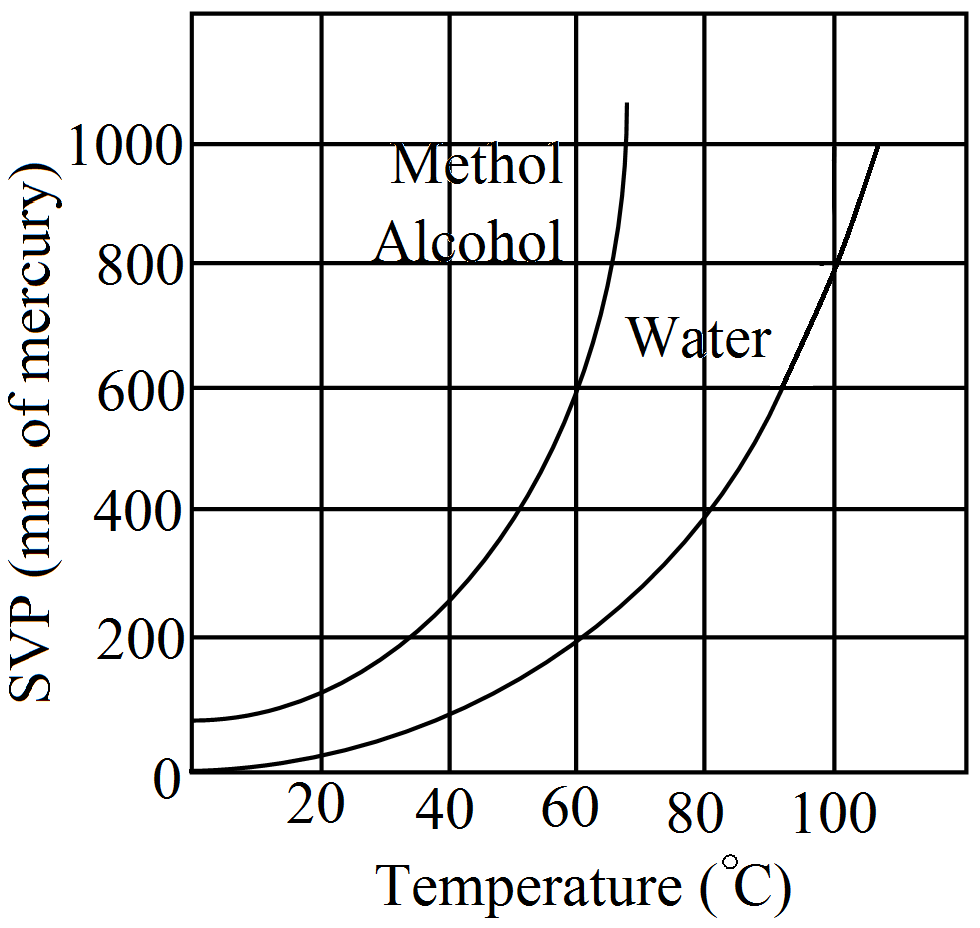
The human body has an average temperature of 98°F. Assume that the vapour pressure of the blood in the veins behaves like that of pure water. Find the minimum atmospheric pressure which is necessary to prevent the blood from boiling. Use figure. of the text for the vapour pressures.
View full solution
50cc of oxygen is collected in an inverted gas jar over water. The atmospheric pressure is 99.4kPa and the room temperature is 27°C. The water level in the jar is same as the level outside. The saturation vapour pressure at 27°C is 3.4kPa. Calculate the number of moles of oxygen collected in the jar.
View full solution
On a winter day, the outside temperature is 0°C and relative humidity 40%. The air from outside comes into a room and is heated to 20°C. What is the relative humidity in the room? The saturation vapour pressure at 0°C is 4.6mm of mercury and at 20°C it is 18mm of mercury.
View full solution

Generate a Kinetic Theory of Gases paper free

Pick question groups from the list above, set marks and difficulty, and export a branded PDF with step-by-step answer keys. First 3 chapters free — no signup.

Download App