Questions · Page 2 of 2

2 Marks Questions

Question 512 Marks
Explain the phenomenon of evaporation on the basis of kinetic theory.
Answer
According to kinetic theory, molecules of a liquid are in a state of continuous random motion. The molecules near the surface of liquid may have enough K.E. so as to overcome the intermolecular attraction of other molecules on the surface and hence manage to escape. Such molecules would move around freely in the space above the liquid. This is the phenomenon of evaporation which may occur at all temperatures.
View full question & answer
Question 522 Marks
Find the ratio of the mean speed of hydrogen molecules to the mean speed of nitrogen molecules in a sample contammg a mixture of the two gases.
Answer
$\text{V}_\text{avg}=\sqrt{\frac{8\text{RT}}{\pi\text{M}}}$$\frac{\text{V}_\text{avg}\text{H}_2}{\text{V}_\text{avg}\text{N}_2}=\sqrt{\frac{8\text{RT}}{\pi\times2}}=\sqrt{\frac{\pi\times28}{8\text{RT}}}=\sqrt{\frac{28}{2}}=\sqrt{14}=3.74$
View full question & answer
Question 532 Marks
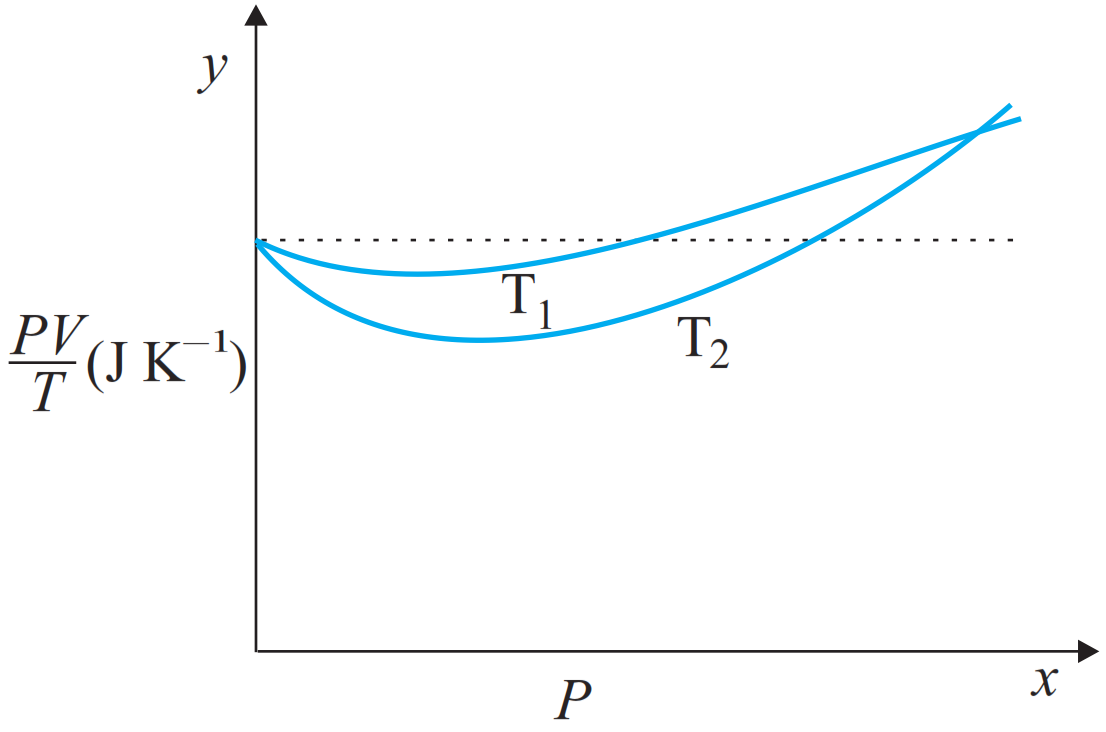
Shows plot of $\frac{P V}{T}$ versus $P$ for $1.00 \times 10^{-3} \mathrm{~kg}$ of oxygen gas at two different temperatures: Which is true, $T_1>T_2$ or $T_1<T_2$ ?
Answer
The dotted plot in the given graph represents an ideal gas. The curve of the gas at temperature $T_1$ is closer to the dotted plot than the curve of the gas at temperature $T_2$. A real gas approaches the behaviour of an ideal gas when its temperature increases. Therefore, $\mathrm{T}_1>\mathrm{T}_2$ is true for the given plot.
View full question & answer
Question 542 Marks
Figure. shows a cylindrical tube of cross-sectional area A fitted with two frictionless pistons. The pistons are connected to each other by a metallic wire. Initially, the temperature of the gas is $T_0$ and its pressure is P, which equals the atmospheric pressure. (a) What is the tension in the wire? (b) What will be the tension if the temperature is increased to $2T_0​​​​​​​$​​​​​​​?
Answer
$\frac{\text{P}_1\text{V}_1}{\text{T}_1}=\frac{\text{P}_2\text{V}_2}{\text{T}_2}$$\Rightarrow\frac{\text{P}_0\text{V}}{\text{T}_0}=\frac{\text{P}'\text{V}}{2\text{T}_0}\Rightarrow\text{P}'=2\text{P}_0$
Net pressure = $P_0$ outwards
$\therefore$ Tension in wire = $P_0A$
Where A is area of tube.
View full question & answer
Question 552 Marks
Calculate the molecular K.E. of 1 gram of Helium (Molecular weight 4) at $127^\circ C$. Given $R = 8.31J mol^{-1} K^{-1}$.
Answer
T = 127 + 273 = 400K Average K.E. per mole of Helium $=\frac{3}{2}\text{RT}$ Average K.E. of I gram of Helium$=\frac{3}{2}\frac{\text{RT}}{\text{M}}=\frac{3\times8.31\times400}{2\times4}$
$=1246.5\text{J}$
View full question & answer
Question 562 Marks
The ratio of specific heat capacity at constant pressure to the specific heat capacity at constant volume of a diatomic gas decreases with increase in temperature. Explain, why.
Answer
We know $\gamma=\frac{\text{C}_\text{p}}{\text{C}_{\text{v}}}=1+\frac{2}{\text{f}},$ where f is the degree of freedom of a diatomic gas. The degree of freedom of a diatomic gas increases with the increase in temperature, so γ decreases with increase in temperature.
View full question & answer
Question 572 Marks
Estimate the fraction of molecular volume to the actual volume occupied by oxygen gas at STP. Given the radius of oxygen molecule as $3\mathring{\text{A}}.$
Answer
Radius of oxygen $=3\mathring{\text{A}}=3\times10^{-10}\text{m}$ Volume of each oxygen molecule $=\frac{4}{3}\pi\text{r}^3$$=\frac{4}{3}\times3.14\times27\times10^{-30}$
Molar volume at STP $=2.24\times10^4\text{m}^3,$$\frac{\text{Molecular volume}}{\text{Volume of gas}}=\frac{6.023\times10^{23}\times\frac{4}{3}\pi\text{r}^3}{2.24\times10^4}$
$=\frac{680.8\times10^{-7}}{2.24\times10^4}$
$=304\times10^{-11}$
View full question & answer
Question 582 Marks
A cylinder of fixed capacity 44.8 litres contains helium gas at standard temperature and pressure. What is the amount of heat needed to raise the temperature of the gas in the cylinder by $15.0^{\circ} C ?\left(R=8.31 J mol ^{-1} K ^{-1}\right)$.
Answer
Using the gas law $P V=\mu R T$, you can easily show that $1 mol$ of any $($ ideal $)$ gas at standard temperature $(273 K )$ and pressure $\left(1 atm =1.01 \times 10^5 Pa \right)$ occupies a volume of $22.4$ litres. This universal volume is called molar volume. Thus the cylinder in this example contains $2 mol$ of helium. Further, since helium is monatomic, its predicted $($ and observed $)$ molar specific heat at constant volume, $C_V=(3 / 2) R$, and molar specific heat at constant pressure, $C_p=(3 / 2) R+R=(5 / 2) R$. Since the volume of the cylinder is fixed, the heat required is determined by $C_V$. Therefore,
Heat required $=$ no. of moles $\times$ molar specific heat rise in temperature
$=2 \times 1.5 R \times 15.0=45 R$
$=45 \times 8.31=374 J .$
View full question & answer
2 Marks Questions - Page 2 - Physics STD 11 Science Questions - Vidyadip