Questions · Page 1 of 3

1 Marks Question

🎯

Test yourself on this topic

50 questions · timed · auto-graded

MCQ 11 Mark
If, in Exercise $5.21$, the speed of the stone is increased beyond the maximum permissible value, and the string breaks suddenly, which of the following correctly describes the trajectory of the stone after the string breaks:
  • A
    The stone moves radially outwards.
  • The stone flies off tangentially from the instant the string breaks.
  • C
    The stone flies off at an angle with the tangent whose magnitude depends on the speed of the particle?
  • D
    Non of this
Answer
Correct option: B.
The stone flies off tangentially from the instant the string breaks.
When the string breaks, the stone will move in the direction of the velocity at that instant. According to the first law of motion, the direction of velocity vector is tangential to the path of the stone at that instant. Hence, the stone will fly off tangentially from the instant the string breaks.
View full question & answer
MCQ 21 Mark
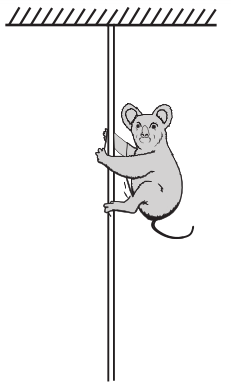
A monkey of mass $40kg$ climbs on a rope $($Fig.$)$ which can stand a maximum tension of $600 N$. In which of the following cases will the rope break: the monkey,

$($Ignore the mass of the rope$)$.
  • Climbs up with an acceleration of $6ms^{-2}$.
  • B
    Climbs down with an acceleration of $4ms^{-2}$.
  • C
    Climbs up with a uniform speed of $5ms^{-1}$.
  • D
    Falls down the rope nearly freely under gravity?
Answer
Correct option: A.
Climbs up with an acceleration of $6ms^{-2}$.
 Case $(a)$ Mass of the monkey, $m=40 \mathrm{~kg}$ Acceleration due to gravity, $\mathrm{g}=10 \mathrm{~m} / \mathrm{s}$ Maximum tension that the rope can bear, $T_{\max }=600 \mathrm{~N}$
Acceleration of the monkey, $a=6 \mathrm{~m} / \mathrm{s}^2$ upward Using Newton's second law of motion, we can write the equation of motion as: $T-m g=m a$
$\therefore T=m(g+a)=40(10+6)=640 \mathrm{~N}$ Since $T>T_{\text {max }}$ the rope will break in this case.
Case $(b)$ Acceleration of the monkey, $a=4 \mathrm{~m} / \mathrm{s}^2$ downward Using Newton's second law of motion,
we can write the equation of motion as: $\mathrm{mg}-\mathrm{T}=\mathrm{ma} $
$\therefore \mathrm{T}=\mathrm{m}(\mathrm{g}-\mathrm{a})=40(10-4)=240 \mathrm{~N}$ Since $\mathrm{T}<\mathrm{T}_{\text {max }}$, the rope will not break in this case.
Case $(c)$ The monkey is climbing with a uniform speed of $5 \mathrm{~m} / \mathrm{s}$.
Therefore, its acceleration is zero,
i.e., $\mathrm{a}=0$. Using Newton's second law of motion, we can write the equation of motion as: $\mathrm{T}-\mathrm{mg}=\mathrm{ma} \mathrm{T}-\mathrm{mg}$
$=0 $
$\therefore \mathrm{~T}=\mathrm{mg}=40 \times 10=400 \mathrm{~N}$ Since $\mathrm{T}<\mathrm{T}_{\max }$, the rope will not break in this case.
Case $(d)$ When the monkey falls freely under gravity, its will acceleration become equal to the acceleration due to gravity,
i.e., a $=\mathrm{g}$ Using Newton's second law of motion, we can write the equation of motion as: $\mathrm{mg}-\mathrm{T}=\mathrm{mg} $
$\therefore \mathrm{T}=\mathrm{m}(\mathrm{g}-\mathrm{g})=0$
Since $\mathrm{T}<\mathrm{T}_{\text {max }}$, the rope will not break in this case.
View full question & answer
Question 31 Mark
Give the magnitude and direction of the net force acting on. A car moving with a constant velocity of 30km/h on a rough road.
Answer
Force is being applied to overcome the force of friction. But as velocity of the car is constant, its acceleration, a = 0. Hence net force on the car F = ma = 0.
View full question & answer
Question 41 Mark
Give the magnitude and direction of the net force acting on. A cork of mass 10g floating on water.
Answer
As the cork is floating on water, its weight is balanced by the up thrust due to water. Therefore, the net force on the cork is 0.
View full question & answer
Question 51 Mark
Give the magnitude and direction of the net force acting on. A high-speed electron in space far from all material objects, and free of electric and magnetic fields.
Answer
As the high speed electron in space is far away from all gravitating objects and free of electric and magnetic fields, the net force on electron is 0.
View full question & answer
Question 61 Mark
Give the magnitude and direction of the net force acting on. A drop of rain falling down with a constant speed.
Answer
As the rain drop is filling with a constant speed, its acceleration, a = 0. Hence net force F = ma = 0.
View full question & answer
Question 71 Mark
Give the magnitude and direction of the net force acting on. A kite skillfully held stationary in the sky.
Answer
As the kite is held stationery, in accordance with the first law of motion, the net force on the kite is 0.
View full question & answer
Question 81 Mark
In the study of rocket propulsion $\vec{\text{F}}=\text{m}\vec{\text{a}}$ cannot be applied. Why?
Answer
Mass varies at every moment.
View full question & answer
Question 91 Mark
What do you mean by normal reaction?
Answer
It is the reaction due to the surface on which the body moves. It acts perpendicular to the surface of contact.
View full question & answer
Question 101 Mark
A pebble of mass 0.05kg is thrown vertically upward. Give the direction and magnitude of the net force on the pebble, at the highest point where it is momentary at rest. ($g = 10ms^{-2}$).
Answer
Mass of a pebble = 0.05kg Since a pebble is thrown vertically upward, then it is accelerated downwards under the influence of a gravity pull. Net force on the pebble = mg = 0.05 × 10 = 0.5N vertically downward.
View full question & answer
Question 111 Mark
Why is static friction called a self-adjusting force?
Answer
As the applied force increases, the static friction also increases and becomes equal to the applied force to make the object stationary. That is why static friction is called a self-adjusting force.
View full question & answer
Question 131 Mark
When a wheel is rolling on a level road, what is the direction of frictional force between the wheel and the road?
Answer
Friction, a tangential force provides the necessary torque to roll the body. This has to act opposite in the direction of motion to bring necessary motion.
View full question & answer
Question 141 Mark
Is earth an inertial frame of reference?
Answer
Since earth rotates on its own axis and also revolves around the sun, there will be acceleration associated. So earth cannot be taken as inertial frame of reference.
View full question & answer
Question 151 Mark
At which place on earth, is the centripetal force maximum?
Answer
Since $\text{F}=\frac{\text{mv}^2}{\text{r}},$ so at the pole, the value of F is maximum.
View full question & answer
Question 171 Mark
Why do we say friction is independent of area of contact?
Answer
Any change in area, leads to only variation in the pressure experienced, but the force to be balanced remains the same.
View full question & answer
Question 181 Mark
A force of 36 dyne is inclined to the horizontal at an angle of 60°. Find the acceleration in a mass of 18g that moves in a horizontal direction.
Answer
Given, F = 36 dyne at an angle of 60°. $\therefore$ Component of force along x-direction, $\text{F}_{\text{x}}=\cos60^\circ$ $=36\times\frac{1}{2}=18\text{dyne}$ But $\text{F}_\text{x}=\text{ms}_\text{x},$ $\text{a}_\text{x}=\frac{\text{F}_\text{x}}{\text{m}}=\frac{18}{18}=1\text{cm}/\ \text{s}^2$
View full question & answer
Question 191 Mark
A thief jumps from the roof of a house with a box of weight on his head. What will be the weight of the box as experienced by the thief during jump?
Answer
The thief is accelerated down by $\text{g}\Big(\frac{\text{m}}{\text{s}^2}\Big).$ $\therefore$ Apparent weight = m(g - a) = m(g - g) = 0. Weight experienced is zero.
View full question & answer
Question 201 Mark
Maximum static friction acting on body is known as _______.
Answer
Maximum static friction acting on body is known as limiting friction.
View full question & answer
Question 221 Mark
Why are curved roads generally banked?
Answer
Curved roads are generally banked so as to help in providing centripetal force needed to balance the centrifugal force, arising due to circular motion on the curved road.
View full question & answer
Question 231 Mark
The distance travelled by a moving body is directly proportional to time. Is any external force acting on it?
Answer
When $\text{S}\propto\text{t},$ so acceleration = 0, Therefore, no external force is acting on the body.
View full question & answer
Question 241 Mark
A retarding force is applied to stop a motor car. If the speed of the motor car is doubled, how much more distance will it cover before stopping under the same retarding force?
Answer
Since, $\text{S}\propto\text{v}^2,$ therefore motor car will cover a distance four times longer than before.
View full question & answer
Question 251 Mark
It is easier to catch a table tennis ball than a cricket ball even when both are moving with same velocity. Why?
Answer
Momentum transferred depends on mass and time in which it is brought to rest.
View full question & answer
Question 261 Mark
What is the source of centripetal force, when an electron revolves around the nucleus?
Answer
The electrostatic force of attraction between the nucleus and the electrons.
View full question & answer
Question 271 Mark
What provides the centripetal force in the following cases?
  1. Electron revolving around the nucleus.
  2. Earth revolving around the sun.
Answer
  1. Electrostatic force.
  2. Gravitational force.
View full question & answer
Question 281 Mark
Action and reaction are equal and opposite. Why do they not balance each other?
Answer
They always act on the two bodies in contact and not on the same body.
View full question & answer
Question 291 Mark
Why does a heavy rifle not kick as strongly as a light rifle using the same cartridges?
Answer
The recoil speed of rifle $\text{V}=\frac{\text{mv}}{\text{M}}$ is inversely proportional to its mass. So for a heavy rifle the kick is less stronger.
View full question & answer
Question 301 Mark
When several passengers are standing in a moving bus, it is said to be dangerous. How will you justify this statement?
Answer
It is dangerous because:When the passengers are standing in the bus, the centre of gravity of the system is raised and as such the whole system is in an unstable equilibrium.
When the running bus suddenly stops due to inertia of motion, the passengers fall forward on each other and this will cause a stampede.
View full question & answer
Question 311 Mark
Explain why does a cyclist bend inwards while riding along a curved road?
Answer
To make use of a component of normal reaction to negotiate the curve.
View full question & answer
Question 321 Mark
If a string of a rotating stone breaks, in which direction will the stone move?
Answer
The stone will move along the tangent at the point of breaking.
View full question & answer
Question 331 Mark
For uniform circular motion does the direction of the centripetal force depend on the sense of rotation (i.e., clockwise or anti-clockwise)?
Answer
No, centripetal force always acts towards the centre.
View full question & answer
Question 351 Mark
When are the two given bodies said to have same inertial mass?
Answer
If on applying same force on the bodies, same acceleration is produced, then their inertial masses are same.
View full question & answer
Question 361 Mark
A body is describing a vertical circle of radius r. What are the values of its minimum speed at the bottom and top of the vertical circle?
Answer
At bottom, $\text{v}=\sqrt{\text{5gr}}$ and at the top $\text{v}=\sqrt{\text{gr}}.$
View full question & answer
Question 371 Mark
It is easier to roll a barrel than to pull it along the road. Why?
Answer
It is easier to roll a barrel because at the time of rolling we require to apply a force in order to overcome rolling friction and value of rolling friction is much less than sliding friction.
View full question & answer
Question 391 Mark
A force of 1N acts on a body of mass 1g. Calculate the acceleration produced in the body.
Answer
Given, F = 1N, m = 1g = 10kg, Now, $\text{F}=\text{ma}$ $\Rightarrow\text{a}=\frac{\text{F}}{\text{m}}=\frac{1}{10^{-3}}=10^3\text{ms}^2$
View full question & answer
Question 401 Mark
The linear momentum of the body can change only in the direction of applied force. Comment.
Answer
The statement is correct. It is in accordance with Newton's second law of motion.
View full question & answer
Question 411 Mark
Proper inflation reduces fuel consumption. Give reason.
Answer
Friction depends on the hardness and smoothness of the surfaces in contact. So proper inflation is required.
View full question & answer
Question 421 Mark
What is momentum and on which factors it depends?
Answer
Momentum of a body is defined as the product of its mass and the velocity with which it is moving Momentum = Mass × Velocity Momentum of a body depends upon it mass and the velocity.
View full question & answer
Question 431 Mark
Why does a child feel more pain when she falls down on a hard cement floor, than when she falls on the soft muddy ground in the garden?
Answer
The effect of force F = ma. i.e., if the mass is constant for a system to decrease force, the ‘a’ should be decreased $\text{a}=\frac{(\text{v}-\text{u})}{\text{t}}$ initial and final velocity of falling body on a surface are u and zero. so it cannot be changed. If time during hitting is increased, the acceleration decreased and force will decrease. On cemented hard floor the time to stop after fall on it is very-very small. But when she/he falls on soft ground of garden she/ he sinks in ground and takes more time to stop hence smaller force or pain acts on her/ him.
View full question & answer
Question 461 Mark
Minimum velocity of body at lowest point looping in vertical circle of radius r is ________.
Answer
Minimum velocity of body at lowest point looping in vertical circle of radius r is $\text{V}_\text{L}=\sqrt{5\text{gr}}.$
View full question & answer
Question 471 Mark
What is the effect on the acceleration of a particle if the net force on the particle is doubled?
Answer
Since, $\text{a}=\frac{\text{F}}{\text{m}}.$ On doubling the force, the acceleration will also be doubled.
View full question & answer
Question 481 Mark
A body of mass 25g is moving with a constant velocity of 5m/ sec on a horizontal frictionless surface in vacuum. What is the force acting on the body?
Answer
Zero.
View full question & answer
Question 491 Mark
What is the angle between frictional force and instantaneous velocity of the body moving on a rough road?
Answer
The angle between the frictional force and instantaneous velocity is $180^o$.
View full question & answer
MCQ 501 Mark
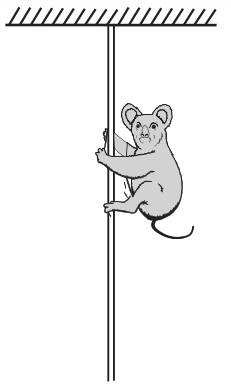
A monkey of mass $40kg$ climbs on a rope $($Fig.$)$ which can stand a maximum tension of $600 N$. In which of the following cases will the rope break: the monkey,

$($Ignore the mass of the rope$)$.
  • Climbs up with an acceleration of $6\ ms^{-2}$.
  • B
    Climbs down with an acceleration of $4\ ms^{-2}$.
  • C
    Climbs up with a uniform speed of $5\ ms^{-1}$.
  • D
    Falls down the rope nearly freely under gravity?
Answer
Correct option: A.
Climbs up with an acceleration of $6\ ms^{-2}$.
Case $(a)$ Mass of the monkey, $m=40 \mathrm{~kg}$ Acceleration due to gravity, $\mathrm{g}=10 \mathrm{~m} / \mathrm{s}$ Maximum tension that the rope can bear, $T_{\max }=600 \mathrm{~N}$
Acceleration of the monkey, $a=6 \mathrm{~m} / \mathrm{s}^2$ upward Using Newton's second law of motion, we can write the equation of motion as: $T-m g=m a$
$\therefore T=m(g+a)=40(10+6)=640 \mathrm{~N}$ Since $T>T_{\text {max }}$ the rope will break in this case.
Case $(b)$ Acceleration of the monkey, $a=4 \mathrm{~m} / \mathrm{s}^2$ downward Using Newton's second law of motion,
we can write the equation of motion as: $\mathrm{mg}-\mathrm{T}=\mathrm{ma} $
$\therefore \mathrm{T}=\mathrm{m}(\mathrm{g}-\mathrm{a})=40(10-4)=240 \mathrm{~N}$ Since $\mathrm{T}<\mathrm{T}_{\text {max }}$, the rope will not break in this case.
Case $(c)$ The monkey is climbing with a uniform speed of $5 \mathrm{~m} / \mathrm{s}$.
Therefore, its acceleration is zero,
i.e., $\mathrm{a}=0$. Using Newton's second law of motion, we can write the equation of motion as: $\mathrm{T}-\mathrm{mg}=\mathrm{ma} \mathrm{T}-\mathrm{mg}$
$=0 $
$\therefore \mathrm{~T}=\mathrm{mg}=40 \times 10=400 \mathrm{~N}$ Since $\mathrm{T}<\mathrm{T}_{\max }$, the rope will not break in this case.
Case $(d)$ When the monkey falls freely under gravity, its will acceleration become equal to the acceleration due to gravity,
i.e., a $=\mathrm{g}$ Using Newton's second law of motion, we can write the equation of motion as: $\mathrm{mg}-\mathrm{T}=\mathrm{mg} $
$\therefore \mathrm{T}=\mathrm{m}(\mathrm{g}-\mathrm{g})=0$
Since $\mathrm{T}<\mathrm{T}_{\text {max }}$, the rope will not break in this case.
View full question & answer
1 Marks Question - Physics STD 11 Science Questions - Vidyadip