Questions

5 Marks Questions

🎯

Test yourself on this topic

8 questions · timed · auto-graded

Question 15 Marks
Considering the pressure p to be proportional to the density, find the pressure p at a height h if the pressure on the surface of the earth is $p_0$.
Answer
Let $p_0$ is the density of air on surface of earth.
$\because$ pressure p at a point is sirectly proportional to density.
$\therefore\ \text{p }\alpha\ \rho\text{ or }\frac{\text{p}}{\text{p}_0}=\frac{\rho}{\rho_0}\text{ or }\rho=\Big(\frac{\text{p}}{\text{p}_0}\Big)\rho_{0}\ ...(\text{ii})$
$\text{dp}=\rho\text{gdh}$ form (i)
$(\rho$ is density of air in atmosphere$)$
$\text{dp}=-\Big(\frac{\text{p}}{\text{p}_0}\Big)\rho_0\text{gdh}$
$\Rightarrow\frac{\text{dp}}{\text{p}}=\frac{-\rho\text{og}}{\text{p}_{\text{i0}}}\text{dh}$
Integrating both sides $\int\limits^{\text{p}}_{\text{p}_0}\log\text{p dp}=-\int\limits^{\text{h}}_0\frac{\rho_0\text{g}}{\text{p}_0}$$\log\Big(\frac{\text{p}}{\text{p}_0}\Big)=\frac{-\rho_0}{\text{p}_0}\text{gh}\ ...(\text{iii})$
$\Rightarrow\frac{\text{p}}{\text{p}_0}=\text{e}^{-\frac{\rho_0\text{gh}}{\text{p}_0}}$
$\Rightarrow\text{p}=\text{p}_0{\text{e}}^{\frac{-\text{p}_0\text{gh}}{\text{p}_0}}$
View full question & answer
Question 25 Marks
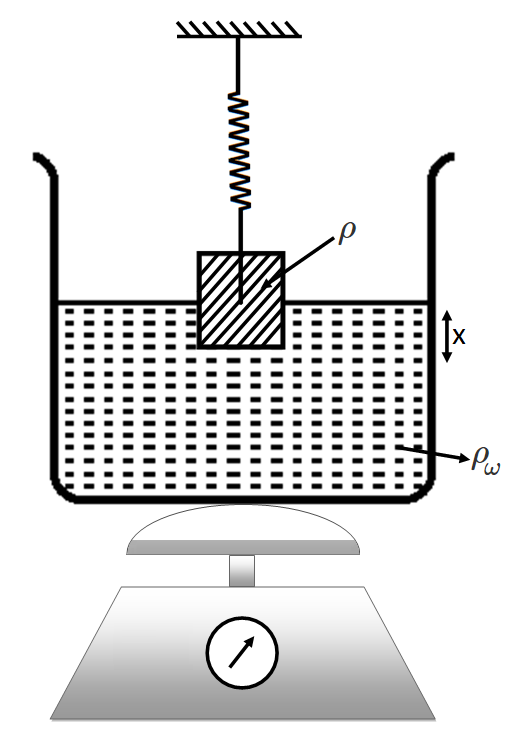
A vessel filled with water is kept on a weighing pan and the scale adjusted to zero. A block of mass $M$ and density $\rho$ is suspended by a massless spring of spring constant $k$. This block is submerged inside into the water in the vessel. What is the reading of the scale?
Answer
Consider the diagram. Beaker filled with water is placed on weighing pan and then scale is adjusted to zero.

At the block is submerged in water the bouyant force (upward) acts on the block by water. This bouyant force acts as reaction force. So, by newton's third law block will apply reaction force downward due to which reading on scale increases equal to the buoyant force = $Vp _wg$

V = Volume of water displaced By block Pw = density of water Mass of block $= M = Vp$ or $\text{V}=\frac{\text{M}}{\text{P}}$
$\therefore$ Reading of weighing scale $=\frac{\text{M}}{\rho}\cdot\text{p}_\text{w}\text{g}=\frac{\text{p}_\text{w}}{\text{p}}\text{Mg}$
View full question & answer
Question 35 Marks
Two mercury droplets of radii $0.1cm$. and $0.2cm$. collapse into one single drop. What amount of energy is released? The surface tension of mercury $T = 435.5 \times 10^{-3}N m^{-1}$
Answer
When two drops form a bigger drop, volume remains conserved. According to the problem, there is two mercury droplets of different radii collapse into one single drop. Radius of smaller drop $= r, = 0.1cm = 10^{-3}m,$ Radius of bigger drop $= r_2 = 0.2cm = 2 x 10^{-3}m$ Surface tension $(7) = 435.5 x 10 ^{-3}N/ m$ Let $V_1$ and $V_2$ be the volumes of these two mercury droplets and volume of big drop formed by collapsing is V. (image) Volume of big drop = Volume of small droplets$\text{V}=\text{V}_1+\text{V}_2$
$\frac{4}{3}\pi\text{R}^3=\frac{4}{3}\text{r}^3_1+\frac{4}{3}\pi\text{r}^3_2$
Or $\text{R}^3=\text{r}^3_1+\text{r}^3_2$$=(0.1)^3+(0.2)^3$
$=0.001+0.008=0.009$
Or $\text{R}=0.21\text{cm}=2.1\times10^{-3}\text{m}$$\therefore$ Decrease in surface area,
$\Delta\text{A}=4\pi\text{R}^2-(4\pi\text{r}^2_1+4\pi\text{r}^2_2)$
$\Delta\text{A}=4\pi\Big[\text{R}^2-\big(\text{r}^2_1+\text{r}^2_2\big)\Big]$ Energy released,$\text{E}=\text{T}\times\Delta\text{A}$
$=\text{T}\times4\pi\Big[\text{R}^2-\big(\text{r}^2_1+\text{r}^2_2\big)\Big]$
$=435.5\times10^{-3}\times4\times3.14\big[(2.1\times10^{-3})^2-(1\times10^{-6}+4\times10^{-6})\big]$
$=435.5\times4\times3.14\big[4.41-5\big]\times10^{-6}\times10^{-3}$
$=-32.23\times10^{-7}$
(Negative sign shows absorption) Therefore, $3.22 \times K^{-6}J$ energy will be absorbed. So, the surface area of the water decreases means surface area of bigger drop is less than the sum of surface area of two smaller drops.
View full question & answer
Question 45 Marks
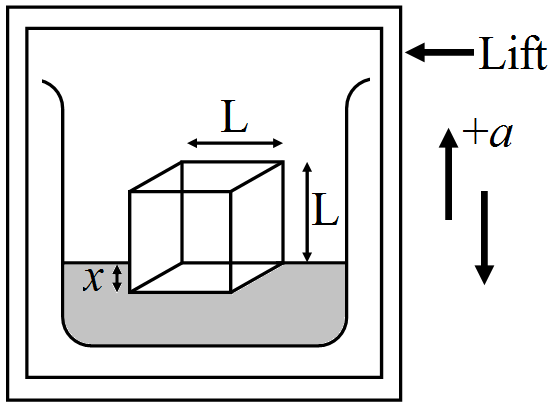
A cubical block of density $\rho$ iis floating on the surface of water. Out of its height L, fraction x is submerged in water. The vessel is in an elevator accelerating upward with acceleration a . What is the fraction immersed?
Answer
When cubical block is submerged in water, by principle of floatation, $Vpg = V' p_wg V'$ = Volume of water displaced by block V' = Volume of block inside water = area of base of block × height (inside water) $V' = L^2x V$ = volume of block $L^3, p_B$ = Density of block$\therefore\ \text{L}^3\text{p}_\text{B}=\text{L}^2\text{xp}_\text{w}\ \text{or}\ \frac{\text{p}_\text{B}}{\text{p}_\text{w}}=\frac{\text{x}}{\text{L}}\ ...(\text{i})$
$\text{x}=\frac{\text{p}_\text{B}}{\text{p}_\text{w}}\text{L}$
When the immersed block is in lift moving upwards then net acceleration of system = (g + a) Weight if block = $m(g + a) = V \times p_B(g + a) = L^3p_B(g + a)$ Now let part of block be submerged into water in moving lift (upward) is $x_1$ Weight of block = Buoyant force$\text{L}^3\text{p}_\text{B}(\text{g}+\text{a})=\text{x}_1\text{L}^2\text{p}_\text{w}(\text{g}+\text{a})$
$\therefore\ \frac{\text{p}_\text{B}}{\text{p}_\text{w}}=\frac{\text{x}_1}{\text{L}}$
$\text{x}_1=\text{L}\cdot\frac{\text{p}_\text{B}}{\text{p}_\text{w}}\ ...(\text{ii})$
From (i), (ii) we observe that sumerged part of cube inside water in both case is $\Big(\frac{\text{p}_\text{B}}{\text{p}_\text{w}}\text{L}\Big)$ which constant ot it is independent of acceleration of lift (+a, -a or zero) i.e., motion of lift upward or downward or at rest.
View full question & answer
Question 55 Marks
The free surface of oil in a tanker, at rest, is horizontal. If the tanker starts accelerating the free surface will be titled by an angle $\theta.$ If the acceleration is a m $s^{-2}$, what will be the slope of the free surface?
Answer
Key concept: The behaviour of a liquid contained in a horizontally accelerated vessel can be understood by understanding the behaviour of a pendulum suspended from the ceiling of a horizontally accelerated trolley. (iamge) Every fluid element attains an equilibrium position under the action of gravity and pseudo force. The free surface of the liquid orients itself perpendicular to the direction of net effective gravity.$\tan\theta=\frac{\text{a}}{\text{g}}$
Suppose tanker accelerates along x-axis with acceleration a, free surface of the tanker will not be horizontal because pseudo force acts as shown in the diagram. (image) Consider an elementary particle of the oil of mass m. The acting forces on the particle with respect to the tanker are shown in the figure alongside. Now, balancing forces (as the particle is in equilibrium) along the inclined direction of surface. ma = pseudo force mg = weight of small part of oil. Along free surface, Net force = 0$\Rightarrow\text{ma}\cos\theta=\text{mg}\sin\theta$
$\Rightarrow\text{a}=\text{g}\tan\theta$
$\Rightarrow\theta=\tan^{-1}\Big(\frac{\text{a}}{\text{g}}\Big)$
View full question & answer
Question 65 Marks
If a drop of liquid breaks into smaller droplets, it results in lowering of temperature of the droplets. Let a drop of radius R, break into N small droplets each of radius r. Estimate the drop in temperature.
Answer
The volume remains conserved, when a big drop, breaks into N small droplets. Volume of liquid drop of radius R = (Volume of liquid droplet of radius r) × N$\frac{4}{3}\pi\text{R}=\text{N}\times\frac{4}{3}\pi\text{r}^3$
Or $\text{R}^3=\text{Nr}^3$ Or $\text{N}=\frac{\text{R}^3}{\text{r}^3}$ Energy released,$\Delta\text{U}=\text{T}\times\Delta\text{A}$
$\Delta\text{U}=\text{T}\big[4\pi\text{R}^2-\text{N}(4\pi\text{r}^2)\big]$
$\Delta\text{U}=4\pi\text{T}\big(\text{R}^2-\text{Nr}^2\big)$
Due to releasing of this energy, the temperature is lowered. If c is specific heat of liquid and its temperature is lowered by $\Delta\text{T}$ then Energy released, $\Delta\text{U}-\text{me }\Delta\text{T}$$\Delta\text{T}=\frac{\Delta\text{U}}{\text{mc}}=\frac{4\pi\text{T}\big(\text{R}^2-\text{Nr}^2\big)}{\big(\frac{4\pi}{3}\big)\text{R}^3\rho\text{c}}$ $\big[\because\rho=\text{density of liquid}\big]$
$\Rightarrow\Delta\text{T}=\frac{3\text{T}}{\rho\text{c}}\Big(\frac{1}{\text{R}}-\text{N}\frac{\text{r}^2}{\text{R}^3}\Big)$
$\Rightarrow\Delta\text{T}=\frac{3\text{T}}{\rho\text{c}}\Big(\frac{1}{\text{R}}-\frac{1}{\text{r}}\Big)$
$\therefore\text{ R}>\text{r}$
$\Rightarrow\frac{1}{\text{R}}<\frac{1}{\text{r}}$
$\Rightarrow\Big(\frac{1}{\text{R}}-\frac{1}{\text{r}}\Big)<0$ [Using eqn. (i)]
$\therefore\ \Delta\text{T}$ will be negative. Hence, temperature of droplet falls.
View full question & answer
Question 75 Marks
A hot air balloon is a sphere of radius 8 m . The air inside is at a temperature of $60^{\circ} \mathrm{C}$. How large a mass can the balloon lift when the outside temperature is $20^{\circ} \mathrm{C}$ ? (Assume air is an ideal gas, $\mathrm{R}=8.314 \mathrm{~J} \mathrm{~mole}^{-1} \mathrm{~K}^{-1}, 1 \mathrm{~atm} .=1.013 \times$ $10^5$ Pa the membrane tension is $5 \mathrm{~N} \mathrm{~m}^{-1}$)
Answer
Pressure inside $(P_i)$ balloon is larger than outer pressure $(p_0)$ of atmosphere.$\therefore\ \text{P}_\text{i}-\text{P}_0=\frac{2\sigma}{\text{R}}$
$\sigma=$ surface tension in membrane of balloon R = radius of balloon. (image) Gas or air inside is perfect (considered)$\therefore\ \text{P}_\text{i}\text{V}=\text{n}_\text{i}\text{RT}_\text{i}$
V = volume of balloon $n_i$ = no. of moles of gas in balloon R = gas constant $T_i$ = temperature of balloon$\text{n}_\text{i}=\frac{\text{P}_\text{i}\text{V}}{\text{RT}_\text{i}}=\frac{\text{mass of air balloon(M}_\text{i})}{\text{molecular mass (m}_\text{A})}$
$\text{n}_\text{i}=\frac{\text{M}_\text{i}}{\text{M}_\text{A}}=\frac{\text{P}_\text{i}\text{V}}{\text{RT}_\text{i}}$
Similarly, $\text{n}_0=\frac{\text{P}_0\text{V}}{\text{RT}_0}$ By principle off floataion $\text{W}+\text{M}_\text{i}\text{g}=\text{M}_0\text{g}$ W = weight lifted by balloon $\text{W}=\text{M}_0\text{g}-\text{M}_\text{i}\text{g}$$\text{W}=(\text{M}_0-\text{M}_\text{i})\text{g}$
where $n_0$ = no. of molecules of air displaces by balloon. V = Volume of air displced by ballon equal to volume of balloon. If $M_0$ mass of air displaced by balloon. $M_A$ = molecular mass inside or outside balloon.$\therefore\ \text{n}_0=\frac{\text{M}_0}{\text{M}_\text{A}}\text{ or }=\frac{\text{M}_0}{\text{M}_\text{A}}=\frac{\text{P}_0\text{V}}{\text{RT}_\text{0}}$
$\text{M}_0=\frac{\text{P}_0\text{VM}_\text{A}}{\text{RT}_0}$
From (i) $\text{M}_\text{i}=\frac{\text{P}_\text{i}\text{V}\cdot\text{M}_\text{A}}{\text{RT}_\text{i}}$$\therefore\ \text{W}=\Big[\frac{\text{P}_0\text{VM}_\text{A}}{\text{RT}_0}-\frac{\text{P}_\text{i}\text{VM}_\text{A}}{\text{RT}_\text{i}}\Big]\text{g}$
$\text{W}=\frac{\text{VM}_\text{A}}{\text{R}}\Big[\frac{\text{P}_0}{\text{T}_0}-\frac{\text{P}_\text{i}}{\text{T}_\text{i}}\Big]\text{g}$
$\text{M}_\text{A}=21\%\text{O}_2+79\%\text{ or N}_2$
$\text{M}_\text{A}=0.21\times32+0.79\times28=4\big[0.21\times8+0.79\times7\big]$
$\text{M}_\text{A}=4\big[1.68+5.53\big]=4\big[7.21\big]=28.84\text{g}$
$\text{M}_\text{A}=0.2884\text{kg P}_\text{i}=\text{P}_0+\frac{2\sigma}{\text{R}}$
$\text{W}=\frac{\frac{4}{3}\pi\times8\times8\times8\times0.2884}{8.314}\Big[\frac{1.013\times10^5}{(273+20)}-\frac{\text{P}_\text{i}}{273+60}\Big]\text{g}$
$\text{P}_\text{i}=\text{P}_0+\text{P}$ due to S.T of membrane $=\text{p}_0+\frac{2\sigma}{\text{R}}$
$\text{P}_\text{i}=\Big[1.013\times10^5+\frac{2\times5}{8}\Big]=\big[1011300+1.25\big]$
$\text{P}_\text{i}=101301.25=1.0130125\times10^5\cong1.013\times10^5$
$\therefore\ \text{W}=\frac{4\times3.14\times8\times8\times8\times0.02884}{3\times8.314}\Big[\frac{1.013\times10^5}{293}-\frac{1.013\times10^5}{333}\Big]\text{g}$
$\text{W}=\frac{4\times3.14\times8\times8\times8\times0.02884\times1.013\times10^5}{3\times8.314}\Big[\frac{1}{293}-\frac{1}{333}\Big]\text{g}$
$\text{W}=\frac{4\times3.14\times8\times8\times8\times0.02884\times1.013\times10^5\times9.8}{3\times8.314}\Big[\frac{333-293}{293\times333}\Big]$
$\text{W}=\frac{3.14\times64\times32\times0.02884\times1.013\times10^5\times9.8\times40}{3\times8.314\times293\times333}=3044.2\text{N}$
View full question & answer
MCQ 85 Marks
Surface tension is exhibited by liquids due to force of attraction between molecules of the liquid. The surface tension decreases with increase in temperature and vanishes at boiling point. Given that the latent heat of vaporisation for water $Lv = 540k ~cal ~kg^{-1}$, the mechanical equivalent of heat $J = 4.2J ~cal^{-1}$, density of water $\rho_\text{w}=10^3\text{kg l}^{-1},$ Avagadro’s No $N_A = 6.0 \times 10^{26}k ~mole^{-1}$ and the molecular weight of water $M_A = 18kg$ for 1k mole.
  • Estimate the energy required for one molecule of water to evaporate.
  • B
    Show that the inter–molecular distance for water is $\text{d}=\Big[\frac{\text{M}_\text{A}}{\text{N}_\text{A}}\times\frac{1}{\rho_\text{w}}\Big]^{\frac{1}{3}}$ and find its value.
  • C
    $1g$ of water in the vapor state at $1 atm$ occupies $1601cm^3$. Estimate the intermolecular distance at boiling point, in the vapour state.
  • D
    During vaporisation a molecule overcomes a force $F$, assumed constant, to go from an inter-molecular distance d to d′. Estimate the value of $F.$
Answer
Correct option: A.
Estimate the energy required for one molecule of water to evaporate.
Accordinag to the problem, latent heat of vaporisation for water,
$\left(L_v\right)=540 kcal=540 \times 10^3 \times 4.2 j=2268 \times 10^3 J$
Therefore, energy required to evaporate $1 k mol (18 kg)$ of water
$=\left(2268 \times 10^3 J\right)(18)$
$=40824 \times 10^3 J=4.0824 \times 10^7 J$
Since, there are $N _{ A }$ molecules in $M _{ Akg }$ of water, the energy required for I molecule to evaporate is
$\text{U}=\frac{\text{M}_\text{A}\text{L}_\text{v}}{\text{N}_\text{A}}\text{J}$
$\big[\text{where N}_\text{A}=6\times10^{26}=\text{Avogadro number}\big]$
$\text{U}=\frac{4.0824\times10^7}{6\times10^{26}}\text{J}=0.68\times10^{-19}\text{J}$
$\text{U}=6.8\times10^{-20}\text{J}$
$b.$Let the water molecules to be at points are places at a distance d from each other,
Volume of $NA$ molecule of water $=\frac{\text{M}_\text{A}}{\rho_\text{w}}$
Thus, the volume around one molecule is
$=\frac{\text{Volume of 1km mol}}{\text{number of molecules/ km mol}}=\frac{\text{M}_\text{A}}{\text{N}_\text{A}\rho_\text{w}}$
And also volume around one molecule $= d^3$
Thus, by equating these, we get
$\text{d}_3=\frac{\text{M}_\text{A}}{\text{N}_\text{A}\rho_\text{w}}$
$\therefore\ \text{d}=\Big(\frac{\text{M}_\text{A}}{\text{N}_\text{A}\rho_\text{w}}\Big)^{\frac{1}{3}}=\Big(\frac{18}{6\times10^{26}\times10^3}\Big)^{\frac{1}{3}}$
$=\big(30\times10^{30}\big)^{\frac{1}{3}}\text{m}=3.1\times10^{-10}\text{m}$
$c.$Volume occupied by $1k \ mol (18\ kg)$ of water molecules,
$=\frac{1601\times10^{-6}\text{m}^3}{\text{g}}(18\times10^{3}\text{g})$
$=28818\times10^{-3}\text{m}^3$
Since $6 \times 10^{26}$ molecules occupies $18 \times 1601 \times 10^{-3}m^3$​​​​​​​
$\therefore$ Volume occupied by $1$ molecule
$=\frac{28818\times10^{-3}\text{m}^3}{6\times10^{26}}=48030\times10^{-30}\text{m}^3$
If d' is the intermolecular distance, then
$(\text{d}')^3=48030\times10^{-30}\text{m}^3$
So, $\text{d}'=36.3\times10^{-10}\text{m}=36.3\times10^{-10}\text{m}$​​​​​​​
d.Work done to chang the distance from $d$ to $d'$ is $U = F(d' - d)$
This work done is equal to energy required to evaporate $1$ molecule.
$\therefore\ \text{F}(\text{d}'-\text{d})=6.8\times10^{-20}$
Or $\text{F}=\frac{6.8\times10^{-20}}{\text{d}'-\text{d}}$
$=\frac{6.8\times10^{-20}}{(36.3\times10^{-10}-3.1\times10^{-10})}$
$=2.05\times10^{-11}\text{N}$​​​​​​​
e.Surface tension $=\frac{\text{F}}{\text{d}}=\frac{2.05\times10^{-11}}{3.0\times10^{-10}}=6.6\times10^{-2}\text{N/ m}$
View full question & answer
5 Marks Questions - Physics STD 11 Science Questions - Vidyadip