Questions

M.C.Q (1 Marks)

🎯

Test yourself on this topic

13 questions · timed · auto-graded

MCQ 11 Mark
Modulus of rigidity of ideal liquids is
  • A
    Infinity.
  • Zero.
  • C
    Unity.
  • D
    Some finite small non - zero constant value.
Answer
Correct option: B.
Zero.
As the liquid is ideal, hence it does not have frictional force among it's layers, thus the tangential forces are zero as there is no stress developed. This verifies.
View full question & answer
MCQ 21 Mark
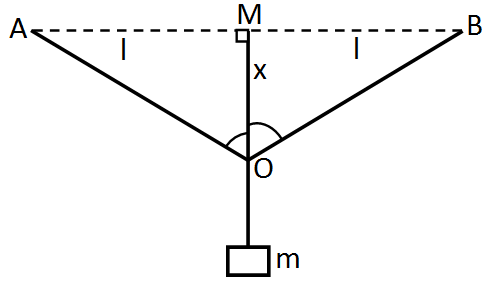
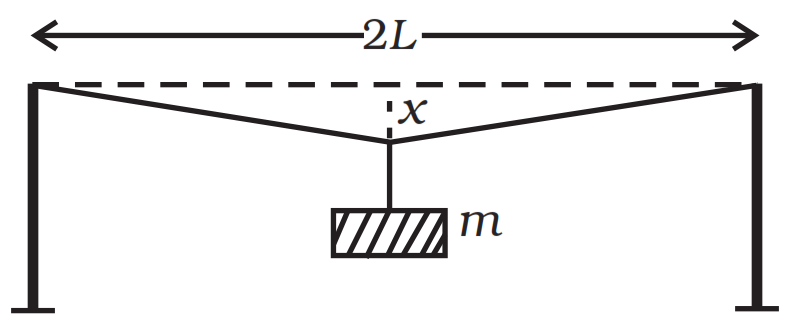
A mild steel wire of length $2L$ and cross $-$ sectional area $A$ isstretched, well within elastic limit, horizontally between two pillars. A mass $m$ is suspended from the mid point of the wire.Strain in the wire is
  • $\frac{\text{x}^2}{2\text{L}^2}$
  • B
    $\frac{\text{x}}{\text{L}}$
  • C
    $\frac{\text{x}^2}{\text{L}}$
  • D
    $\frac{\text{x}^2}{\text{2L}}$
Answer
Correct option: A.
$\frac{\text{x}^2}{2\text{L}^2}$
$\Delta\text{l}=(\text{AO+BO})-\text{AB}$
$\Delta\text{L}=2\text{AO}-\text{2l}=2[\text{AO}-\text{l}]$
$=2\Big[\big(\text{l}^2+\text{x}^2\big)^{\frac{1}{2}}-1\Big]$
$=2\text{l}\Big[\Big(1+\frac{\text{x}^2}{\text{l}^2}\Big)^{\frac{1}{2}}-1\Big]$

$\Delta\text{l}=2\text{l}\Big[1+\frac{\text{x}^2}{\text{2l}^2}-1\Big]=2\text{l}.\frac{\text{x}^2}{2\text{l}^2}=\frac{\text{x}^2}{\text{l}}$
Strain $=\frac{\Delta\text{l}}{2\text{l}}=\frac{\frac{\text{x}^2}{\text{l}}}{\text{2l}}=\frac{\text{x}2}{2\text{l}^2}$ verifies the Option $(a).$
View full question & answer
MCQ 31 Mark
A spring is stretched by applying a load to its free end. The strain produced in the spring is
  • A
    Volumetric.
  • B
    Shear.
  • Longitudinal and shear.
  • D
    Longitudinal.
Answer
Correct option: C.
Longitudinal and shear.
When a spring is stretched by a load its shape (shear) and length changes. So strain produced is shearing and longitudinal strain.
View full question & answer
MCQ 41 Mark
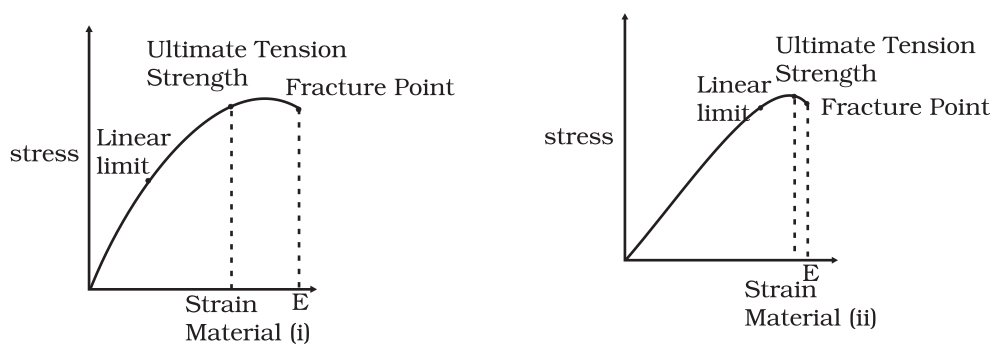
The stress - strain graphs for two materials are shown in $($assume same scale$).$
  1. Material $(ii)$ is more elastic than material $(i)$ and hence material $(ii)$ is more brittle.
  2. Material $(i)$ and $(ii)$ have the same elasticity and the same brittleness.
  3. Material $(ii)$ is elastic over a larger region of strain as compared to $(i).$
  4. Material $(ii)$ is more brittle than material $(i).$
  • A
    $a$ and $b$
  • B
    $b$ and $c$
  • $c$ and $d$
  • D
    All of the above
Answer
Correct option: C.
$c$ and $d$
On comparing ultimate tensile strength of the materials, $(ii)$ is greater than $(i)$. Hence, material $(ii)$ is elastic over larger region as compare to $(i)$ so the material $(ii)$ is elastic over a larger region of strain as compared to $(i) ($verifies option $c).$
As the fracture point of material $(ii)$ is nearer than $(i),$ hence the material $(ii)$ is more brittle than material $(i).$
View full question & answer
MCQ 51 Mark
The maximum load a wire can withstand without breaking, when its length is reduced to half of its original length, will
  • A
    Be double.
  • B
    Be half.
  • C
    Be four times.
  • Remain same.
Answer
Correct option: D.
Remain same.
$\text{Breaking stress}=\frac{\text{Breaking force}}{\text{Area of cross - section}}$
Since breaking force doesn't depend on length, hence changing the cross section has no effect.
So the breaking force remain same.
View full question & answer
MCQ 61 Mark
A wire is suspended from the ceiling and stretched under the action of a weight F suspended from its other end. The force exerted by the ceiling on it is equal and opposite to the weight.
  1. Tensile stress at any cross section $A$ of the wire is $F/ A.$
  2. Tensile stress at any cross section is zero.
  3. Tensile stress at any cross section $A$ of the wire is $2F/ A.$
  4. Tension at any cross section $A$ of the wire is $F.$
  • $a, d$
  • B
    $a, c$
  • C
    $c, d$
  • D
    $b, d$
Answer
Correct option: A.
$a, d$
Stress $=\frac{\text{F}}{\text{A}}$ verifies option $(a).$
Here, Tension is balanced by force $F$.
Hence, $T = F$ verifies option $(d).$
View full question & answer
MCQ 71 Mark
A copper and a steel wire of the same diameter are connected end to end. A deforming force $F$ is applied to this composite wire which causes a total elongation of $1\ cm.$ The two wires will have
  • A
    The same stress.
  • B
    Different stress.
  • C
    Different strain.
  • Both $A$ and $C$
Answer
Correct option: D.
Both $A$ and $C$
$\because\text{stress}=\frac{\text{F}}{\text{A}}$
$\because$ area of cross section for both wire same and stretched by same force.
So their stress are equal verifies option $(a).$
$\text{strain}=\frac{\text{stress}}{\text{Y}}$
As stress for both wires are same, so
$\text{strain}_\text{steel}\propto=\frac{\text{1}}{\text{Y}_\text{steel}}$ and $\text{(strain)}_\text{Al}\propto\frac{1}{\text{Y}_\text{Al}}$
$\frac{\text{strain}_\text{steel}}{\text{(strain)}_\text{Al}}=\frac{\text{Y}_\text{Al}}{\text{Y}_\text{steel}}$
$\text{Y}_\text{Al}<\text{Ys}$
So $\frac{\text{Al}}{\text{steel}}$
or $(\text{strain})_\text{steel}<​​(\text{strain})_\text{Al}$
Verifies option $(c).$
View full question & answer
MCQ 81 Mark
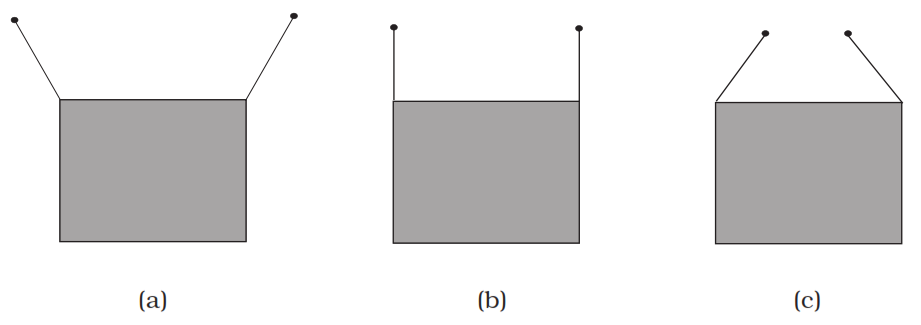
A rectangular frame is to be suspended symmetrically by two strings of equal length on two supports. It can be done in one of the following three ways;

The tension in the strings will be
  • A
    The same in all cases.
  • B
    Least in (a).
  • Least in (b).
  • D
    Least in (c).
Answer
Correct option: C.
Least in (b).
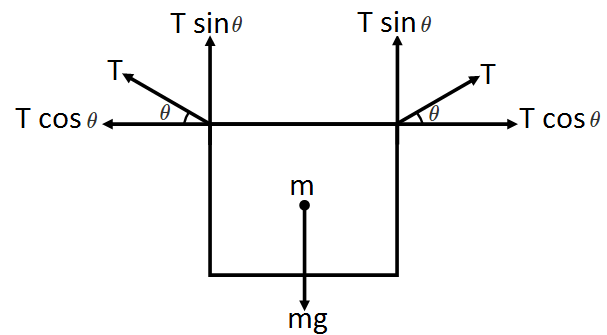
According to the FBD diagram of the rectangular frame. Let M be the mass of rectangular frame and 0be the angle which the tension T in the string makes with the horizontal

Balancing vertical forces,
$2\text{T}\sin\theta-\text{mg}=0$ [T is tension in the string]
$\Rightarrow2\text{T}\sin\theta=\text{mg}$
Total horizontal force will be zero because of equal and opposite forces balance each other $(\text{T}\cos\theta).$
Now from Eq. (i), $\text{T}=\frac{\text{mg}}{2\sin\theta}$
Here, we know mg is constant.
$\Rightarrow\text{T}\propto\frac{1}{\sin\theta}$
T is least if $\sin\theta$ has maximum value.
$\text{T}_\text{min}=\frac{\text{mg}}{2\sin\theta_\text{max}}\text{ (since,}\sin\theta_{\text{max}}=1)$
$\sin\theta_\text{max}=1\Rightarrow\theta=90^\circ$
So the correct option is option (c).
Hence, tension is least for the case (b).
View full question & answer
MCQ 91 Mark
For an ideal liquid
  • A
    The bulk modulus is infinite.
  • B
    The shear modulus is zero.
  • C
    The shear modulus is infinite.
  • $B$ and $C$
Answer
Correct option: D.
$B$ and $C$
An ideal liquid is not compressible.
Bulk modulus $(\text{K})=\frac{-\text{p(V)}}{\Delta\text{V}} (\because\Delta\text{V=0})$
$\because\Delta\text{V=0}$ for ideal liquid.
$\therefore\text{K=}\infty$ for ideal liquid.
As there is no net tangential force on liquid $(S.T.$ is all around on a particle$)$ so shearing strain $\Delta\theta=0$ and $F=0.$
$\eta=\frac{\text{F/A}}{\Delta\theta}=\frac{0}{0}$ indeterminant value.
Hence, verifies option $(a)$ and $(d)$ and rejects option $(b, c).$
View full question & answer
MCQ 101 Mark
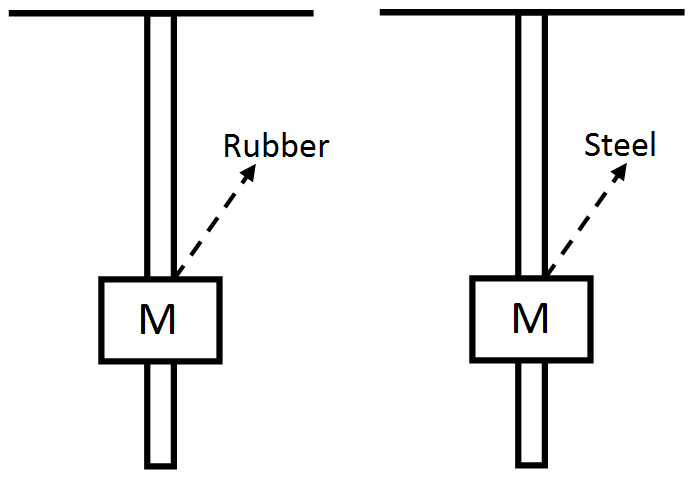
Consider two cylindrical rods of identical dimensions, one of rubber and the other of steel. Both the rods are fixed rigidly at one end to the roof. A mass M is attached to each of the free ends at the centre of the rods.
  • A
    Both the rods will elongate but there shall be no perceptible change in shape.
  • B
    The steel rod will elongate and change shape but the rubber rod will only elongate.
  • C
    The steel rod will elongate without any perceptible change in shape, but the rubber rod will elongate and the shape of the bottom edge will change to an ellipse.
  • The steel rod will elongate, without any perceptible change in shape, but the rubber rod will elongate with the shape of the bottom edge tapered to a tip at the centre.
Answer
Correct option: D.
The steel rod will elongate, without any perceptible change in shape, but the rubber rod will elongate with the shape of the bottom edge tapered to a tip at the centre.


According to the diagram shown below in which a mass AT is attached at the centre of each rod, then both rods will be elongated. But due to different elastic properties of material the steel rod will elongate without making any perceptible change in shape, but the rubber rod will elongate with the shape of the bottom edge tapered to a tip at the centre.
View full question & answer
MCQ 111 Mark
A rigid bar of mass M is supported symmetrically by three wires each of length l . Those at each end are of copper and the middle one is of iron. The ratio of their diameters, if each is to have the same tension, is equal to
  • A
    $\text{Y}_\text{copper}/\text{Y}_\text{iron}.$
  • $\sqrt{\frac{\text{Y}_\text{iron}}{\text{Y}_\text{copper}}}.$
  • C
    $\frac{\text{Y}^2_\text{iron}}{\text{Y}^2_\text{copper}}.$
  • D
    $\frac{\text{Y}_\text{iron}}{\text{Y}_\text{copper}}.$
Answer
Correct option: B.
$\sqrt{\frac{\text{Y}_\text{iron}}{\text{Y}_\text{copper}}}.$
As the bar is supported symmetrically by the three wires, therefore extension in each wire is same. Let T be the tension in each wire and diameter of the wire is D, then Young’s modulus is
$(\text{Y})=\frac{\text{Stress}}{\text{Strain}}=\frac{\text{F/A}}{\Delta\text{L}/\text{L}}=\frac{\text{F}}{\text{A}}\times\frac{\text{L}}{\Delta\text{L}}$
$=\frac{\text{F}}{\pi(\text{D/2})^2}\times\frac{\text{L}}{\Delta\text{L}}=\frac{4\text{FL}}{\pi\text{D}^2\Delta\text{L}}$
$\Rightarrow\ \text{D}^2=\frac{4\text{FL}}{\pi\Delta\text{LY}}\Rightarrow\ \text{D}=\sqrt{\frac{4\text{FL}}{\pi\Delta\text{LY}}}$
As F and $\frac{\text{L}}{\Delta\text{L}}$ are constants.
Hence, $\text{D}\propto\sqrt{\frac{1}{\text{Y}}}$
or $\text{D}=\frac{\text{K}}{\sqrt{\text{Y}}}$ (K is the proportionality constant)
Now we can find ratio as $\frac{\text{D}_\text{copper}}{\text{D}_\text{iron}}=\sqrt{\frac{\text{Y}_\text{iron}}{\text{Y}_\text{copper}}}$
View full question & answer
MCQ 121 Mark
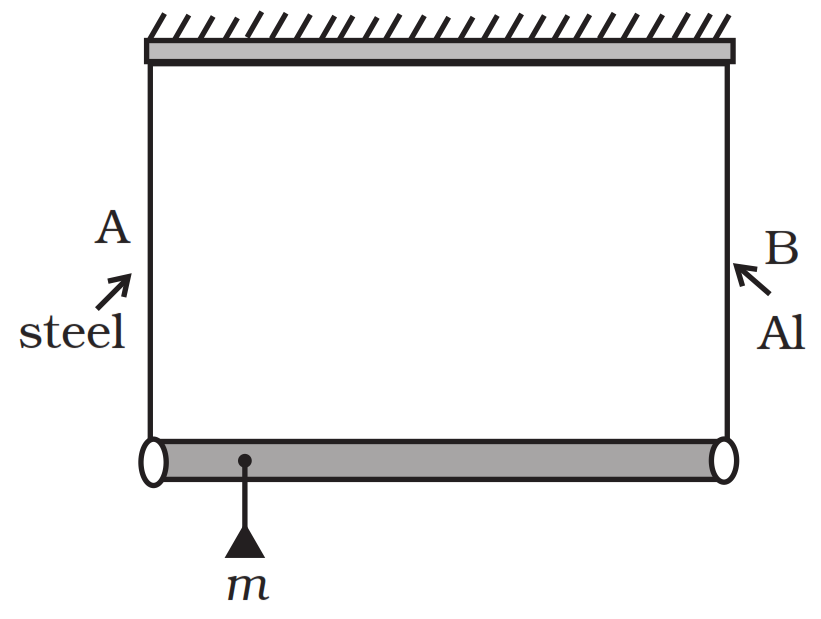
A rod of length $I$ and negligible mass is suspended at its two ends by two wires of steel $($wire $A )$ and aluminium $($wire $B)$ of equal lengths. The cross $-$ sectional areas of wires $A$ and $B$ are $1.0 mm^2$ and $2.0 mm^2$, respectively. $\left(Y_{\text {al }}=70 \times 10 Nm ^{-2}\right.$ and $\left.Y_{\text {steel }}=200 \times 10^9 Nm ^{-2}\right)$
  • A
    Mass $m$ should be suspended close to wire $A$ to have equal stresses in both the wires.
  • B
    Mass $m$ should be suspended close to $B$ to have equal stresses in both the wires.
  • C
    Mass $m$ should be suspended close to wire $A$ to have equal strain in both wires.
  • $B$ and $C$
Answer
Correct option: D.
$B$ and $C$
According to the diagram a massless rod is suspended at its two ends by two wires of steel $($wire $A)$ and aluminum $($wire $B)$ of equal lengths.
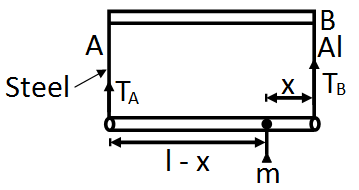
Let the mass is suspended at $x$ from the end $B$, which develop equal stress in wires.
Let $T_a$ and $T_B$ be the tensions in wire $A$ and wire $B$ respectively.

stress in steel wire $A, \text{S}_\text{A}=\frac{\text{T}_\text{A}}{\text{A}_\text{A}}=\frac{\text{T}_\text{A}}{10^{-6}}$
stress in $Al$ wire $\text{S}_\text{B}=\frac{\text{T}_\text{B}}{\text{A}_\text{B}}=\frac{\text{T}_\text{B}}{2\times10^{-6}}$
where $A_A$ and $A_B$ are cross $-$ sectional areas of wire $A$ and $B$ respectively. Also, from rotational equilibrium, net torque is zero, i.e. $\text{T}_\text{B}\text{x}-\text{T}_\text{A}(\text{l}-\text{x})=0$
$\Rightarrow\frac{\text{T}_\text{B}}{\text{T}_\text{A}}=\frac{\text{l}-\text{x}}{\text{x}} ...(\text{i})$
For equal stress, $S_A = S_B$
$\Rightarrow\text{S}_\text{A}=\text{S}_\text{B}$
$\Rightarrow\frac{\text{T}_\text{A}}{10^{-6}}=\frac{\text{T}_\text{B}}{2\times10^{-6}}$
$\Rightarrow\frac{\text{l}-\text{x}}{\text{x}}=2$
$\Rightarrow\frac{\text{l}}{\text{x}}-1=2$
$\Rightarrow\text{x}=\frac{\text{l}}{\text{3}}$
$\Rightarrow\text{l}-\text{x}=\text{l}-\frac{\text{l}}{\text{3}}=\frac{2\text{l}}{3}$
Hence, mass m should be suspended close to wire $B (Al$ wire$).$
We know, Strain $=\frac{\text{Stress}}{\text{Y}}$
So, for equal strain in the wires,
$\Rightarrow\ \frac{\text{S}_\text{A}}{\text{Y}_\text{Steel}}=\frac{\text{S}_\text{B}}{\text{Y}_\text{Al}}$
$\Rightarrow\ \frac{\text{Y}_\text{Steel}}{\text{T}_\text{A}/\text{a}_\text{A}}=\frac{\text{Y}_\text{Al}}{\text{T}_\text{B}/\text{a}_\text{B}}$
$\Rightarrow\ \frac{\text{Y}_\text{Steel}}{\text{Y}_\text{Al}}=\frac{\text{T}_\text{A}}{\text{T}_\text{B}}\times\frac{\text{a}_\text{B}}{\text{a}_\text{A}}=\Big(\frac{\text{x}}{\text{l}-\text{x}}\Big)\Big(\frac{2\text{a}_\text{A}}{\text{a}_\text{A}}\Big)$
$\Rightarrow\ \frac{200\times10^9}{70\times10^9}=\frac{\text{2x}}{\text{l}-\text{x}}$
$\Rightarrow\frac{20}{7}=\frac{\text{2x}}{\text{l}-\text{x}}$
$\Rightarrow17\text{x}=10\text{l}$
$\Rightarrow\text{x}=\frac{10\text{l}}{17}$
$\Rightarrow\text{l}-\text{x}=\text{l}-\frac{10\text{l}}{17}=\frac{7\text{l}}{17}$
Hence, mass m should be suspended close to wire $A ($steel wire$).$
View full question & answer
MCQ 131 Mark
The temperature of a wire is doubled. The Young’s modulus of elasticity
  • A
    Will also double.
  • B
    Will become four times.
  • C
    Will remain same.
  • Will decrease.
Answer
Correct option: D.
Will decrease.
Key concept: Youngs modulus $(Y).$
It is defined as the ratio of normal stress to longitudinal strain within limit of proportionality.
$\text{Y}=\frac{\text{Normal stress}}{\text{Longitudinal strain}}=\frac{\text{F/A}}{\Delta\text{L/L}}=\frac{\text{FL}}{\text{A}\Delta\text{L}}$
The fractional change in length of any material is defined as
$\frac{\Delta\text{L}}{\text{L}_0}=\alpha\Delta\text{T}$
where $\Delta T$ is change in the temperature, $L_o$ is original length, $\alpha$ is the coefficient of linear expansion of the given material and $L_o$ is the original length of material.
So, simply change in length is due to change in temperature.
$\Delta\text{A}=\text{L}_0\alpha\Delta\text{T}$
And Young's modulus
$(\text{Y})=\frac{\text{Stress}}{\text{Strain}}=\frac{\text{FL}_0}{\text{A}\times\Delta\text{L}}=\frac{\text{FL}_0}{\text{AL}_0\alpha\Delta\text{T}}\propto\frac{1}{\Delta\text{T}}$
As $\text{Y}\propto\frac{1}{\Delta\text{T}}$
View full question & answer
M.C.Q (1 Marks) - Physics STD 11 Science Questions - Vidyadip