Questions · Page 2 of 2

2 Marks Questions

Question 512 Marks
A football is kicked 20m/ s at a projection angle of 45°. A receiver on the goal line 25m away in the direction of the kick runs the same instant to meet the ball. What must be his speed, if he has to catch the ball before it hits the ground?
Answer
Given, u = 20m/ s, $\theta=45^\circ,$ d = 25m Horizontal range is given by $\text{R}=\frac{\text{u}^2}{\text{g}}\sin2\theta=\frac{(20)^2}{9.8}\sin2(45^\circ)$ $=\frac{400}{9.8}\times1=40.82\text{m}$ Time of flight, $\text{T}=\frac{2\text{u}\sin\theta}{\text{g}}=\frac{2\times20}{9.8}\sin45^\circ$ $=2.886\text{s}$The goal man is 25m away in the direction of the ball, so to catch the ball, he is to cover a distance
= 40.82 - 25 = 15.82m in time 2.886s.
$\therefore$ Velocity of the goal man to catch the ball
$\text{v}=\frac{15.82}{2.886}=5.48\text{m/ s}$
View full question & answer
Question 522 Marks
Find the angle of projection for a projectile motion whose range R is n times the maximum height H.
Answer
Given R = nH $\Rightarrow\ \frac{\text{u}^2\sin2\theta}{\text{g}}=\text{n}\times\frac{\text{u}^2\sin^2\theta}{2\text{g}}$ $\Rightarrow\ \theta=\tan^{-1}\Big(\frac{4}{\text{n}}\Big)$
View full question & answer
Question 532 Marks
Suppose you have two forces $\vec{\text{F}}$ and $\vec{\text{F}}.$ How would you combine them in order to have resultant force of magnitudes $(a)$ zero, $(b) 2\vec{\text{F}}$ and $(c) \vec{\text{F}}?$
Answer
  1. If they act at opposite direction, resultant is zero.
  2. If they act in same direction, $R = 2F.$
  3. For the resultant to be $F,$
$\text{F}^2=\text{F}^2+\text{F}^2+2\text{F}^2\cos\theta$
$\cos\theta=-\frac{1}{2}$ or $\theta=120^\circ.$
View full question & answer
Question 542 Marks
Find the scalar product of two vectors $\vec{\text{a}}=(3\hat{\text{i}}-4\hat{\text{j}}+5\hat{\text{k}})$ and $\vec{\text{b}}=(-2\hat{\text{i}}+\hat{\text{j}}-3\hat{\text{k}}).$
Answer
$\vec{\text{a}}=(3\hat{\text{i}}-4\hat{\text{j}}+5\hat{\text{k}})$ $\vec{\text{b}}=(-2\hat{\text{i}}+\hat{\text{j}}-3\hat{\text{k}})$ $\vec{\text{a}}.\vec{\text{b}}=3(-2)-4(1)+5(-3)$ $=-6-4-15=-25$
View full question & answer
Question 552 Marks
The sum and difference of two vectors are perpendicular to each other. Prove that the ectors are equal in magnitude.
Answer
As the vectors A + B and A - B are perpendicular to each other, therefore$(\text{A}+\text{B}).(\text{A}-\text{B})=0$
$\text{A}.\text{A}-\text{A}.\text{B}+\text{B}.\text{A}-\text{B}.\text{B}=0$
$\text{A}-\text{B}=0\ \ [\because\ \text{A}.\text{B}=\text{B}.\text{A}]$
$\Rightarrow\ \text{A}=\text{B}$
View full question & answer
Question 562 Marks
Show that $\vec{\text{a}}.(\vec{\text{b}}\times\vec{\text{c}})$ is equal in magnitude to the volume of a parallelopiped formed by the three vectors $\vec{\text{a}},\vec{\text{b}}$ and $\vec{\text{c}}.$
Answer

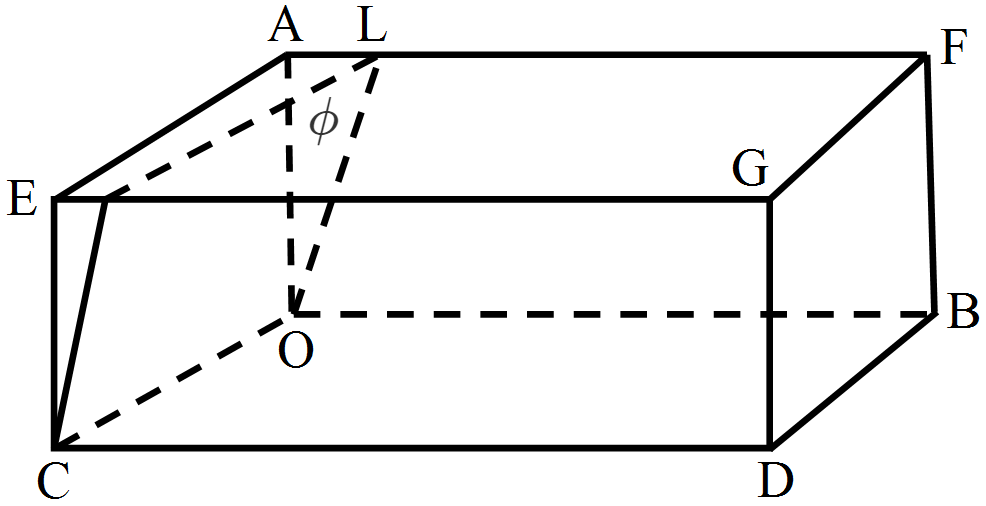
Consider $\vec{\text{OA}}=\vec{\text{a}}$
$\vec{\text{OB}}=\vec{\text{b}}$
$\vec{\text{OC}}=\vec{\text{c}}$
Then $\vec{\text{b}}\times\vec{\text{c}}$ is a vector perpendicular to the plane of $\vec{\text{b}}$ and $\vec{\text{c}}.$
Let $\phi$ be the angle between $\vec{\text{a}}$ and $\vec{\text{b}}\times\vec{\text{c}}$ and $\hat{\text{n}}$ unit vector along $\vec{\text{b}}\times\vec{\text{c}}.$
$\vec{\text{a}}.(\vec{\text{b}}\times\vec{\text{c}})=$ (area of parallelogram OBDC)
= area of parallelogram OBDC $(\hat{\text{n}}.\vec{\text{a}})$
= area of parallelogram OBDC $|\vec{\text{a}}|\cos\phi$
$(\because\ |\hat{\text{n}}|=1)$
= (area of parallelogram OBDC) (OL)
$[\because\ \text{OA}\cos\phi=\text{OL}]$
= (area of parallelogram OBDC) × (height)
= volume of parallelopiped with edges $\vec{\text{a}},\vec{\text{b}},\vec{\text{c}}$
View full question & answer
Question 572 Marks
If two vectors of equal magnitude add to either of them by magnitude, what is the angle between them?
Answer
$\sqrt{\text{p}^2+\text{p}^2+2\text{p}^2\cos\theta}=\text{p}$ Squaring, $2\text{p}^2(1+\cos\theta)=\text{p}^2$ $1+\cos\theta=\frac{1}{2}\cos\theta=\frac{-1}{2},$ $\theta=120^\circ$
View full question & answer
Question 582 Marks
Determine $\lambda$ such that: $\vec{\text{A}}=2\hat{\text{i}}+\lambda\hat{\text{j}}+\hat{\text{k}};\ \vec{\text{B}}=4\hat{\text{i}}-2\hat{\text{j}}-2\hat{\text{k}}$ are perpendicular to each other.
Answer
$\vec{\text{A}}=2\hat{\text{i}}+\lambda\hat{\text{j}}+\hat{\text{k}}$ $\vec{\text{B}}=4\hat{\text{i}}-2\hat{\text{j}}-2\hat{\text{k}}$ $\vec{\text{A}}.\vec{\text{B}}=(2\hat{\text{i}}+\lambda\hat{\text{j}}+\hat{\text{k}}).(4\hat{\text{i}}-2\hat{\text{j}}-2\hat{\text{k}})$ $=8-2\lambda-2$ $0=6-2\lambda$ or $\lambda=3$
View full question & answer
Question 592 Marks
Can a flight of a bird, an example of composition of vectors. Why?
Answer
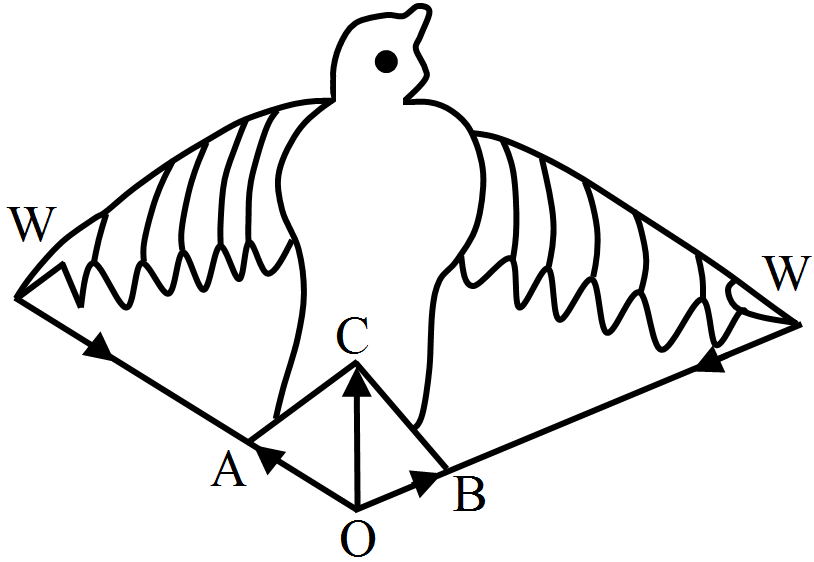
Yes, the flight of a bird is an example of composition of vectors. As the bird flies, it strikes the air with its wings W, W along WO. According to Newton's third law of motion, air strikes the wings in opposite directions with the same force in reaction. The reactions are OA and OB. From law of parallelogram vectors, OC is the resultant of OA and OB. This resultant upwards force OC is responsible for the flight of the bird.
View full question & answer
Question 602 Marks
A string can withstand a tension of 25N. What is the greatest speed at which a body of mass 1kg can be whirled in a horizontal circle using a 1m length of the string?
Answer
As the body is whirled in a horizontal circle, the force of gravity, acting vertically downwards, has no effect on its motion. If v is the greatest speed with which the body can be whirled, the centripetal forces in the string must balance the maximum tension that the string can withstand. $\therefore\ \text{Tension, T}=\frac{\text{mv}^2}{\text{r}}$ or $25=\frac{1\times\text{v}^2}{1}$ or, $\text{v}=5\text{ ms}^{-1}$
View full question & answer
Question 612 Marks
An insect trapped in a circular groove of radius $12 \ cm$ moves along the groove steadily and completes $7$ revolutions in $100 s$. $(a)$ What is the angular speed, and the linear speed of the motion? $(b)$ Is the acceleration vector a constant vector? What is its magnitude?
Answer
This is an example of uniform circular motion. Here $R=12 \ cm$. The angular speed $\omega$ is given by
$\omega=2 \pi / T=2 \pi 7 / 100=0.44 rad / s$
The linear speed $v$ is :
$v=\omega R=0.44 s ^{-1} 12 \ cm =5.3 \ cm s ^{-1}$
The direction of velocity $v$ is along the tangent to the circle at every point. The acceleration is directed towards the centre of the circle. Since this direction changes continuously, acceleration here is not a constant vector. However, the magnitude of acceleration is constant:
$a=\omega^2 R=\left(0.44 s ^{-1}\right)^2(12 \ cm )$
$=2.3 \ cm s ^{-2}$
View full question & answer
Question 622 Marks
A cricket ball is thrown at a speed of $28\ m s ^{-1}$ in a direction $30$ above the horizontal. Calculate $(a)$ the maximum height, $(b)$ the time taken by the ball to return to the same level, and $(c)$ the distance from the thrower to the point where the ball returns to the same level.
Answer
$(a)$ The maximum height is given by
$h_m =\frac{\left(v_o \sin \theta_o\right)^2}{2 g}$
$=\frac{\left(28 \sin 30^{\circ}\right)^2}{2(9.8)} m$
$ =\frac{14 \times 14}{2 \times 9.8}$
$=10.0 m$
$(b)$ The time taken to return to the same level is
$T_f=(2 v_0 \sin \theta_0) / g$
$=(2 28 \sin 30) / 9.8$
$=28 / 9.8 s$
$=2.9 s$
$(c)$ The distance from the thrower to the point where the ball returns to the same level is
$R=\frac{\left(v_{ o }^2 \sin 2 \theta_{ o }\right)}{a}$
$=\frac{28 \times 28 \times \sin 60^{\circ}}{98}$
$=69 m$
View full question & answer
Question 632 Marks
The position of a particle is given by
$
r =3.0 t \hat{ i }+2.0 t^2 \hat{ j }+5.0 \hat{ k }
$
where $t$ is in seconds and the coefficients have the proper units for $r$ to be in metres. (a) Find $v (t)$ and $a(t)$ of the particle. (b) Find the magnitude and direction of $v (t)$ at $t=1.0 s$.
Answer
$
\begin{aligned}
v (t) & =\frac{ d r }{ d t}=\frac{ d }{ d t}\left(3.0 t \hat{ i }+2.0 t^2 \hat{ j }+5.0 \hat{ k }\right) \\
& =3.0 \hat{ i }+4.0 t \hat{ j } \\
a (t) & =\frac{ d v }{ d t}=+4.0 \hat{ j } \\
a & =4.0 m s ^{-2} \text { along } y \text { - direction }
\end{aligned}
$
At $t=1.0 s , \quad v =3.0 \hat{ i }+4.0 \hat{ j }$
It's magnitude is $v=\sqrt{3^2+4^2}=5.0 m s ^{-1}$ and direction is
$\theta=\tan ^{-1}\left(\frac{v_y}{v_x}\right)=\tan ^{-1}\left(\frac{4}{3}\right) \cong 53^{\circ}$ with $x$-axis.
View full question & answer
Question 642 Marks
View full question & answer
2 Marks Questions - Page 2 - Physics STD 11 Science Questions - Vidyadip