Questions · Page 3 of 3

3 Marks Question

Question 1013 Marks
Derive a relation for the time taken by a projectile to reach the highest point and the maximum height attained?
Answer
Consider a projectile projected at an angle $\theta$ to the horizontal with velocity u. The horizontal and vertical components initially with velocity are $\text{u}\cos\theta$ and $\text{u}\sin\theta$ respectively. Vertical velocity at highest point is zero, due to acceleration due to gravity acting vertically downwards. Using v = u + at we have, $0=\text{u}\sin\theta-\text{gt}$ $\Rightarrow\ \text{t}=\frac{\text{u}\sin\theta}{\text{g}}$ The time to reach topmost point $\text{t}=\frac{\text{u}\sin\theta}{\text{g}}$ Using, $v^2 = u^2 + 2as$, we have $0=\text{u}^2\sin^2\theta-2\text{gh}_\text{max}$ $\text{h}_\text{max}=\frac{\text{u}^2\sin^2\theta}{2\text{g}}$
View full question & answer
Question 1023 Marks
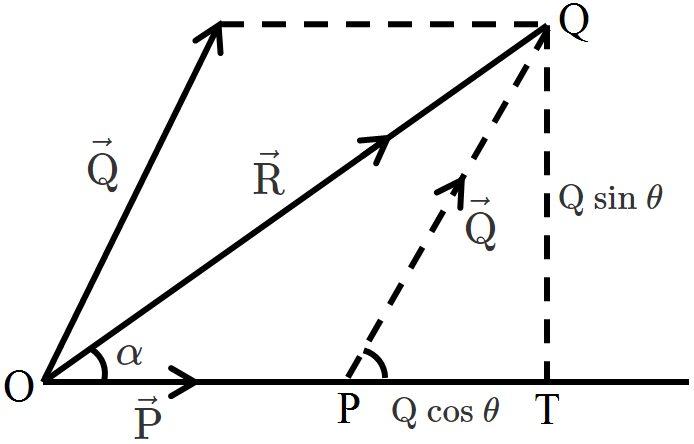
State law of parallelogram of vector addition. Show that the magnitude of resultant $\vec{\text{R}}$ of two vectors $\vec{\text{P}}$ and $\vec{\text{Q}}$ inclined at an angle $\theta$ is $|\vec{\text{R}}|=\sqrt{\text{P}^2+\text{Q}^2+2\text{PQ}\cos\theta}.$OR
For what value of m, the vector $\vec{\text{A}}=2\hat{\text{i}}+3\hat{\text{j}}-6\hat{\text{k}}$ is perpendicular to $\vec{\text{B}}=3\hat{\text{i}}-\text{m}\hat{\text{j}}+6\hat{\text{k}}.$
Answer
Parallelogram law of vector addition: If two vectors $\vec{\text{P}}$ and $\vec{\text{Q}}$ represent two adjacent sides of a parallelogram, the sum of the vectors is represented by the diagonal of the parallelogram.
Let $\vec{\text{P}}$ and $\vec{\text{Q}}$ be two vectors at an angle $\theta$ between them. According to the law of parallelogram of vectors, the diagonal of the parallelogram indicates the sum of the other two vectors $\vec{\text{P}}$ and $\vec{\text{Q}}.$ $|\vec{\text{OQ}}|=|\vec{\text{P}}+\vec{\text{Q}}|=\sqrt{\text{OT}^2+\text{TQ}^2}$ $|\vec{\text{R}}|=\sqrt{(\text{P}+\text{Q}\cos\theta)^2+(\text{Q}\sin\theta)^2}$ $\text{R}=\sqrt{\text{P}^2+\text{Q}^2+2\text{PQ}\cos\theta}$ The resultant R is inclined at an angle $\alpha$ to $\vec{\text{P}}$ and is given by$\alpha=\tan^{-1}\Big(\frac{\text{Q}\sin\theta}{\text{P}+\text{Q}\cos\theta}\Big)$
Given: $\vec{\text{A}}=2\hat{\text{i}}+3\hat{\text{j}}-6\hat{\text{k}};$ $\vec{\text{B}}=3\hat{\text{i}}-\text{m}\hat{\text{j}}+6\hat{\text{k}};$ $\therefore\ \vec{\text{A}}.\vec{\text{B}}=\text{AB}\cos90^\circ=0$ Hence, $(2\hat{\text{i}}+3\hat{\text{j}}-6\hat{\text{k}}).(3\hat{\text{i}}-\text{m}\hat{\text{j}}+6\hat{\text{k}})=0$ $\Rightarrow\ 2\times3+3\times(-\text{m})+(-6)\times6=0$ $\Rightarrow\ 6-3\text{m}-36=0$ $\Rightarrow\ \text{m}=-10$
View full question & answer
Question 1033 Marks
Define dot product of two vectors and give its geometrical interpretation.
Answer
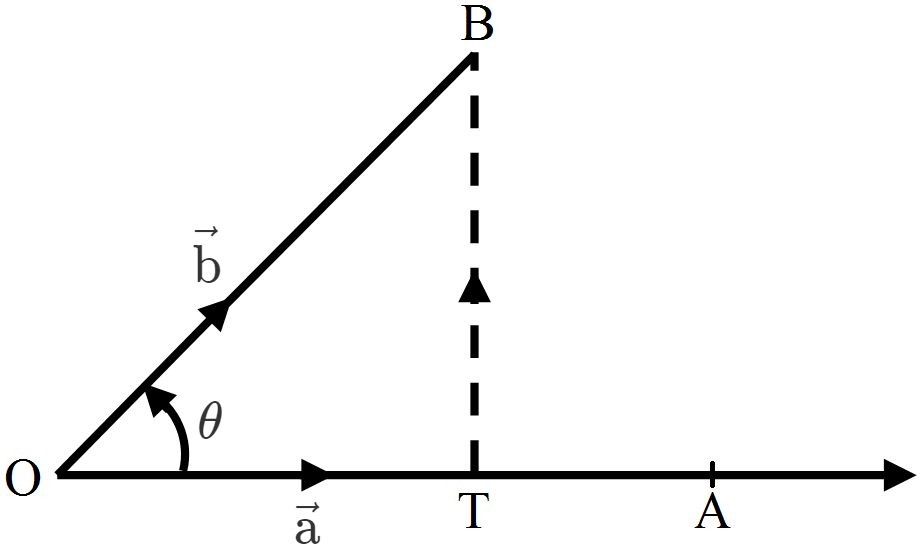
Dot product of two vectors $\vec{\text{a}}$ and $\vec{\text{b}}$ is defined as, $\vec{\text{a}}.\vec{\text{b}}$ $=|\vec{\text{a}}||\vec{\text{b}}|\cos\theta$ where $\theta$ is the angle between $\vec{\text{a}}$ and $\vec{\text{b}}.$ Let $\vec{\text{OA}}=\vec{\text{a}},\ \vec{\text{OB}}=\vec{\text{b}}$ and $\angle\text{AOB}=\theta$ Then, $\text{OT}=|\vec{\text{b}}|\cos\theta$
$\vec{\text{a}}.\vec{\text{b}}=|\vec{\text{a}}||\vec{\text{b}}|\cos\theta$ $=\text{OA}\times\text{OT}$ $\vec{\text{a}}.\vec{\text{b}}=\text{OA}.$ Projection of $\vec{\text{b}}$ on $\vec{\text{a}}.$
View full question & answer
Question 1043 Marks
A person aims a gun at a bird from a point at a horizontal distance of $100m$. If the gun can impart a speed of $500ms^{-1}$ to the bullet, at what height above the bird must he aim his gun in order to hit it?
Answer
Horizontal distance, $x = 100m$ velocity, $v = 500ms^{-1}$ Time taken to travel this distance, $\text{t}=\frac{\text{x}}{\text{v}}=\frac{100}{500}=\frac{1}{5}\text{s}$
Vertical distance travelled by the bullet in time $\frac{1}{5}\text{s}$ is $\text{y}=\text{u}_\text{oy}\text{t}+\frac{1}{2}\text{gt}^2$ $=0+\frac{1}{2}\times10\times\frac{1}{25}=\frac{1}{5}\text{m}=20\text{cm}.$
If he directly aims at the bird, the bullet will hit 20cm below the bird. Therefore, the gun must be aimed at 20cm above the position of the bird.
View full question & answer
Question 1053 Marks
Rain is falling vertically with a speed of $30m s^{-1}$. A woman rides a bicycle with a speed of $10ms^{-1}$ in the north to south direction. What is the direction in which she should hold her umbrella?
Answer
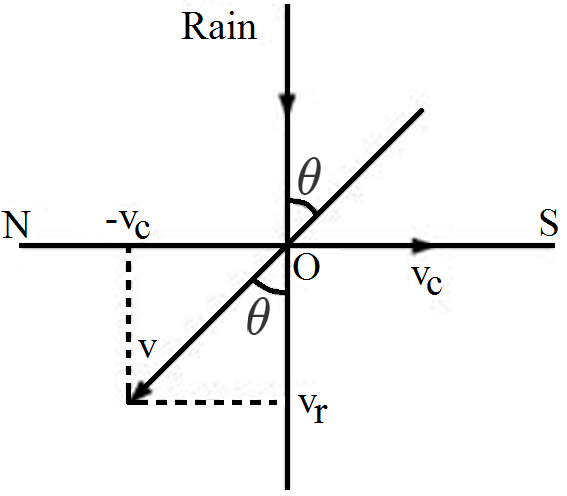
The described situation is shown in the given figure.

 Here, $v_c$ = Velocity of the cyclist $v_r$ = Velocity of falling rain
In order to protect herself from the rain, the woman must hold her umbrella in the direction of the relative velocity (v) of the rain with respect to the woman. $v = v_r + (-v_c) = 30 + (-10) = 20m/s \tan\theta=\frac{\text{v}_\text{c}}{\text{v}_\text{r}}=\frac{10}{30}$ $\theta=\tan^{-1}\big(\frac{1}{3}\big)$ $=\tan^{-1}(0.333)\approx10^\circ$ Hence, the woman must hold the umbrella toward the south, at an angle of nearly 18° with the vertical.
View full question & answer
Question 1063 Marks
There are two displacement vectors, one of magnitude $3$ metres and the other of $4$ metres. How would the two vectors be added so that the magnitude of the resultant vector be $(a)\  7$ metres $(b)\  1$ metre and $(c)\  5$ metres?
Answer
The magnitude of resultant $\vec{\text{R}}$ of two vectors $\vec{\text{A}}$ and $\vec{\text{B}}$ is given by $\text{R}=\sqrt{\text{A}^2+\text{B}^2+2\text{AB}\cos\theta};$
where $A = 3m$ and $B = 4m$. Now, $\text{R}=\sqrt{3^2+4^2+2\times3\times4\cos\theta}$
  1. $R$ will be $7m$ if $\theta=0^\circ$
  2. $R$ will be $1$ metre if $\theta=180^\circ$
  3. $R$ will be $5m$ if $\theta=90^\circ$
View full question & answer
Question 1073 Marks
An object of mass m is moving in a circular path of radius R at a constant speed v. Obtain an expression for the magnitude of acceleration of the body.
Answer


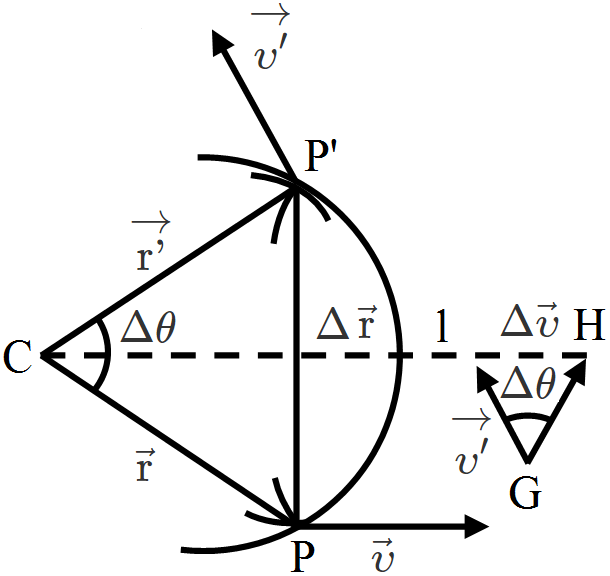
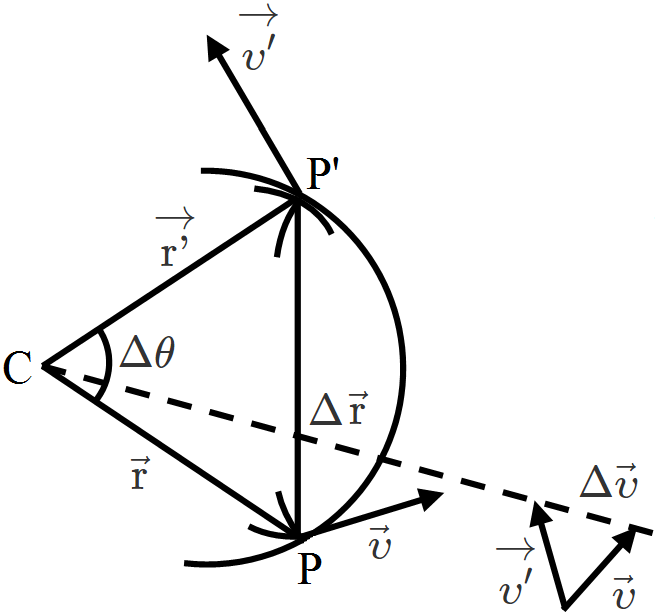
Let $\vec{\text{r}}$ and $\vec{\text{r}}'$ be the position vectors and $\vec{\text{v}}$ and $\vec{\text{v}}'$ the velocities of object at point P and P'.
Since path is circular $\vec{\text{v}}$ is $\perp\vec{\text{r}}$ and $\vec{\text{v}}'\perp\vec{\text{r}}'.$
$\therefore\ \Delta\vec{\text{v}}=(\vec{\text{v}}'-\vec{\text{v}})\perp\Delta\vec{\text{r}}.$
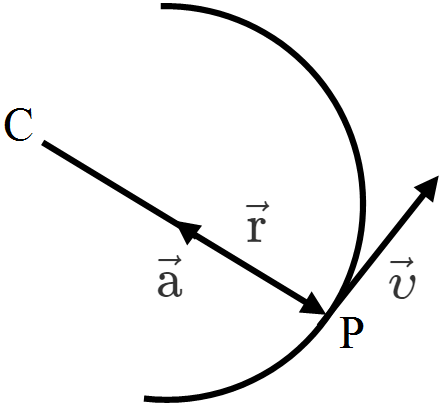
Since average acceleration is along $\Delta\vec{\text{v}}=\Big[\vec{\text{a}}=\frac{\Delta\vec{\text{v}}}{\Delta\text{t}}\Big]$
Acceleration $\Delta\vec{\text{a}}$ is perpendicular to $\Delta\vec{\text{r}}'.$
Acceleration in uniform circular motion is always directed towards the centre of the circle.
$|\vec{\text{a}}|=\lim\limits_{\Delta\text{t}\rightarrow0}\frac{|\Delta\vec{\text{v}}|}{\Delta\text{t}}$
From figure $\frac{|\Delta\vec{\text{v}}|}{\text{v}}=\frac{|\Delta\vec{\text{r}}|}{\text{R}}$
$|\Delta\vec{\text{v}}|=\Delta\frac{|\Delta\vec{\text{r}}|}{\text{R}}$
$\therefore\ |\vec{\text{a}}|=\lim\limits_{\Delta\text{t}\rightarrow0}\frac{\Delta\vec{\text{v}}}{\Delta\text{t}}=\lim\limits_{\Delta\text{t}\rightarrow0}\frac{\text{v}|\Delta\vec{\text{r}}|}{\text{R}\Delta\text{t}}$
$=\frac{\text{v}}{\text{R}}\lim\limits_{\Delta\text{t}\rightarrow0}\frac{|\Delta\vec{\text{r}}|}{\Delta\text{t}}$
If $\Delta\text{t}$ is small $|\Delta\vec{\text{r}}|\cong\text{v}\Delta\text{t}$
$\frac{|\Delta\vec{\text{r}}|}{\Delta\text{t}}\cong\text{v}$
or $\lim\limits_{\Delta\text{t}\rightarrow0}\frac{|\Delta\vec{\text{r}}|}{\Delta\text{t}}=\text{v}$
$\therefore\ \text{a}_\text{c}=\Big(\frac{\text{v}}{\text{R}}\Big)\text{v}=\frac{\text{v}^2}{\text{R}}$
View full question & answer
Question 1083 Marks
Prove that the vectors $\vec{\text{A}}=2\hat{\text{i}}-3\hat{\text{j}}+\hat{\text{k}}$ and $\vec{\text{B}}=\hat{\text{i}}+\hat{\text{j}}+\hat{\text{k}}$ are mutuallly perpendicular.
Answer
$\vec{\text{A}}.\vec{\text{B}}=(2\hat{\text{i}}-3\hat{\text{j}}+\hat{\text{k}}).(\hat{\text{i}}+\hat{\text{j}}+\hat{\text{k}})$ $\text{AB}\cos\theta=(2)(1)+(-3)(1)+(1)(1)=0$ $\text{AB}\cos\theta=0\ (\text{as A}\neq0,\text{ B}\neq0)$ $\therefore\ \theta=90^\circ$or, the vectors $\vec{\text{A}}$ and $\vec{\text{B}}$ are mutually perpendicular.
View full question & answer
Question 1093 Marks
A clever strategy in a snowball fight is to throw two snowballs at your opponent in quick succession. The first one with a high trajectory and the second one with a lower trajectory and shorter time of flight, so that they both reach the target at the same instant. Suppose your opponent is $20.0m$ away. You throw both snowballs with the same initial speed vo but $\theta _0$ is $60.0°$ for the first snowball and $30.0°$ for the second. If they are both to reach their target at the same instant, how much time must elapse between the release of the two snowballs?
Answer
We need to find the time of flight for each snowball. The time $t_R$ is determined by $v_{y0}$, the vertical component of initial velocity, then $\text{t}_\text{R}=\frac{2\text{v}_{\text{y0}}}{\text{g}}=\frac{2\text{v}_0\sin\theta_0}{\text{g}}$To find $t_R$ we need to know, in addition to the initial angle $\theta_0$ (as given), the initial speed $v_0$, which is not given. We can find $v_0$ by applying the range equation
$\text{R}=\frac{\text{v}_0^2\sin2\theta_0}{\text{g}}$ Solving for $v_0$, we obtain $\text{v}_0=\sqrt{\frac{\text{Rg}}{\sin2\theta_0}}$ We obtain the same value for $v_0$ whether we use,$\theta_0=30.0^\circ$ or $\theta_0=60.0^\circ$
Since, $\sin2(30.0^\circ)=\sin2(60.0^\circ)$
$\text{v}_0=\sqrt{\frac{(20.0\text{m})(9.80\text{m/s}^2)}{\sin60.0^\circ}}=15.0\text{m/ s}$
Now, we can find tp for each snowball $\text{t}_\text{g}=\frac{2\text{v}_{\text{y0}}}{\text{g}}\Rightarrow\ \text{t}_\text{g}=\frac{2\text{v}_0\sin\theta_0}{\text{g}}$ For the first snowball, $\text{t}_\text{R}=\frac{2(15.0\text{m/s})(\sin60.0^\circ)}{9.80\text{m/s}^2}=2.65\text{s}$ For the second snowball, $\text{t}_\text{R}'=\frac{2(15.0\text{m/s})(\sin30.0^\circ)}{9.80\text{m/s}^2}=1.53\text{s}$ Thus, you should wait a time $\Delta\text{t}$ before making your second throw, where $\Delta\text{t}$ is the difference in the times of flight, $\Delta\text{t}=\text{t}_\text{R}-\text{t}_\text{R}'=2.65\text{s}-1.53\text{s}=1.12\text{s}$
View full question & answer
Question 1103 Marks
A body is suspended by a string of length 1m and is projected horizontally with velocity $4m/ s$. Calculate the tangential and radial accelerations when the string rises by $60°$ from its initial position. Also find the difference in velocity.
Answer

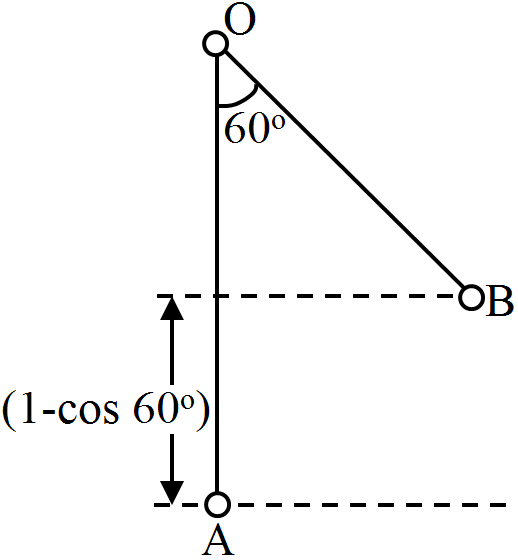
l = 1m
By applying conservation of energy, we have
$\text{mg}(1-\cos60^\circ)=\frac{1}{2}\text{mv}^2_\text{B}$
$\text{v}_\text{B}=2\text{g}\Big(1-\frac{1}{2}\Big)=\text{g}=10\text{ms}^{-2}$
Centripetal acceleration at $\text{B}=\frac{\text{v}^2_\text{B}}{\text{r}}=\frac{\text{g}^2}{\text{r}}$
At B, tangential acceleration $=\text{g}\sin60^\circ=\frac{\sqrt{3}}{2}\text{g}$
Velocity difference $(v_B - v_A) = 10ms^{-1} - 4ms^{-1} = 6ms^{-1}$
View full question & answer
Question 1113 Marks
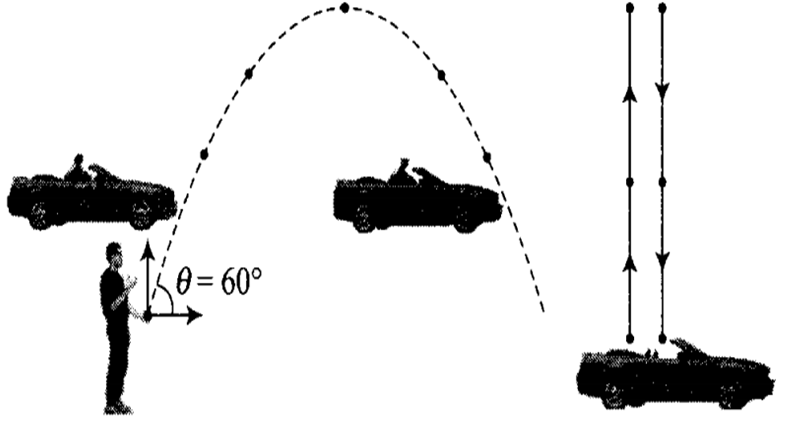
A boy throws a ball in air at 60° to the horizontal along a road with a speed of 10m/ s (36km/ h). Another boy sitting in a passing by car observes the ball. Sketch the motion of the ball as observed by the boy in the car, if car has a speed of (18km/ h). Give explanation to support your diagram.
Answer
The situation is shown in the below diagram. According to the problem the boy standing on ground throws the ball at an angle of 60° with horizontal at a speed of 10m/ s. $\therefore$ Horizontal component of velocity, $\text{u}_\text{x}=10\cos\theta$ $\text{u}_\text{x}=(10\text{m/s})\cos60^\circ=10\times\frac{1}2=5\text{m/s}$ Vertical component of velocity, $\text{u}_\text{y}=10\sin\theta$ $\text{u}_\text{y}=(10\text{m/s})\sin60^\circ=10\times\frac{\sqrt{3}}{2}=5\sqrt3\text{m/s}$ Speed of the car = 18km/ h = 5m/ s As horizontal speed of ball and car is same, hence relative velocity of ball w.r.t car in the horizontal direction will be zero. Only vertical motion of the ball will be observed by the boy in the car, as shown in above diagram.
View full question & answer
Question 1123 Marks
Establish a relation between angular velocity and time period.
Answer
We know that angular velocity $\omega=\frac{\Delta\theta}{\Delta\text{t}}$ For motion with uniform angular velocity, in one complete revolution $\Delta\theta=2\pi$ radian and $\Delta\text{t}=\text{T s},$ hence $\omega=\frac{2\pi}{\text{T}}$ or $\text{T}=\frac{2\pi}{\omega}.$
View full question & answer
Question 1133 Marks
An aeroplane is flying in a horizontal direction with a velocity of 600km/ hr and at a height of 1960m. When it is vertically above the point A on the ground, a body is dropped from it. The body strikes the ground at point B. Calculate the distance AB.
Answer
Velocity of aeroplane in horizontal direction is, $\text{v}_\text{ox}=600\text{km/ hr}=600\times\frac{5}{18}\text{ms}^{-1}$ $=\frac{500}{3}\text{ms}^{-1}$ This velocity remains constant throughout the flight of the body. $\text{v}_\text{oy}=0$ and $\text{y}=\text{h}=1960\text{m}$ Let t = the time taken by the body to reach the ground Now, $\text{y}=\text{v}_\text{oy}\text{t}+\frac{1}{2}\text{gt}^2$ Here, $\text{y}=\text{h}=1960\text{m};\ \text{v}_{\text{oy}}=0$ (initial vertical velocity) $\therefore\ 1960=\frac{1}{2}\times9.8\text{t}^2$ $\therefore\ \text{t}=\sqrt{\frac{1960}{4.9}}\text{s}=\sqrt{400}\text{s}=20\text{s}$ Distance travelled by the body in the horizontal direction $=\text{v}_\text{ox}\text{t}=\frac{500}{3}\times20=\frac{10,000}{3}$ $=3333\text{m}=3.333\text{km}$ $\therefore\ \text{AB}=3.333\text{km.}$
View full question & answer
Question 1143 Marks
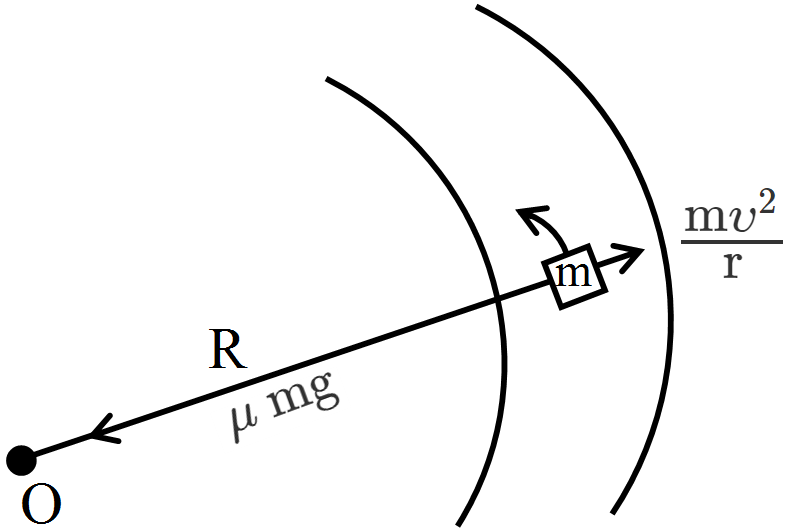
Find an expression for the maximum speed of circular motion of a car in a circular horizontal track of radius 'R'. The coefficient of static friction between the car tyres and the road along the surfaces is $\mu\text{s}.$
Answer
Let a car of mass m move in a circular orbit of radius R as shown. The centrifugal force trying to take it away from the circular path is overcome by the force of friction.
$\therefore\ \frac{\text{mv}^2}{\text{R}}=\mu_\text{s}\text{mg}$ $\text{v}^2=\mu_\text{s}\text{gR}$ $\therefore$ Maximum speed $\text{v}=\sqrt{\text{Rg}\mu_\text{s}}$
View full question & answer
Question 1153 Marks
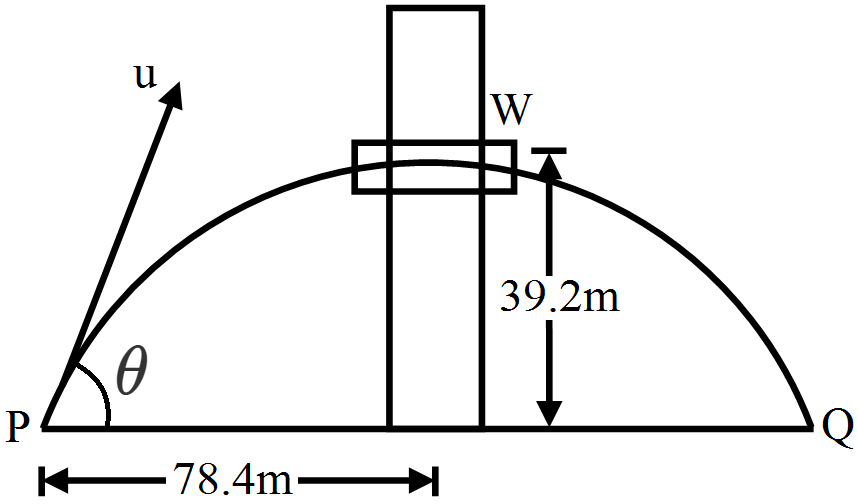
A boy stands at 78.4m from a building and throws a ball which just enters a window 39.2m above the ground. Calculate the velocity of projection of the ball.
Answer
Consider a boy standing at P throw a ball with a velocity u at an angle with the horizontal which just enters window W. As the boy is at 78.4m from the building and the ball just enters the window 39.2m above the ground. $\therefore$ Maximum height, $\text{H}=\frac{\text{u}^2\sin^2\theta}{2\text{g}}$ $\Rightarrow\ 39.2=\frac{\text{u}^2\sin^2\theta}{2\text{g}}\dots(\text{i})$ and horizontal range, $\text{R}=\frac{\text{u}^2\sin2\theta}{\text{g}}$ $\Rightarrow\ 2\times78.4=\frac{\text{u}^2\sin2\theta}{\text{g}}\dots(\text{ii})$ Dividing eq. (i) by eq. (ii), we get $\frac{\text{u}^2\sin^2\theta}{2\text{g}}\times\frac{\text{g}}{\text{u}^22\sin\theta\cos\theta}=\frac{39.2}{2\times78.4}$ $\Rightarrow\ \frac{1}{4}\tan\theta=\frac{1}{4}$ $\Rightarrow\ \theta=45^\circ$ Substituting $\theta=45^\circ$ in eq. (ii), we get $\frac{\text{u}^2\sin90^\circ}{9.8}=2\times78.4$ $\Rightarrow\ \text{u}=\sqrt{2\times78.4\times9.8}=39.2\text{m/ s}$
View full question & answer
Question 1163 Marks
Two bodies are thrown with the same initial velocity at angles $\alpha$ and $(90^\circ-\alpha)$ with and is of horizontal. What will be the ratio of (i) maximum heights attained by them and (ii) of horizontal ranges?
Answer
Horizontal range, $\text{R}=\frac{\text{u}^2}{\text{g}}\sin2\theta$ and Max. height, $\text{H}=\frac{\text{u}^2\sin^2\theta}{2\text{g}}$ Case (i): When $\theta=\alpha;$ $\text{R}_1=\frac{\text{u}^2}{\text{g}}\sin2\alpha$ and $\text{H}_1=\frac{\text{u}^2\sin^2\alpha}{2\text{g}}$ Case (ii): When $\theta=(90^\circ-\alpha);$ $\text{R}_2=\frac{\text{u}^2\sin2(90^\circ-\alpha)}{\text{g}}=\frac{\text{u}^2\sin2\alpha}{\text{g}}$ and $\text{H}_2=\frac{\text{u}^2\sin^2(90^\circ-\alpha)}{\text{g}}=\frac{\text{u}^2\cos^2\alpha}{\text{g}}$ $\therefore\ \frac{\text{H}_1}{\text{H}_2}=\frac{\sin^2\alpha}{\cos^2\alpha}=\tan^2\alpha$ and $\frac{\text{R}_1}{\text{R}_2}=1.$
View full question & answer
Question 1173 Marks
A man can swim with a speed of $4.0km/h$ in still water. How long does he take to cross a river $1.0km$ wide if the river flows steadily at $3.0km/h$ and he makes his strokes normal to the river current? How far down the river does he go when he reaches the other bank?
Answer
Speed of the man, $v_m = 4 km/h$ Width of the river = 1km $\text{Time taken to cross the river}=\frac{\text{Width of the river}}{\text{Speed of the river}}$ $=\frac{1}{4}\text{h}=1\times\frac{60}{4}=15\text{min}$ Speed of the river, $v_r = 3km/h$ Distance covered with flow of the river = $v_r \times t=3\times\frac{1}{4}=\frac{3}{4}\text{km}$
$=3\times\frac{1000}{4}$ = 750m.
View full question & answer
Question 1183 Marks
A hiker stands on the edge of a cliff $490 m$ above the ground and throws a stone horizontally with an initial speed of $15\ m s ^{-1}$. Neglecting air resistance, find the time taken by the stone to reach the ground, and the speed with which it hits the ground. $($Take $g=9.8\ m s ^{-2} ).$
Answer
We choose the origin of the $x^{-}$, and $y^{-}$ axis at the edge of the cliff and $t=0 s$ at the instant the stone is thrown. Choose the positive direction of $x-$axis to be along the initial velocity and the positive direction of $y-$axis to be the vertically upward direction. The $x^{-}$, and $y^{-}$ components of the motion can be treated independently. The equations of motion are :
$x(t)=x_o+v_{a x} t$
Here,
$y(t)=y_o+v_{o y} t+(1 / 2) a_y t^2$
$x_o=y_o=0,$
$v_{o y}=0,$
$a_y=-g=-9.8\ m s ^{-2},$
$v_{ ox }=15\ m s ^{-1} .$
The stone hits the ground when $y(t)=-490 m$.
$-490 m =-(1 / 2)(9.8) t^2.$
This gives $t=10 s$.
The velocity components are $v_x=v_{ox}$ and
$v_y=v_{o y}-g t$
so that when the stone hits the ground:
$v_{ax}=15\ ms ^{-1}$
$v_{oy}=0-9.8 10=-98\ ms ^{-1}$
Therefore, the speed of the stone is
$\sqrt{v_x^2+v_y^2}$
$=\sqrt{15^2+98^2}$
$=99\ ms^{-1}$
View full question & answer
Question 1193 Marks
A particle starts from origin at $t=0$ with a velocity $5.0 \hat{i} m / s$ and moves in $x-y$ plane under action of a force which produces a constant acceleration of $(3.0 \hat{ i }+2.0 \hat{ j }) m / s ^2. (a)$ What is the $y-$coordinate of the particle at the instant its $x-$coordinate is $84 m ? (b)$ What is the speed of the particle at this time?
Answer
From Eq. $(3.34a)$ for $r _0=0$, the position of the particle is given by
$r (t)= v _{ 0 } t+\frac{1}{2} a t^2$
$=5.0 \hat{ i } t+(1 / 2)(3.0 \hat{ i }+2.0 \hat{ j }) t^2$
$=\left(5.0 t+1.5 t^2\right) \hat{ i }+1.0 t^2 \hat{ j }$
Therefore,
$x(t)=5.0 t+1.5 t^2$
$y(t)=+1.0 t^2$
Given
$x(t)=84 m , t=\text { ? }$
$5.0 t+1.5 t^2=84 \Rightarrow t=6 s$
At $t=6 s , y=1.0(6)^2=36.0 m$
Now, the velocity $v =\frac{ d r }{ d t}=(5.0+3.0 t) \hat{ i }+2.0 t \hat{ j }$
At $t=6 s , v =23.0 \hat{ i }+12.0 \hat{ j }$
$\text { speed }=| v |=\sqrt{23^2+12^2} \cong 26 m s ^{-1} \text {. }$
View full question & answer
Question 1203 Marks
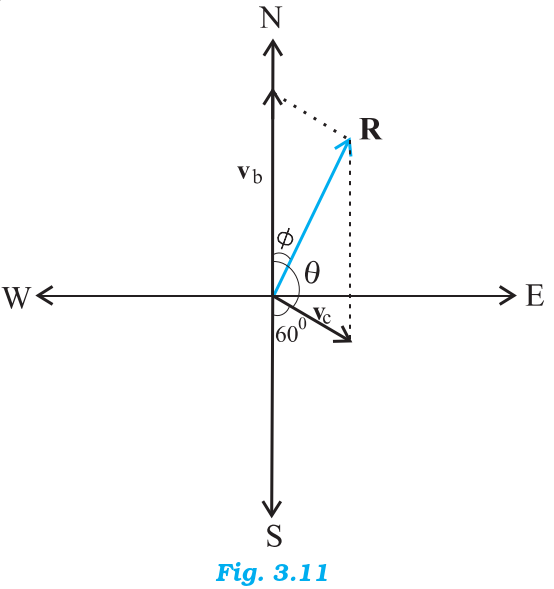
A motorboat is racing towards north at $25 \ km / h$ and the water current in that region is $10 \ km / h$ in the direction of $60^{\circ}$ east of south. Find the resultant velocity of the boat.
Answer
The vector $v _{ b }$ representing the velocity of the motorboat and the vector $v _{ c }$ representing the water current are shown in Fig. $3.11$ in directions specified by the problem. Using the parallelogram method of addition, the resultant $R$ is obtained in the direction shown in the figure.
Image
We can obtain the magnitude of $R$ using the Law of cosine :
$R=\sqrt{v_{ b }^2+v_{ c }^2+2 v_{ b } v_{ c } \cos 120^{\circ}}$
$= \sqrt{25^2+10^2+2 \times 25 \times 10(-1 / 2)} \cong 22 \ km / h$
To obtain the direction, we apply the Law of sines
$\frac{R}{\sin \theta}=\frac{v_c}{\sin \phi} \text { or, } \sin \phi=\frac{v_c}{R} \sin \theta$
$=\frac{10 \times \sin 120^{\circ}}{21.8}=\frac{10 \sqrt{3}}{2 \times 21.8} \cong 0.397$
$\phi \cong 23.4^{\circ}$
View full question & answer
3 Marks Question - Page 3 - Physics STD 11 Science Questions - Vidyadip