Questions · Page 1 of 2

2 Marks Questions

🎯

Test yourself on this topic

50 questions · timed · auto-graded

Question 12 Marks
Give the location of the centre of mass of a:
  1. Sphere.
  2. Cylinder.
  3. Ring, and
  4. Cube, each of uniform mass density.
Does the centre of mass of a body necessarily lie inside the body?
Answer
In all the four cases, as the mass density is uniform, the centre of mass is located at their respective geometrical centres. No, it is not necessary that the centre of mass of a body should lie on the body. For example: in the case of a circular ring, centre of mass is at the centre of the ring, where there is no mass.
View full question & answer
Question 22 Marks
State whether the statement given below is true or false giving reason in brief. A ring of mass 0.3kg and radius 0.1m and a solid cylinder of mass 0.4kg and of the same radius are given the same kinetic energy and released simultaneously on a flat horizontal surface such that they begin to roll as soon as released towards a wall which is at the same distance from the ring and cylinder. The rolling friction in both the cases is negligible. The cylinder will reach the wall first.
Answer
In case of rolling, total kinetic energy $\text{K}=\frac{1}{2}\text{mv}^2+\frac{1}{2}\text{I}\omega^2$ with $\omega=\frac{\text{v}}{\text{r}}$ $\text{K}=\frac{1}{2}\text{mv}^2+\frac{1}{2}\text{I}\frac{\text{v}^2}{\text{r}^2}=\frac{1}{2}$ $=\text{mv}^2\big[1+\frac{\text{I}}{\text{mr}^2}\big]$For a ring, $\text{I}=\text{mr}^2$
$\therefore\text{K}_{\text{r}}=\frac{1}{2}\text{mv}^2(1+1)=\text{mv}^2$ $\text{v}=\sqrt{\frac{\text{Kr}}{\text{m}}}=\sqrt{\frac{\text{K}_{r}}{0.3}}$ For a cylinder, $\text{I}=\frac{1}{2}\text{mr}^2$ $\therefore\text{IK}_{\text{c}}=\frac{3}{4}\text{mv}^2$ $\text{v}=\sqrt{\frac{4\text{K}_{\text{c}}}{3\text{m}}}=\sqrt{\frac{\text{K}_{\text{c}}}{\frac{3}{4}\times0.4}}$ $=\sqrt{\frac{\text{K}_{\text{c}}}{0.3}}$ As $\mathrm{K}_{\mathrm{r}}=\mathrm{K}_{\mathrm{c}}$, therefore, velocity (v) of both the ring and cylinder is same. As the motion is uniform, both the ring and cylinder will reach the wall at the same time. The given statement is false.
View full question & answer
Question 32 Marks
A car is moving on road with speed 54kmh. What should be the value of torque if the car is brought to rest in 15 seconds? Radius and moment of inertia of wheel about the axis of rotation are 0.35m and 3kgm respectively.
Answer
Angular acceleration $\alpha=\frac{\omega_{\text{t}}-\omega_0}{\text{t}}$ $=\frac{0-\frac{15}{0.35}}{15}=\frac{-1}{0.35}\text{rad s}^{-2}$ Torque $\tau=\text{I}\alpha=3\times\Big(\frac{-1}{0.35}\Big)\text{kg m}^2\text{s}^{-2}$ $=-87\text{kg m}^2\text{s}^{-2}$ Speed of car = $54 \mathrm{kmh}^{-1}=15 \mathrm{~ms}^{-1}$ Radius of a car = 0.35m Angular velocity $\omega_0=\frac{\text{speed}}{\text{R}}=\frac{15}{0.35},\text{Initial }\omega_{\text{t}}=0$
View full question & answer
Question 42 Marks
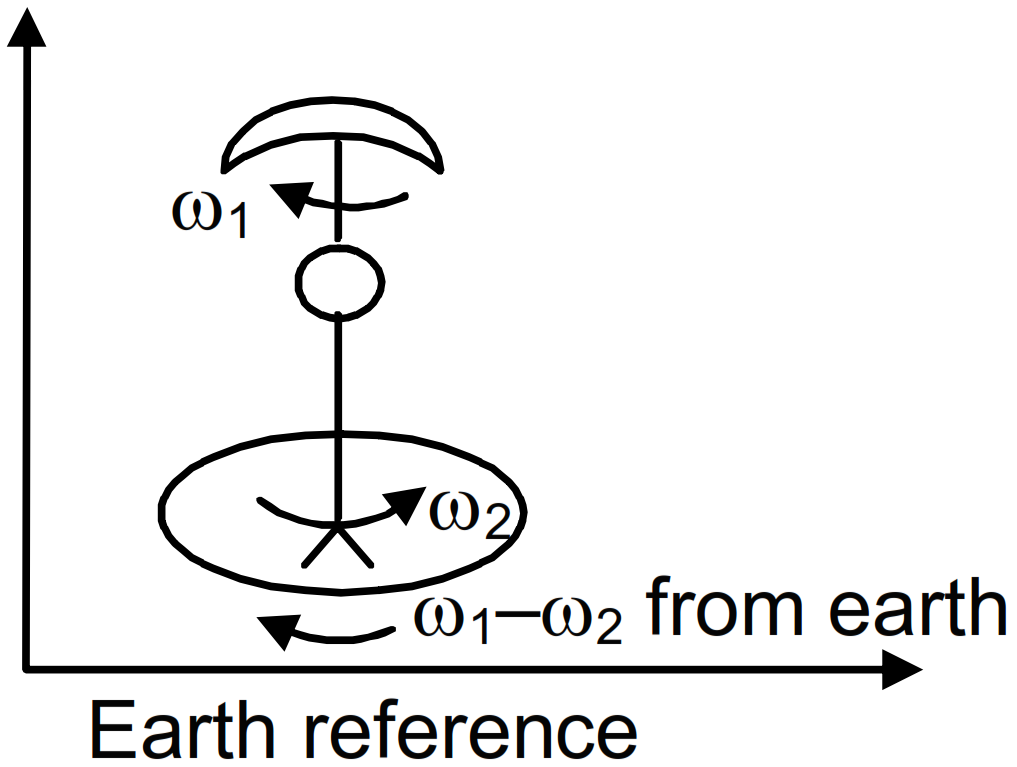
A boy is standing on a platform which is free to rotate about its axis. The boy holds an open umbrella in his hand. The axis of the umbrella coincides with that of the platform. The moment of inertia of ''the platform plus the boy system'' is $3.0 \times 10^{-3}kg-m^2$ and that of the umbrella is $2.0 \times 10^3kg-m^2$. The boy starts spinning the umbrella about the axis at an angular speed of $2.0rev/s$ with respect to himself. Find the angular velocity imparted to the platform.
Answer


$\text{l}_1=2\times10^{-3}\text{Kg-m}^2$
$\text{l}_2=3\times10^{-3}\text{Kg-m}^2$
$\omega_1=2\text{rad/s}$
From the earth reference the umbrella has a angular velocity $(\omega_1-\omega_2)$
And the angular velocity of the man will be $\omega_2$
Therefore $\text{l}_1(\omega_1-\omega_2)=\text{l}_2\omega_2$
$\Rightarrow2\times10^{-3}(2-\omega_2)=3\times10^{-3}\times\omega_2$
$\Rightarrow5\omega_2=4$
$\Rightarrow\omega_2=0.8\text{rad/s}.$
View full question & answer
Question 52 Marks
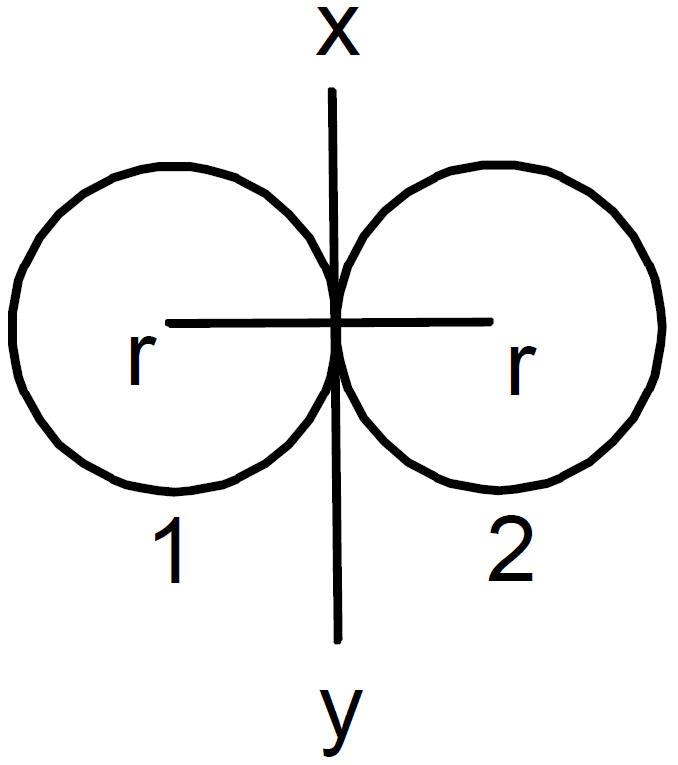
Find the moment of inertia of a pair of spheres, each having a mass m and radius r, kept in contact about the tangent passing through the point of contact.
Answer
The two bodies of mass m and radius r are moving along the common tangent. Therefore moment of inertia of the first body about XY tangent $=\text{mr}^2+\frac{2}5{}\text{mr}^2$ – Moment of inertia of the second body XY tangent $=\text{mr}^2+\frac{2}{5}\text{mr}^2=\frac{7}{5}\text{mr}^2$ Therefore, net moment of inertia $=\frac{7}5{}\text{mr}^2+\frac{7}{5}\text{mr}^2=\frac{14}{5}\text{mr}^2\text{units}$
View full question & answer
Question 62 Marks
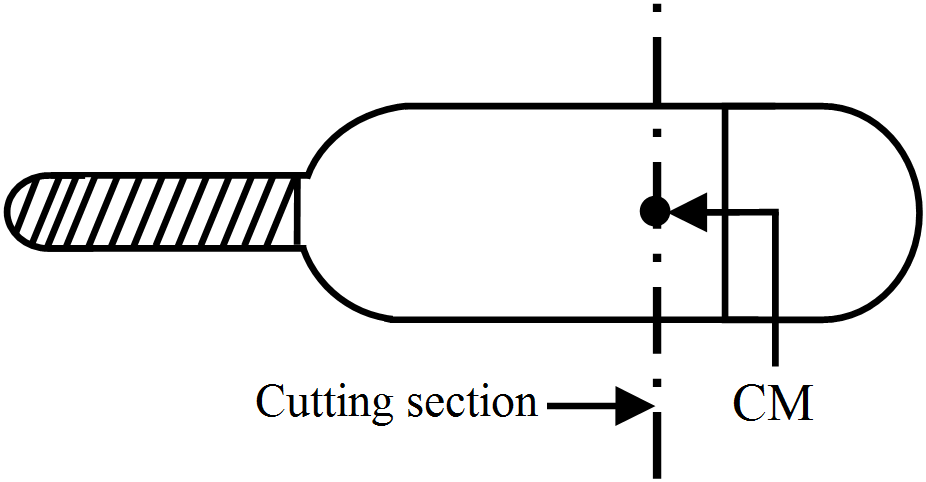
A cricket bat is cut through its centre of mass into two parts as shown Then, state whether both parts are of same mass or not. Also, give reason.
Answer
Centre of mass of a body lies towards region of heavier mass. So, if bat is cut through its centre of mass, both parts are not of equal masses.
View full question & answer
Question 72 Marks
Why in hand driven grinding machine, handle is put near the circumference of the stone or wheel?
Answer
For a given force, torque can be increased if the perpendicular distance of the point of application of the force from the axis of rotation is increased. Hence, the handle put near the circumference produces maximum torque.
View full question & answer
Question 82 Marks
Find the torque of a force $(7\hat{\text{i}}+3\hat{\text{j}}-5\hat{\text{k}})$ N about the origin, the force acts on a particle whose position vector is $(7\hat{\text{i}}-\hat{\text{j}}+\hat{\text{k}})\text{m.}$
Answer
$\begin{matrix}\text{F}=7\hat{\text{i}}+3\hat{\text{j}}-5\hat{\text{k}}\text{ N}\ \ \ \ \ \ \ \ \ \ \ \ \ \ \ \ \ \ \ \ \ \\\text{Position vector }\vec{\text{r}}=\hat{\text{i}}-{\hat{\text{j}}}+\hat{\text{k}}\text{ m}\end{matrix}\Bigg](\text{Given})$ The torque or moment of a force is given by $\vec{\tau}=\vec{\text{r}}\times\vec{\text{F}}$$\vec{\tau}\begin{vmatrix}\hat{\text{i}} & \hat{\text{j}}&\hat{\text{k}} \\1 & -1&1\\7&3&-3 \end{vmatrix}$
$\vec{\tau}=\hat{\text{i}}(5-3)-\hat{\text{j}}(5-7)+\hat{\text{k}}(3+7)$
$\vec{\tau}=2\hat{\text{i}}+12\hat{\text{j}}+10\hat{\text{k}}$
View full question & answer
Question 92 Marks
Two identical cylinders 'run a race' starting from rest at the top of an inclined plane, one slides without rolling and other rolls without slipping. Assuming that no mechanical energy is dissipated in heat, which one will win?
Answer
When a cylinder slides without rolling, $\text{E}=\frac{1}{2}\text{mv}^2_1,\text{v}_1=\sqrt{2\frac{\text{E}}{\text{m}}}$ When the cylinder rolls without slipping $\text{E}=\frac{1}{2}\text{mv}^2+\frac{1}{2}\text{I}\omega^2$ $\text{E}=\frac{1}{2}\text{mv}^2+\frac{1}{2}\Big(\frac{1}{2}\text{mv}^2\Big)\omega^2$ $=\frac{1}{2}\text{mv}^2+\frac{1}{4}\text{mv}^2[\because\text{v}=\text{r}\omega]$ $=\frac{3}{4}\text{mv}^2$ $\text{v}=\sqrt{\frac{4\text{E}}{3\text{m}}}$ As $v_1$ > $v_2$ therefore sliding cylinder will win the race.
View full question & answer
Question 102 Marks
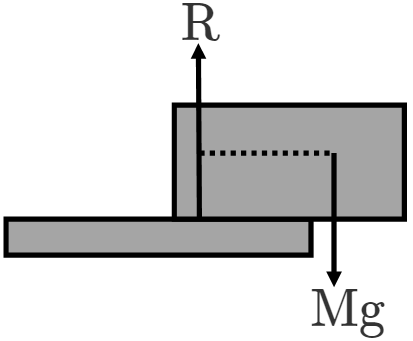
The torque of the weight of any body about any vertical axis is zero. Is it always correct?
Answer
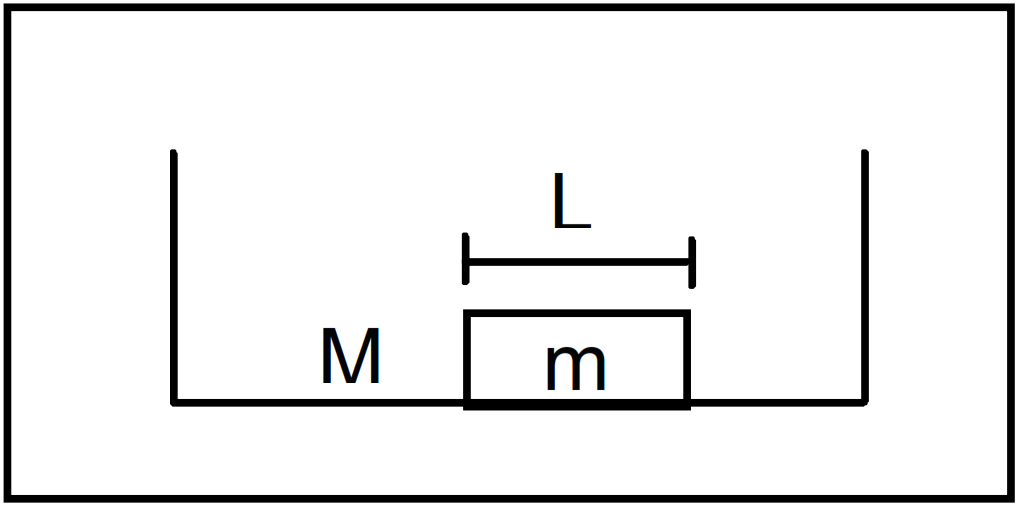
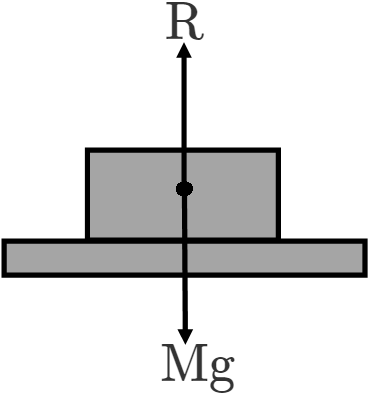
No, its not always correct. Figure 1 Explanation: If the centre of mass of the body is not on the same vertical line as the normal reaction R of the body, a net torque acts on the body about its vertical axis. In fig. 1, R and CM lies in the same vertical line. Thus, there is no torque about any vertical axis Figure 2 But in fig. 2, as R and CM do not lie along the same vertical line, there exists a torque about the vertical axis.
View full question & answer
Question 112 Marks
A wheel is making revolutions about its axis with uniform angular acceleration. Starting from rest, it reaches 100rev/sec in 4 seconds. Find the angular acceleration. Find the angle rotated during these four seconds.
Answer
$\omega_0=0;\ \rho=100\text{rev/s};\ \omega=2\pi;\ \rho=200\pi\text{rad/s}$ $\Rightarrow\omega=\omega_0=\alpha\text{t}$ $\Rightarrow\omega=\alpha\text{t}$ $\Rightarrow\alpha=\Big(\frac{200\pi}{4}\Big)=50\pi\text{rad/s}^2$ or $25\text{rev/s}^2$ $\therefore\theta=\omega_0\text{t}+\frac{1}2{}\alpha\text{t}^2=8\times50\pi$ $=400\pi\text{rad}$ $\therefore\alpha=50\pi\text{rad/s}^2$ or $25\text{rev/s}^2$ $\theta=400\pi\text{rad}$
View full question & answer
Question 122 Marks
Name the physical quantity corresponding to inertia in rotational motion. How is it calculated? Give its units.
Answer
Moment of Inertia (I)$\text{I}=\text{MK}^2,\text{where K}-=\sqrt{\frac{\text{r}^2_1+\text{r}^2_2\dots\text{r}^2_{\text{n}}}{\text{n}}}$
where $r_1, r_2, r_3$, are all perpendicular distances from the axis of rotation. Its S.I. unit is $\mathrm{kgm}^2$.
View full question & answer
Question 132 Marks
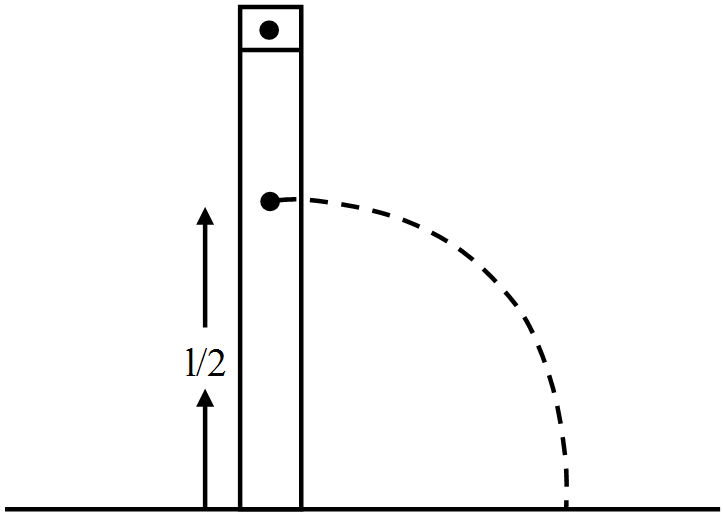
A rod of length l and mass M held vertically is let go down, without slipping at the point of contact. What is the velocity of the top end at the time of touching the ground?
Answer
Loss in potential energy = Gain in rotational kinetic energy $\text{Mg}\frac{\text{l}}{2}=\frac{\text{l}}{2}\frac{\text{Ml}^2}{3}\omega^2$ $\omega=\sqrt{\frac{3\text{gl}}{\text{l}^2}}=\sqrt{\frac{3\text{g}}{\text{l}}}$ $\therefore\text{v}=\text{l}\omega=\sqrt{3\text{gl}}.$
View full question & answer
Question 142 Marks
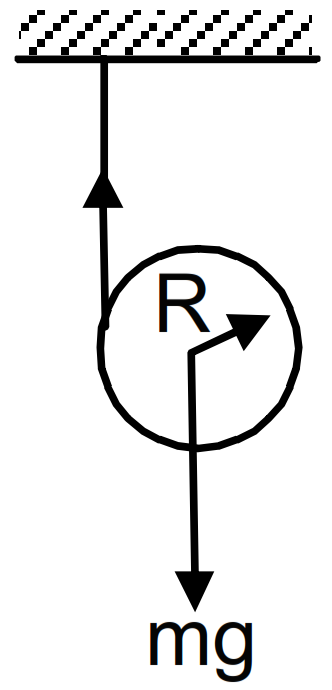
A string is wrapped over the edge of a uniform disc and the free end is fixed with the ceiling. The disc moves down, unwinding the string. Find the downward acceleration of the disc.
Answer

Let the radius of the disc = R
Therefore according to the question & figure
Mg - T = ma ...(1)
& the torque about the centre
$=\text{T}\times\text{R}=\text{l}\times\alpha$
$\Rightarrow\text{TR}=\Big(\frac{1}{2}\Big)\text{mR}^2\times\frac{\text{a}}{\text{R}}$
$\Rightarrow\text{T}=\Big(\frac{1}{2}\Big)\text{ma}$
Putting this value in the equation (1) we get
$\Rightarrow\text{mg}-\Big(\frac{1}{2}\Big)\text{ma}=\text{ma}$
$\Rightarrow\text{mg}=\frac{3}{2}\text{ma}$
$\Rightarrow\text{a}=\frac{\text{2g}}{3}$
View full question & answer
Question 152 Marks
Because of the friction between the water in oceans with the earth's surface, the rotational kinetic energy of the earth is continuously decreasing. If the earth's angular speed decreases by 0.0016rad/ day in 100 years, find the average torque of the friction on the earth. Radius of the earth is 6400km and its mass is $6.0 \times 10^{24} \mathrm{~kg}$
Answer
The earth’s angular speed decreases by 0.0016rad/ day in 100 years. Therefore the torque produced by the ocean water in decreasing earth's angular velocity $\tau=\text{I}\alpha$ $=\frac{2}{5}\text{mr}^2\times\frac{(\omega-\omega_0)}{\text{t}}$ $=\frac{2}{6}\times6\times10^{24}\times64^2\times10^{10}\times\Big(\frac{0.0016}{26400^2\times100\times365}\Big)$ (1 year = 365 days= 365 × 56400 sec) $=5.678\times10^{20}\text{N-m}$
View full question & answer
Question 162 Marks
Derive the relations
  1. $\text{L}=\text{I}\omega$
  2. $\tau=\text{I}\alpha$
Answer
  1. To prove $\text{L}=\text{I}\omega$
We know, $L = r \times p = r \times mv$
$=\text{rmr}\omega=\text{mr}^2\omega=\text{I}\omega$
  1. To prove $\tau=\text{I}\alpha$
We know, $\tau=\text{r F}=\text{rma}$
$=\text{mr}^2\alpha=\text{I}\alpha$
View full question & answer
Question 172 Marks
A boy is seated in a revolving chair revolving at an angular speed of 120 revolutions per minute. Two heavy balls form part of the revolving system and the boy can pull the balls closer to himself or may push them apart. If by pulling the balls closer, the boy decreases the moment of inertia of the system from $6 \mathrm{~kg}-\mathrm{m}^2$ to $2 \mathrm{~kg}-\mathrm{m}^2$, what will be the new angular speed?
Answer
$\omega=120\text{rpm}=120\times\Big(\frac{2\pi}{60}\Big)=4\pi\text{rad/s}$ $\text{l}_1=6\text{kg-m}^2,\ \text{l}_2=2\text{Kg-m}^2$ Since two balls are inside the system Therefore, total external torque = 0 Therefore $\text{l}_1\omega_1=\text{l}_2\omega_2$ $\Rightarrow6\times4\pi=2\omega_2$ $\Rightarrow\omega_2=12\pi\text{rad/s}$ $=6\text{rev/s}$ $=360\text{rev/}\ \text{minute}.$
View full question & answer
Question 182 Marks
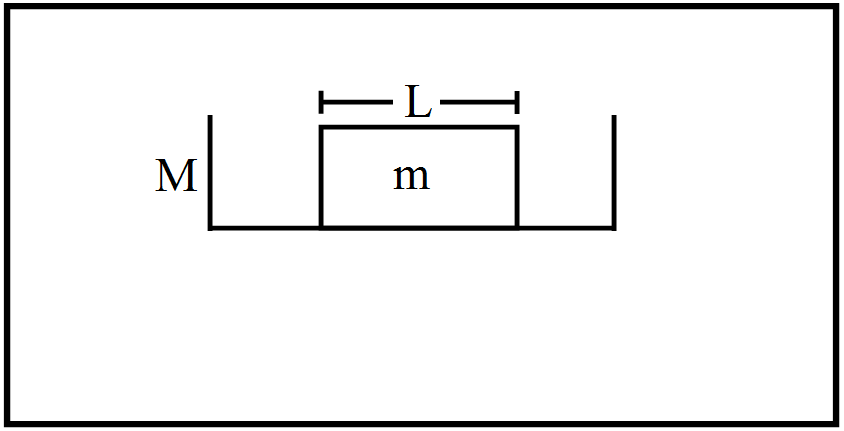
Consider a gravity-free hall in which a tray of mass M, carrying a cubical block of ice of mass m and edge L, is at rest in the middle. If the ice melts, by what distance does the centre of mass of "the tray plus the ice" system descend?
Answer
As the hall is gravity free, after the ice melts, it would tend to acquire a spherical shape. But, there is no external force acting on the system. So, the centre of mass of the system would not move.
View full question & answer
Question 192 Marks
Write an expression for the moment of inertia of a ring of mass $M$ and radius $r.$
  1. About an axis passing through its centre and perpendicular to its plane.
  2. About its diameter.
  3. About a tangent in its own plane.
  4. About a tangent perpendicular to the plane of the ring.
Answer
  1. $\text{MR}^2$
  2. $\frac{\text{MR}^2}{2}$
  3. $\frac{\text{MR}^2}{2}+\text{MR}^2=\frac{3}{2}\text{MR}^2$
  4. $\text{MR}^2+\text{MR}^2=2\text{MR}^2$
View full question & answer
Question 202 Marks
A body rotates about a fixed axis with an angular acceleration of one radian/ second/ second. Through what angle does it rotate during the time in which its angular velocity increases from 5rad/s to 15rad/s.
Answer
$\alpha=1\text{rad/s}^2,\ \omega_0=5\text{rad/s};\ \omega=15\text{rad/s}$ $\therefore\text{w}=\text{w}_0+\alpha\text{t}$ $\Rightarrow\text{t}=\frac{(\omega-\omega_0)}{\alpha}=\frac{(15-5)}{1}=10\text{sec}$ Also, $\theta=\omega_0\text{t}+\frac{1}{2}\alpha\text{t}^2$ $=5\times10+\frac{1}{2}\times1\times100=100\text{rad}$
View full question & answer
Question 212 Marks
If no external force is acting on a two body system, what will happen to:
  1. Velocity of $\text{COM}\ ?$
  2. Angular momentum?
Answer
  1. Velocity of centre of mass will be same.
  2. Angular momentum is conserved and will be zero, if no rotational motion exists.
View full question & answer
Question 222 Marks
Briefly explain motion of the centre of mass of earth moon system.
Answer
The centre of mass of a earth-moon system moves in elliptical path around the sun. The system of earth-moon moves due to the external force provided by the sun, and the parts of the system under motion about COM is due to the internal force between them.
View full question & answer
Question 232 Marks
Two circular discs $A$ and $B$ of the same mass and same thickness are made of two different metals whose densities are $d_A$ and $d_B\left(d_A>d_B\right)$. Their moments of inertia about the axes passing through their centres of gravity and perpendicular to their planes are $\mathrm{I}_A$ and $\mathrm{I}_{\mathrm{B}}$. Which is greater $\mathrm{I}_{\mathrm{A}}$ or $\mathrm{I}_{\mathrm{B}}$ ?
Answer
Let $\text{r}_{\text{A}}$ and $\text{r}_{\text{B}}$ be the radii of discs A and B. As their mass (m) and thickness (t) are same, therefore, $\text{m}=(\pi\text{r}^2_{\text{A}})\text{t}\times\text{d}_{\text{A}}=(\pi\text{r}^2_{\text{B}})\times\text{t}\times\text{d}_{\text{B}}$ $\therefore\frac{\text{r}^2_{\text{A}}}{\text{r}^2_{\text{A}}}=\frac{\text{d}_{\text{B}}}{\text{d}_{\text{A}}}$ Now $\frac{\text{I}_{\text{A}}}{\text{I}_{\text{B}}}=\frac{\frac{1}{2}\text{mr}^2_{\text{A}}}{\frac{1}{2}\text{mr}^2_{\text{B}}},\text{but as }\frac{\text{r}^2_{\text{A}}}{\text{r}^2_{\text{B}}}=\frac{\text{d}_{\text{B}}}{\text{d}_{\text{A}}}$ and $\text{d}_{\text{A}}>\text{d}_{\text{B}},$ $\therefore\text{I}_{\text{B}}>\text{I}_{\text{A}}.$
View full question & answer
Question 242 Marks
A sphere of mass m rolls on a plane surface. Find its kinetic energy at an instant when its centre moves with speed v.
Answer

A sphere having mass m rolls on a plane surface. Let its radius R. Its centre moves with a velocity v.
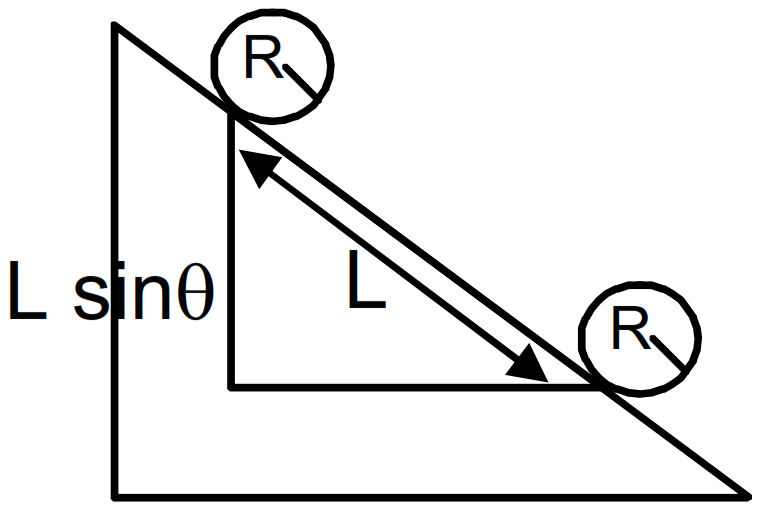
Therefore Kinetic energy $=\Big(\frac{1}{2}\Big)\text{l}\omega^2+\Big(\frac{1}{2}\Big)\text{mv}^2$
$=\frac{1}{2}\times\frac{2}{5}\text{mR}^2\times\frac{\text{v}^2}{\text{R}^2}+\frac{1}{2}\text{mv}^2$
$=\frac{2}{10}\text{mv}^2+\frac{1}{2}\text{mv}^2$
$=\frac{2+5}{10}\text{mv}^2=\frac{7}{10}\text{mv}^2$
View full question & answer
Question 252 Marks
Why does a girl have to lean towards right when carrying a bag in her left hand?
Answer
When the girl carries a bag in her left hand, the centre of gravity of the system is shifted to the left. In order to bring it in the middle, the girl has to lean towards right.
View full question & answer
Question 262 Marks
When a labourer cuts down a tree, he makes a cut on the side facing the direction in which he wants it to fall.Why?
Answer
The weight of tree exerts a torque about the point where the cut is made. This causes rotation of the tree about the cut.
View full question & answer
Question 272 Marks
The bottom of a ship is made heavy. Why?
Answer
The bottom of a ship is made heavy so that its centre of gravity remains low. This ensures the stability of its equilibrium.
View full question & answer
Question 282 Marks
Two bodies of masses 1kg and 2kg are located at (1, 2) and (-1, 3) respectively. Calculate the coordinates of the centre of mass.
Answer
$\text{X}_{\text{cm}}=\frac{\text{m}_1\text{x}_1+\text{m}_2\text{x}_2}{\text{m}_1+\text{m}_2}$ $=\frac{1\times1+2\times(-1)}{3}=\frac{-1}{3}$ $\text{Y}_{\text{cm}}=\frac{\text{m}_1\text{y}_1+\text{m}_2\text{y}_2}{\text{m}_1+\text{m}_2}$ $=\frac{1\times2+2\times3}{3}=\frac{9}{3}=\frac{8}{3}$ Coordinate of centre of mass (COM) is $\Big(\frac{-1}{3},\frac{8}{3}\Big)$
View full question & answer
Question 292 Marks
A sphere starts rolling down an incline of inclination $\theta.$ Find the speed of its centre when it has covered a distance l.
Answer

A sphere is rolling in inclined plane with inclination $\theta.$
Therefore according to the principle
$\text{Mgl}\sin\theta=\Big(\frac{1}{2}\Big)\text{l}\omega^2+\Big(\frac{1}{2}\Big)\text{mv}^2$
$\Rightarrow\text{Mgl}\sin\theta=\Big(\frac{1}{5}\Big)\text{mv}^2+\Big(\frac{1}{2}\Big)\text{mv}^2$
$\text{Gl}\sin\theta=\frac{7}{10}\omega^2$
$\Rightarrow\text{v}=\sqrt{\frac{10}{7}\text{gl}\sin\theta}$
View full question & answer
Question 302 Marks
Suppose the platform of the previous problem is brought to rest with the ball in the hand of the kid standing on the rim. The kid throws the ball horizontally to his friend in a direction tangential to the rim with a speed v as seen by his friend. Find the angular velocity with which the platform will start rotating.
Answer
Initial angular momentum = Final angular momentum (The total external torque = 0) Initial angular momentum = mvR (m = Mass of the ball, v = Velocity of the ball, R = Radius of platform) Therefore angular momentum $=\text{l}\omega+\text{MR}^2\omega$ Therefore $\text{mVR}=\text{l}\omega+\text{MR}^2\omega$ $\Rightarrow\omega=\frac{\text{mVR}}{(1+\text{MR}^2)}$
View full question & answer
Question 312 Marks
What is torque? Write its formula in vector form. Handle, to open the door, is always provided at the free edge of a door. Why?
Answer
Torque is the moment of force. It is written as the cross –product of the position vector of the point of application of the force and the force, i.e., $\vec{\tau}=\vec{\text{r}}\times\vec{\text{F}}$ It is measured in Nm and has dimensions of $\mathrm{ML}^2 \mathrm{~T}^2$. Since, $\tau=\text{rF}\sin\theta,$ where $\theta$ is the angle between $\vec{\text{r}}\text{ and }\vec{\text{F}},$ it is also said, torque is the product of the perpendicular distance between the axis of rotation and point of application of force in line with the force. It is the cause of rotational motion. To open the door, handle is to be rotated. So we need a torque. With less force one can exert more torque if the handle is at the edge.
View full question & answer
Question 322 Marks
Why a wrench of longer arm is preferred in comparison to a wrench of shorter arm?
Answer
The torque applied on the nut by the wrench is equal to the force multiplied by the perpendicular distance from the axis of rotation. Hence, to increase torque a wrench of longer arm is preferred.
View full question & answer
Question 332 Marks
A high jumper successfully clears the bar. Is it possible that his centre of mass crossed the bar from below it? Try it with appropriate figures.
Answer
The the man jumps over bar the shape of the body is like semicircle so the center of mass lies near about the center of the semicircle of the body of high jumper. if jumper just clears the bar it is possible that his center of mass may lie below bar.
View full question & answer
Question 342 Marks
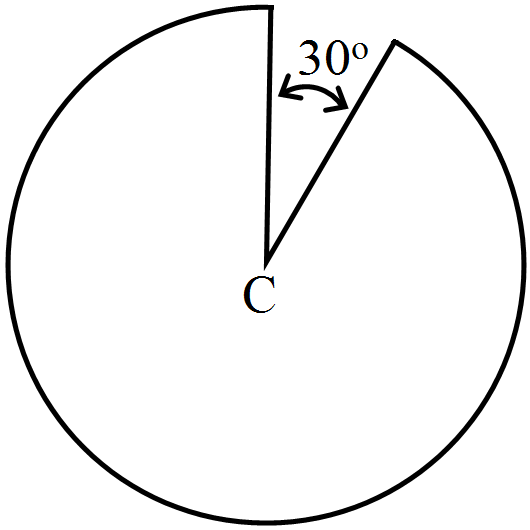
From a complete ring of mass M and radius R, a 30° sector is removed. What is the moment of inertia of the incomplete ring about an axis passing through the centre of the ring and perpendicular to the plane of the ring?
Answer
Mass of incomplete ring $=\text{M}-\frac{\text{M}}{2\pi}\times\frac{\pi}{6}$ $=\text{M}-\frac{\text{M}}{2}=\frac{11}{12}\text{M}$ Moment of inertia of incomplete ring $=\Big(\frac{11\text{M}}{2}\Big)\text{R}^2=\frac{11}{12}\text{MR}^2$
View full question & answer
Question 352 Marks
If earth contracts to half its radius, what would be the duration of the day? Ans. According to the law of conservation of angular momentum,
Answer
$\text{I}_1\omega_1=\text{I}_2\omega_2$ $\Rightarrow\frac{\text{I}_1}{\text{T}_1}=\frac{\text{I}_2}{\text{T}_2}\text{ or }\text{T}_2=\frac{\text{I}_2}{\text{I}_1}\text{T}_1$ $\text{I}_1=\frac{2}{5}\text{MR}^2,\text{I}_2=\frac{2}{5}\text{M}\Big(\frac{\text{R}}{2}\Big)^2$ $\therefore\text{T}_1=\frac{1}{4}\times24=6\text{hr.}$
View full question & answer
Question 362 Marks
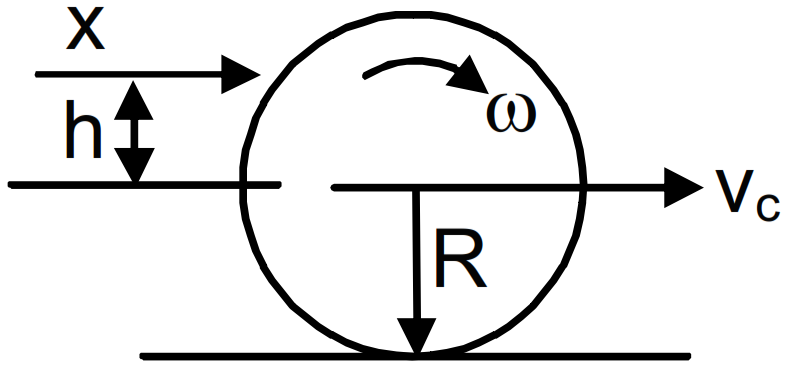
A thin spherical shell of radius R lying on a rough horizontal surface is hit sharply and horizontally by a cue. Where should it be hit so that the shell does not slip on the surface?
Answer

Let the cue strikes at a height ‘h’ above the centre, for pure rolling, $\text{V}_{\text{c}}=\text{R}_{\omega}$
Applying law of conservation of angular momentum at a point A,
$\text{mv}_{\text{c}}\text{h}-\ell\omega=0$
$\text{mv}_{\text{c}}\text{h}=\frac{2}{3}\text{mR}^2\times\Big(\frac{\text{v}_{\text{c}}}{\text{R}}\Big)$
$\text{h}=\frac{2\text{R}}{3}$
View full question & answer
Question 372 Marks
A disc of mass M and radius r is rotating with an angular velocity $\omega.$ If gently, two masses m are placed at a distance $\frac{\text{r}}{2}$ on either side of the axis, what will be its angular velocity?
Answer
Angular momentum initially $=\frac{\text{Mr}^2}{2}.\omega[\because\text{L}=\text{I}\omega]$ When the masses are placed, $\text{I}=\frac{\text{Mr}^2}{2}+\Big[\text{m}\big(\frac{\text{r}}{2}\big)^2\Big]\times2$ $=\frac{\text{r}^2}{2}[\text{M}+\text{m}]$ As I increases, $\omega$ decreases because angular momentum is to be conserved, New angular velocity, $\omega'$$=\frac{\frac{\text{Mr}^2}{2}\omega}{\frac{\text{r}^2}{2}[\text{M}+\text{m}]}=\frac{\text{M}\omega}{(\text{M}+\text{m})}$
View full question & answer
Question 382 Marks
A ring, a disc and a sphere all of the same radius and same mass roll down on an inclined plane from the same height h. Which of the three reaches the bottom (i) earliest (ii) latest?
Answer
We have already deduced that acceleration of an object down on inclined plane is given by $\alpha=\frac{\text{g}\sin\theta}{\text{I}+\Big(\frac{\text{I}}{\text{mr}}\Big)^2}$ For a ring $\text{I}=\text{mr}^2$
$\therefore\text{a}_{\text{ring}}=\frac{\text{g}\sin\theta}{1+1}=0.5\text{g}\sin\theta$ For a disc, $\text{I}=\frac{1}{2}\text{mr}^2$ $\therefore\text{a}_{\text{disc}}=\frac{\text{g}\sin\theta}{1+\frac{1}{2}}=\frac{2}{3}\text{g}\sin\theta$ $=0.67\text{g}\sin\theta$ For a sphere, $\text{I}=\frac{2}{5}\text{mr}^2$
$\therefore\text{a}_{\text{sphere}}=\frac{\text{g}\sin\theta}{1+\frac{2}{5}}=\frac{5}{7}\text{g}\sin\theta=0.71\text{g}\sin\theta.$ As $a_{sphere}$ is maximum, it will reach the bottom at the earliest. Again as $a_{ring}$ is minimum, it will reach the bottom at the end.
View full question & answer
Question 392 Marks
Establish the relation between angular momentum and rotational kinetic energy.
Answer
Angular momentum $\text{L}=\text{I}\omega$ Rotational K.E.,$\text{E}_{\text{k}} =\text{I}\omega^2$ $\text{E}_{\text{k}}=\frac{1}{2}\frac{(\text{I}\omega)^2}{\text{I}}=\frac{\text{L}^2}{2\text{I}}$
View full question & answer
Question 402 Marks
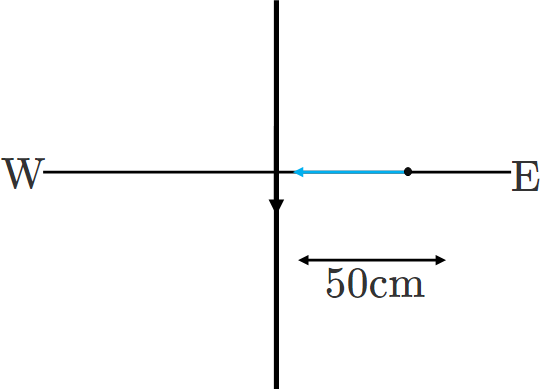
A heavy particle of mass m falls freely near the earth's surface. What is the torque acting on this particle about a point 50cm east to the line of motion? Does this torque produce any angular acceleration in the particle?
Answer
We know that: $\overrightarrow{\text{r}}=\overrightarrow{\text{r}}\times\overrightarrow{\text{F}}$ Given: $\overrightarrow{\text{r}}=-0.5\hat{\text{i}}\text{m}$ $\overrightarrow{\text{F}}=-\text{mg}\hat{\text{j}}$ The torque becomes: $\overrightarrow{\text{r}}=0.5\big(-\hat{\text{i}}\big)\times\text{mg}\big(-\hat{\text{j}}\big)$ $\overrightarrow{\text{r}}=0.5\text{mg}\hat{\text{k}}$ $\big[\because\hat{\text{i}}\times\hat{\text{j}}=\hat{\text{k}}\big]$ No, there will be no angular acceleration on the particle due to the torque.Angular acceleration is given by $\alpha=\frac{\text{T}}{\text{I}}.$ As the particle here moves in a straight line, the centre of rotation lies at a distance infinity $(\text{r}=\infty);$ so, moment of inertia $\big(\text{I}=\text{mr}^2\big)$ of the particle is infinity. $\therefore\alpha=0$
View full question & answer
Question 412 Marks
Prove the Kepler's law, that the line joining the sun and the planet sweeps equal areas in equal time, using the angular momentum conservation with the planet.
Answer
When the planet moves along the line joining the sun and the planet it sweeps some area given by $\text{A}=\frac{1}{2}\text{r}^2\theta$ where $\theta$ is the angular displacement. $\therefore\frac{\text{dA}}{\text{dt}}=\frac{1}{2}\text{r}^2\frac{\text{d}\theta}{\text{dt}}=\frac{1}{2}\text{r}^2\omega$ $\frac{\text{dA}}{\text{dt}}=\frac{1}{2\text{m}}\text{mr}^2\omega=\frac{\text{L}}{2\text{m}}$ Since no torque acts, angular momentum L is a constant, so $\frac{\text{dA}}{\text{dt}}$ is a constant, i.e., the line joining the sun and the planet sweeps equal areas in equal intervals of time.
View full question & answer
Question 422 Marks
A constant torque is acting on a wheel. If starting from rest, the wheel makes n rotations in t seconds, show that the angular acceleration is given by $\alpha=\frac{4\pi\text{n}}{\text{t}^2}\text{rad}{\text{ s}}^{-2}$
Answer
Here, $\omega_1=0,\theta=2\pi\text{n}$ radian, $\text{t}=\text{t},\alpha=?$ Since $\theta=\omega_1\text{t}+\frac{1}{2}\alpha\text{t}^2$ $\therefore2\pi\text{n}=0+\frac{1}{2}\alpha\text{t}^2$ $\text{or }\alpha=\frac{4\pi\text{n}}{\text{t}^2}\text{rad/s}^2$
View full question & answer
Question 432 Marks
hat is the relation between angular momentum, moment of inertia and angular velocity?
Answer
If L = Angular momentum I = Moment of Inertia $\omega=$ Angular velocity $\therefore\text{L} = \text{I}\omega.$
View full question & answer
Question 442 Marks
Torques of equal magnitude are applied to hollow cylinder and a solid sphere both having the same mass and radius. The cylinder is free to rotate about its standard axis of symmetry, and the sphere is free to rotate about an axis passing through its centre. Which of the two will acquire a greater angular speed?
Answer
MI of solid sphere about an axis through its centre, $\text{I}_2=\frac{2}{5}\text{MR}^2\text{ and}$ $\text{I}_1=\text{MI} \text{ of cylinder}=\text{MR}^2$ Torque applied, $\tau=\text{I}_1\alpha_1=\text{I}_2\alpha_2$ $\therefore\frac{\alpha_2}{\alpha_1}=\frac{\text{I}_1}{\text{I}_2}=\frac{\text{MR}^2}{\frac{2}{5}\text{MR}^2}=\frac{5}{2}$ $\therefore\alpha_2>\alpha_1$ From $\omega=\omega_0+\alpha\tau,$ we find that for given $\omega_0\text{ and }\tau\omega_2>\omega_1,\text{i.e.,}$ angular speed of solid sphere will be greater than the angular speed of hollow cylinder.
View full question & answer
Question 452 Marks
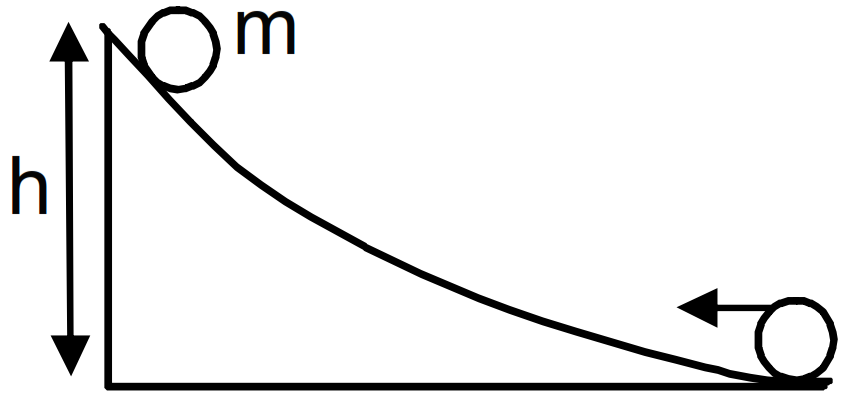
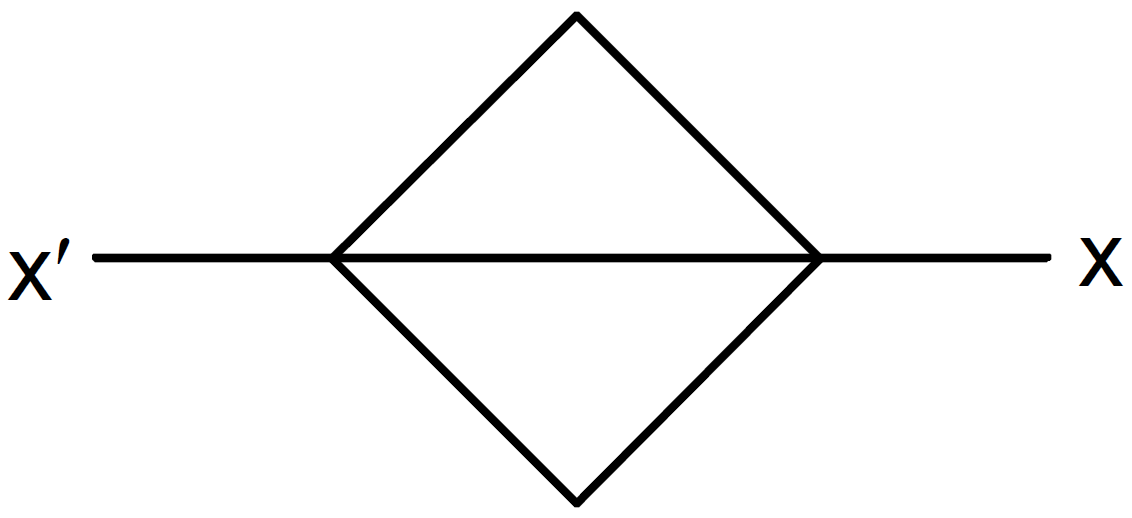
A small disc is set rolling with a speed v on the horizontal part of the track of the previous problem from right to left. To what height will it climb up the curved part?
Answer

A disc is set rolling with a velocity V from right to left. Let it has attained a height h.
Therefore $\Big(\frac{1}{2}\Big)\text{mV}^2+\Big(\frac{1}{2}\Big)\text{l}\omega^2=\text{mgh}$
$\Rightarrow\Big(\frac{1}{2}\Big)\text{mV} ^2+\Big(\frac{1}{2}\Big)\times\Big(\frac{1}{2}\Big)\text{mR}^2\omega^2=\text{mgh}$
$\Rightarrow\Big(\frac{1}{2}\Big)\text{V}^2+\frac{1}{4}\text{V}^2=\text{gh}$
$\Rightarrow\Big(\frac{3}{4}\Big)\text{V}^2=\text{gh}$
$\Rightarrow\text{h}=\frac{3}{4}\times\frac{\text{V}^2}{\text{g}}$
View full question & answer
Question 462 Marks
Write an expression for the moment of inertia of a circular disc of mass $M$ and radius $R.$
  1. About an axis passing through its centre, and perpendicular to its plane.
  2. About its diameter.
  3. About a tangent to its own plane.
  4. About a tangent perpendicular to the plane of the disc.
Answer
  1. $\text{I}=\frac{\text{MR}^2}{2}$
  2. $\text{I}_{\text{d}}=\frac{\text{MR}^2}{4}$
  3. $\text{I}_{\tau\text{p}}=\frac{\text{MR}^2}{4}+\text{MR}^2=\frac{5}{4}\text{MR}^2$
  4. $\text{I}_{\tau\bot}=\frac{\text{MR}^2}{2}+\text{MR}^2=\frac{3}{2}\text{MR}^2$
View full question & answer
Question 472 Marks
Calculate the torque on the square plate of the previous problem if it rotates about a diagonal with the same angular acceleration.
Answer

Moment of inertial of a square plate about its diagonal is $\frac{\text{ma}^2}{12}$ (m = mass of the square plate)
a = edges of the square
Therefore torque produced $=\Big(\frac{\text{ma}^2}{12}\Big)\times\alpha$
$=\Big\{\frac{120\times10^{-3}\times5^2\times10^{-4}}{12}\Big\}\times0.2$
$=0.5\times10^{-5}\text{N-m}$
View full question & answer
Question 482 Marks
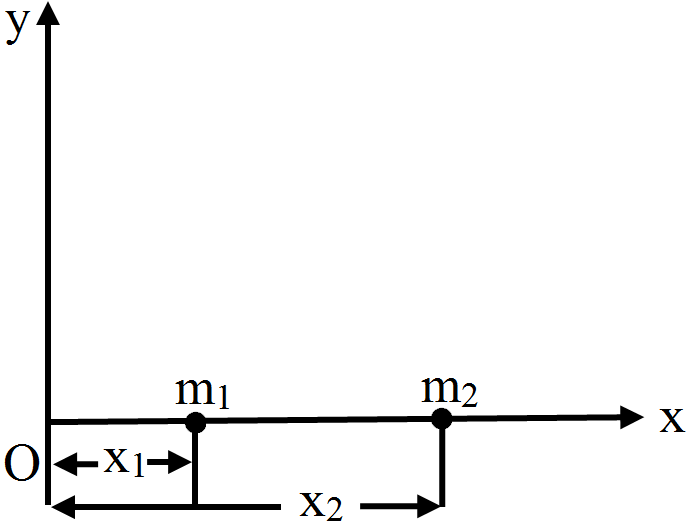
What will be the centre of mass of the pair of particles described below in figure on the x-axis?
Answer
The centre of mass of the pair of particles is located on the x-axis and lies somewhere between the particles. The x-coordinate of the centre of mass in this case would be, $\text{x}_{\text{cm}}=\frac{\text{m}_1+\text{x}_1+\text{m}_2\text{x}_2}{\text{m}_1+\text{m}_2}$
View full question & answer
Question 492 Marks
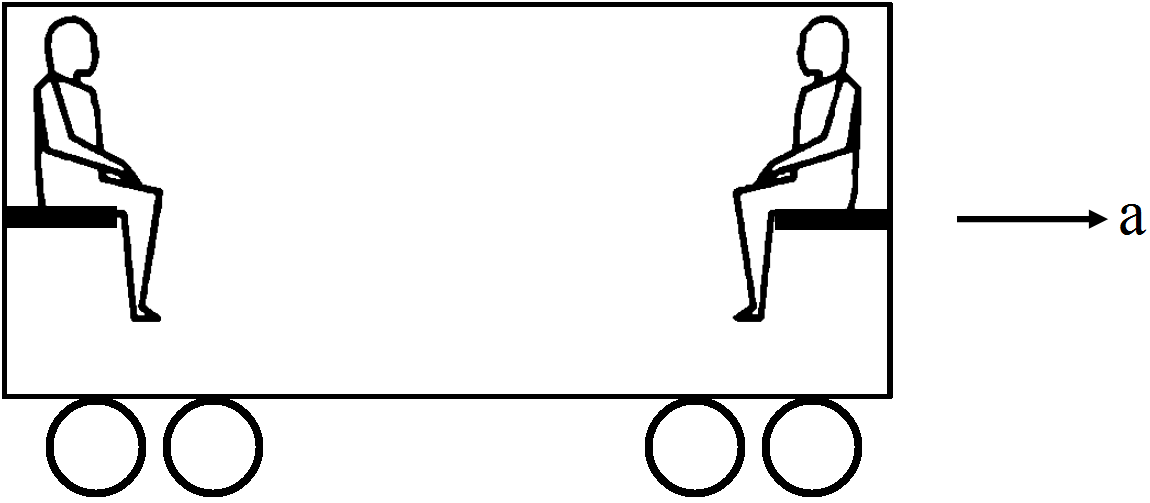
Which of the two persons shown in figure is more likely to fall down? Which external force is responsible for his falling down? 100%
Answer
The person sitting on right side of the figure is likely to fall Because of moment of inertia of the body of person his upper body is still in rest but lower body that is in contact with seat due to friction may move forward (right) as center of mass may be at the center of body the man may fall towards left.
View full question & answer
Question 502 Marks
Name the physical quantity corresponding to force in rotational motion. How is it related to force and give its units?
View full question & answer