Questions

3 Marks Question

🎯

Test yourself on this topic

4 questions · timed · auto-graded

Question 13 Marks
The centre of gravity of a body on the earth coincides with its centre of mass for a ‘small’ object whereas for an ‘extended’ object it may not. What is the qualitative meaning of ‘small’ and ‘extended’ in this regard?
For which of the following the two coincides? A building, a pond, a lake, a mountain?
Answer
Main concept used: Centre of gravity is the centre of it’s Geometry but centre of mass is the point where the whole mass of body can be considered. When the vertical height or Geometric centre of object is very near to surface of earth the object is called small. If it is larger then it is called extended objects.
  1. Building $($high$)$, pond are small objects.
  2. Mountain and lake are big objects so their geometrical centre will be above and below the surface of earth respectively, with appreciable distances, so called extended objects.
View full question & answer
Question 23 Marks
Why does a solid sphere have smaller moment of inertia than a hollow cylinder of same mass and radius, about an axis passing through their axes of symmetry?
Answer
$\text{I}=\sum\limits^{\text{n}}_{\text{i}=1}\text{m}_\text{i}\text{r}^2_\text{i}$Moment of inertia is directly proportional to the square of distance of mass from the axis of rotation. In solid sphere whole mass is distributed from centre to radius of sphere R. But it hollow sphere whole mass is concentrated near the periphery or surface of the sphere so average value of $r_i$ becomes larger in hollow sphere as compared to solid sphere. So MI of hollow sphere becomes larger than solid sphere.
View full question & answer
Question 33 Marks
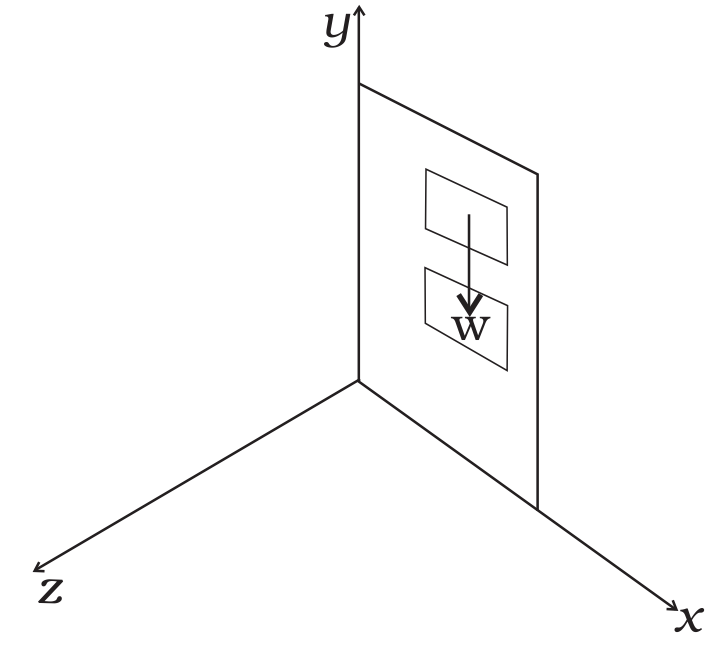
A door is hinged at one end and is free to rotate about a vertical axis. Does its weight cause any torque about this axis? Give reason for your answer.
Answer
Here axis of rotation of door is along Y-axis and door is in x-y plane and force F can be applied along z-axis, the torque is experience by door. So a force can produce torque only along $\pm\text{z}-\text{axis.}$ in the direction normal to force. Force due to gravity of door is parallel to the axis of rotation. So cannot produce torque along y-axis. Gravity due to door is along -y axis. So it can rotate the door in axis along $\pm\text{z}-\text{axis.}$ Hence the weight of door cannot rotate the door along y-axis.
View full question & answer
Question 43 Marks
The vector sum of a system of non-collinear forces acting on a rigid body is given to be non-zero. If the vector sum of all the torques due to the system of forces about a certain point is found to be zero, does this mean that it is necessarily zero about any arbitrary point?
Answer
The vector sum of all torques due all torques due to forces at a point is zero. It does not mean that the resultant of forces are zero. E.g., Torque on sea-saw of a boy and child can be equal (can be balance). If the point of support of sea-saw changes without changes their position, the torques will not balance the sea-saw. So it is not necessary that, if the sum of all torques due to different forces at a point is zero, it will may not be zero for other arbitrary point.$\text{G}_\text{i}\sum\limits^{\text{n}}_{\text{i}=1}\text{F}_\text{i}\neq0$
$\tau$ about a point P(let)
$\tau=\tau_1+\tau_2+\ ....\ +\tau_\text{n}=\sum\limits^{\text{n}}_{\text{i}=1}\vec{\text{r}}_\text{i}\times\vec{\text{F}}_{\text{i}}=0$ (given)
$\tau$ about any other point $Q_1$ (say) $\vec{\text{r}}_\text{i}$ will be different forces
$\sum\limits^{\text{n}}_{\text{i}=1}(\vec{\text{r}}_{\text{i}}-\text{a})\times\text{F}_\text{i}=\sum\limits^{\text{n}}_{\text{i}=1}\vec{\text{r}}\times\text{F}_\text{i}-\text{a}\sum\limits^{\text{n}}_{\text{i}=1}\text{F}_1$
As a and $\sum\text{F}_\text{i}$ are not zero. so sum of all the torques about any arbitrary point need not be zero necessarilly.
View full question & answer
3 Marks Question - Physics STD 11 Science Questions - Vidyadip