Questions · Page 2 of 3

1 Marks Question

Question 511 Mark
Mark the odd one in the following group.
Fragmentation, Stratification, Leaching, Catabolism.
Answer
Stratification.
View full question & answer
Question 521 Mark
What is net primary productivity?
Answer
The amount of energy or biomass remaining in a producer after meeting the cost of its respiration is called the net primary productivity.
View full question & answer
Question 531 Mark
Name the dominant producers in a deep aquatic ecosystem. What other name could you give to a primary consumer?
Answer
Phytoplanktons are the dominant producers in aquatic ecosystem. Primary consumers are also known as herbivores.
View full question & answer
Question 541 Mark
What is the starting point of a grazing food chain and detritus food chain, respectively?
Answer
The grazing food chain starts with producers while the detritus food chain starts with decomposers.
View full question & answer
Question 561 Mark
All primary productivity is not available for herbivores. Give one reason.
Answer
Some of the gross primary productivity gets lost in the form of respiration, that is why all primary productivity is not available for herbivores.
View full question & answer
Question 571 Mark
What is an ecosystem?
Answer
An ecosystem is a functional unit of nature, where biotic components (living organisms) interact among themselves and also with the abiotic environmental or physical factors.
View full question & answer
Question 581 Mark
Why the pyramid of energy is always upright?
Answer
Because when energy flows from a particular trophic level to the next trophic level, some energy is always lost as heat at each step.
View full question & answer
Question 591 Mark
Why is the pyramid of biomass inverted in a pond ecosystem?
Answer
The pyramid of biomass is inverted in a pond ecosystem because the biomass of fish (top consumer) is far larger than the producers (phytoplanktons).
View full question & answer
Question 601 Mark
Answer the following questions:
Identify the climax community of hydrarch and xerarch succession.
Answer
Forest is the climax community for both successions.
View full question & answer
Question 611 Mark
Differentiate between standing state and standing crop in an ecosystem.
Answer
Differences:
S.No.
Standing State
Strndirg Crop
(i)
Standing state refers to the amount of nutrients such as nitrogen, phosphorus, calcium, etc. present in the soil of an ecosystem at a given time.
Standing crop refers to the amount of biomass or organic matter available at a given rophic level/ ecosystem at a given time.
(ii)
It is in the abiotic comPonents.
It is in the biotic components.
View full question & answer
Question 631 Mark
Name the important steps in the process of decomposition.
Answer
Fragmentation, leaching, catabolism, humification and mineralisation.
View full question & answer
Question 641 Mark
What is meant by 10% law?
Answer
It states that only 10% energy of a trophic level is transferred to the next higher trophic level.
View full question & answer
Question 651 Mark
Climax stage is achieved quickly in secondary succession as compared to primary succession. Why?
Answer
The rate of succession is much faster in secondary succession as the substratum (soil) is already present as compared to primary succession where the process starts from a bare area (rock).
View full question & answer
Question 661 Mark
List two factors that determine the vegetation and soil type of an ecosystem.
Answer
Two factors that determine the vegetation and soil type of an ecosystem are:
  1. Precipitation.
  2. Temperature.
View full question & answer
Question 671 Mark
All the primary productivity is not available to a herbivore. Give one reason.
Answer
A considerable amount of gross primary productivity is used by the plants in respiration; so not all primary productivity is available for consumers.
View full question & answer
Question 691 Mark
Mr. Galgotia eats curd/ yoghurt In this case, which trophic level will he occupy?
Answer
He occupies third tropic level, i.e. he is a secondary consumer.
View full question & answer
Question 721 Mark
Arrange the following as observed in vertical stratification of a forest: Grass, Shrubby plants, Teak, Amaranths.
Answer
Grass (floor of forest) → Amaranthus → Shrubby plants → Teak (tree).
View full question & answer
Question 741 Mark
In terrestrial ecosystem DFC and GFC are interlinked at certain level. Justify the statement.
Answer
Some of the organisms of DFC are prey to the animal of GFC, hence they are interlinked.
View full question & answer
Question 751 Mark
Why are green algae not likely to be found in the deepest strata of the ocean?
Answer
Green algae are autotrophic organisms, i.e. they synthesise their own food with the help of photosynthesis. At deepest layers of ocean, light is absent. So, photosynthesis does not take place there and hence, green algae are not found in deep strata
View full question & answer
Question 761 Mark
Under what conditions would a particular stage in the process of succession revert back to an earlier stage?
Answer
Natural or human induced disturbances like fire, deforestation, etc.
View full question & answer
Question 771 Mark
Name the four levels of group organization of living things in order of increasing size.
Answer
Population, community, ecosystem, biosphere.
View full question & answer
Question 781 Mark
Define mineralisation.
Answer
The process of degradation of humus by microbial action and release of inorganic nutrients.
View full question & answer
Question 791 Mark
Give any two examples of xerarch succession.
Answer
  • Bare rocks $($xerosere$).$
  • Sandy areas $($psammosere$).$
View full question & answer
Question 811 Mark
Define biomass.
Answer
It is the amount of living material or organic matter present in an organism, community or biome.
View full question & answer
Question 821 Mark
How much of productivity is contributed by oceans?
Answer
Oceans contribute about 55 billion tons organic matter.
View full question & answer
Question 831 Mark
What is stratification in an ecosystem? Explain with an example.
Answer
The vertical distribution of different species occupying different levels in an ecosystem is called stratification. Trees occupy the topmost vertical layer of a forest, shrubs occupy the second layer and herbs and grasses occupy the bottom most or base layers.
View full question & answer
Question 841 Mark
How is primary productivity in an ecosystem determined?
Answer
Primary productivity is determined as the amount of biomass or organic matter produced per unit area over a time period by the plants during photosynthesis.
View full question & answer
Question 851 Mark
Write the equation that helps in deriving the net primary productivity of an ecosystem.
OR
How is the net primary productivity of an ecosystem derived?
Answer
Net Primary Productivity (NPP) is the weight of the organic matter stored by the producers which is available to heterotrophs for consumption. It is equal to the rate of organic matter produced during photosynthesis GPP minus respiratory losses (R), i.e. NPP = GPP - R
View full question & answer
Question 861 Mark
Name the term used for rate of storage of organic matter not used by heterotrophs.
Answer
Net primary productivity.
View full question & answer
Question 871 Mark
Why is measurement of biomass in terms of dry weight more accurate than fresh weight?
Answer
Measurement of biomass in terms of dry weight is more accurate because it avoids variations in weights due to seasonal moisture differences.
View full question & answer
Question 921 Mark
Who put a price tag for the ecosystem services? What is its value?
Answer
  1. Robert Constanza et al have tried to put a price tag.
  2. It's estimated to be about $33$ trillion $US$ dollars.
View full question & answer
Question 931 Mark
Mention any two reasons why the primary productivity varies in different types of ecosystems?
Answer
The primary productivity varies in different types of ecosystems as:
  1. It depends upon plant species $($producers$)$ of a given ecosystem and their photosynthetic capacity.
  2. It is dependent on various environmental factors like availability of nutrients.
View full question & answer
Question 941 Mark
Standing crop and biomass are related to each other, how?
Answer
The standing crop is measured as the mass of living organisms or the number in a unit area. The biomass of a species is expressed in terms of fresh or dry weight.
View full question & answer
Question 951 Mark
Name the two forms of reservoir of carbon, that regulate the ecosystem carbon cycle.
Answer
Atmosphere and oceans.
View full question & answer
Question 961 Mark
Why is a food web formed in nature?
Answer
Many organisms occupy positions in different food chains and several food chains become interconnected to form a food web.
View full question & answer
Question 971 Mark

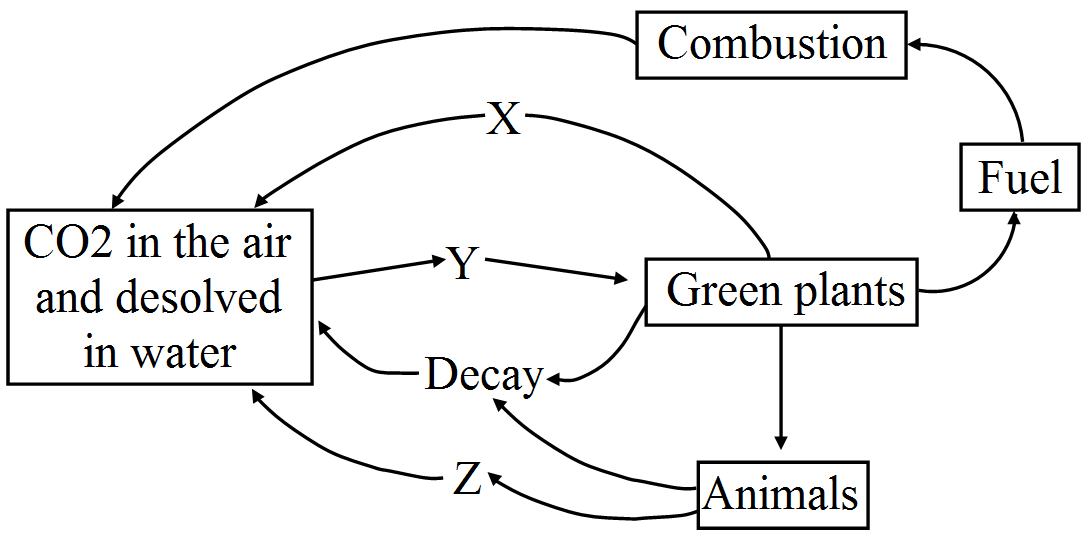
The diagram shows the carbon cycle.


Identify X, Y and Z.
Answer
X and Z- Respiration and Y- Photosynthesis.
View full question & answer
Question 981 Mark
'Ecosystem is called an interactive system'. Name a functional aspect of ecosystem which justifies the above statement.
Answer
Energy exchange and flow of nutrient cycling
View full question & answer
Question 991 Mark
List any two ways of measuring the standing crop of a trophic level.
Answer
Two ways of measuring the standing crop of a trophic level are:
  1. Biomass of living organisms.
  2. Number in an unit area.
View full question & answer
Question 1001 Mark
State what does standing crop of a trophic level represent.
Answer
Standing crop represents total amount of living matter or organic matter present in an ecosystem in an unit area and at a specific time.
View full question & answer
1 Marks Question - Page 2 - BIOLOGY STD 12 Science Questions - Vidyadip