Questions · Page 1 of 2

2 Marks Questions

🎯

Test yourself on this topic

50 questions · timed · auto-graded

Question 12 Marks
Distinguish between
Primary and secondary productivity.
Answer
Primary and secondary productivity:
  Primary productivity Secondary productivity
1 Rate of amount of production of organic matter by producers over a period of time. Rate of amount of production of organic matter by consumers over a period of time.
2 It is due to photosynthesis. It is due to herbivory and predation.
View full question & answer
Question 22 Marks
Distinguish between
Food chain and Food web.
Answer
Food chain and Food web:
  Food chain Food web
1 Food chain is single pathway of energy transfer from upper to lower. Food web is made of several interconnecting pathways.
2 One individual occupies one trophic level at a time. One individual occupies many trophic level at a time.
3 It decreases stability of the ecological system and less adaptive. It increases stability of the ecological system and more adaptive.
View full question & answer
Question 32 Marks
Distinguish between
Production and decomposition.
Answer
Production and decomposition:
  Production Decomposition
1 It is the rate of producing organic matter (food) by producers It is the process of breaking down of complex organic matter or biomass from the body of dead plants and animals with the help of decomposers into organic raw materials.
2 It depends on the photosynthetic capacity of the producers. It occurs with the help of decomposers.
3 Sunlight is required by plants for primary production Sunlight is not required for decomposition by decomposers.
View full question & answer
Question 42 Marks
What is primary productivity? Give brief description of factors that affect primary productivity.
Answer
It is defined as the amount of organic matter or biomass produced by producers per unit area over a period of time. Primary productivity of an ecosystem depends on the variety of environmental factors such as light, temperature, water, precipitation, etc. It also depends on the availability of nutrients and the availability of plants to carry out photosynthesis.
View full question & answer
Question 52 Marks
Distinguish between
Grazing food chain and detritus food chain.
Answer
Grazing food chain and detritus food chain:
  Grazing food chain Detritus food chain
1 In this food chain, energy is derived from the Sun. In this food chain, energy comes from organic matter (or detritus) generated in trophic levels of the grazing food chain.
2 It begins with producers, present at the first trophic level. It begins with detritus such as dead bodies of animals or fallen leaves, which are then eaten by decomposers or detritivores.
3 This food chain is usually large. It is usually smaller as compared to the grazing food chain.
View full question & answer
Question 62 Marks
Distinguish between
Litter and detritus.
Answer
Litter and detritus:
  Litter Detritus
1 Litter contains all kinds of waste materials above the surface of the earth. Detritus contains dead animals and plants below and above the surface of the earth.
2 It contains both biodegradable as well as non-biodegradable wastes. It contains only biodegradable wastes.
View full question & answer
Question 72 Marks
Distinguish between
Upright and inverted pyramid.
Answer
Upright and inverted pyramid:
  Upright pyramid Inverted pyramid
1 The pyramid of energy is always upright. The pyramid of biomass and the pyramid of numbers can be inverted.
2 The number and biomass of organisms in the producer level of an ecosystem is the highest, which keeps on decreasing at each trophic level in a food chain. The number and biomass of organisms in the producer level of an ecosystem is the lowest, which keeps on increasing at each tropic level. Light is not required for decomposition by decomposers.
View full question & answer
Question 82 Marks
“It is possible that a species may occupy more than one trophic level in the same ecosystem at the same time.” Explain with the help of one example.
Answer
The trophic level represents a functional level, not a species as such. A given species may occupy more than one trophic level in the same ecosystem at the same time; for example, a sparrow is a primary consumer when it eats seeds, fruits, peas, and a secondary consumer when it eats insects and worms.
View full question & answer
Question 92 Marks
Explain brood parasitism with the help of an example.
Answer
Koel is a parasitic bird (which has lost the instinct to make its own nest to lay eggs) has evolved the technique of layings eggs in the nest of a crow, Its eggs bear resemblences to those of crow.
View full question & answer
Question 102 Marks
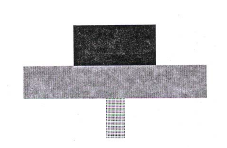
Identify the type of the given ecological pyramid and give one example each of pyramid of number and pyramid of biomass in such cases.

Answer
Inverted pyramid.
Inverted pyramid of biomass in a lake-phytoplankton$\rightarrow$Zooplankton$\rightarrow$fishes.
Inverted pyramid of number-tree$\rightarrow$insects$\rightarrow$birds.
View full question & answer
Question 112 Marks
State the difference between the first trophic levels of detritus food chain and grazing food chain.
Answer
DFC - Dead and decaying organic matter/Dead remains of plants and animals.GFC - Living green plants/producers.
View full question & answer
Question 122 Marks
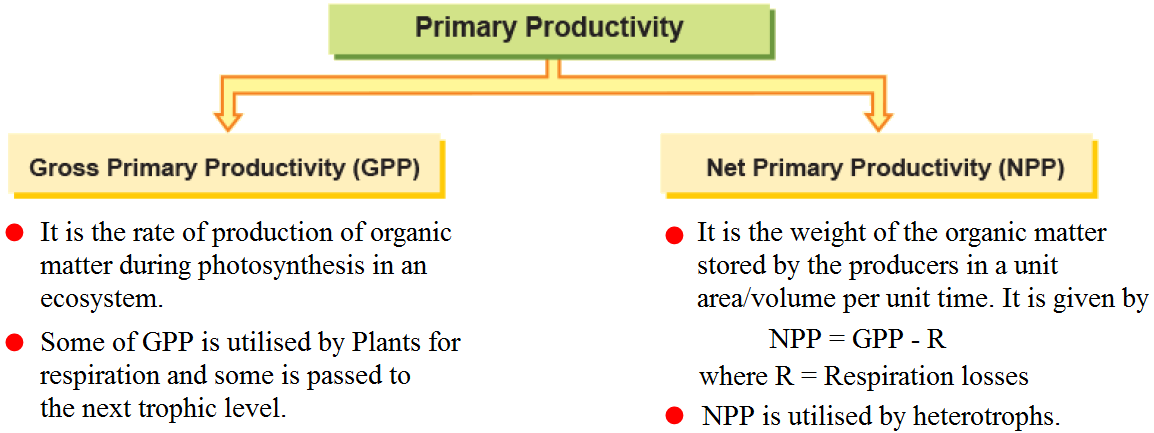
How are productivity, gross productivity, net primary productivity and secondary productivity interrelated?
Answer
Productivity is rate of biomass production.
GPP - R = NPP.
NPP - is biomass available to consumers for secondary productivity.
View full question & answer
Question 132 Marks
Why the pyramid of energy is always upright? Explain.
Answer
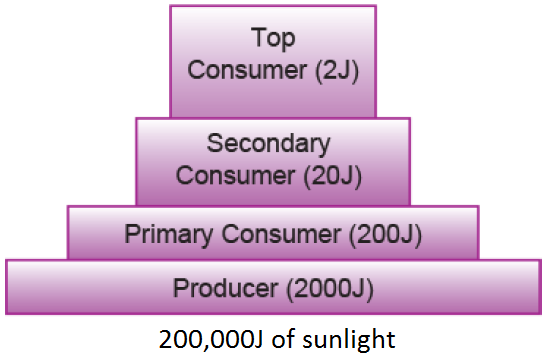
Pyramid of energy is always upright, can never be inverted, because when energy flows from a particular trophic level to the next trophic level, some energy is always lost as heat at each step. Each bar in the energy Pyramid indicate the amount of energy present at each trophic level in a given time or annually per unit area.
View full question & answer
Question 142 Marks
Name the type of food chains responsible for the flow of larger fraction of energy in an aquatic and a terrestrial ecosystem respectively. Mention one difference between the two food chains.
Answer
Aquatic ecosystem - Grazing Food Chain/GFC.
Terrestrial ecosystem - Detritus Food Chain/DFC.
Difference : GFC begins with phytoplanktons/producers whereas DFC begins with dead organisms/detritus.
View full question & answer
Question 152 Marks
Differentiate between a detritivore and a decomposer giving an example of each.
Answer
Detrivore feeds on dead plants and animals/detritus.Example: Earthworm/Nematodes.
Decomposer breaks down complex (organic) matter in (inorganic) matter.
Example: Fungus/Bacteria.
View full question & answer
Question 162 Marks
What does secondary productivity in an ecosystem indicate? List any two factors by which productivity is limited in aquatic ecosystems.
Answer
The secondary productivity indicates the rate at which food energy is assimilated at the trophic level of consumers, Light, oxygen, temperature, nitrogen.
View full question & answer
Question 172 Marks
What would happen to the successive trophic levels in the pyramid of energy if the rate of reproduction of phytoplankton was slowed down? Suggest two factors, which could cause such a reduction in phytoplankton reproduction.
Answer
Gradual decrease of energy at successive trophic levels.Decrease in light/ nutrients/ oxygen.
View full question & answer
Question 182 Marks
Mention four significant services that a healthy forest ecosystem provide.
Answer
Ecosystem services are the products of ecosystem processes. Healthy forest ecosystem provides the following ecosystem services:
  1. Purification of air and water.
  2. Cycling of nutrients.
  3. Generation of fertile soil.
  4. Provision of habitat to wildlife.
View full question & answer
Question 192 Marks
Global carbon is fixed in the biosphere through photosynthesis. Explain any two ways by which carbon is returned to the atmosphere.
Answer
Carbon is returned to the atmosphere by:
  1. Respiration of all living organisms.
  2. Burning of fossil fuels.
  3. Decomposition of organic matter.
  4. Forest fires.
View full question & answer
Question 202 Marks
Mention the factors that regulate the rate of function of the entire pond.
Answer
  1. Solar input.
  2. Day length.
  3. Cycle of temperature.
  4. Other climatic factors.
View full question & answer
Question 212 Marks
Why is a food chain formed in nature?
Answer
  1. A food chain is formed because of interdependence of organisms for food.
  2. Starting from the producers (plants), which alone capture solar energy, the energy passes on to other consumers.
  3. When the organisms die, the decomposers start acting on them and the detritus food chain starts.
View full question & answer
Question 222 Marks
“Decomposition is an oxygen requiring process” Comment.
Answer
Detritus is rich in nitrogen and sugars. For oxidation of nitrogen and sugars oxygen is required by a class of aerobic microbes.
View full question & answer
Question 232 Marks
How is the first law of thermodynamics satisfied in the functioning of an ecosystem?
Answer
  1. Plants capture the solar energy and convert it into organic compounds during photosynthesis.
  2. All other organisms depend on plants directly (herbivores) or indirectly (carnivores) on the plants for their energy needs.
  3. So energy flows from producer to a number of consumers in a unidirectional manner and energy is neither created nor destroyed; thus the first law of thermodynamics is satisfied in the ecosystem functioning.
View full question & answer
Question 242 Marks
Due to uncontrolled excessive hunting, the population of tiger in a forest becomes zero. Discuss the long-term effects of this situation in the population of deer in that forest.
Answer
The reduction in population of tiger (predator) will result in an increase in deer (prey) population. The increased deer population will give more pressure on vegetation due to overgrazing. As a result, the plant population will decrease and lead to decreased deer population due to starvation, death and migration. As a result, the ecological balance will be disturbed, but in the long run these relationships stabilise the prey and predator population in a community.
View full question & answer
Question 252 Marks
Climax stage is achieved quickly in secondary succession as compared to primary succession. Why?
Answer
The rate of succession is much faster in secondary succession as the substratum (soil) is already present as compared to primary succession where the process starts from a bare area (rock).
View full question & answer
Question 262 Marks
Discuss the relationship between detritus food chain and grazing food chain in a terrestrial ecosystem.
Answer
The producers occupy the first trophic level in terrestrial ecosystem and thus, make base of food chain. These producers (plants) are grazed upon by the grazers (herbivores) so herbivores are primary consumers. Primary carnivores prey upon herbivores and are eaten up by secondary carnivores.
This way the top carnivores are ferocious and are not eaten up by any other animal. The decomposers act on all dead animals/plants and return nutrients stored in them to the soil. These nutrients are again used up by the plants and cycle goes on. This way the grazing food chain and detritus food chains are linked up.
View full question & answer
Question 272 Marks
In the pyramid of biomass drawn below, name the two crops:
  1. One which is supported
  2. The one which supports.
In which ecosystem is such a pyramid found?
Answer
  1. The small standing crop of the phytoplanktons-the one supports.
  2. Large standing crop of zooplanktons-one which is supported.
Such a pyramid is found in aquatic ecosystem.
View full question & answer
Question 282 Marks
The number of trophic levels in a food chain is limited. Justify.
Answer
  1. Only 1% of the incident light energy is converted by producers into chemical energy.
  2. 10% energy is transferred from one trophic level to another trophic level in the food chain.
  3. After a few transfers, the amount of energy at the higher trophic levels will be very less, to sustain those organisms; hence, the number of trophic levels in a food chain is limited.
View full question & answer
Question 292 Marks
What is natural ecosystem? Explain with the help of suitable example.
Answer
Natural ecosystem These are capable of maintaining and operating themselves, without interference of man. They are further classified as:
  1. Terrestrial ecosystem Forest, grassland, desert, etc.
  2. Aquatic ecosystem Pond, lake, river, wetland, estuary, etc.
View full question & answer
Question 302 Marks
What could be the reason for the faster rate of decomposition in the tropics?
Answer
The rate of decomposition is regulated by climatic factors like temperature and soil moisture as they have an effect on the activities of soil microbes. The tropics with its hot and humid climatic condition provides an environment which is ideal for the microbes to speed up the process of decomposition.
View full question & answer
Question 312 Marks
"The energy flow in an ecosystem is unidirectional'. Justify the statement.
Answer
Energy in an ecosystem flows from producers to primary consumers, then from primary consumers to secondary consumers and so on. There is never a back flow of energy, i.e. energy cannot come back to a trophic it has already passed. Therefore, the energy flow is unidirectional in an ecosystem.
View full question & answer
Question 322 Marks
What would happen to the successive trophic levels in the pyramid of energy, if the rate of reproduction of phytoplanktons was slowed down? Suggest two factors which could cause such a reduction in phytoplankton reproduction.
Answer
If the rate of reproduction of phytoplanktons slows down then the net primary productivity decrease. As a result, flow of energy will also decrease in the successive trophic level.The following two factors cause reduction in phytoplankton reproduction:
  1. Less water availability.
  2. Less nutrient availability.
View full question & answer
Question 332 Marks
Describe how do oxygen and chemical composition of detritus control decomposition.
Answer
Effect of oxygen The decomposition of detritus is an energy requiring process. Most of the decomposers (bacteria and fungi) are aerobic organisms. They require oxygen for their cellular activities while acting on dead organic matter. Effect of chemical composition Decomposition rate is slower, if detritus is rich in lignin and chitin. It is quicker if detritus is rich in nitrogen and water soluble substances like sugars.
View full question & answer
Question 342 Marks
What are the two important points one must realise regarding succession?
Answer
  1. Succession, especially primary succession, is a very slow process taking thousands of years.
  2. Both xerarch and hydrarch successions lead to a similar climax community that is mesic.
View full question & answer
Question 352 Marks
Explain:
  1. Stratification.
  2. Leaching.
Answer
  1. Stratification: It is the venical distribution of different species occupying different levels in an ecosystem, e.g. trees occupy top vertical strata or layer of a forest, shrubs the second and herbs and grasses occupy the bonom (third) layers.
  2. Leaching: It is the process by which water-soluble inorganic nutrients go down into the soil horizon and get precipitated as unavailable salts.
View full question & answer
Question 362 Marks
Fill in the missing stages in the given primary hydrarch succession. Phytoplankton-A B C Submerged free-floating → D-Forest plant stage.
Answer
A-Reed-swamp stage B-Submerged plant stage
C-Marsh meadow stage D-Shrub stage.
View full question & answer
Question 372 Marks
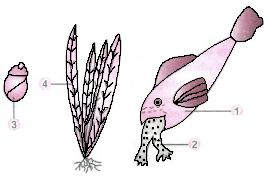
In the picture provided, what is the relationship between (1) and (2) with respect to population interaction and between (3) and (4) with respect to trophic levels.
Answer
(1) and (2) are predator and prey respectively.
(3) is a primary consumer (second trophic level).
(4) is a producer (first trophic level).
View full question & answer
Question 382 Marks
  1. What is primary productivity? In what units could you express productivity?
  2. Explain the differences between net primary productivity and gross primary productivity.
Answer
  1. The rate at which solar radiation is trapped by producers for the synthesis of organic compound through photosynthesis is called primary productivity. It is expressed as $\mathrm{g} \mathrm{m}^{-2} \mathrm{y}^{-1}$ or kcal $\mathrm{m}^{-2}$ year ${ }^{-1}$.
  2.  
View full question & answer
Question 392 Marks
Why is the rate of assimilation of energy at the herbivore level called secondary productivity?
Answer
It is because the biomass available to the consumer for consumption is a resultant of the primary productivity from plants.
View full question & answer
Question 402 Marks
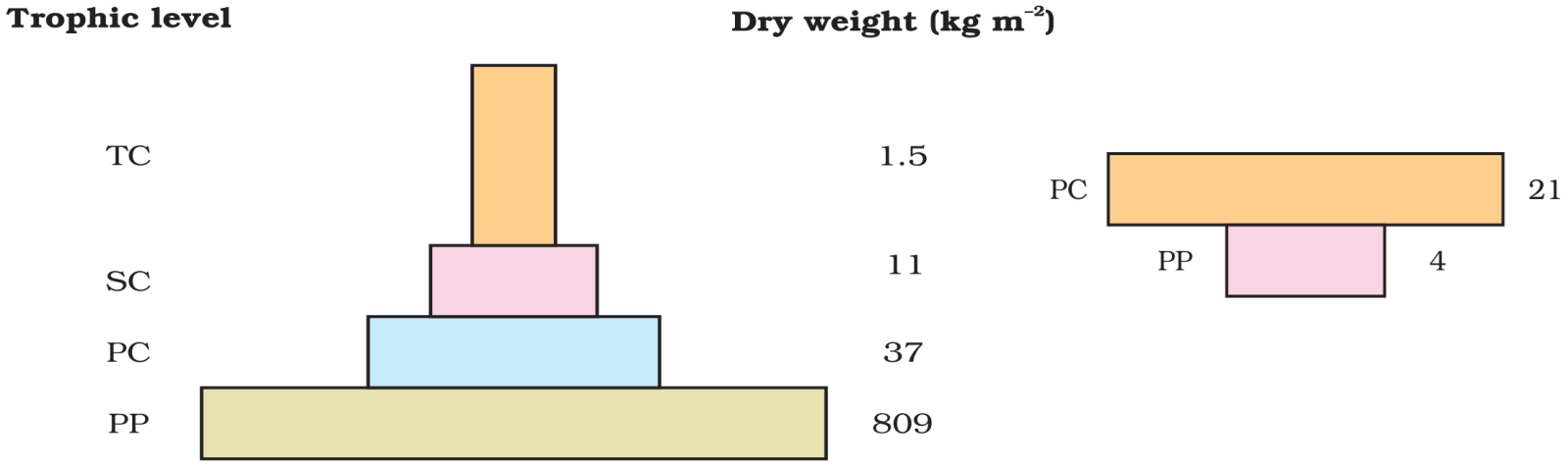
Compare the two ecological pyramids of biomass given below and explain the situations in which this is possible. Also, construct an ideal pyramid of energy, if 200,000 joules of sunlight is available.
Answer
The first pyramid of biomass corresponds to a terrestrial ecosystem. Second pyramid refers to a small standing crop of phytoplankton supporting a large standing crop of zooplankton or an aquatic ecosystem.
View full question & answer
Question 412 Marks
Differentiate between primary and secondary succession.
Answer
S.No.
Primary Succession
Secondary Succession
(i)
The ecological succession that takes place in a place, where no life existed before, is called primary succession.
The ecological that takes place in a region where life existed in the past but got wiped out completely is called secondary succession.
(ii)
It is comparatively slow as suitable soil has to be formed.
It is comparatively faster as soil or sediment is already present.
View full question & answer
Question 422 Marks
How are primrry consumers dlfferent from primary carnivores?
Answer
S.No.
Primary consumers
Primary carnivores
(i)
These are the animals which depend on plants for their food.
These are the animals which feed on the herbivorous animals.
(ii)
They occupy the second trophic level; they are herbivores.
They occupy the third trophic level; they are secoundary consumers.
View full question & answer
Question 432 Marks
The diagram shows the flow of energy through an ecosystem.

Which arrows represent the smallest amount of energy transferred between organisms and the largest amount of energy lost to the ecosystem?
Answer
The smallest amount of energy transferred is represented by arrow 2 and largest energy loss by arrow 3.
View full question & answer
Question 442 Marks
Mention the factors on which the nature/ type of pioneer species of a secondary succession depend.
Answer
  1. Condition of the soil.
  2. Availability of water.
  3. Environmental conditions.
  4. Seeds/ other propagules present.
View full question & answer
Question 452 Marks
Sometimes due to biotic/ abiotic factor the climax remain in a particular seral stage (preclimax) without reaching the climax. Do you agree with this statement. If yes, give a suitable example.
Answer
It is true that any change in the abiotic/ biotic factor will arrest a particular seral stage leading to a pre-climax condition before the climax stage is achieved. This can happen in cases of forest fires, landslide, change in soil characteristics, increase in herbivore population leading to overgrazing.
View full question & answer
Question 462 Marks
Construct a grazing food chain and a detritus food chain using the following, with five links in each:
Earthworm, bird, snake, vulture, grass, grasshopper, frog, decaying plant matter.
Answer
Grazing food chain:
Grass → Grasshopper → Frog → Snake → Vulture.
Detritus food chain:
Decaying plant matter → Earthworm → Bird Snake → Vulture.
View full question & answer
Question 472 Marks
Expand GPP and NPP. Differentiate between the two.
Answer
GPP stands for Gross Primary Productivity. It is the rate of production of organic matter during photosynthesis in an ecosystem.
NPP stands for Net Primary Productivity. It is defined as GPP-Respiratory loss.
View full question & answer
Question 482 Marks
What fraction (as percent) of the cost of ecosystem services is accounted by each of the following?
  1. Soil formation
  2. Nutrient cycling.
  3. Climate regulation.
  4. Habitat for wildlife.
Answer
  1. About 50%
  2. < 10%
  3. < 6%
  4. < 6%
View full question & answer
Question 492 Marks
In the North East region of India, during the process of jhum cultivation, forests are cleared by burning and left for regrowth after a year of cultivation. How would you explain the regrowth of forest in ecological term?
Answer
In this case, regrowth of forests is an example of ecological succession. After clearing of forests, the conditions become xerarch which proceeds to mesarch condition after the growth of forests.
View full question & answer
Question 502 Marks
Name the four functional aspects of an ecosystem.
Answer
Functional aspects of an ecosystem are:
  1. Productivity.
  2. Decomposition.
  3. Energy flow.
  4. Nutrient cycle.
View full question & answer