Questions · Page 1 of 2

2 Marks Questions

🎯

Test yourself on this topic

50 questions · timed · auto-graded

Question 12 Marks
How did a citizen group called Friends of Arcata Marsh, Arcata, California, USA, help to improve water quality of the marshland using Integrated Waste Water Treatment? Explain in four steps.
Answer
Wastewater including sewage can be treated in an integrated manner, by utilising a mix of artificial and natural processes.
  1. The conventional sedimentation, filtering and chlorine treatments are given. After this stage, lots of dangerous pollutants like dissolved heavy metals still remain.
  2. To combat this, an innovative approach was taken and the biologists developed a series of six connected marshes over 60 hectares of marshland.
  3. Appropriate plants, algae, fungi and bacteria were seeded into this area, which neutralise, absorb and assimilate the pollutants. Hence, as the water flows through the marshes, it gets purified naturally.
  4. The marshes also constitute a sanctury, with a high level of biodiversity in the form of fishes, animals and birds.
View full question & answer
Question 32 Marks
Why are there regular reminders to reduce the use of CFCs in the production of industrial and household appliances? Explain.
Answer
  • CFC adds to degradation of ozone layer in the stratosphere.
  • Ozone shields the earth by absorbing UV radiation from sun.
  • UV rays are highly injurious to organisms.
  • To prevent degradation of ozone layer (in stratosphere)/to maintain a balance between production and degradation of ozone in stratosphere.
View full question & answer
Question 42 Marks
List four benefits to human life by eliminating the use of CFCs.
Answer
  1. Delay in aging of skin.
  2. Prevent damage to skin cells.
  3. Prevent skin cancer.
  4. Prevent snow blindness/inflammation of cornea.
  5. Prevent cataract.
  6. Prevents ozone depletion.
  7. Prevents global warming.
  8. Reduces greenhouse effect.
  9. Reduces odd climatic changes or El Nino effect.
View full question & answer
Question 52 Marks
Plenty of algal bloom is observed in a pond in your locality.
  1. Write what has caused this bloom and how does it affect the quality of water.
  2. Suggest a preventive measure.
Answer
  1. Presence of large amounts of nutrients/Nitrogen/Phosphorus in water causes excessive growth of algae, depletes dissolved oxygen/imparts distinct colour to the water bodies/bloom-forming algae are extremely toxic/deteriorates water quality/fish mortality.
  2. Treatment of waste water before it reaches the pond/Integrated waste water treatment/avoiding using NPK fertilisers/use of organic or biodegradable manure/resort to organic farming.
View full question & answer
Question 62 Marks
Explain the relationship between green house gases and global warming.
Answer
Green house gases absorb a major fraction of infra red radiation, emitted by earth, and do not allow it to escape into space and reflects it back to earth, leading to considerable heating of earth and its atmosphere causing global warming.
View full question & answer
Question 72 Marks
Lower BOD of a water body helps reappearance of clean-water organisms. Explain.
Answer
Lowering of BOD results in decreased biodegradable material $\rightarrow$ reduced microbial decomposition $\rightarrow$ oxygen utilisation reduced $\rightarrow$ more Dissolved Oxygen (DO) available (clean water - organisms reappear.)
View full question & answer
Question 82 Marks
How e-wastes are being handled in our country? Write the correct solution for treating this waste.
Answer
E-wastes are being buried in landfills or incinerated. (manually)
Recycling, in the environment friendly manner.
View full question & answer
Question 92 Marks
Sewage discharge into a clean-water body leads to increased fish mortality. Explain.
Answer
Leads to increase in nutrients, promotes algal growth, increases BOD reduces dissolved oxygen. (aquatic animals deprived of oxygen leading to death), some bloom farming algae are extremely toxic to fish/other pollutants of sewage.
View full question & answer
Question 102 Marks
Name any two sources of e-wastes and write two different way for their disposal.
Answer
Two sources of e-waste are:
  1. Irreparable computers.
  2. Electronic items like mobile phones, television sets etc.
Two different way of disposal of e-Waste are:
  1. Damping the e-Waste into landfills.
  2. Incinerating e-Waste i.e. burning the e-Wastes completely into ashes.
These ways of disposal pose threat to the environment by releasing toxic substances into it, so recycling of e-Waste in an environment-friendly manner is the only solution its disposal.
View full question & answer
Question 112 Marks
How did Ahmed Khan, plastic sacks manufacturer from Bangalore, solve the ever-increasing problem of accumulating plastic waste?
Answer
Collected plastic wastes - recycled - powdered - to form polyblend, blended with bitumen, used in road laying, increased road life by a factor of three/more durable.
View full question & answer
Question 122 Marks
Mention the major cause of air pollution in metro cities. Write any three ways by which it can be reduced.
Answer
Automobiles,
Using catalytic converters, application of stringent pollution level norms, switching over to CNG as fuel, phasing out old vehicles, using unleaded petrol, using low sulphur petrol or diesel.
View full question & answer
Question 132 Marks
How does an electrostatic precipitator work to remove particulate pollutants released from the thermal power plants?
Answer
Electrode wires at several thousand volts produce a corona that releases electrons, electrons attach to dust particles, (dust particles) become negatively charged, are attracted to collecting plates, low velocity of air help settling of dust.
View full question & answer
Question 142 Marks
Explain accelerated eutrophication. Mention any two consequences of this phenomenon.
Answer
Accelerated eutrophication is addition of effluents from industries and homes that accelerates the ageing of a lake.Consequences are destruction of aquatic life/decreased dissolved oxygen, algal bloom.
View full question & answer
Question 152 Marks
Explain the cause of algal bloom in a water body. How does it affect an ecosystem?
Answer
Effluents from home/industries/chemical fertilisers/agriculture/sewage, bring or add nutrients to the water body which enhances algal growth.Effects - Reduces oxygen content/BOD increases. Deterioration of water quality, affects all aquatic life forms, toxicity of water increases.
View full question & answer
Question 162 Marks
A crane had DDT level as 5 ppm in its body. What would happen to the population of such birds? Explain giving reasons.
Answer
Population of birds decreases, DDT can neither be metabolised nor be excreted, interferes with calcium metabolism causing thinning of egg shells, premature breaking of egg shells.
View full question & answer
Question 172 Marks
DDT content in the water of a lake that supplies drinking water to the nearby villages, is found to be 0.003 ppm. The kingfishers of that area are reported to have 2 ppm of DDT. Why has the concentration increased in these birds? What harm will this cause to the bird population? Name the phenomenon.
Answer
DDT neither excreted nor metabolised, interferes with Calcium metabolism, decline in bird population/due to thinning of egg shell/premature breaking of eggs, biomagnification.
View full question & answer
Question 182 Marks
Thermal power plants are inevitable in industrial and densely populated country like ours. What harm do they do to the environment? Also, mention any precaution that could be taken to save our environment.
Answer
Release particulate and gaseous air pollutants, hot thermal waste, kills organism sensitive to high-temperature indigenous flora and fauna lost, Use of electrostatic precipitator.
View full question & answer
Question 192 Marks
What is eutrophication? Explain its consequences on the life of plants and animals in such water bodies.
Answer
Eutrophication: Excessive enrichment of water bodies with nutrients (due to inflow of waste water) causes profuse growth of algae.(algal bloom), releases toxins in water cause oxygen deficiency in water.
Growth of algae inhibited due to toxins, aquatic animals (fish) may die due to toxicity or lack of oxygen/loss of species.
View full question & answer
Question 202 Marks
Explain the relationship between biotic potential and environmental resistance.
Answer
Biotic potential: Inherent/ physiological capacity of an organism to reproduce/ increase in number, is only realised when environmental conditions are non-limiting.Environmental resistance: Nature keeps a check on the expression of Biotic potential/population size, all factors that keep a check on population size constitute environmental resistance.
View full question & answer
Question 212 Marks
Is global warming real, only a theory or speculation?
Answer
Global warming is real and has been with us for sometime, increasingly during the past two decades, but gradually for more than a hundred years. The reality of it is seen in direct temperature measurements and also in the melting of glaciers in low latitudes, permafrost decay in Alaska and the decrease in sea-ice cover in Arctic.
View full question & answer
Question 222 Marks
What are the effects of waste water of thermal power plants if disposed directly into water bodies?
Answer
Thermal water waste if disposed directly into water bodies eliminates or reduces the number of organisms sensitive to high temperature, and may change the growth of plants and fish in extremely cold areas after causing damage to the native flora and fauna.
View full question & answer
Question 232 Marks
Mention two important problems relating to nuclear energy.
Answer
  1. Radiation from nuclear material/ waste is extremely harmful for the living organisms. It causes mutations at high rate and also increases the risk of cancer.
  2. Nuclear energy contributes a very small amount of emissions into the atmosphere which can cause many environmental problems such as global warming. Uranium is not burned in a nuclear power plant as coal is so there are no emissions from it.
View full question & answer
Question 242 Marks
Humans, as well as other animals, have been dumping their wastes into the environment for thousands of years. What is the reason that this appears to be such a problem today?
Answer
The human population is increasing rapidly, producing more wastes, and a significant amount of the wastes are non-biodegradable.
View full question & answer
Question 252 Marks
Why is it necessary to reduce sulphur from petroleum products?
Answer
It is necessary to reduce sulphur from petroleum products because sulphur dioxide formed as a result of fuel combustion is highly hazardous for our environment. It has significant impact on human health and is a major cause of acid rain.
View full question & answer
Question 262 Marks
Write an account on Montreal Protocol.
Answer
The Montreal Protocol is an agreement which was signed on $16^{th}$ September 1987 at Montreal (Canada) by 27 countries and became effective in 1989. It is an international treaty to limit the production and use of ozone-depleting substances like chlorofluorocarbons (CFCS) and to implement the use of alternatives to CFCS.
View full question & answer
Question 272 Marks
Name the various green house gases? Give their percentage contribution to global warming.
Answer
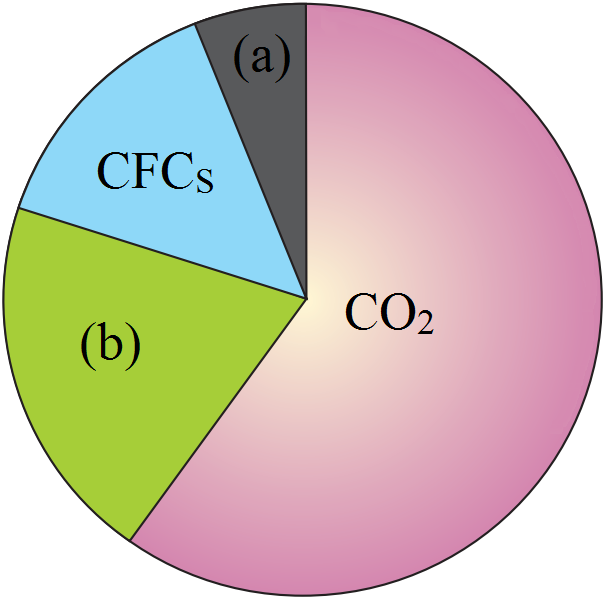
  • Methane, CFCs (Chloroflurocarbons) and nitrous oxide.
  • $CO_2$ contributes 60% of total global warming.
  • Methane contributes 20%.
  • CFCs contribute 14%.
  • Nitrous oxide 6%.
View full question & answer
Question 282 Marks
Mention the two major environmental issues of global nature.
Answer
  1. Increasing greenhouse effect.
  2. Depletion of ozone in the stratosphere.
View full question & answer
Question 292 Marks
Write a note on deforestation and enumerate it's consequences.
Answer
People's Participation in Conservation of Forests:
  1. In 1731, a Bishnoi woman, Amrita Devi (Jodhpur) showed, exemplary courage by hugging a tree and prevented it from cutting. Her three daughters and hundreds of other Bishnois, followed her and lost their lives, while saving trees. The Government of India has recently instituted the Amrita Devi Bishnoi Protection Award for individuals or communities from rural areas that have shown extraordinary courage and dedication to save trees.
  2. Chipko Movement started in Garhwal Himalayas in 1974, is primarily aimed to save trees and forests. Local women protected the trees by hugging them.
  3. Government of India in 1980s has introduced the concept of Joint Forest Management (JFM) to work closely with local communities in forest conservation. In return, the communities get benefits of various forest products (e.g. fruits, gum, rubber, medicine, etc.), thus enabling sustainable development of forest.
View full question & answer
Question 302 Marks
What are the problems associated with e-waste?
Answer
(e-wastes) comprise the damaged electronic goods and irreparable computers E-wastes release many toxins like lead, mercury, cadmium, etc, in soil and water. These toxins thus, get accumulated in biological chains of organisms.
View full question & answer
Question 312 Marks
Differentiate between bad and good ozone.
Answer
Serial Number
Good ozone
Bad ozone
i
The ‘stratospheric ozone' is also known as “Good Ozone."
The ‘Tropospheric Ozone’ is also known as “bad ozone”
ii
UV radiation with wavelengths between 280 and 315 nanometers called UV-B, and is damaging to almost all forms of life.
Ozone at ground level is a harmful pollutant. Ozone pollution is a concern during the summer months, when the weather conditions needed to form it lots of sun, hot temperatures normally occur.
View full question & answer
Question 322 Marks
Mention the consequences of deforestation.
Answer
  1. Increased concentration of carbon dioxide, leading to global warming.
  2. Loss of biodiversity due to habitat destruction.
  3. Soil erosion.
  4. Disturbance to hydrological cycle.
  5. Desertification in extreme cases.
View full question & answer
Question 332 Marks
The figure given below shows relative contributions of various greenhouse gases to the total global warming.
  1. Name the gases (a) and (b).
  2. Explain how increase in greenhouse gases in earth's atmosphere leads to melting of ice caps.
Answer
  1.  
  1. Nitrous oxide $\left(\mathrm{N}_2 \mathrm{O}\right)$.
  2. Methane $\left(\mathrm{CH}_4\right)$.
  1. Greenhouse gases cause global warming (increase in the earth's temperature), which causes melting of ice caps.
View full question & answer
Question 342 Marks
Why are the environmentalists worried about the considerate increase in the level of greenhouse gases? List the different greenhouse gases other than carbon dioxide.
Answer
  • Increase in the level of greenhouse gases will lead to heating of the Earth and result in global warming.
  • Environmentalists believe that the increased temperature is leading to deleterious changes in the environment and resulting in odd climatic changes (El Nino effect), melting of polar ice caps, etc.
  • The different greenhouse gases are methane, chlorofluorocarbons and nitrous oxide other than carbon dioxide.
  • The melting of polar ice caps may increase the sea level in due course of time and many coastal areas may become submerged.
View full question & answer
Question 352 Marks
What are the three major kinds of impurities in domestic wastewater?
Answer
Following are the three major kinds of impurities in domestic wastewater.
  1. Suspended impurities.
  2. Colloidal materials.
  3. Dissolved materials.
View full question & answer
Question 362 Marks
Why does biomagnification occur with certain substances? Name two such substances.
Answer
Biomagnification is increase in the concentration of certain toxic substances at successive trophic levels; this happens because these substances can neither be metabolised nor excreted, but get accumulated and passed on to the next higher trophic level, e.g. Mercury and DDT.
View full question & answer
Question 372 Marks
Enumerate the ill-effects of the PM 2.5 on human health.
Answer
When these fine particulate matter is inhaled deep into the lungs, it causes:
  1. Breathing and respiratory problems.
  2. Irritation and inflammation of the lungs.
  3. Damage to the lungs leading to premature death.
View full question & answer
Question 382 Marks
What do you understand by algal bloom?
Answer
Presence of large amount of nutrients in water bodies causes excessive growth of planktonic algae that causes colouration of water is called algal bloom. It causes deterioration of water quality and fish mortality.
View full question & answer
Question 392 Marks
Is it true that if the dissolved oxygen level drops to zero the water will become septic? Given example which could lower the dissolved oxygen content of an aquatic body.
Answer
Yes, the water become septic if the dissolved oxygen drops to zero. Organic pollution (biodegradable) is an example.
View full question & answer
Question 402 Marks
Suggest any four control measures of noise pollution.
Answer
  • By using sound-adsorbent materials.
  • Delimiting horn free zones near hospitals, schools etc.
  • Playing loudspeaker only in permissible limits and limiting the timings after
  • Which loudspeaker can not be played.
  • Having permissible sound levels of crackers.
View full question & answer
Question 412 Marks
List any two adverse effects of particulate matter on human health.
Answer
When particulate matter inhaled deep into the lungs they cause:
  1. Breathing and respiratory symptoms.
  2. Irritation.
  3. Inflammations.
  4. Damage to the lungs and premature death.
View full question & answer
Question 422 Marks
All of a sudden a great many dead fish are found floating on the surface of a pond. What might be the cause of such a fish kill?
Answer
It is likely that eutrophication has occurred in the pond. If so, large algal blooms can result from the excess nutrients. As this dead organic matter falls to the lower depths, decomposers consume the organic matter, but deplete the $O_2$ of water, which kills fish.
View full question & answer
Question 432 Marks
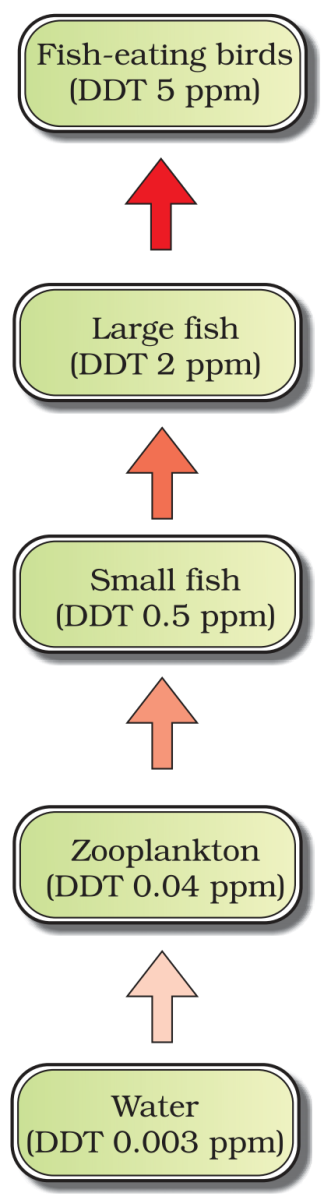
Study the given aquatic food chain and answer the questions that follow:
  1. Give reasons why there is a continuous increase in the DDT content in different trophic levels of the chain.
  2. Name the phenomenon responsible for themincrease in DDT content.
Answer
  1. The DDT concentration increases because:
  • It cannot be metabolised.
  • It is not excreted, but is passed on to the next higher trophic level.
  1. The phenomenon is called biomagnification.
View full question & answer
Question 442 Marks
Eichhornia crassipes is an alien hydrophyte introduced in India. Mention the problems posed by this plant.
Answer
Eichhornia crassipes (water hyacinth) is the world's most problematic aquatic weed. It grows abundantly in eutrophic water bodies and imbalances water ecosystem. It blocks the water, ways and growth of other organisms due to its excessive growth.
View full question & answer
Question 452 Marks
Answer the following:
  1. What depletes ozone in the stratosphere? How does this affect human life?
  2. What is El Nino effect? Explain how it accounts for biodiversity loss.
Answer
  1. Ozone in the stratosphere is depleted by CFCS, i.e. chlorofluorocarbons, released primarily from refrigerators and other industrial emissions. This affects the human life as it leads to more exposure of UV radiation, which is considered to be harmful for health.
  2. Effects of UV Rays:
    1. Damage to DNA and leads to mutation.
    2. Damage to the skin cells.
    3. Ageing of the skin.
    4. Various types of cancers.
  3. El Nino is abnormal warming of surface ocean water in the Eastern Pacific Ocean. During El Nino, there is movement of warm water to East which causes bleaching and death of coral reefs. It changes the route of migration of birds, fishes and whales thereby increasing the risk for them. It is also known to be responsible for sudden changes in rainfall pattern and drought. All this makes El Nino, a factor for biodiversity loss.
View full question & answer
Question 462 Marks
Explain how the inflow of large amount nutrients like phosphates and nitrates into the water body drastically affect the aquatic life there. Name the phenomenon responsible.
OR
'Fish mortality increases with the influx of nutrients in a freshwater body.' Write two reasons. How will the influx of nutrients affect the BOD level of this water body?

OR
How is it that the mortality rate of fish increases downstream from the point of sewage discharge into a water body? Explain.
Answer
  • The nutrients like phophates and nitrates in the sewage stimulate the excess growth of planktonic algae and cause algal blooms. \
  • Some bloom-forming algae secrete toxic chemicals that affect humans and other aquatic animals like fish.
  • They deteriorate the water quality and cause fish mortality.
  • When they die, the decomposers acting on them use oxygen and there is increased BOD and depletion of oxygen, which also causes mortality of aquatic animals like fish.
  • The phenomenon is called accelerated eutrophication.
View full question & answer
Question 472 Marks
What is meant by ozone hole? Which unit is used for measuring ozone thickness?
Answer
  • Ozone layer is a protective shield in stratosphere. Its depletion over a part of the atmosphere is called ozone hole which will result in an increased UV radiations reaching the earth surface.
  • Dobson Units (D.U.)
View full question & answer
Question 482 Marks
How has DDT caused decline in bird population?
Answer
High concentrations of DDT disturb calcium metabolism in birds, which causes thinning of eggshell and their premature breaking, eventually causing decline in bird populations.
View full question & answer
Question 492 Marks
What is meant by Jhum cultivation? Explain how it is responsible for deforestation.
Answer
In Jhum cultivation, farmers clear the trees of the forest and burn the plant remains. The ash of the burnt vegetation contains minerals and is used as fertiliser. The land is then used for farming or cattle grazing. After cultivation, farmers move to another area and this process is repeated. Thus, in north-eastern states of India, this practice has caused major deforestation.
View full question & answer
Question 502 Marks
Differentiate between biodegradable and non biodegradable wastes.
Answer
Differences:
Biodigradable wastes
Non-biodegradable wastes
These are the wastes which can be broken down into simpler, harmless, (sometimes useful) substances by the action of living organisms through decomposition.
These are the wastes which cannot be broken down into simpler or harmless substances by the action of living organisms.
  • Non-biodegradable wastes are more harmful, as they tend to remain as such for many years on the surface of earth; this type of wastes must be reduced significantly.
View full question & answer