Questions · Page 2 of 2

3 Marks Question

Question 513 Marks
Mention any six harmful effects of noise on human health/ body.
Answer
Noise on human health:
  1. Sleeplessness.
  2. Increased rate of heart beat.
  3. Altered breathing pattern.
  4. Stress.
  5. Very high sound levels > 150 dB can cause damage to eardrum and permanent loss of hearing.
  6. Chronic exposure to low level noise may also cause damage to hearing abilities.
View full question & answer
Question 523 Marks
How does a water body age naturally? Explain. State how this phenomenon of ageing of a water body gets accelerated.
OR
How does eutrophication of a lake take place? Explain.
Answer
Young lake (water is cold and clear)
$\downarrow$
Streams drain into the lake and introduce nutrients like $N_2$, P etc.
$\downarrow$
Fertility of lake increases.
$\downarrow$
Plant and animal life burgeons.
$\downarrow$
Organic remains are deposited at the bottom of the lake.
$\downarrow$
Over centuries, the lake becomes shallower and warmer.
$\downarrow$
Marshy plants take roots and fill in the original lake basin.
$\downarrow$
Large masses of floating plants (bog).
$\downarrow$
Lake is converted into land.
View full question & answer
Question 533 Marks
Why is there a decline in the population of fish-eating birds when the water body is amidst agricultural fields?
Answer
  • It refers to the increase in concentration of the harmful/toxic substances at successive trophic levels.
  • It happens because such harmful/ toxic substances can neither be metabolised nor excreted, but are passed onto the next (higher) trophic level.
  • In fish-eating birds, the high concentrations of DDT disturb the calcium metabolism.
  • It causes thinning of eggshell and the premature breaking of such eggs leads to a decline in bird populations of fish-eating birds.
View full question & answer
Question 543 Marks
Match the Government initiatives to reduce pollution in Column I with the year in which they into effect in Column II.
S.No.
Column I
S.No.
Column II
A.
Air (Prevention and control of Pollution) Act
i.
1974
B.
Joint Forest Management water
ii.
1986
C.
Water (Prevention and Control Pollution)
iii.
1980
D.
Environment (Protection) Act
iv.
1981
Answer
S.No.
Column I
S.No.
Column II
A.
Air (Prevention and control of Pollution) Act
iv.
1981
B.
Joint Forest Management water
iii.
1980
C.
Water (Prevention and Control Pollution)
i.
1974
D.
Environment (Protection) Act
ii.
1986
View full question & answer
Question 553 Marks
A factory drains its waste water into the nearby lake. It has caused algal bloom.
Name the phenomenon that caused it.
Answer
Accelerated eutrophication.
View full question & answer
Question 563 Marks
Answer the following questions in one word:
  1. The impurities in domestic sewage.
  2. The natural source of water pollution.
Answer
  1. It primarily contains biodegradable organic matter degraded by the microorganisms. A mere 0.196 impurities make domestic sewage unfit for human use. The impurities include suspended solids (e.g. sand, silt and clay), colloidal material (e.g. faecal matter, bacteria, cloth and paper fibres), dissolved materials (e.g. nutrients like nitrate, ammonia, phosphate, sodium and calcium).
  2. Clay and silt from soil erosion, leaching of minerals and filling of organic matter from the banks constitute natural sources of water pollution.
View full question & answer
Question 573 Marks
Kishor visited his village and saw some trees on the boundary of the agricultural field. He thought that these are for partioning the land and discussed the matter with his grandfather. His grandfather explained him the utility of trees to the farmers and the farmlands.
  1. What are the benefits these trees impart to the farmland?
  2. What are such trees called?
Answer
  1. ​The benefits these trees impart to the farmland are:
  1. Prevent soil erosion.
  2. Provide shade during excessively high temperatures in the sunlight in hot season.
  3. Regulate/ control wind speed.
  1. Such trees are called multi-purpose trees.
  2. Kishor is a vigilant, nature loving and attentive boy.
View full question & answer
Question 583 Marks
How are solid wastes disposed of?
Answer
  1. Burning reduces the volume of solid wastes.
  2. Solid wastes are buried in the landfills.
  3. Hospital wastes are incinerated.
  4. Some materials are recycled.
  5. Biodegradable wastes can be decomposed into manure.
View full question & answer
Question 593 Marks
Explain two ways of 'improper resource utilization' that can cause degradation of natural resources.
Answer
  1. Soil erosion is caused by over-cultivation, unrestricted grazing, poor irrigation practices and deforestation
  2. Irrigation without proper drainage of water leads to waterlogging in the soil.
  • Waterlogging draws salts to the surface of the soil which are deposited as a thin crust on the surface or collect at the roots of plants, this affects crop growth severely.
View full question & answer
Question 603 Marks
  1. What are the three kinds into which all the wastes we generate can be categorised. How can they be disposed of?
  2. Why are the colourful polysterene and plastic packaging used for protecting the food, considered an environmental menace?
Answer
  1. The three categories of wastes are:
  1. Biodegradable.
  2. Recyclable.
  3. Non-biodegradable.
  1. Since polysterene and plastic are non-biodegradable; they remain in the soil for several years and contribute heavily to environmental pollution.
View full question & answer
Question 613 Marks
Why should the spraying of DDT as an insecticide on vegetable crops be banned? Explain.
Answer
  • When DDT is sprayed on the crop plants, it remains in the soil as it is non-biodegradable and enters the plant.
  • As it travels through food chain, it undergoes biomagnification, i.e. increase in concentration at successive higher trophic levels, as it can neither be metabolised nor excreted; this causes disorders in those organisms.
  • In birds, a high concentration of DDT interferes with calcium metabolism and causes thinning of egg shells leading to their premature breaking, consequently there is a decline in bird population.
View full question & answer
Question 623 Marks
Why has the National Forest Commission of India recommended a relatively larger forest cover for hills than for plains?
Answer
It is an established fact that conservation efforts in biodiversity rich area always give better results. Hills have better biodiversity than plans because of less degree of human intervention in plains. This is the reason the National Forest Commission of India has recommended a relatively larger forest cover for hills than for plains.
View full question & answer
Question 633 Marks
While explaining environmental issues, teacher makes a remark that 'Global warming is the most serious threat to civilisation now'. Kalpana gets curious about the various aspects of global warming and asks some questions to her teacher.
  1. What is global warming?
  2. What are various causes of global warming?
  3. How can global warming be reduced?
  4. What values are shown by Kalpana?
Answer
  1. The gradual continuous increase in average temperature of surface of the earth, is called global warming.
  2. Various causes of global warming are:
    1. High level of greenhouse gases in the atmosphere.
    2. Rise in atmospheric temperature.
  3. Global warming can be reduced by taking following steps:
  1. Cutting down use of fossil fuels.
  2. Improving energy usage efficiency.
  3. Reducing deforestation.
  1. Planting trees and slowing down the growth of human population.
  2. International initiatives are also being taken to curb the emission of greenhouse gases, mostly CFCS.
  3. Kalpana is inquisitive, attentive and environment friendly.
View full question & answer
Question 643 Marks
  1. How is ozone formed in the 'stratosphere'?
  2. CFCs contribute to ozone hole formation. Explain.
Answer
  1. Ozone is formed by the action of UV rays on molecular oxygen in the stratosphere.
  2.  
  • CFCs discharged in the lower part of the atmosphere move upward and reach stratosphere.
  • In the stratosphere, UV rays act on CFCs and release Cl atoms.
  • Cl atoms act as catalyst and degrade the ozone into molecular oxygen.
  • Since Cl atoms are not consumed, whatever CFCs are added to the stratosphere, they have a permanent and continuing effect on ozone levels.
View full question & answer
Question 653 Marks
  1. Expand BOD.
  2. At a particular segment of a river near a sugar factory, the BOD is much higher than the normal level. What is it indicative of? What will happen to the living organisms in this part of the river?
Answer
  1. BOD
  • Biochemical Oxygen Demand.
  1.  
  • It indicates the addition of lot of organic matter, micro-organisms involved in the biodegradation of organic matter in the water body consume a lot of oxygen and as a result, there is a sharp decline in the dissolved oxygen content downstream from the point of addition of effluent from the factory.
  • This causes mortality of fish and other aquatic organisms.
View full question & answer
Question 663 Marks
What is global warming? List four strategies for reducing global warming.
Answer
Increase in the level of greenhouse gases in the atmosphere causes the rise in global mean temperature called global warming.Four strategies for reducing global warming are:
  1. Reducing deforestation.
  2. Planting trees (afforestation).
  3. Slowing down the growth of human population.
  4. Reduction of emission of greenhouse gases into the atmosphere.
  5. Cutting down use of fossil fuels.
  6. Improving efficiency of energy usage.
View full question & answer
Question 673 Marks
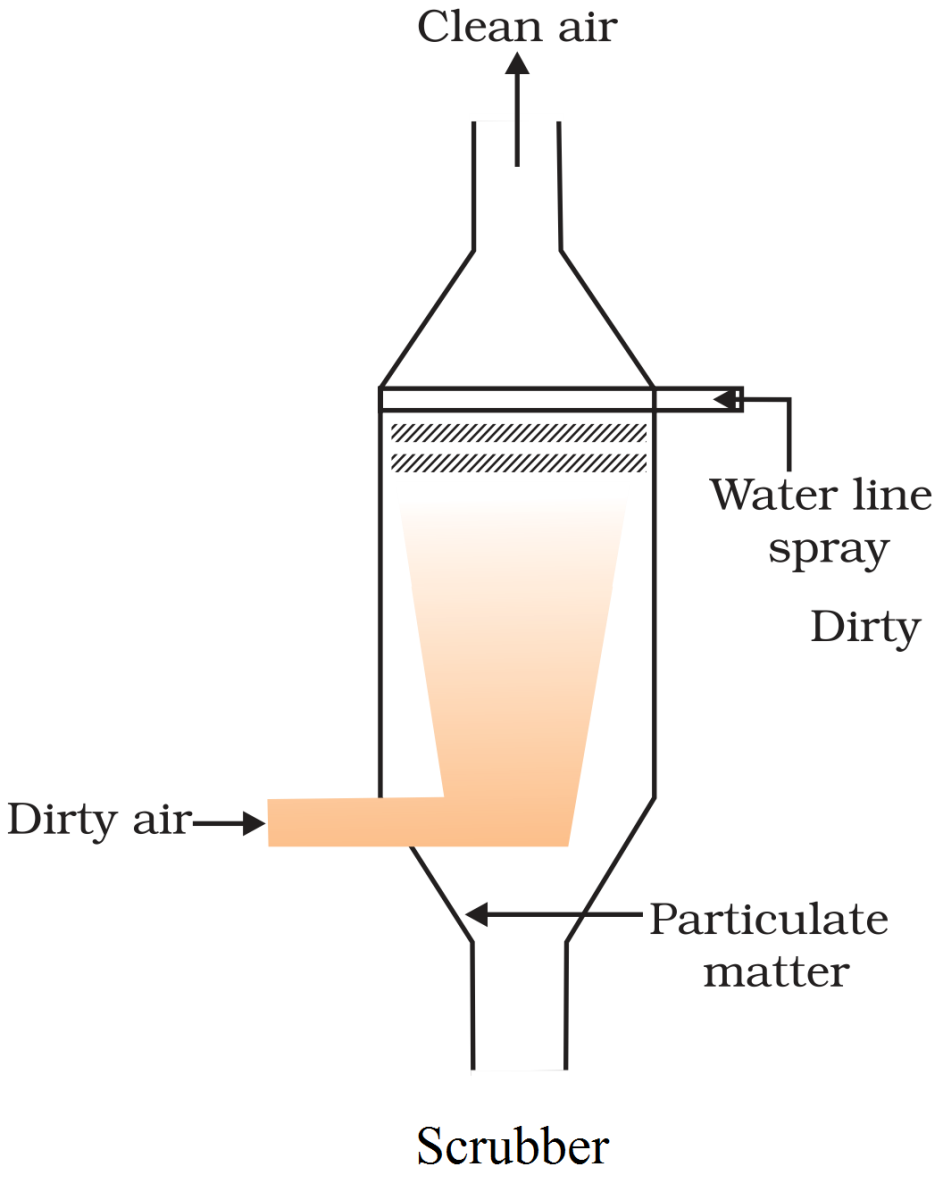
Draw a schematic labelled sketch of a scrubber and mention its use to remove pollutants.
Answer
Scrubber:
  • It is used to remove gases like sulphur dioxide from industrial exhaust.
  • The exhaust is passed through a spray of water or lime.
  • Water dissolves the gases and lime reacts with sulphur dioxide to form a precipitate of calcium sulphate or sulphite.
View full question & answer
Question 683 Marks
State the function of catalytic converter in automobile. Name any two metals used in these converters.
Answer
Catalytic converters are fitted into automobiles (major cause ofair pollution in metro cities) for reducing emissions of poisonous gases like CO and $NO_2$. They are made with expensive metals like platinum-palladium and rhodium as catalysts.As the exhaust passes through catalytic converter, following changes occur:
  • Unburnt hydrocarbons get burnt completely into $\mathrm{CO}_2$ and $\mathrm{H}_2 \mathrm{O}$.
  • Carbon monoxide and nitric oxide are convened into $\mathrm{CO}_2$ and $\mathrm{N}_2$ gases, respectively.
Motor vehicles equipped with catalytic converter should use unleaded petrol, as lead present in petrol inactivates the catalyst.
View full question & answer
Question 693 Marks
A factory drains its waste water into the nearby lake. It has caused algal bloom.
How was the algal bloom caused?
Answer
Algal bloom is caused due to large amounts of nutrients present in the waste water.
View full question & answer
Question 703 Marks
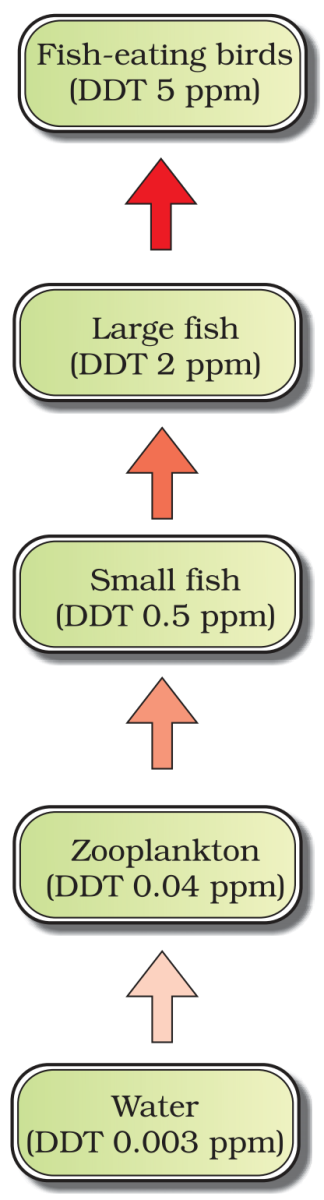
Match the DDT concentration in Column I with the organisms in an aquatic food chain in Coulmn II.
S. No. Column I S. No. Column II
A. 0.04ppm i. Large fish
B. 2.0ppm ii. Zooplanktons
C. 0.5ppm iii. Fish-eating birds
D. 25ppm iv. Small fish
Answer
S. No.
Column I
S. No.
Column II
A.
0.04ppm
ii.
Zooplanktons
B.
2.0ppm
i.
Large fish
C.
0.5ppm
iv.
Small fish
D.
25ppm
iii.
Fish-eating birds
View full question & answer
Question 713 Marks
A factory drains its waste water into the nearby lake. It has caused algal bloom.
What would be the consequences?
Answer
It causes deterioration of water quality and increased fish mortality rate. Some bloom forming algae are toxic to human beings and animals.
View full question & answer
Question 723 Marks
Since October 02, 2014 'Swachh Bharat Abhiyan' has been launched in our country.
  1. Write your views on this initiative giving justification.
  2. As a biologist name two problems that you may face while implementing the programme in your locality.
  3. Suggest two remedial methods to overcome these problems.
Answer
  1. 'Swachh Bharat Abhiyan' is a cleanliness drive launched by Shri Narendra Modi, Prime Minister of India on 2 October 2014. I totally support this campaign. This initiative is needed to solve the sanitation problem and waste management in India. Following this drive all citizens will ensure hygiene across the country. It will spread awareness among people on the importance of clean surroundings. An unclean environment leads to various diseases, different types of pollution and creates a feeling of disgust in the minds of viewer. As a responsible Indian citizen, we all should join this drive with enthusiasm.
  2. Two major problems can be:
  1. Lack of adequate sanitation.
  2. Separation of biodegradable and non-biodegradable substances, so that they can be treated properly.
  1. Two remedial measures to overcome these problems are:
  1. Large number of toilets need to be constructed and people should be made aware about the importance of proper sanitation.
  2. Separate bins have to be installed for biodegradable and non-biodegradable substances.
View full question & answer
Question 733 Marks
Delhi Municipality has started the concept of keeping two dustbins of two different colours (green and blue) in many places, for waste disposal.
  1. What is the significance of this practice?
  2. Differentiate between the two types of wastes we produce. Which of them is more harmful and must be reduced significantly?
  3. What value can be learnt from this arrangement?
Answer
  1. Two dustbins of different colours are meant for separating the two types of wastes.
  2. Two types of wastes are:
  • Biodegradable wastes in the green dustbin).
  • Non-biodegradable wastes (in the blue dustbin).
Biodegradable wastes
Non-biodegradable wastes
These are the wastes which can be broken down into simpler, harmless, (sometimes useful) substances by the action of living organisms through decomposition.
These are the wastes which cannot be broken down into simpler or harmless substances by the action of living organisms.
  • Non-biodegradable wastes are more harmful, as they tend to remain as such for many years on the surface of earth; this type of wastes must be reduced significantly.
  1. Non-biodegradable wastes must be reduced. Biodegradable wastes can be used for various purposes so as to reduce pressure on natural resources.
  • Pollution from non-biodegradable wastes can be reduced.
View full question & answer
3 Marks Question - Page 2 - BIOLOGY STD 12 Science Questions - Vidyadip