Question 511 Mark
Account for the following:
Methylamine in water reacts with ferric chloride to precipitate hydrated ferric oxide.
AnswerDue to the +I effect of $-CH_3$ group, methylamine is more basic than water. therefore, in water methylamine produces $OH^-$ ions by accepting $H^+$ions form water.
Methyl amine is a base and dissolves in water to produce hydroxide ions.
$CH_3 NH_2 + H_2O ⇌ CH_3 NH_3^⊕ + OH^Θ$
$FeCl_3$ combines with $OH^-$ ions to give reddish brown precipitate of $Fe(OH)_3$
$FeCl_3 + 3OH^-→ Fe(OH)_3$
View full question & answer→Question 521 Mark
Write IUPAC names of the following compounds and classify them into primary, secondary and tertiary amines.
$(CH3)_3CNH_2$
Answer$(CH_3)_3CNH_2$
Tert-butylamine (primary amine)
View full question & answer→Question 531 Mark
Account for the following:
Ethylamine is soluble in water whereas aniline is not.
AnswerIn $C_2H_5NH_2,$ the $C_2H_5$ group has $a + I$ effect and increases the electron density on N atom.
This results in stronger intermolecular H-bonding.
While in $C_6H_5NH_2$ due to resonance, N acquires a +ve charge and electron density on N decreases.
The tendency to form H-bonding diminishes.
Hence, ethylamine is soluble while $C_6H_5NH_2$ is insoluble.
View full question & answer→Question 541 Mark
Give one chemical test to distinguish between the following pairs of compounds.
Aniline and benzylamine.
AnswerAniline and benzylamine: Add $NaNO_2$ and HCl to each separately. Cool, it to $0-5^\circ C$.
Then add an alkaline solution of phenol. Orange azo dye is formed in aniline.
Benzylamine $(C_6H_5CH_2NH_2)$ does not form an azo dye.
View full question & answer→Question 551 Mark
How will you convert?
Benzene into aniline.
Question 561 Mark
How will you convert?
$Cl – (CH_2)_4 –Cl$ into hexan-1, 6 - diamine?
Answer$\text{Cl}-(\text{CH}_2)_4-\text{Cl}\xrightarrow[]{\text{Ethanolic NaCN}}\text{N}\equiv\text{C}-(\text{CH}_4)-\text{C}\equiv\text{N}\\ \ \ \ \ \ \ \ \ \ \ \ \ \ \ \ \ \ \ \ \ \ \ \ \ \ \ \ \ \ \ \ \ \ \ \ \ \ \ \ \ \ \ \ \ \ \ \ \ \ \ \ \ \ \ \ \ \ \ \ \ \ \ \ \ \ \ \ \ \ \ \ \ \ \ \ \ \Bigg\downarrow{\text{H}_2/\text{Ni}}\\ \ \ \ \ \ \ \ \ \ \ \ \ \ \ \ \ \ \ \ \ \ \ \ \ \ \ \ \ \ \ \ \ \ \ \ \ \ \ \ \ \ \ \ \ \ \ \text{H}_2\text{N}-\text{CH}_2-(\text{CH}_2)_4-\text{CH}_2-\text{NH}_2\\ \ \ \ \ \ \ \ \ \ \ \ \ \ \ \ \ \ \ \ \ \ \ \ \ \ \ \ \ \ \ \ \ \ \ \ \ \ \ \ \ \ \ \ \ \ \ \ \ \ \ \ \ \ \ \ \ \ \ \text{Hexane- 1,6-diamine}$
View full question & answer→Question 571 Mark
Give one chemical test to distinguish between the following pairs of compounds. Secondary and tertiary amines
Answer
Shake the given amines separately with Hinsberg’s reagent (benzene sulphonyl chloride) in the presence of an excess of aqueous KOH solution.
A secondary amine forms N, N—dialkyl benzene sulphonamide which remains insoluble in aqueous KOH and even after acidification with dilute HCl.
A tertiary amine does not react with benzene sulphonyl chloride and remains
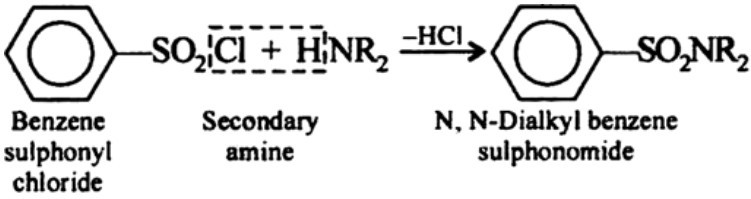
insoluble in aqueous KOH.
View full question & answer→Question 581 Mark
Write IUPAC name of the following compounds and classify them into primary, secondary and tertiary amines.
$(CH_3CH_2)_2NCH_3$
Answer$(CH_3CH_2)_2 NCH_3$
N - Ethyl - N - methylethanamine (3° amine)
View full question & answer→Question 591 Mark
Write IUPAC name of following and classify them into primary, secondary, tertiary amines:
$(CH_3)_2CHNH_2$
Answer$(CH_3)_2CHNH_2:$
1-Methylethanamine (1° amines)
View full question & answer→Question 601 Mark
Convert 3-Methylaniline into 3-nitrotoluene.
Question 611 Mark
Arrange the following in increasing order of their basic strength:
$CH_3NH_2, (CH_3)_2NH, (CH_3)_3N, C_6H_5NH_2, C_6H_5CH_2NH_2$
Answer$C_6H_5NH_2 < C_6H_5CH_2NH_2 < (CH_3)_3 N < CH_3NH_2 < (CH_3)_2NH$
View full question & answer→Question 621 Mark
Give one chemical test to distinguish between the following pairs of compounds.
Aniline and N-methylaniline.
AnswerAniline and N—Methylaniline Carbylamine test: Heat both the compounds separately with chloroform and alcoholic KOH. The compound which gives an unpleasant or offensive smell in aniline while the compound which does not give any smell is N-Methylaniline.
$\text{C}_6\text{H}_5\text{NH}_2+\text{CHCl}_3+3\text{KOH}\xrightarrow[\ \ \ \ \ \ \ \ \ \ \ \ \ ]{\text{Heat}}\text{C}_6\text{H}_5\stackrel{{\rightarrow}}{{=}}\text{C}\\\text{Aniline}\ \ \ \ \ \ \ \ \ \ \ \ \ \ \ \ \ \ \ \ \ \ \ \ \ \ \ (\text{alc})\ \ \ \ \ \ \ \ \ \text{Phenyl isocyanide}\\ \ \ \ \ \ \ \ \ \ \ \ \ \ \ \ \ \ \ \ \ \ \ \ \ \ \ \ \ \ \ \ \ \ \ \ \ \ \ \ \ \ \ \ \ \ \ \ \ \ \ \ \ \ \ \ \ \ \ (\text{Offencive smell})\\ \ \ \ \ \ \ \ \ \ \ \ \ \ \ \ \ \ \ \ \ \ \ \ \ \ \ \ \ \ \ \ \ \ \ \ \ \ \ \ \ \ \ \ \ \ \ \ \ \ \ \ \ \ \ +3\text{KCl}+3\text{H}_2\text{O}$
$\text{C}_6\text{H}_5\text{NHCH}_3+\text{CHCl}_3+3\text{KOH}\xrightarrow[\ \ \ \ \ \ \ \ \ \ \ \ \ ]{\text{Heat}}\text{No smell}.\\\text{N-methyl}\ \ \ \ \ \ \ \ \ \ \ \ \ \ \ \ \ \ \ \ \ \ \ (\text{alc}) \ \ \ \ \ \ \ \ \ \ \ \ \ \ \ \ \ \ \ \ \ \ \ \ \\\ \ \ \ \ \text{aniline}\ \ \ \ \ \ \ \ \ \ \ \ \ \ \ \ \ \ \ \ \ \ \ \ \ \ \ \ \ \ \ \ \ \ \ \ \ \ \ \ \ \ \ \ \ \ \ \ \ \ \ \ \ \ \ \ \ \ \ \ \ \ \ \ \ \ \ $
View full question & answer→Question 631 Mark
The conversion of primary aromatic amines into diazonium salts is known as ___________.
Question 641 Mark
Write the structure of n-methy-lethanamine.
Question 651 Mark
Rearrange the following in an increasing order of their basic strengths:
$C_6H_5NH_2, C_6H_5N(CH_3)_2, (C_6H_5)_2NH$ and $CH_3NH_2.$
Answer$(C_6H_5)_2NH < C_6H_5NH_2 < C_6H_5N(CH_3)_2 < CH_3NH_{2.}$
View full question & answer→Question 661 Mark
Arrange the following compounds in an increasing order of basic strengths in their aqueous solutions:
$NH_3, CH_3NH_2, (CH_3)_3NH, (CH_3)_3N.$
Answer$NH_3 < (CH_3)_3N < CH_3NH_2 < (CH_3)_2NH.$
View full question & answer→Question 671 Mark
Why do amines react as nucleophiles?
AnswerDue to the presence of lone pair of electrons on the nitrogen atom.
View full question & answer→Question 681 Mark
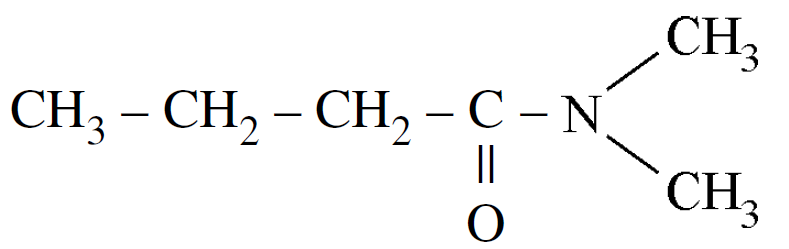
Write the IUPAC name of the given compound.
Question 691 Mark
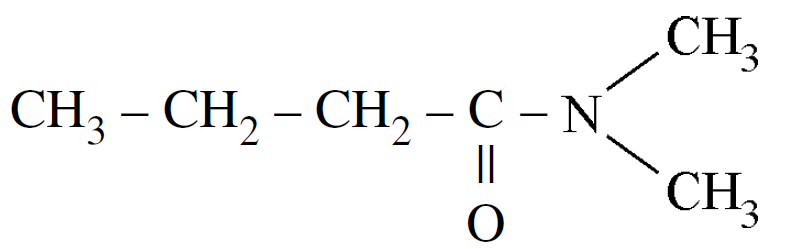
Write the IUPAC name of the given compound.
Question 701 Mark
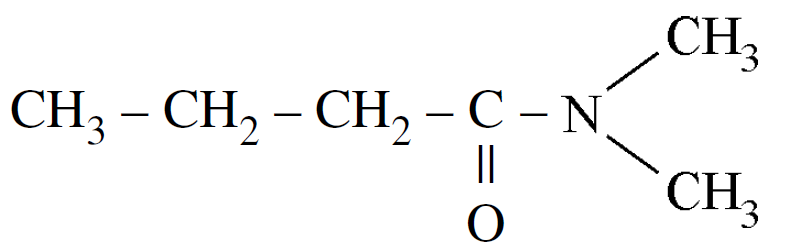
Write the IUPAC name of the given compound.
Question 711 Mark
Write the IUPAC name of the given compound:
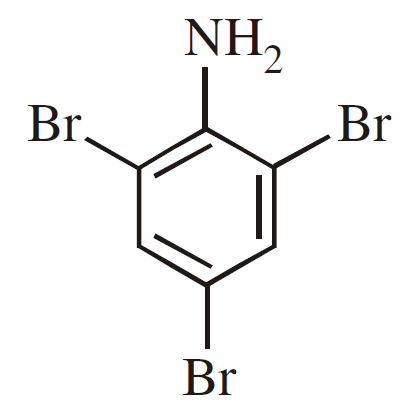
Answer2,4,6-Tribromoaniline/2,4,6-Tribromobenzenamine.
View full question & answer→Question 721 Mark
Write the IUPAC name of the given compound:
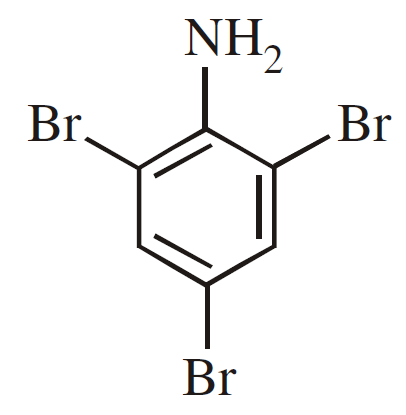
Answer2,4,6-Tribromoaniline/2,4,6-Tribromobenzenamine.
View full question & answer→Question 731 Mark
Write IUPAC name of the following compound:
$(CH_3CH_2)_2NCH_3$
AnswerN-Ethyl-N-methylethanamine.
View full question & answer→Question 741 Mark
Write the IUPAC name of the given compound:
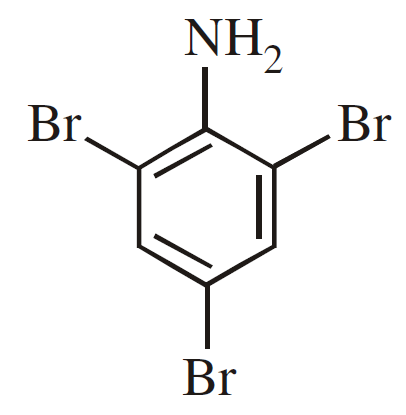
Answer2,4,6-Tribromoaniline/2,4,6-Tribromobenzenamine.
View full question & answer→Question 751 Mark
Arrange the following compounds in increasing order of solubility in water:
$C_6H_5NH_2, (C_2H_5)_2NH, C_2H_5NH_{2.}$
Answer$C_6H_5NH_2 < (C_2H_5)_2NH2H_5NH_{2.}$
View full question & answer→Question 761 Mark
Arrange the following in increasing order of their basic strength in aqueous solution:
$CH_3.NH_{2,} (CH_3)_3N, (CH_3)_2NH$
Answer$(CH_3)_3N3NH_2<(CH_3)_2NH.$
View full question & answer→Question 771 Mark
Arrange the following in the decreasing order of their basic strength in aqueous solutions:
$CH_3NH_2, (CH_3)_2NH, (CH_3)_3N$ and $NH_3.$
Answer$(CH_3)_2NH > CH_3NH_2 > (CH_3)_3N > NH_3.$
View full question & answer→Question 781 Mark
Give the IUPAC name of $H_2N-CH_2–CH_2-CH=CH_2.$
View full question & answer→Question 791 Mark
Why is an alkylamine more basic than ammonia?
AnswerDue to electron donating nature of alkyl group or +I effect.
View full question & answer→Question 801 Mark
Write a chemical reaction in which the iodide ion replaces the diazonium group in a diazonium salt.
Answer$C_6H_5N_2^+Cl^- + KI → C_6H_5I + KCl + N_2.$
View full question & answer→Question 811 Mark
Why do nitro compounds have high boiling points in comparison with other compounds of same molecular mass?
AnswerBecause of polar nature, they are much more strongly associated.
View full question & answer→Question 821 Mark
Give a chemical test to distinguish between aniline and N-methyl aniline.
AnswerAdd chloroform and KOH and heat. Aniline forms pungent smelling isocyanide.
View full question & answer→Question 831 Mark
Complete the following reaction:$\text{C}_6\text{H}_5\text{N}_2\text{Cl}+\text{C}_2\text{H}_5\text{OH}\rightarrow$
Answer$ \ \ \ \ \ \ \ \ \ \ \ \ \text{C}_6\text{H}_5\text{N}_2\text{Cl} \ \ + \ \ \ \text{C}_2\text{H}_5\text{OH}\rightarrow\text{C}_6\text{H}_6+\text{CH}_3\text{CHO}+\text{N}_2+\text{HCl}\\\text{Benzenediazonium} \ \ \ \ \ \ \ \text{Ethanol} \ \ \ \ \ \ \ \text{Benzene} \ \ \ \ \ \text{Ethanal}\\ \ \ \ \ \ \ \ \ \ \ \ \text{Cloride}$
View full question & answer→Question 841 Mark
Suggest a route by which the following conversion can be accomplished.
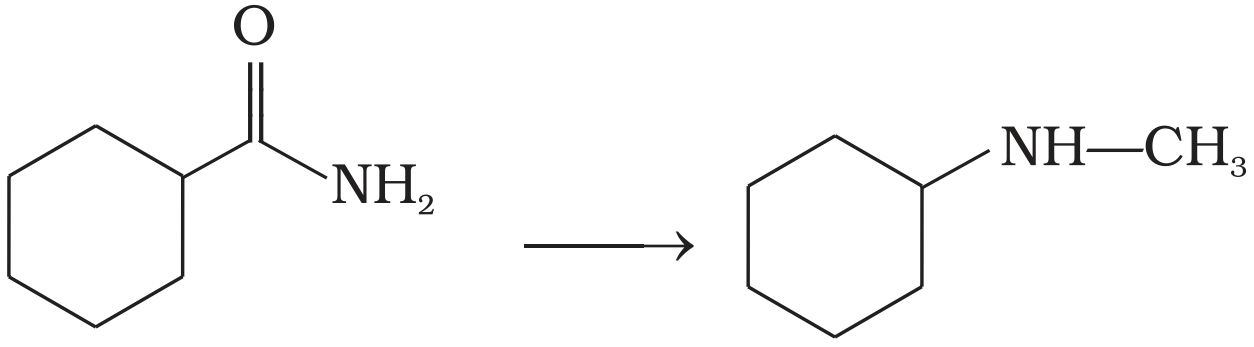
Question 851 Mark
What type of bonding helps in stabilising the $\alpha$ - helix structure of protins.
AnswerIn the $\alpha$ - helix configuration, a polypeptide chain forms all possible hydrogen bonds by twisting into a right handed screw (helix) with -NH group of each amino acid residue hydrogen to the bonded $ \ \ \ \ \ \text{O}\\ \ \ \ \ \ ||\\ -\text{C}-$of an adjacent turn of the helix.
View full question & answer→Question 861 Mark
What is the product when $C_6H_5CH_2NH_2$ reacts with $HNO_2?$
Answer$\text{C}_6\text{H}_5\text{CH}_2\text{NH}_2+\text{HONO}\xrightarrow{\ \text{HCl}\ \ }\text{C}_6\text{H}_5\text{CH}_2\text{OH}+\text{N}_2+\text{H}_2\text{O}\\\text{Benzyl amine}\ \ \ \ \ \ \ \ \ \ \ \ \ \ \ \ \ \ \ \ \ \ \ \ \ \ \ \ \ \ \text{Benzyl alohol}$
View full question & answer→Question 871 Mark
What is the role of $HNO_3$ in the nitrating mixture used for nitration of benzene?
Answer$HNO_3$ acts as a base in the nitrating mixture $(HNO_3 + H_2SO_4)$ and provides the electrophile.$\text{HNO}_3+\text{H}_2\text{SO}_4\xrightarrow{\ \ \ \ \ \ \ \ }\text{NO}_2^++\text{HSO}_4^-+\text{H}_2\text{O}\\\ \ \ \ \ \ \ \ \ \ \ \ \ \ \ \ \ \ \ \ \ \ \ \ \ \ \ \ \ \ \ \ \ \ \ \ \ \ \ \text{Electrofile}$
View full question & answer→Question 881 Mark
Arrange the following compounds in the order of property indicated for each set:
Methylamine, dimethylamine, aniline, N-methylaniline (increasing order of their acid strength).
AnswerThe acid strength increases in the reverse order of their basic strength, i.e.,
Dimethylamine < methylamine < N-methylaniline < aniline.
View full question & answer→Question 891 Mark
Explain why $MeNH_2$ is stronger base than $MeOH?$
AnswerNitrogen is less electronegative than oxygen, therefore, lone pair of electrons on nitrogen is readily available for donation. Hence, $MeNH_2$ is more basic than $MeOH.$
View full question & answer→Question 901 Mark
Give an example of a zwitter ion.
Answer
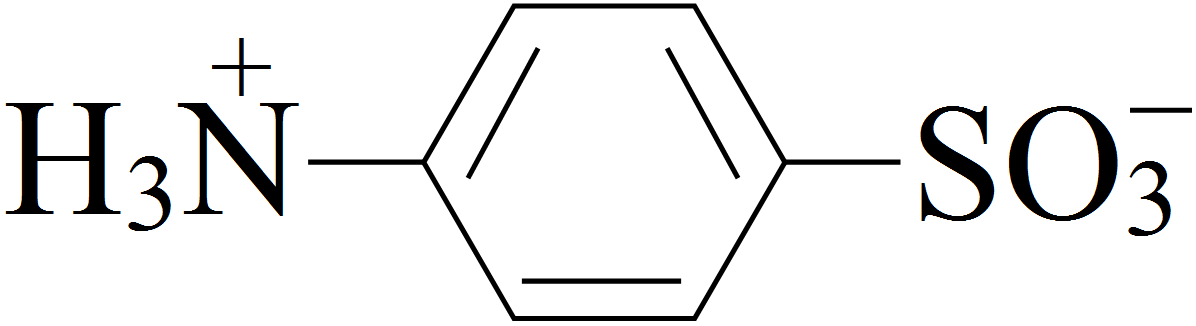
sulphanilic acid.
View full question & answer→Question 911 Mark
Predict the product of reaction of aniline with bromine in non-polar solvent such as $CS_2.$
Answer
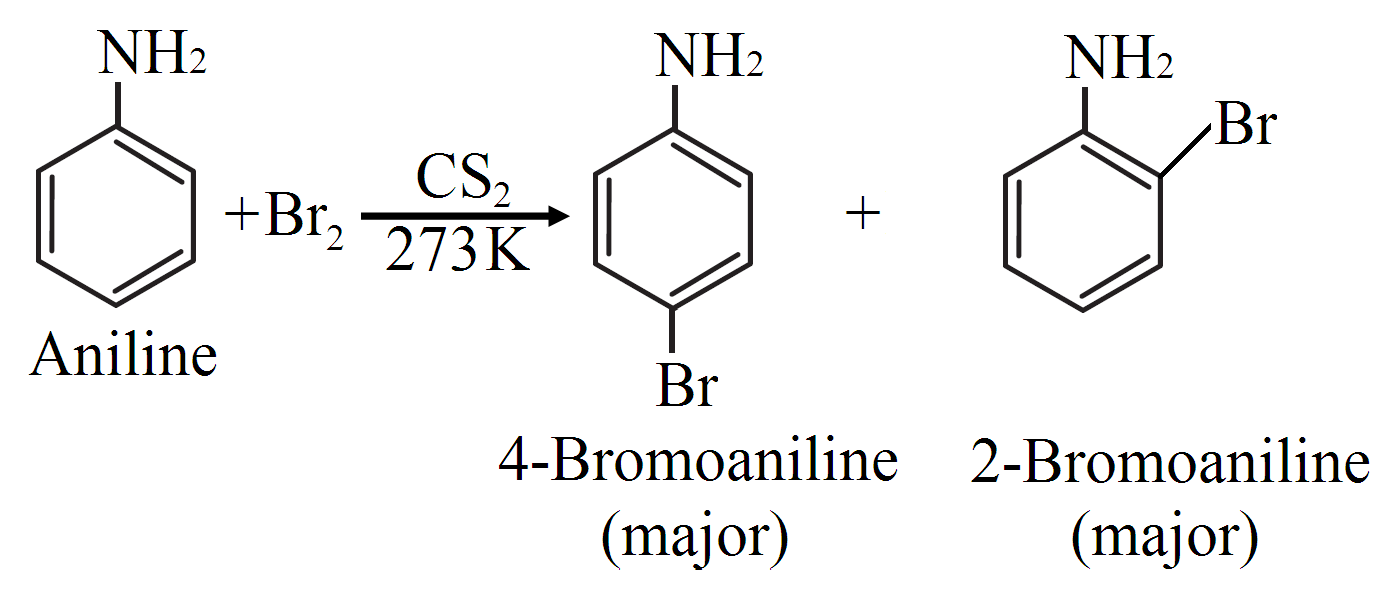
In non-polar solvent $($such as $CS_2)$ the activating effect of $-NH_2$ group is reduced (due to resonance) and
hence, mono substitution occurs only at o-and p-positions. View full question & answer→Question 921 Mark
Why do amines behave as nucleophiles?
AnswerDue to the presence of a lone pair of electrons on nitrogen atom, amines behave as nucleophiles.
View full question & answer→Question 931 Mark
Give the structure of 'A' in the following reaction.
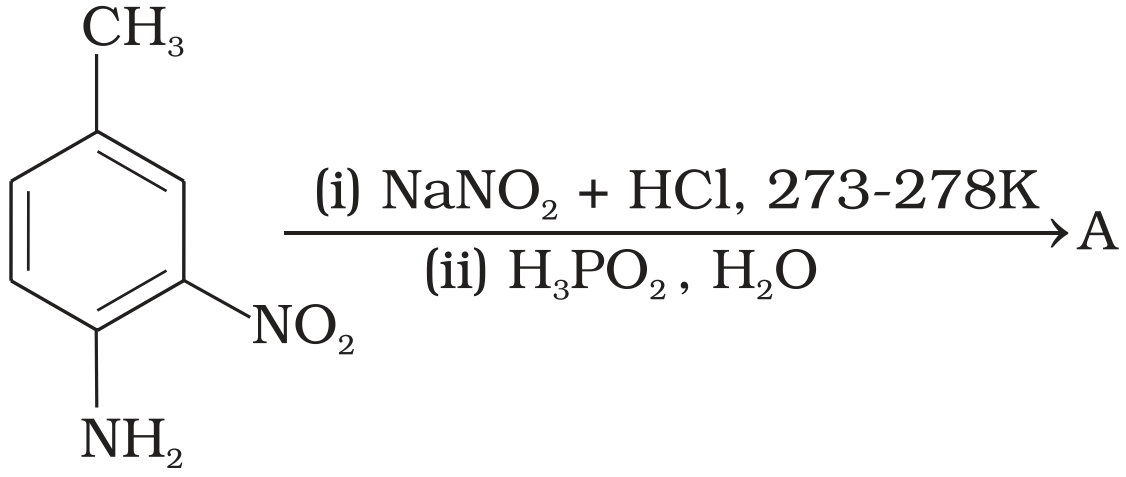
Question 941 Mark
Identify A and B in the following reaction.
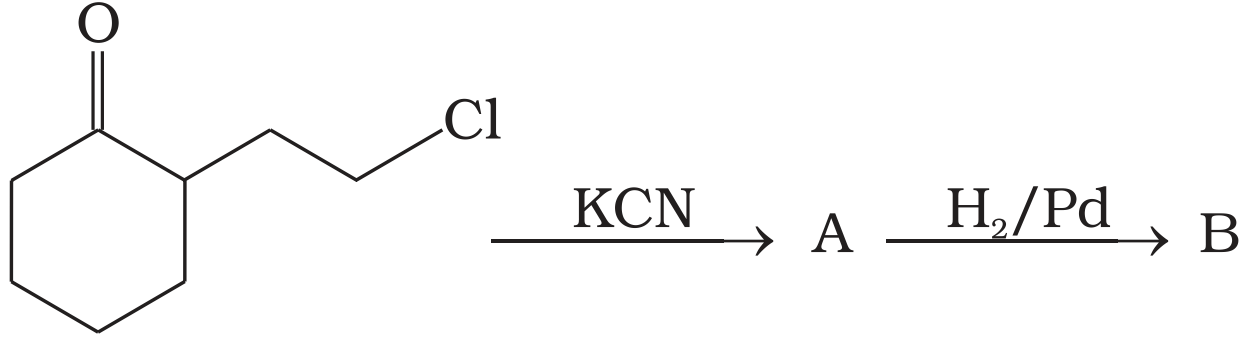
Question 951 Mark
Complete the following reaction:$\text{C}_6\text{H}_5\text{NH}_2+(\text{CH}_3\text{CO})_2\text{O}\rightarrow$
Answer$\text{C}_6\text{H}_5\text{NH}_2+(\text{CH}_3\text{CO})_2\text{O}\rightarrow\text{C}_6\text{H}_5-\text{N}-\text{C}-\text{CH}_3+\text{CH}_3\text{COOH}\\\text{Aniline} \ \ \ \ \ \ \ \ \text{acitic anhydride} \ \ \ \ \ \ \ \ \ \ \ \ \ \ \ \ \ | \ \ \ \ \ \ ||\\ \ \ \ \ \ \ \ \ \ \ \ \ \ \ \ \ \ \ \ \ \ \ \ \ \ \ \ \ \ \ \ \ \ \ \ \ \ \ \ \ \ \ \ \ \ \ \ \ \ \ \ \ \ \ \ \ \ \ \ \ \ \ \ \ \text{H} \ \ \ \ \ \text{O}\\ \ \ \ \ \ \ \ \ \ \ \ \ \ \ \ \ \ \ \ \ \ \ \ \ \ \ \ \ \ \ \ \ \ \ \ \ \ \ \ \ \ \ \ \ \ \ \ \ \ \ \ \ \ \ \ \ \ \text{N}-\text{Phenylethanamide}$
View full question & answer→Question 961 Mark
Complete the following reaction:$\text{C}_6\text{H}_5\text{N}_2\text{Cl}\xrightarrow[(\text{ii})\text{NaNO}_2/\text{Cu}.\Delta]{(\text{i})\text{HBF}_4}$
Answer$\text{C}_6\text{H}_5\text{N}_2\text{Cl}\xrightarrow[(\text{ii})\text{NaNO}_2/\text{Cu}.\Delta]{(\text{i})\text{HBF}_4}\text{C}_6\text{H}_5\text{NO}_2+\text{N}_2+\text{NaBF}_4\\\text{Benzenediazonium} \ \ \ \ \ \ \ \ \ \ \ \ \text{Nitrobenzene}\\ \ \ \ \ \ \ \text{chloride}$
View full question & answer→Question 971 Mark
Convert Aniline into p-nitroaniline.
Question 981 Mark
Complete the following reaction:$\text{C}_6\text{H}_5\text{NH}_2+\text{H}_2\text{SO}_4(\text{conc.})\rightarrow$
Answer$\text{C}_6\text{H}_5\text{NH}_2+\text{conc}.\text{H}_2\text{SO}_4\rightarrow\text{C}_6\text{H}_5\stackrel{{+}}{{\text{N}}}\text{H}_3\text{HS}\stackrel{{-}}{{\text{O}_4}}\\\text{Aniline} \ \ \ \ \ \ \ \ \ \ \ \ \ \ \ \ \ \ \ \ \ \ \ \ \ \ \ \ \ \ \ \ \text{Anilinium hydrogen sulphate}$
View full question & answer→Question 991 Mark
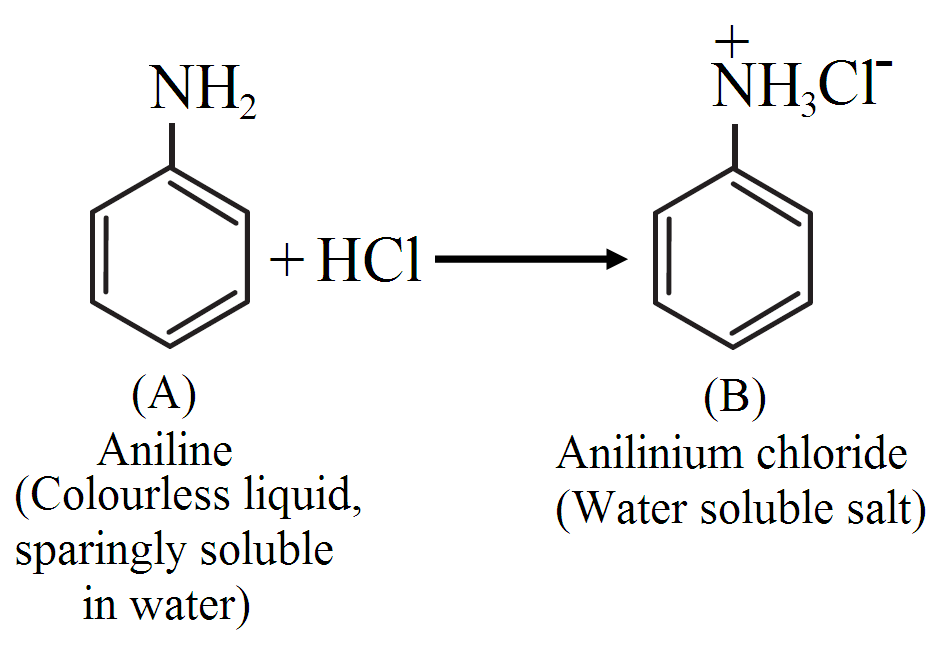
Why is aniline soluble in aqueous HCl?
Answer
Aniline forms the salt anilinium chloride which is water soluble.
View full question & answer→Question 1001 Mark
Complete the following reaction:$\text{C}_6\text{H}_5\text{N}_2\text{Cl}+\text{H}_3\text{PO}_2+\text{H}_2\text{O}\rightarrow$
Answer$\text{C}_6\text{H}_5\text{N}_2\text{Cl}+\text{H}_3\text{PO}_2+\text{H}_2\text{O}\rightarrow\text{C}_6\text{H}_6+\text{N}_2+\text{H}_3\text{PO}_3+\text{HCl}\\\text{Benzenediazonium} \ \ \ \ \ \ \ \ \ \ \ \ \ \ \ \ \ \ \ \ \ \text{Benzene}\\\text{Cloride}$
View full question & answer→