Questions · Page 3 of 4

M.C.Q (1 Marks)

MCQ 1011 Mark
The process of vulcanization was introduced by $......$
  • Charles Goodyear
  • B
    Kolbe
  • C
    Wohler
  • D
    Zeigher
Answer
Correct option: A.
Charles Goodyear
Charles Goodyear invented vulcanization process in $1839.$
Vulcanisation is a process involving heating of rubber with sulphur is called vulcanisation.
View full question & answer
MCQ 1021 Mark
Which polymer among the following polymers does $\text{NOT}$ soften on heating?
  • Bakelite
  • B
    Polythene
  • C
    Polystyrene
  • D
    $\text{PVC}$
Answer
Correct option: A.
Bakelite
Thermoplastics:
A plastic material, which can be repeatedly melted$-$molded again and again by simple heating, is called a thermoplastic. Thermoplastics become soft and moldable on heating. They can then be recast in different shapes and cooled. On cooling the thermoplastic material hardens.
Polyethylene, polystyrene and $\text{PVC}$ are examples.
Thermosetting plastics:
A plastic material, which cannot be repeatedly melted$-$molded again, is called a thermosetting plastic.thermosetting plastics do not become soft on heating and they do not change their shape on heating.
Bakelite is one example of a thermosetting plastic.
View full question & answer
MCQ 1031 Mark
Which of the following is/are true statement$(s)$ for the preparation of Teflon?
  • A
    It is produced by condensation polymerization.
  • Water acts as catalyst.
  • C
    The monomer used is tetrafluoroethane.
  • D
    The monomer is obtained from carbon tetrachloride.
Answer
Correct option: B.
Water acts as catalyst.
It is produced by addition polymerization. Water acts as a catalyst. The monomer used is tetrafluoroethylene. It is obtained from chloroform.
The option $(B)$ represents a true statement for the preparation of Teflon.
View full question & answer
MCQ 1041 Mark
The following are synthetic polymers except:
  • A
    Teflon
  • B
    Terylene
  • C
    Nylon
  • Proteins
Answer
Correct option: D.
Proteins
Proteins are natural polymers. Rest of them are synthetic polymers.
View full question & answer
MCQ 1051 Mark
Polyester is made up of the repeating units of a chemical called:
  • Ester
  • B
    Ether
  • C
    Cotton
  • D
    Ethene
Answer
Correct option: A.
Ester
Polyester is a man$-$made or synthetic fibre made up of repeating units of a chemical substance called esters.
Esters are sweet smelling compounds, which are primarily made of carbon, hydrogen, and oxygen.
View full question & answer
MCQ 1061 Mark
Which of the following is not a polymer?
  • Ice
  • B
    Starch
  • C
    Protein
  • D
    Cellulose
Answer
Correct option: A.
Ice
Ice is not a polymer. Whereas all the others are polymers of glucose and/or fructose.
View full question & answer
MCQ 1071 Mark
Natural rubber is obtained as 'latex', which is a milky, white fluid from rubber trees. Latex is a:
  • A
    Mixture of rubber and gum
  • Colloidal dispersion of rubber in water
  • C
    Solution of rubber in water
  • D
    Paste of rubber, clay and water
Answer
Correct option: B.
Colloidal dispersion of rubber in water
Natural rubber latex is basically a colloidal dispersion of rubber hydrocarbon in an aqueous medium. Ammonium and potassium alums are used as a coagulant in latex.
View full question & answer
MCQ 1081 Mark
For natural polymers$, \text{PDI}$ is generally $.......$
  • A
    $0$
  • $1$
  • C
    $100$
  • D
    $1000$
Answer
Correct option: B.
$1$
For natural polymers$, \text{PDI}\ ($Polydispersity Index$)$ is generally equal to $1,$ which means that they are monodisperse. Such polymers are more homogeneous.
View full question & answer
MCQ 1091 Mark
Dacron is an example of a/an:
  • A
    Elastomer
  • Fibre
  • C
    Thermoplastic
  • D
    Thermosetting polymer
Answer
Correct option: B.
Fibre
Fibres are thread forming solids which possess high tensile strength.
Dacron is formed by the interaction of ethylene glycol and terephthalic acid.
View full question & answer
MCQ 1101 Mark
Synthetic fibres are synthesized from raw material called:
  • A
    Polyester
  • Polymers
  • C
    Polythene
  • D
    Polycot
Answer
Correct option: B.
Polymers
Synthetic fibres are synthesized from a raw material called polymers.
View full question & answer
MCQ 1111 Mark
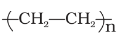
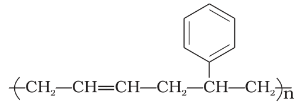
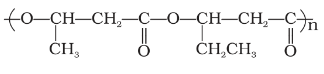
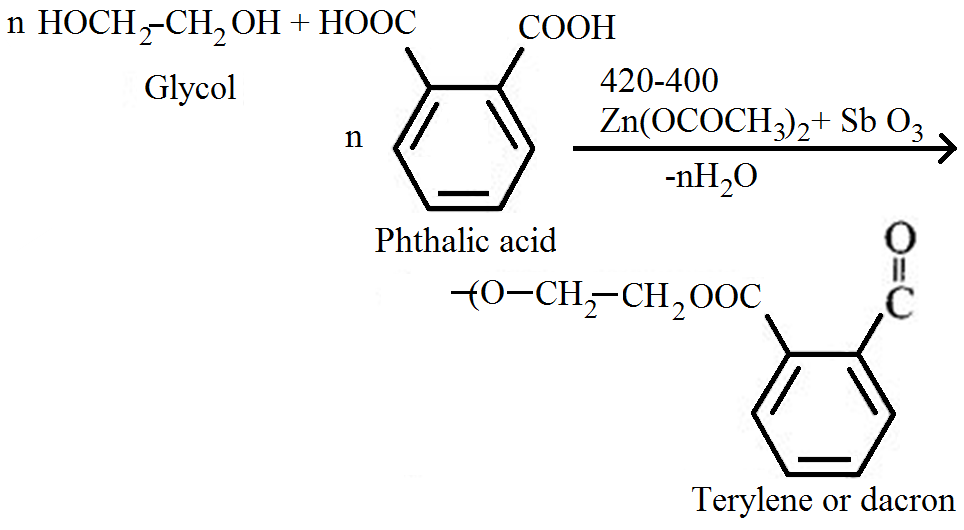
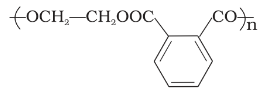
In which of the following polymers ethylene glycol is one of the monomer units?
  • B
  • C
  • D
Answer
Correct option: A.


Given polymer can be obtained condensation polymerization of ethylene glycol and phthalic acid with the elimination of water molecule.

View full question & answer
MCQ 1121 Mark
'Guttapercha' is a tough, crystalline, thermoplastic. It is:
  • An isomer of natural rubber
  • B
    A synthetic rubber
  • C
    A type of nylon sheet
  • D
    The thread of terylene
Answer
Correct option: A.
An isomer of natural rubber
Guttapercha is a tough plastic substance obtained from the latex of several trees.
Guttapercha is also called as polyterpene$-$ a polymer of isoprene or polyisoprene.
Guttapercha is a thermoplastic of natural rubber $($isoprene$).$
It is an excellent non$-$conductor and is used in insulating marine and underground cables.
View full question & answer
MCQ 1131 Mark
A condensation polymer among the following polymers is:
  • A
    Teflon
  • B
    Polysterene
  • C
    $\text{PVC}$
  • Dacron
Answer
Correct option: D.
Dacron
Teflon, Polystrene, and $\text{PVC}$ are addition polymers. while Dacron $($also called Terylene$)$ is a condensation polymer. Condensation polymer is defined as a polymer that is formed by the combination of two or more monomer units and the elimination of water takes place.
In dacron, ethylene glycol and terephthalic acid reacts and removal of water molecule takes place,
Hence, dacron is an example of condensation polymer.
View full question & answer
MCQ 1141 Mark
Fishing nets are made of:
  • A
    Rayon
  • B
    Dacron
  • Nylon
  • D
    Viscose rayon
Answer
Correct option: C.
Nylon
Nylon is strong enough to bear heavy weights, extend and then regain its original shape and length, making it very resourceful in fishing nets and also durable.
View full question & answer
MCQ 1151 Mark
The cross$-$linked polymers possess the property of:
  • A
    Being soluble in common organic solvents.
  • B
    Not undergoing change while being heated.
  • C
    Forming a hard mass which can be remoulded.
  • High resistance to heat and mechanical deformation.
Answer
Correct option: D.
High resistance to heat and mechanical deformation.
The cross$-$linked polymers possess the property of high resistance of heat and mechanical deformation.
Cross$-$links are the characteristic property of thermosetting plastic materials.
View full question & answer
MCQ 1161 Mark
The polymer that can be classified as polyester polymer is:
  • A
    Bakelite
  • B
    Melamine
  • C
    Nylon$-6, 6$
  • Terylene
Answer
Correct option: D.
Terylene
View full question & answer
MCQ 1171 Mark
Most balloons, tyres and footballs are made$-$of rubber. This is because rubber is:
  • A
    Naturally available
  • B
    Cheap
  • C
    An electrical insulator
  • Soft and flexible
Answer
Correct option: D.
Soft and flexible
Prior to rubber tires, metal and wood were the materials in use. However it was found that natural Rubber provides better cushioning, makes less noise.
Further rubber deforms under weight /force which results in larger contact patch with the road than with metal/wood tires of same diameter/width.
During cornering at high speeds, the deformation of sidewall and larger contact area improves the traction or grip on the road increasing safety.
View full question & answer
MCQ 1181 Mark
The $S$ in Buna$- S$ refers to:
  • A
    Sulphur
  • Styrene
  • C
    Sodium
  • D
    just a trade name
Answer
Correct option: B.
Styrene
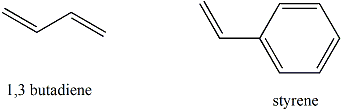
The $S$ in Buna$- S$ refers to styrene. Buna stands for butadiene and $Na$ for sodium.
Buna$-S$ refers to styrene Butadiene Rubber $\text{(SBR)}.$
It is copolymer of buta$-1,3-$diene and styrene in the ratio of $3 : 1$ in the presence of sodium.
View full question & answer
MCQ 1191 Mark
As plastics and synthetic fibers consist of repeating monomer units, they are known as $.........$
  • A
    Polyesters
  • Polymers
  • C
    $Co-$polymers
  • D
    None of the above
Answer
Correct option: B.
Polymers
As plastics and synthetic fibers consist of repeating monomer units, they are known as polymers.
Polymers are macro$-$molecules having high molecular weights and composed of smaller repeating units called monomers.
'Poly' means 'many' and 'meros' means 'part'.
View full question & answer
MCQ 1201 Mark
Which among the following is a polymer of cellulose?
  • A
    Nylon
  • B
    Polyester
  • Cotton
  • D
    Polythene
Answer
Correct option: C.
Cotton
The cotton$-$ball part of the cotton plant has a lot of cellulose. Cellulose makes great fibres.
Due to cellulose, cotton fibres can be twisted into thread and woven into cloth.
Cotton fibres are even found in some fancy kinds of paper, and that makes the paper feel more cloth-like.
View full question & answer
MCQ 1211 Mark
Natural rubber is heated with an element $X$ to make it hard, strong and more elastic$. X$ is:
  • A
    Zinc
  • Sulphur
  • C
    Lead
  • D
    $\mathrm{H}_2$
Answer
Correct option: B.
Sulphur
Natural Rubber is heated in the presence of sulphur. This produces cross$-$linking and leads to a harder material that is markedly more resistant to heat and relatively more elastic. This process is called vulcanization.
View full question & answer
MCQ 1221 Mark
Which of the following are example of synthetic rubber?
$a.$ Polychloroprene.
$b.$ Polyacrylonitrile.
$c.$ Buna$-N.$
$d.$ cis$-$polyisoprene.
  • A
    $a$ and $b$
  • $a$ and $c$
  • C
    $b$ and $c$
  • D
    $b$ and $d$
Answer
Correct option: B.
$a$ and $c$
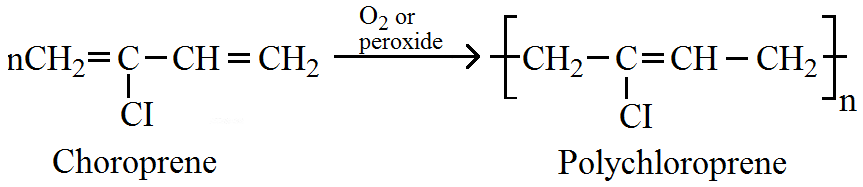
  1. Polychloroprene is a polymer of chloroprene and it is synthetic rubber.
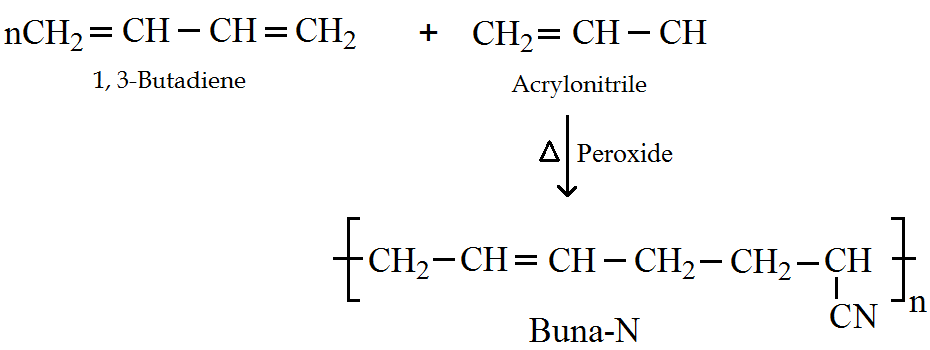
  2. Buna$-N$ is a synthetic rubber made from the polymerisation of $1, 3-$butadiene acrylonitrile.
View full question & answer
MCQ 1231 Mark
Which polymer among the following does not soften on heating?
  • Bakelite
  • B
    Polythene
  • C
    Polystyrene
  • D
    $\text{PVC}$
Answer
Correct option: A.
Bakelite
Bakelite is a highly cross$-$linked thermosetting polymer. It does not soften on heating because it is heat resistant in nature. Remaining other polymers are thermoplastics which gets soften on heating.
View full question & answer
MCQ 1241 Mark
The monomeric repeating units of nylon $- 6$ is:
  • Caprolactam
  • B
    Phenol and formaldehyde
  • C
    Tetrafluoroethylene
  • D
    Butadiene
Answer
Correct option: A.
Caprolactam
Monomer $($repeating unit$)$ of Nylon $- 6$ is caprolactam.
Monomer $($repeating unit$)$ of Nylon $- 6, 6$ is derived from two monomers, hexamethylenediamine, and adipic acid.
View full question & answer
MCQ 1251 Mark
The polymer used in making handles of cookers and frying pans is:
  • Bakelite
  • B
    Nylon$-2-$nylon$-6$
  • C
    Orlon
  • D
    Polyvinyl chloride
Answer
Correct option: A.
Bakelite
The polymer used in making handles of cookers and frying pans is Bakelite.
It is also used in making switches, combs etc. It is phenol formaldehyde polymer.
View full question & answer
MCQ 1261 Mark
Bakelite is formed by:
  • A
    Polymerization of phenol and formaldehyde.
  • B
    Polymerization of alcohol and acetaldehyde.
  • Condensation of phenol and formaldehyde.
  • D
    Condensation of phenol and acetaldehyde.
Answer
Correct option: C.
Condensation of phenol and formaldehyde.
Bakelite is a thermosetting phenol formaldehyde resin, formed from a condensation reaction of phenol with formaldehyde.
View full question & answer
MCQ 1271 Mark
Which compound is condensation polymer?
  • A
    Nylon
  • B
    $\text{PVC}$
  • C
    Natural
  • Teflon
Answer
Correct option: D.
Teflon
Teflon is a condensation polymer.
View full question & answer
MCQ 1281 Mark
Rubber is very soft. Therefore, it is vulcanized and used in tires. Vulcanised rubber resists:
  • A
    Drops of acid rain
  • B
    Cold temperatures
  • C
    Jerking movement
  • Wear and tear due to friction
Answer
Correct option: D.
Wear and tear due to friction
Vulcanization is the process by which rubber molecules are cross linked with each other by heating the liquid rubber with sulphur. Crosslinking increases the strength and elasticity of rubber.
It is very elastic such that it can be stretched reversible.
View full question & answer
MCQ 1291 Mark
Woolen clothes are prepared from:
  • A
    Wool warms
  • B
    Carbon compounds
  • Fleece of sheep
  • D
    Cotton plants
Answer
Correct option: C.
Fleece of sheep
Sheep have soft, woolly coats called a fleece. In the summertime the farmer cuts off the sheep's fleece. The fleece is then spun and made into $\text{WOOL}.$ Clothes made from wool keep us warm.
View full question & answer
MCQ 1301 Mark
Which of the following statements about low density polythene is $\text{FALSE}\ ?$
  • A
    It is a poor conductor of electricity.
  • B
    Its synthesis requires dioxygen or a peroxide initiator as a catalyst.
  • It is used in the manufacture of buckets, dust-bins etc.
  • D
    Its synthesis requires high pressure.
Answer
Correct option: C.
It is used in the manufacture of buckets, dust-bins etc.
Low density polythene is a poor conductor of electricity.
For the preparation of this low density polythene dioxygen or a peroxide initiator is used as a catalyst and its synthesis requires high pressure but it is not used in preparation of buckets, dust$-$bins etc.
The preparation of Low density polythene is exothermic process.
View full question & answer
MCQ 1321 Mark
Bakelite is obtained from phenol by reacting with:
  • A
    $\left(\mathrm{CH}_2 \mathrm{OH}\right)_2$
  • B
    $\mathrm{CH}_3 \mathrm{CHO}$
  • C
    $\mathrm{CH}_3 \mathrm{COCH}_3$​
  • $\text{HCHO}$
Answer
Correct option: D.
$\text{HCHO}$
Bakelite was the first plastic made from synthetic components.
It is a thermosetting phenol formaldehyde resin, formed from a condensation reaction of phenol $\left(\mathrm{C}_6 \mathrm{H}_5 \mathrm{OH}\right)$ with formaldehyde $\text{(HCHO)}.$
 
View full question & answer
MCQ 1331 Mark
Acrylonitrile, butadiene and styrene are a kind of:
  • A
    Addition polymer
  • $Co -$ polymer
  • C
    Homopolymer
  • D
    Thermosetting polymer
Answer
Correct option: B.
$Co -$ polymer
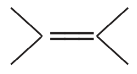
$\text{ABS}$ or acrylonitrile, butadiene and styrene are a common thermoplastic polymer formed by copolymerization of these three monomers as shown.
Acrylonitrile, butadiene and styrene are a kind of:
View full question & answer
MCQ 1341 Mark
What is the monomer unit of natural rubber?
  • Isoprene
  • B
    Ethene
  • C
    Neoprene
  • D
    Tetrafluro ethene
Answer
Correct option: A.
Isoprene
Isoprene $(2-$Methylbuta$-1,3-$diene$)$ is the monomer unit of natural rubber.
View full question & answer
MCQ 1351 Mark
Nylon is an example of:
  • A
    Polyester
  • B
    Polysaccharide
  • Polyamide
  • D
    Polythene
Answer
Correct option: C.
Polyamide
Nylon is an example of Polyamide.
For example, Nylon$-6, 6$ is a copolymer of adipic acid $\left[\mathrm{HOOC}-\left(\mathrm{CH}_2\right)_4-\mathrm{COOH}\right]$ and hexamethylenediamine $\left[\mathrm{H}_2 \mathrm{~N}-\left(\mathrm{CH}_2\right)_6-\mathrm{NH}_2\right]$.
It is a polyamide represented as $\left[-\mathrm{CO}-\left(\mathrm{CH}_2\right)_4-\mathrm{CO}-\mathrm{NH}-\left(\mathrm{CH}_2\right)_6-\mathrm{NH}-\right]_n$.
View full question & answer
MCQ 1361 Mark
Which of the following is coated as a thin layer on the inner side of non$-$stick pans?
  • A
    Bakelite
  • B
    $\text{PVC}$
  • Teflon
  • D
    Polypropylene
Answer
Correct option: C.
Teflon
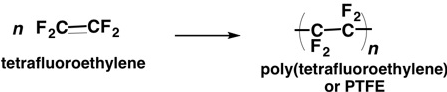
Polytetrafluoroethylene $\text{(PTFE)}$ or Teflon is used to make non$-$stick cookware. Given image explains the formation of $\text{PTFE}.$
View full question & answer
MCQ 1371 Mark
The process of addition of sulphur to rubber is called $........$
  • A
    Vulcenization.
  • Vulcanization.
  • C
    Valcanization.
  • D
    Vulcanisation.
Answer
Correct option: B.
Vulcanization.
Vulcanization is a chemical process of addition of sulphur.
By this method physical properties of natural rubber are improved. Finished rubber has higher tensile strength and resistance to swelling and abrasion.
View full question & answer
MCQ 1381 Mark
The two monomers used in the preparation of dextron are:
  • A
    $3-$hydroxy butanoic acid and $3-$hydroxy pentanoic acid.
  • B
    $\epsilon$ amino caproic acid and glycine.
  • C
    isobutylene and isoprene.
  • lactic acid and glycolic acid.
Answer
Correct option: D.
lactic acid and glycolic acid.
Dextron is a polyacetic acid polyglycolic acid polymer. The monomers used are lactic acid and glycolic acid. It is copolymer and has ester linkage. It is used as friction modifier. It is added to lubricants to reduce surface friction.
View full question & answer
MCQ 1391 Mark
Which of the following fibres is made of polyamides?
  • A
    Dacron
  • B
    Orion
  • Nylon
  • D
    Rayon
Answer
Correct option: C.
Nylon
Nylon is a generic designation for a family of synthetic polymers, based on aliphatic or semi$-$aromatic polyamides.
Nylon is a thermoplastic silky material that can be melt$-$processed into fibers, films, or shapes.
Nylon$−66 \ \&\ $ nylon$−6$ are examples of condensation polymers made of polyamides.
View full question & answer
MCQ 1401 Mark
Which is used in making of thermocol?
  • A
    Polypropylene
  • B
    Polyethylene
  • Polystyrene
  • D
    High density polyethylene
Answer
Correct option: C.
Polystyrene
Polystyrene is used to make disposal plastic such as thermocol.
 
View full question & answer
MCQ 1411 Mark
Acetaldehyde can be used for making synthetic:
  • A
    Protein
  • B
    Perfumes
  • Rubbers
  • D
    Sugar
Answer
Correct option: C.
Rubbers
Acetaldehyde is primarily used as an intermediate in the manufacture of a range of chemicals, perfumes, aniline dyes, plastic and synthetic rubber, etc.
View full question & answer
MCQ 1421 Mark
The most common type of molecular weights used in the case of polymer is:
  • Number average molecular weight method.
  • B
    $z -$ average molecular weight method.
  • C
    Viscosity average molecular weight method.
  • D
    All of the above.
Answer
Correct option: A.
Number average molecular weight method.
The most common type of molecular weights used in the case of polymers is number average molecular weight method.
It gives the relationship between the number of moles of each polymer species $\left(\mathrm{N}_{\mathrm{i}}\right)$ and the molar mass $\left(\mathrm{M}_{\mathrm{i}}\right)$ of that species as$, \text{M}_\text{n}=\frac{\sum\text{M}_\text{i}\text{N}_\text{i}}{\sum\text{Ni}}.$
View full question & answer
MCQ 1431 Mark
Which one of the following is used to make 'non$-$stick' cookware?
  • A
    Polystyrene
  • B
    $\text{PVC}$
  • C
    Polyethylene terephthalate
  • Polytetra fluoroethylene
Answer
Correct option: D.
Polytetra fluoroethylene
Polytetrafluoroethylene $\text{(PTFE)}$ or Teflon is used to make non$-$stick cookware.
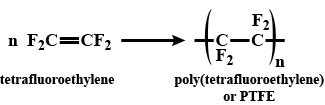
Above given image explains formation of $\text{PTFE}.$
View full question & answer
MCQ 1441 Mark
Which one of the following polymer is prepared by condensation polymerization?
  • A
    Polystyrene
  • Nylon$ - 6, 6$
  • C
    Teflon
  • D
    Rubber
Answer
Correct option: B.
Nylon$ - 6, 6$
Condensation polymers are formed through a condensation reaction, where molecules join together, losing small molecules as byproducts. For e.g., Nylon$ - 6, 6$ is formed by condensation polymerization of adipic acid and hexamethylenediamine.
Whereas Polystyrene, Teflon and Rubber all are formed by chain$-$growth polymerization of monomers styrene, tetrafluoroethylene and isoprene respectively.
Here, an unsaturated monomer molecule adds to the active site of a growing polymeric chain one at a time.
View full question & answer
MCQ 1451 Mark
Which of the following is a condensation homopolymer?
  • Nylon $- 6$
  • B
    Nylon $- 6, 6$
  • C
    Nylon $- 6, 10$
  • D
    Dacron
Answer
Correct option: A.
Nylon $- 6$
Condensation homo polymer is the polymer which is formed by only one monomer and get polymerizes by condensation and loss of small compounds such as water, alcohol, etc. whereas all other examples given are examples of $co-$polymer.
View full question & answer
MCQ 1461 Mark
Which type of polymer is the Buna $- S -$ rubber?
  • A
    Homo polymer
  • B
    Condensation polymer
  • Copolymer
  • D
    None of the above
Answer
Correct option: C.
Copolymer
Buna $- S$ Rubber: It is a random $co -$ polymer formed by the emulsion polymerisation of a mixture of $1, 3$ butadiene and styrene in the presence of peroxide catalyst at $5$ degree Celsius and therefore the product is called as cold rubber.
Copolymer is the right answer.
View full question & answer
MCQ 1471 Mark
'Buna$-N$ rubber' is a coploymer of butadiene and acrylonitrile. In comparison to natural rubber it:
  • A
    Is delicate and soft
  • Has better resistance to wear and tear
  • C
    Is a poor substitute for natural rubber
  • D
    Does not last for a long time
Answer
Correct option: B.
Has better resistance to wear and tear
Synthetic rubber is more resistant to acids, oils, heat, aging and has more strength than natural rubber.
View full question & answer
MCQ 1481 Mark
Which of the following is a step $-$ growth polymer?
  • A
    Polyacrylonitrile
  • B
    Polyisoprene
  • Nylon
  • D
    Polythene
Answer
Correct option: C.
Nylon
Step$-$growth polymerization refers to a type of polymerization mechanism in which $bi-$functional or multifunctional monomers react to form first dimers, then trimers, longer oligomers and eventually long-chain polymers.
For example, Nylon polymerizes by the step$-$growth polymerization process in which difunctional monomers containing equal parts of amine and carboxylic acid react so that amides are formed at both ends of each monomer
Polyacrylonitrile, Polyisoprene and Polythene polymerize by chain$-$growth polymerization of acrylonitrile, isoprene $(2-$methyl$-1, 3-$butadiene$)$ and ethene, respectively.
Chain-growth polymerization $($or addition polymerization$)$ involves the linking together of molecules incorporating double or triple carbon$-$carbon bonds.
View full question & answer
MCQ 1491 Mark
In the process of vulcanization:
  • Natural rubber is heated with sulphur.
  • B
    Natural rubber is heated with carbon.
  • C
    Natural rubber is heated with phosphorous.
  • D
    Natural rubber is heated with sodium.
Answer
Correct option: A.
Natural rubber is heated with sulphur.
Vulcanization is a chemical process by which the physical properties of natural or synthetic rubber are improved. In its simplest form, vulcanization is brought about by heating rubber with sulfur.
View full question & answer
MCQ 1501 Mark
Nylon$-6$ is manufactured from which of the following?
  • A
    Maleic anhydride and hexamethylene diamine.
  • Caprolactum
  • C
    Adipic acid and hexamethylene diamine.
  • D
    Sebasic acid and hexamethylene diamine.
Answer
Correct option: B.
Caprolactum
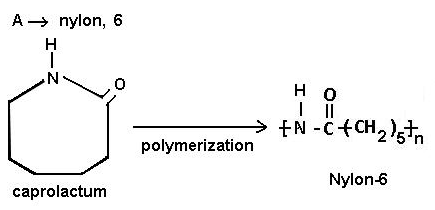
Nylon$-6$ is manufactured from the monomer called caprolactum. The monomer caprolactum is heated at $533 K$ in an inert atmosphere, it polymerises to give nylon$-6.$
Nylon - 6 is manufactured from which of the following?
View full question & answer
M.C.Q (1 Marks) - Page 3 - Chemistry STD 12 Science Questions - Vidyadip