Questions · Page 1 of 2

1 Marks Question

🎯

Test yourself on this topic

50 questions · timed · auto-graded

Question 11 Mark
Name the non-stoichiometric point defect responsible for colour in alkali halides.
Answer
Presence of F-centres.
View full question & answer
Question 21 Mark
Give an example each of a molecular solid and an ionic solid.
Answer
  1. Molecular Solid $- I_2$.
  2. Ionic Solid - NaCl.
View full question & answer
Question 31 Mark
Write the formula of a compound in which the element Y forms ccp lattice and atoms of X occupy 1/3rd of tetrahedral voids.
Answer
$X_2Y_3$
View full question & answer
Question 41 Mark
How may the conductivity of an intrinsic semiconductor be increased?
Answer
Their conductivity is increased by adding an appropriate amount of suitable impurity/by doping.
View full question & answer
Question 51 Mark
What type of interactions hold the molecules together in a polar molecular solid?
Answer
Dipole–Dipole interaction.
View full question & answer
Question 61 Mark
How do metallic and ionic substances differ in conducting electricity?
Answer
Metallic solid conducts electricity in solid state but ionic solids do so only in molten state or in solution or metals conduct electricity through electrons and ionic substances through ions.
View full question & answer
Question 71 Mark
What is the total number of atoms per unit cell in a face-centred cubic (fcc) crystal structure?
Answer
4.
View full question & answer
Question 81 Mark
Find out the number of atoms per unit cell in a face-centred cubic structure having only single atoms at its lattice points.
Answer
4.
View full question & answer
Question 91 Mark
What is the formula of a compound in which the element P forms ccp lattice and atoms of Q occupy 1/3rd of tetrahedral voids?
Answer
$\mathrm{P}_3 \mathrm{Q}_2$
View full question & answer
Question 101 Mark
What is the formula of a compound in which the element P forms ccp lattice and atoms of Q occupy $2/3^{rd}$ of tetrahedral voids?
Answer
$P_3Q_4$
View full question & answer
Question 121 Mark
What type of magnetism is shown by a substance if magnetic moments of domains are arranged in same direction?
Answer
Ferromagnetism.
View full question & answer
Question 131 Mark
What is the formula of a compound in which the element Y forms ccp lattice and atoms of X occupy 1/3rd of tetrahedral voids?
Answer
$X_2Y_3.$
View full question & answer
Question 151 Mark
What is meant by 'doping' in a semiconductor?
Answer
Addition of a suitable impurity to the semi-conductor to increase its conductivity is called Doping.
View full question & answer
Question 161 Mark
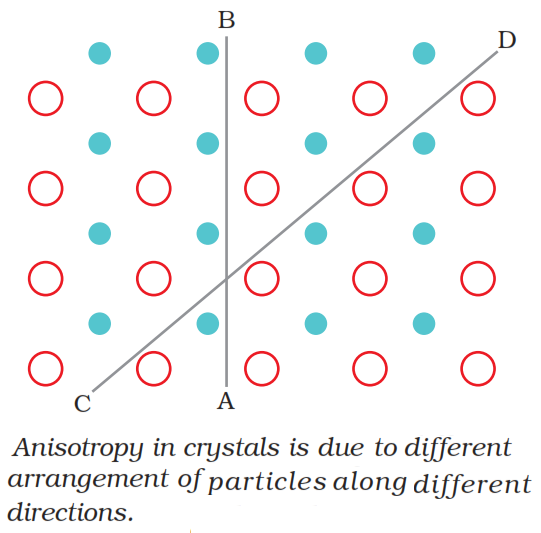
'Crystalline solids are anisotropic in nature.' What does this statement mean?
Answer
It means that some of their physical properties show different values when measured along different directions in the same crystal.
View full question & answer
Question 171 Mark
Write a feature which will distinguish a metallic solid from an ionic solid.
Answer
Mode of conduction, through electrons in solid metal and through ions in molten state or in solution in ionic solid/Metals are malleable and ductile whereas ionic solids are hard and brittle.
View full question & answer
Question 201 Mark
A cubic solid is made of two elements X and Y. Atoms Y are at the corners of the cube and X at the body centre. What is the formula of the compound?
Answer
XY.
View full question & answer
Question 211 Mark
Arrange the following in decreasing order of solubility in water:
$\left(\mathrm{CH}_3\right)_3 \mathrm{N},\left(\mathrm{CH}_3\right)_2 \mathrm{NH}, \mathrm{CH}_3 \mathrm{NH}_2$
Answer
$\mathrm{CH}_3 \mathrm{NH}_2>\left(\mathrm{CH}_3\right)_2 \mathrm{NH}>\left(\mathrm{CH}_3\right)_3 \mathrm{N}$
View full question & answer
Question 221 Mark
Out of NaCl and AgCl, which one shows Frenkel defect and why?
Answer
The Frenkel defect is that in which one smaller ion (usually cations) move from its lattice position to an interstitial site i.e. a tetrahedral/ octahedral hole to form a vacancy in the lattice of course, AgCl has the defect because, the size of AgCl is intermediate and since, the size of $Ag^+$ cation is smaller than chloride ion so it can move to interstitial spaces causing Frenkel defect while in NaCl (alkali metal halide) they have larger size of cations which do not fit into voids and so the defect is not shown by the alkali metal halides.
View full question & answer
Question 231 Mark
Body centred cubic unit cell?
Answer
8(corner atoms) $\times\frac{1}{8}+1$ (body centre atom) × 1 = 1 + 1 = 2
View full question & answer
Question 251 Mark
Why are solids rigid?
Answer
The intermolecular forces of attraction that are present in solids are very strong. The constituent particles of solids cannot move from their positions i.e., they have fixed positions. However, they can oscillate about their mean positions. This is the reason solids are rigid.
View full question & answer
Question 261 Mark
Define void.
Answer
The empty spaces present between the atoms or the ions when they are packed within the crystal are called voids.
View full question & answer
Question 271 Mark
Under which situations can an amorphous substance change to crystalline form?
Answer
On heating, amorphous substance change to crystalline form at some temperature. This is due to crystallization.
View full question & answer
Question 281 Mark
Solid A is a very hard electrical insulator in solid as well as in molten state and melts at extremely high temperature. What type of solid is it?
Answer
The given properties are the properties of a covalent or network solid. Therefore, the given solid is a covalent or network solid. Examples of such solids include diamond (C) and quartz $(SiO_2).$
View full question & answer
Question 291 Mark
What type of stoichiometric defect is shown by:
  1. ZnS.
  2. AgBr.
Answer
  1. ZnS shows Frenkel defect.
  2. AgBr shows Frenkel as well as Schottky defect.
View full question & answer
Question 301 Mark
An element with molar mass $2.7 \times 10^{-2} \mathrm{~kg} \mathrm{~mol}^{-1}$ forms a cubic unit cell with edge length 405 pm . If its density is $2.7 \times 103 \mathrm{~kg}^{-3}$, what is the nature of the cubic unit cell?
Answer
$\text{Z}=\frac{\text{d}\times\text{a}^3\times\text{N}_\text{A}}{\text{M}}$
View full question & answer
Question 311 Mark
What are the types of lattice imperfections found in crystals?
Answer
  1. Stoichiometric defects, viz., Schottky defect and Frenkel defect.
  2. Non-stoichiometric defects, viz., metal excess, metal deficiency,
  3. Impurity defects.
View full question & answer
Question 321 Mark
What type of solids are electrical conductors, malleable and ductile?
Answer
Metallic solids are electrical conductors, malleable and ductile.
View full question & answer
Question 331 Mark
Give the significance of a ‘lattice point’.
Answer
The significance of a lattice point is that each lattice point represents one constituent particle of a solid which may be an atom, a molecule (group of atom), or an ion.
View full question & answer
Question 351 Mark
What is the non-stoichiometric defect in crystals?
Answer
If, as a result of the imperfections in the crystal, the ratio of the cations to the anions becomes different from that indicated by the ideal chemical formula, then the defects are termed as non-stoichiometric defects.
View full question & answer
Question 361 Mark
What is the difference between phosphorus doped and gallium doped semiconductors?
Answer
Silicon doped with phosphorus gives n-type whereas silicon doped with gallium are p-type semiconductors.
View full question & answer
Question 371 Mark
How does the electrical conductivity of metallic conductors vary with temperature?
Answer
Electrical conductivity decreases with rise in temperature because kernels begin to vibrate and create hindrance in the flow of electrons.
View full question & answer
Question 381 Mark
Name the non-stoichiometric point defect responsible for colour in alkali metal halides.
Answer
Metal excess defect due to anionic vacancies.
View full question & answer
Question 391 Mark
What are primitive unit cells and what are non-primitive unit cells?
Answer
Primitive unit cells have one atom per unit cell. On the other hand, non-primitive unit cells have more than one atom per unit cell.
View full question & answer
Question 401 Mark
How many lattice point are there in one unit cell of each of the following lattice?
Body-centred.
Answer
There are 9 (1 from the centre + 8 from the corners) lattice points in body-centred cubic.
View full question & answer
Question 421 Mark
How many lattice point are there in one unit cell of each of the following lattice?
Face-centred tetragonal.
Answer
There are 14 (8 from the corners + 6 from the faces) lattice points in face-centred tetragonal.
View full question & answer
Question 431 Mark
A compound is formed by two elements M and N. The element N forms ccp and atoms of M occupy 1/3rd of tetrahedral voids. What is the formula of the compound?
Answer
The ccp lattice is formed by the atoms of the element N.
Here, the number of tetrahedral voids generated is equal to twice the number of atoms of the element N.
According to the question, the atoms of element M occupy $\frac{1}{3}\text{rd}$ of the tetrahedral voids.
$2\times\frac{1}{3}=\frac{2}{3}$
Therefore, the number of atoms of M is equal to of the number of atoms of N.
$=\frac{2}{3}:1$
Therefore, ratio of the number of atoms of M to that of N is M : N
$=2:3$
Thus, the formula of the compound is $M_2\ N_3$.
View full question & answer
Question 441 Mark
What type of defect can arise when a solid is heated? Which physical property is affected by it and in what way?
Answer
When a solid is heated, vacancy defect can arise. A solid crystal is said to have vacancy defect when some of the lattice sites are vacant.
Vacancy defect leads to a decrease in the density of the solid.
View full question & answer
Question 451 Mark
Define superconductivity of a substance.
Answer
The property of a substance to offer no resistance to the flow of electricity at a particular temperature is known as superconductivity.
View full question & answer
Question 461 Mark
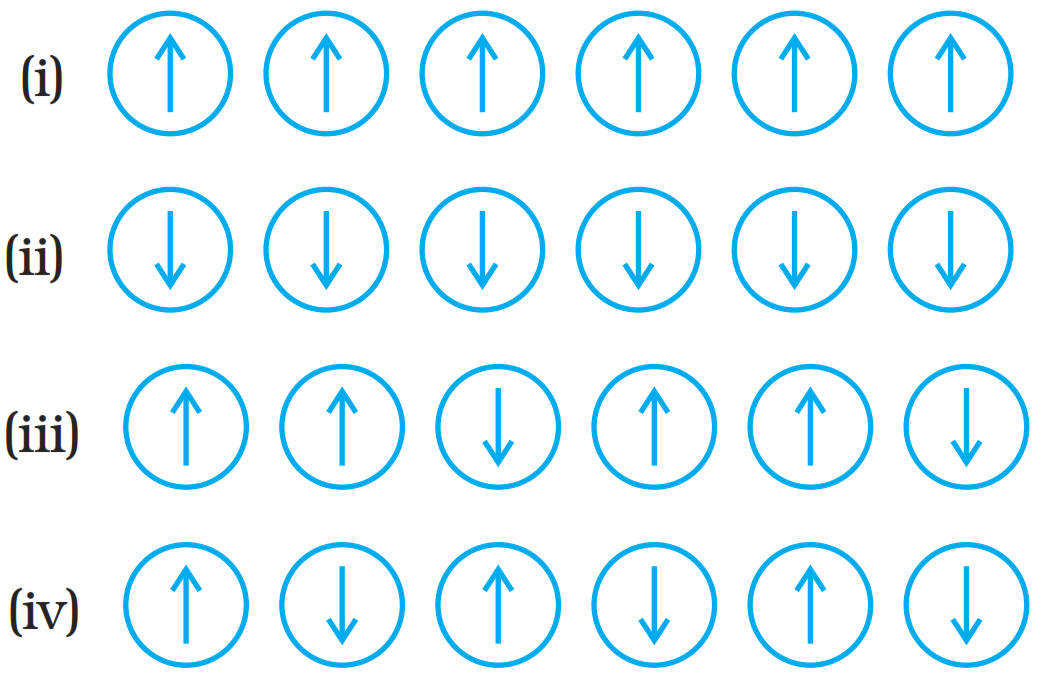
Which of the following arrangements shows schematic alignment of magnetic moments of antiferromagnetic substances?
Answer


Explanation:

In antiferromagnetic substances their domains (a group of small regions of metal ions) are oppositely oriented and cancel out each other’s magnetic moments [as depicted in Figure (iv)] above.
View full question & answer
MCQ 471 Mark
Which of the following is not a characteristic of a crystalline solid?
  • A
    Definite and characteristic heat of fusion.
  • Isotropic nature.
  • C
    A regular periodically repeated pattern of arrangement of constituent particles in the entire crystal.
  • D
    A true solid.
Answer
Correct option: B.
Isotropic nature.
Anisotropy: Crystalline solids are anisotropic in nature, that is some of their physical properties like electrical resistance or refractive index show different values when measured along different directions in the same crystal. This arises from different arrangement of particles in different directions arrangement of particles along different directions.

Isotropy: In case of amorphous substances, properties such as electrical conductivity, refractive index, thermal expansion, etc. are identical in all directions just as in case of gases or liquids. This property is called isotropy and the substances showing this property are called isotropic.
View full question & answer
Question 481 Mark
What is Schottky defect?
Answer
When some ions (usually cations) are missing from the lattice sites and they occupy the interstitial sites so that electrical neutrality as well as stoichiometry is maintained, it is called Frenkel defect.
View full question & answer
Question 501 Mark
What are interstitials in a crystal?
Answer
Atoms or ions that fill the normal vacant interstitial voids in a crystal are called interstitials.
View full question & answer
1 Marks Question - Chemistry STD 12 Science Questions - Vidyadip