MCQ 511 Mark
The distance moved by the particle in time t is given by $x = t^3- 12t^2 + 6t + 8.$ At the instant when its acceleration is zero, the velocity is:
Answer$\text{x}=\text{t}^{3}-12\text{t}^{2}+6\text{t}+8$
$\Rightarrow\frac{\text{dx}}{\text{dt}}=3\text{t}^{2}-24\text{t}+8$
$\Rightarrow\frac{\text{d}^{2}\text{x}}{\text{dt}^{2}}=6\text{t}-24$
$\Rightarrow6\text{t}-24=0 [\therefore$ acceleration is zero$]$
$\Rightarrow\text{t}=4$
So, Velocity at $\text{t}=4$
$\Rightarrow\frac{\text{dx}}{\text{dt}}=3(4)^{2}-24\times4+6$
$\Rightarrow\frac{\text{dx}}{\text{dt}}=48-96+6$
$\Rightarrow\frac{\text{dx}}{\text{dt}}=-42$
View full question & answer→MCQ 521 Mark
The diameter of a circle is increasing at the rate of 1cm/sec. When its radius is $\pi$ the rate of increase of its area is:
- A
$\pi\text{cm}^{2}/\text{sec}.$
- B
$2\pi\text{cm}^{2}/\text{sec}.$
- ✓
$\pi^{2}\text{cm}^{2}/\text{sec}.$
- D
$2\pi^{2}\text{cm}^{2}/\text{sec}^{2}.$
AnswerCorrect option: C. $\pi^{2}\text{cm}^{2}/\text{sec}.$
Let D be the diameter and A be the area of the cricle at any time t. Then,
$\text{A}=\pi\text{r}^{2}$ (where r is the radius of the circle)
$\Rightarrow\text{A}=\pi\frac{\text{D}^{2}}{4} \ \Big[\therefore\text{r}=\frac{\text{D}}{2}\Big]$
$\Rightarrow\frac{\text{dA}}{\text{dt}}=2\pi\frac{\text{D}}{4}\frac{\text{dD}}{\text{dt}}$ $\Big[\therefore\frac{\text{dD}}{\text{dt}}=1\text{cm}/\text{sec}\Big]$
$\Rightarrow\frac{\text{dA}}{\text{dt}}=\pi^{2}\text{cm}^{2}/\text{sec}.$
View full question & answer→MCQ 531 Mark
The point on the curve $9y^2 = x^3$, where the normal to the curve makes equal intercepts with the axes is:
- ✓
$\Big(4,\frac{8}{3}\Big)$
- B
$\Big(-4,\frac{8}{3}\Big)$
- C
$\Big(4,-\frac{8}{3}\Big)$
- D
AnswerCorrect option: A. $\Big(4,\frac{8}{3}\Big)$
$9y^2 = x^3$
$\Rightarrow18\text{y}\frac{\text{dy}}{\text{dx}}=3\text{x}^2$
$\Rightarrow\frac{\text{dy}}{\text{dx}}=\frac{\text{x}^2}{6\text{y}}=$slope of tangent
Slope of normal $=\frac{-6\text{y}}{\text{x}^2}$
Given that normal makes equal intercept on axes.
$\Rightarrow$ Slope of normal $=\pm1$
$\frac{-6\text{y}}{\text{x}^2}=1$ or $\frac{-6\text{y}}{\text{x}^2=}=-1$
$\Rightarrow\text{y}=\frac{-\text{x}^2}{6}$ or $\text{y}=\frac{\text{x}^2}{6}$
$\text{y}=\frac{-\text{x}^2}{6}$
$9\text{y}^2=\text{x}^3$
$9\Big(\frac{-\text{x}^2}{6}\Big)^2=\text{x}^3$
$\Rightarrow\text{x}=0$ or $4$
$\Rightarrow\text{y}=0,\pm\frac{8}{3}$
Point are $\Big(4,\frac{8}{3}\Big)$ and $\Big(4,\frac{-8}{3}\Big)$
View full question & answer→MCQ 541 Mark
Choose the correct answer from the given four options:
At $\text{x}=\frac{5\pi}{6},\text{ f(x)}=2\sin3\text{x}+3\cos\text{x}$ is 6:
- A
- B
- C
- ✓
Neither maximum nor minimum.
AnswerCorrect option: D. Neither maximum nor minimum.
We have, $\text{f(x)}=2\sin3\text{x}+3\cos3\text{x}$
$\therefore\ \text{f}'(\text{x})=2\cdot\cos3\text{x}3+3(-\sin3\text{x})\cdot3$
$\Rightarrow\ \text{f}'(\text{x})=6\cos3\text{x}-9\sin3\text{x}\ \ \dots(\text{i})$
Now, $\text{f}''(\text{x})=-18\sin3\text{x}-27\cos3\text{x}$
$=-9(2\sin3\text{x}+3\cos3\text{x})$
$\therefore\ \text{f}'\Big(\frac{5\pi}{6}\Big)=6\cos\Big(3\cdot\frac{5\pi}{6}\Big)-9\sin\Big(3\cdot\frac{5\pi}{6}\Big)$
$=6\cos\frac{5\pi}{2}-9\sin\frac{5\pi}{2}$
$=6\cos\Big(2\pi+\frac{\pi}{2}\Big)-9\sin\Big(2\pi+\frac{\pi}{2}\Big)$
$=-9\neq0$
So, $\text{x}=\frac{5\pi}{6}$ cannot be point of maxima or minima.
Hence, f(x) at $\text{x}=\frac{5\pi}{6}$ is neither maximum nor minimum.
View full question & answer→MCQ 551 Mark
The function $f(x) = x^2e^{-x}$ is monotonic increasing when:
AnswerCorrect option: B. $0<\text{x}<2$
$f(x) = x^2e^{-x}$
$\Rightarrow f'(x) = -x^2e^{-x} + 2xe^{-x}$
$\Rightarrow f'(x) = -e^{-x}x(x - 2)$
Given that function is monotonically increasing.
$-e^{-x}x(x - 2) > 0$
$x(x - 2) < 0$
$0 < x < 2$
View full question & answer→MCQ 561 Mark
Choose the correct answer from the given four options: The function $f(x) = 2x^3 - 3x^2 - 12x + 4,$ has:
- A
Two points of local maximum.
- B
Two points of local minimum.
- ✓
One maxima and one minima.
- D
AnswerCorrect option: C. One maxima and one minima.
We have,$ f(x) = 2x^3 - 3x^2 - 12x + 4$
$\Rightarrow f'(x) = 6x^2 - 6x - 12$
$\Rightarrow f'(x) = 6(x^2 - x - 2)$
$\Rightarrow f'(x) = 6(x + 1)(x - 2)$
Find the critical points by equating $f'(x)$ to $0.$
$\therefore f'(x) = 0$
$\Rightarrow 6(x + 1)(x - 2) = 0$
$\Rightarrow x = -1$ and $x = +2$
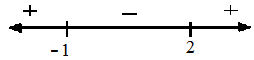
From the above number line, we can conclude that, $x = -1$ is point of local maxima and $x = 2$ is point of local minima.
Thus, $f(x)$ has one maxima and one minima. View full question & answer→MCQ 571 Mark
Choose the correct answer from the given four options:
The function $\text{f(x)}=4\sin^3\text{x}-6\sin^2\text{x}+12\sin\text{x}+100$ is strictly:
- A
$\text{Increasing in }\Big(\pi,\frac{3\pi}{2}\Big)$
- ✓
$\text{Decreasing in }\Big(\frac{\pi}{2},\pi\Big)$
- C
$\text{Decreasing in }\Big[\frac{-\pi}{2},\frac{\pi}{2}\Big]$
- D
$\text{Decreasing in }\Big[0,\frac{\pi}{2}\Big]$
AnswerCorrect option: B. $\text{Decreasing in }\Big(\frac{\pi}{2},\pi\Big)$
We have, $\text{f(x)}=4\sin^3\text{x}-6\sin^2\text{x}+12\sin\text{x}+100$
$\therefore\ \text{f(x)}=12\sin^2\text{x}\cdot\cos\text{x}-12\sin\text{x}\cdot\cos\text{x}+12\cos\text{x}$
$=12\cos\text{x}\big[\sin^2\text{x}-\sin\text{x}+1\big]$
$=12\cos\text{x}\big[\sin^2\text{x}+(1-\sin\text{x}\big]$
Now, $1-\sin\text{x}\geq0\text{ and }\sin^2\text{x}\geq0$
$\therefore\ \sin^2\text{x}+\text{f}-\sin\text{x}>0$
Hence, f'(x) > 0, when $\cos\text{x}>0\text{ i.e., x}\in\Big(\frac{-\pi}{2},\frac{\pi}{2}\Big)$
So, f(x) is increasing when $\text{x}\in\Big(-\frac{\pi}{2},\frac{\pi}{2}\Big)$
and f'(x) < 0, when $\cos\text{x}<0\text{ i.e., x}\in\Big(\frac{\pi}{2},\frac{3\pi}{2}\Big)$
Hence, f(x) is decreasing when $\text{x}\in\Big(\frac{\pi}{2},\frac{3\pi}{2}\Big)$
Hence, f(x) is decreasing in $\Big(\frac{\pi}{2},\pi\Big)$
View full question & answer→MCQ 581 Mark
The altitude of a cone is 20cm and its semi-vertical angle is 30°. If the semi-vertical angle is increasing at the rate of 2° per second, then the radius of the base is increasing at the rate of:
- A
$30\text{cm}/\text{sec}.$
- B
$\frac{160}{3}\text{cm}/\text{sec}.$
- ✓
$10\text{cm}/\text{sec}.$
- D
$160\text{cm}/\text{sec}.$
AnswerCorrect option: C. $10\text{cm}/\text{sec}.$
Let r be the radius, h be the height and $\alpha$ be the semi-vertical angle of the cone.
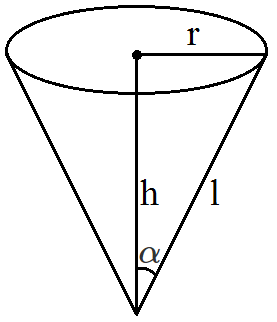
Then, $\tan\alpha = \text{rh}$
$\Rightarrow\sec2\alpha\text{d}\alpha\text{dt}=\text{dr}\text{h }\text{dt}$
$\Rightarrow\text{dr }\text{dt}=\text{h}\times\sec2\alpha\text{d}\alpha\text{dt}$
$\Rightarrow\text{dr }\text{dt}=20\times\sec230\times2 $
$\therefore\text{h}=20, \alpha=30^{\circ}$ and per second
$\Rightarrow\text{dr }\text{dt}=40\times232$
$\Rightarrow\text{dr }\text{dt}=\frac{160}{3}\text{cm}/\text{sec}.$ View full question & answer→MCQ 591 Mark
The radius of a sphere is changing at the rate of $0.1\text{cm}/\sec.$ The rate of change of its surface area when the radius is 200cm is:
AnswerCorrect option: C. $160\pi\text{ cm}^2/\sec.$
Let r be the radius nad S be the surface area of the sphere at any time t. Then,
$\text{S}=4\pi\text{r}^2$
$\Rightarrow\frac{\text{dS}}{\text{dt}}=8\pi\text{r}\frac{\text{dr}}{\text{dt}}$
$\Rightarrow\frac{\text{dS}}{\text{dt}}=8\pi(200)(0.1)$
$\Rightarrow\frac{\text{dS}}{\text{dt}}=160\pi\text{ cm}^2/\sec.$
View full question & answer→MCQ 601 Mark
The volume of a sphere is increasing at the rate of $4\pi\text{cm}^{3}/\text{sec}$. The rate of increase of the radius when the volume is $288\pi\text{cm}^{3}/\text{sec}$ is:
- A
$\frac{1}{4}$
- B
$\frac{1}{12}$
- ✓
$\frac{1}{36}$
- D
$\frac{1}{9}$
AnswerCorrect option: C. $\frac{1}{36}$
$\text{v}=\frac{4}{3}\pi\text{r}^{3}$
$\frac{4}{3}\pi\text{r}^{3}=288\pi$
$\text{r}^{3}=288\times\frac{3}{4}$
$\text{r}^{3}=216$
$\text{v}=\frac{4}{3}\pi\text{r}^{3}$
$\frac{\text{dv}}{\text{dt}}=4\pi \text{r}^{2}\frac{\text{dr}}{\text{dt}}$
$\frac{\text{dv}}{\text{dt}}=4\pi(6)^{2}\frac{\text{dr}}{\text{dt}}$
$4\pi=144\pi\frac{\text{dr}}{\text{dt}}$
$\frac{\text{dr}}{\text{dt}}=\frac{4}{144}$
$=\frac{1}{36}$
View full question & answer→MCQ 611 Mark
The equation to the normal to the curve $\text{y}=\sin\text{x}$ at $(0, 0)$ is:
- A
$x = 0$
- B
$y = 0$
- ✓
$x + y = 0$
- D
$x - y = 0$
AnswerCorrect option: C. $x + y = 0$
Given:
$\text{y}=\sin\text{x}$
On differentiating both sides $\text{w.r.t.x}$, we get
$\frac{\text{dy}}{\text{dx}}=\cos\text{x}$
Slope of the tangent $=\Big(\frac{\text{dy}}{\text{dx}}\Big)_{(0,0)}=\cos=1$
Slope of the normal, $\text{m}=\frac{-1}{1}=-1$
Given:
$(x_1, y_1) = (0, 0)$
$\therefore$ equation of the normal
$= y - y_1 = m (x_1, y_1)$
$\Rightarrow y - 0 = -1 (x - 0)$
$\Rightarrow y = -x$
$\Rightarrow x + y = 0$
View full question & answer→MCQ 621 Mark
The coordinates of the point on the ellipse $16x^2+ 9y^2= 400$ where the ordinate decreases at the same rate at which the abscissa increases, are:
- ✓
$ (3, \frac{16}{3})$
- B
$ (-3, \frac{16}{3})$
- C
$ (3, -\frac{16}{3})$
- D
$ (3, -3)$
AnswerCorrect option: A. $ (3, \frac{16}{3})$
According to the question,
$\frac{\text{dy}}{\text{dt}}=\frac{-\text{dx}}{\text{dt}}$
$16\text{x}^{2}+9\text{y}^{2}=400$
$\Rightarrow32\text{x}\frac{\text{dx}}{\text{dt}}+18\text{y}\frac{\text{dy}}{\text{dt}}=0$
$\Rightarrow32\text{x}\frac{\text{dx}}{\text{dt}}=-18\text{y}\frac{\text{dy}}{dt}$
$\Rightarrow32\text{x}=18\text{y}$
$\Rightarrow\text{x}=\frac{9\text{y}}{16} ...(\text{i}) $
Now,
$16\Big(\frac{9\text{y}}{16}\Big)^{2}+9\text{y}^{2}=400$
$\Rightarrow\frac{81\text{y}^{2}}{16}+9\text{y}^{2}=400$
$\Rightarrow81\text{y}^{2}+144\text{y}^{2}=6400$
$\Rightarrow225\text{y}^{2}=6400$
$\Rightarrow\text{y}^{2}=\frac{6400}{225}$
$\Rightarrow\text{y}=\sqrt{\frac{6400}{225}}$
$\Rightarrow\text{y}=\frac{16}{3}$ and $-\frac{16}{3}$
So, $\text{x}=\frac{9}{16}\times\frac{16}{3} [$Using $(1)]$
Or $\text{x}=-\frac{9}{16}\times\frac{16}{3}$
$\Rightarrow\text{x}=3 \text{ or} -3$
So, the required point is $(3, \frac{16}{3}).$
View full question & answer→MCQ 631 Mark
If $\text{f}(\text{x})=\text{x}+\frac{1}{\text{x}}, \text{x}>0$, then its greatest value is:
AnswerGiven, $\text{f}(\text{x})=\text{x}+\frac{1}{\text{x}}$
$\Rightarrow \text{f}'(\text{x})=1-\frac{1}{\text{x}^{2}}$
For a local maxima or a local minima, we must have f'(x) = 0
$\Rightarrow 1-\frac{1}{\text{x}^{2}}=0$
$\Rightarrow \text{x}^{2}-1=0$
$\Rightarrow \text{x}^{2}=1$
$\Rightarrow \text{x}=\pm1$
$\Rightarrow \text{x}=1$
Now, $\text{f}''(\text{x})=\frac{2}{\text{x}^{3}}$
$\text{f}''(1)=2>0$
So, x = 1 is a local minima.
View full question & answer→MCQ 641 Mark
The total revenue in Rupees received from the sale of $x$ units of a product is given by $R(x) 2 = 3x^2+ 36x + 5.$ The marginal revenue, when $x = 15$ is:
AnswerTotal revenue $\text{R (x)} = 3\text{x}^{2 }+ 36\text{x}+5$
$\therefore\ \text{Marginal revenue}=\frac{\text{d}}{\text{dx}}\text{R (x)}=6\text{x}+36=6\times15+36=126$
Therefore, option $(D)$ is correct.
View full question & answer→MCQ 651 Mark
If the function $f(x) = x^3 - 9kx^2 + 27x + 30$ is increasing on $R,$ then:
- ✓
$-1\leq\text{k}\leq1$
- B
$k < -1$ or $k > 1$
- C
$0 < k < 1$
- D
$-1 < k < 0$
AnswerCorrect option: A. $-1\leq\text{k}\leq1$
$f(x) = x^3 - 9kx^2 + 27x + 30$
$\Rightarrow f'(x) = 3x^3 - 18kx + 27$
$\Rightarrow 3(x^2 - 6kx + 9)$
Function is always increasing on $R.$
$3(x^2 - 6kx + 9) > 0$
$x^2 - 6kx + 9 > 0$
In $ax^2 + bx + c = 0$ if $a > 0$
$ \Rightarrow b^2 - 4ac < 0$
$36k^2 - 36 < 0$
$k^2 - 1 < 0$
$(k + 1)(k - 1) < 0$
$\Rightarrow -1 < k < 1$
View full question & answer→MCQ 661 Mark
For what valuse of $x$ is the rate of increase of $x^3 - 5x^2 + 5x + 8$ is twice the rate of increase of $x?$
- A
$-3, -\frac{1}{3}$
- B
$-3, \frac{1}{3}$
- C
$3, -\frac{1}{3}$
- ✓
$3, \frac{1}{3}$
AnswerCorrect option: D. $3, \frac{1}{3}$
Let, $\text{y}=\text{x}^{3}-5\text{x}^{2}+5\text{x}+8$
Differentiating with respect yo $t,$
$\frac{\text{dy}}{\text{dt}}=(3\text{x}^{2}-10\text{x}+5)\frac{\text{dx}}{\text{dt}}$
Given that twice of rate of increase in $x$ euals rate of increase in $x,$
$\Rightarrow\frac{\text{dx}}{\text{dt}}=2\frac{\text{dx}}{\text{dt}}$
$\Rightarrow(3\text{x}^{2}-10\text{x}+5)\frac{\text{dx}}{\text{dt}}=2\frac{\text{dx}}{\text{dt}}$
$\Rightarrow3\text{x}^{2}-10\text{x}+5=2$
$\Rightarrow\text{x}=3$ or $\text{x}=\frac{1}{3}$
View full question & answer→MCQ 671 Mark
Choose the correct answer from the given four options:
The maximum value of $\Big(\frac{1}{\text{x}}\Big)^\text{x}$ is:
AnswerCorrect option: C. $\frac{1}{_\text{e}\text{e}}$
Let $\text{y}=\Big(\frac{1}{\text{x}}\Big)^\text{x}$
$\Rightarrow\ \log\text{y}=\text{x}\cdot\log\frac{1}{\text{x}}=-\text{x}\cdot\log\text{x}$
Diffrentiating both sides w.r.t x, we get,
$\frac{1}{\text{y}}\cdot\frac{\text{dy}}{\text{dx}}=-\text{x}\cdot\frac{1}{\text{x}}-\log\text{x}$
$=-1-\log\text{x}$
$\therefore\ \frac{\text{dy}}{\text{dx}}=-\Big(\frac{1}{\text{x}}\Big)^\text{x}(1+\log\text{x})$
Now, $\frac{\text{dy}}{\text{dx}}=0$
$\Rightarrow\ 1+\log\text{x}=0$
$\Rightarrow\ \text{x}=\frac{1}{\text{e}}$
Sign scheme of f'(x) is as shown in the following figure.
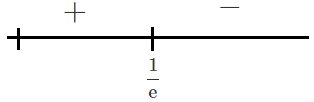
From the figure, $\text{x}=\frac{1}{\text{e}}$ is the point of maxima
Hence, maximum value of y is $\Big(\frac{1}{\frac{1}{\text{e}}}\Big)^{\frac{1}{\text{e}}}=\text{e}^{\frac{1}{\text{e}}}$ View full question & answer→MCQ 681 Mark
The equation of the normal to the curve $\text{y}=\text{x}+\sin\text{x}\cos\text{x}\text{ at }\text{x}=\frac{\pi}{2}$ is
- A
$\text{x}= 2$
- B
$\text{x}=\pi$
- ✓
$\text{x}+\pi=0$
- D
$2\text{x}=\pi$
AnswerCorrect option: C. $\text{x}+\pi=0$
Given:
$\text{y}=\sin\text{x}$
On differentinating both sides w.r.t. x,
We get,
$\frac{\text{dy}}{\text{dx}}=\cos\text{x}$
Slope of the tangent $=\Big(\frac{\text{dy}}{\text{dx}}\Big)_{(0,0)}=\cos0=1$
Slope of the normal $\text{m,}=\frac{-1}{1}=-1$
Given:
$(\text{x}_1,\text{y}_1)=(0,0)$
$\therefore$ Equation of the normal
$=\text{y}-\text{y}_1=\text{m}(\text{x}-\text{x}_1)$
$\Rightarrow\text{y}-0=-1(\text{x}-0)$
$\Rightarrow\text{y}=-\text{x}$
$\Rightarrow\text{x}+\text{y}=0$
View full question & answer→MCQ 691 Mark
The angle of intersection of the curves $xy = a^2$ and $x^2 - y^2 = 2a^2$ is :
- A
$0^\circ$
- B
$45^\circ$
- ✓
$90^\circ$
- D
AnswerCorrect option: C. $90^\circ$
$\text{x}\text{y}=\text{a}^2$ and $\text{x}^2-\text{y}^2=2\text{a}^2$
$\text{x}\frac{\text{dy}}{\text{dx}}+\text{y}=0$ and $2\text{x}-2\text{y}\frac{\text{dy}}{\text{dx}}=0$
$\Rightarrow\frac{\text{dy}}{\text{dx}}=\frac{-\text{y}}{\text{x}}$ and $\frac{\text{dy}}{\text{dx}}=\frac{\text{x}}{\text{y}}$
We can see dearly that product of the slopes of $\tan$ gents is $-1$
Hence, angle between two tangents is $90^\circ.$
View full question & answer→MCQ 701 Mark
The function $\text{f}(\text{x})=\frac{\text{x}}{1+|\text{x}|}$ is:
- ✓
- B
- C
Neither increasing nor decreasing.
- D
Answer$\text{f}(\text{x})=\frac{\text{x}}{1+|\text{x}|}$
Case I:
When x > 0, |x| = x
$\text{f}(\text{x})=\frac{\text{x}}{1+|\text{x}|}$
$=\frac{\text{x}}{1+\text{x}}$
$\Rightarrow\text{f}'(\text{x})=\frac{(1+\text{x})1-\text{x}(1)}{(1+\text{x})^2}$
$=\frac{1}{(1+\text{x})^2}>0,\forall\ \text{x}\in\text{R}$
So, f(x) is strictly increasing when x > 0.
Case II:
When x < 0, |x| = -x
$\text{f}(\text{x})=\frac{\text{x}}{1+|\text{x}|}$
$=\frac{\text{x}}{1+\text{x}}$
$\Rightarrow\text{f}'(\text{x})=\frac{(1-\text{x})1-\text{x}(-1)}{(1-\text{x})^2}$
$=\frac{1}{(1-\text{x})^2}>0,\forall\ \text{x}\in\text{R}$
So, f(x) is strictly increasing when x < 0.
Thus, f(x) is strictly increasing on R.
View full question & answer→MCQ 711 Mark
Choose the correct answer from the given four options : The smallest value of the polynomial $x^3 - 18x^2 + 96x$ in $[0, 9]$ is:
AnswerWe have, $f(x) = x^3 - 18x^2 + 96x$
$\therefore f'(x) = 3x^2 - 36x + 96$
$f'(x) = 0$
$\therefore 3x^2 - 36x + 96 = 0$
$\Rightarrow 3(x^2 - 12x + 32) = 0$
$\Rightarrow (x - 8)(x - 4) = 0$
$\Rightarrow x = 4, 8$
For least value of $f(x)$ in $[0, 9]$, we should find the value of function at $x = 0,$
$4, 8, 9$
$f(0) = 0$
$f(4) = 4^3 - 18 \times 4^2 + 96 \times 4 = 64 - 288 + 384 = 160$
$f(8) = 8^3 - 18 \times 8^2 + 96 \times 8 = 128$
$f(9) = 9^3 - 18 \times 9^2 + 96 \times 9 = 729 - 1458 + 864 = 195$
Thus, absolute minimum value of $f$ on $[0, 9]$ is $0$ occurring at $x = 0.$
View full question & answer→MCQ 721 Mark
Choose the correct answer from the given four options:
Let the f: R → R be defined by $\text{f(x)}=2\text{x}+\cos\text{x}$ then f:
AnswerCorrect option: D. Is an increasing function.
We have, $\text{f(x)}=2\text{x}+\cos\text{x}$
$\Rightarrow\ \text{f}'(\text{x})=2+(-\sin\text{x})$
$=2-\sin\text{x}$
Since, the maximum value of $\sin\text{x}$ is 1.
Hence, $\text{f}'(\text{x})>0,\forall\text{ x}$
Thus, f'(x) is an increasing function.
View full question & answer→MCQ 731 Mark
Function f(x) = |x| - |x - 1| is monotonically increasing when:
Answerf(x) = |x| - |x - 1|
Case I:
Let x < 0
If x < 0, then |x| = -x
⇒ |x - 1| = -(x - 1)
Now,
f(x) = |x| - |x - 1|
= -x - (-x + 1)
= -x + x - 1
= -1
f'(x) = 0
So, f(x) is not monotonically increasing when x < 0.
Case II:
Let x < 0 < 1
Here,
|x| = x
⇒ |x - 1| = -(x - 1)
Now,
f(x) = |x| - |x - 1|
= x + x -1
= 2x - 1
View full question & answer→MCQ 741 Mark
Choose the correct answer : The point on the curve $x^2 = 2y$ which is nearest to the point $(0, 5)$ is:
AnswerEquation of the curve is $x^2 = 2y ...(i)$
Let $P(x, y)$ be any point on the curve $(i),$ then according to question,
Distance between given point $(0, 5)$ and $P = \sqrt{(\text{x-2})^2+(\text{y-5)}^5}=\text{z (Say)}$
$\Rightarrow\ \text{z}^2=\text{x}^2+(\text{y}-5)^2$
$=2\text{y}+(\text{y}-5)^2\ \ [\text{From eq. (i)}]$
$\Rightarrow\ \text{z}^2=2\text{y}+\text{y}^2+25-10\text{y}$
$\Rightarrow\ \text{z}^2=\text{y}^2-8\text{y}+25=\text{z (Say})$
$\Rightarrow\ \frac{\text{dZ}}{\text{dy}}=2\text{y}-8$ and $\frac{\text{d}^2\text{Z}}{\text{dy}^2}=2$
Now $\frac{\text{dZ}}{\text{dy}}=0\ $
$\Rightarrow\ 2\text{y}-8=0$
$\Rightarrow\ \text{y}=4$
$\text{At y}=4\ \frac{\text{d}^2\text{Z}}{\text{dy}^2}=2\ \ [$Positive$]$
$\therefore Z$ is minimum and $z$ is minimum at $y = 4$
$\therefore$ From eq. $(i) x^2 = 8$
$ \Rightarrow\ \text{x}=\pm2\sqrt{2}$
$\therefore\ (2\sqrt{2,\ 4}) $ and $(-2\sqrt{2, 4})$ are two points on curve $(i)$ which are nearest to $(0, 5).$
View full question & answer→MCQ 751 Mark
Choose the correct answer from the given four options:
Which of the following functions is decreasing on $\Big(0,\frac{\pi}{2}\Big)?$
- A
$\sin2\text{x}$
- B
$\tan\text{x}$
- ✓
$\cos\text{x}$
- D
$\cos3\text{x}$
AnswerCorrect option: C. $\cos\text{x}$
$\text{f}_1(\text{x})=\sin2\text{x},$ increases from '0' to '1' in $\Big(0,\frac{\pi}{2}\Big)$
$\text{f}_2(\text{x})=\tan\text{x}$ is increasing function in each quadrant.
$\text{f}_3(\text{x})=\cos\text{x},$ decreases from '1' to '0' in $\Big(0,\frac{\pi}{2}\Big) $
$ \text{f}_4(\text{x})=\cos3\text{x},$ decreases if $3\text{x}\in\Big(0,\frac{\pi}{2}\Big)\ \text{or x }\in\Big(0,\frac{\pi}{6}\Big)$
View full question & answer→MCQ 761 Mark
If x + y = 8, then the maximum value of xy is:
AnswerGiven, x + y =8
lmplies that y = 8 - x ..(i)
Let f(x) = x(8 - x) [From eq.(i)]
lmplies that f'(x) = 8 - 2x
For a local maxima or a local mimima, we must have f'(x) = 0
lmplies that 8 - 2x = 0
lmplies that 8 = 2x
lmplies that x = 4
lmplies that y = 8 - 4 = 4 [From eq.(i)]
Now, f''(x) = -2
lmplies that f''(4) = -2 < 0
Therefore, x = 4 is a local maxima.
Hence, the local maximum value is given by
f(4) = 4 × 4 = 16.
View full question & answer→MCQ 771 Mark
The slope of the tangent to the curve $x = 3t^2 + 1, y = t^3 -1$ at $x = 1$ is:
- A
$\frac{1}{2}$
- ✓
$0$
- C
$-2$
- D
$\infty$
Answer$\text{x}=3\text{t}^2+1$ and $\text{y}=\text{t}^3-1$
$\frac{\text{dx}}{\text{dt}}=6\text{t}$ and $\frac{\text{dy}}{\text{dt}}=3\text{t}^2$
$\Rightarrow\frac{\text{dy}}{\text{dx}}=\frac{\frac{\text{dy}}{\text{dt}}}{\frac{\text{dx}}{\text{dt}}}=\frac{\text{t}}{2} \ ...(1)$
But $, \text{x}=1$
$\Rightarrow3\text{t}^2+1=1$
$\Rightarrow\text{t}=0$
$\frac{\text{dy}}{\text{dx}}=\frac{\text{t}}{2}=0 \ (\because\text{From(i))}$
View full question & answer→MCQ 781 Mark
If the curve $ay + x^2 = 7$ and $x^3 = y$ cut orthogonally at $(1, 1),$ then a is equal to:
AnswerGiven:
$\text{ay}+\text{x}^2=7 \ ...(1)$
$\text{x}^3=\text{y} \ ...(2)$
Point $= (1, 1)$
On differentiatuing $(1) \text{ w.r.t. x},$ we get
$\text{a}\frac{\text{dy}}{\text{dx}}+2\text{x}=0$
$\Rightarrow\frac{\text{dy}}{\text{dx}}=\frac{-2\text{x}}{\text{a}}$
$\Rightarrow\text{m}_1=\Big(\frac{\text{dy}}{\text{dx}}\Big)_{(1,1)}=\frac{-2}{\text{a}}$
Again, on differetiating $(2) \text{ w.r.t. x},$ we get
$3\text{x}^2=\frac{\text{dy}}{\text{dx}}$
$\Rightarrow\text{m}_2=\Big(\frac{\text{dy}}{\text{dx}}\Big)_{(1,1)}=3$
It is given that curves are orthogonal at the given point,
$\therefore\text{m}_1\times\text{m}_2=-1$
$\Rightarrow\frac{-2}{\text{a}}\times3=-1$
$\Rightarrow\text{a}=6$
View full question & answer→MCQ 791 Mark
The line $y = mx + 1$ is a tangent to the curve $y^2 = 4x,$ if the value of $m$ is:
- ✓
$1$
- B
$2$
- C
$3$
- D
$\frac{1}{2}$
AnswerLet $(x_1, y_1)$ be the required point.
The slope of the given line is $m.$
we have
$\text{y}^2=4\text{x}$
$\Rightarrow2\text{y}\frac{\text{dy}}{\text{dx}}=4$
$\Rightarrow\frac{\text{dy}}{\text{dx}}=\frac{4}{2\text{y}}=\frac{2}{\text{y}}$
Slope of the tangent $=\Big(\frac{\text{dy}}{\text{dx}}\Big)_{(\text{x}_1,\text{y}_1)}=\frac{2}{\text{y}_1}$
Given:
Slope of tangent $= m$
Now,
$\frac{2}{\text{y}_1}=\text{m}\ ...(1)$
Because the given line is a tangent to the given curve at point $(x_1, y_1)$ this point lies on both the line and the curve.
$\therefore\text{y}_1=\text{mx}+1$ and $\text{y}_1^2=4\text{x}_1$
$\Rightarrow\text{x}_1=\frac{\text{y}_1-1}{\text{m}}$ and $\text{x}_1=\frac{\text{y}_1^2}{4}$
So $, \frac{\text{y}_1-1}{\text{m}}=\frac{\text{y}_1^2}{4}$
$\Rightarrow\frac{\text{y}_1-1}{\Big(\frac{2}{\text{y}_1}\Big)}=\frac{\text{y}_1{^2}}{4}\Big[\text{From} (1)$
$\Rightarrow\frac{\text{y}_1(\text{y}_1-1)}{2}=\frac{\text{y}_1^2}{4}$
$\Rightarrow2\text{y}_1^2-2\text{y}_1=\text{y}_1^2$
$\Rightarrow\text{y}_1^2-2\text{y}_1=0$
$\text{y}_1(\text{y}_1-2)=0$
$\Rightarrow\text{y}_1=0,2$
So, for $\text{y}_1=0,\text{m}=\frac{2}{0}=\infty$
For $\text{y}_1=2,\text{m}=\frac{2}{2}=1$
View full question & answer→MCQ 801 Mark
Choose the correct answer from the given four options : If $x$ is real, the minimum value of $x^2 - 8x + 17$ is:
AnswerLet $f(x) = x^2 - 8x + 17$
$\therefore f'(x) = 2x - 8$
So, $f'(x) = 0,$ gives $x = 4$
Now,$f''(x) = 2 > 0, \forall x$
So, $x =4$ is the point of local minima.
$\therefore$ Minimum value of $f(x)$ at $x = 4,$
$f(4) = 4 \times 4 - 8 \times 4 + 17 = 1$
View full question & answer→MCQ 811 Mark
If an error of k% is made in measuring the radius of a sphere, then percentage error in its volume is:
- A
- ✓
- C
- D
$\frac{\text{k}}{3}\%$
AnswerLet, x be the radius of the sphere and y be its volume
Then,
$\frac{\triangle\text{x}}{\text{x}}\times100=\text{k}$
Also, $\text{y}=\frac{4}{3}\pi\text{x}^3$
$\Rightarrow\frac{\text{dy}}{\text{dx}}=4\pi\text{x}^2$
$\Rightarrow\frac{\triangle\text{y}}{\text{y}}=\frac{4\pi\text{x}^2}{\text{y}}\text{dx}=\frac{4\pi\text{x}^2}{\frac{4}{3}\pi\text{x}^3}\times\frac{\text{kx}}{100}$
$\Rightarrow\frac{\triangle\text{y}}{\text{y}}\times100=3\text{k}$
Hence, the error in the volume is 3K%
View full question & answer→MCQ 821 Mark
Choose the correct answer:
For all real values of x, the minimum value of $\frac{1-\text{x}+\text{x}^2}{1+\text{x}+\text{x}^2}$ is:
AnswerCorrect option: D. $\frac{1}{3}$
$\text{f}\text{(x)}=\frac{1-\text{x}+\text{x}^2}{1+\text{x}+\text{x}^2}\ \dots\text{(i)}$
$\Rightarrow\ \text{f}'\text{(x)}=\frac{(1+\text{x}+\text{x}^2)\frac{\text{d}}{\text{dx}}(1-\text{x}+\text{x}^2)-(1-\text{x}+\text{x}^2)\frac{\text{d}}{\text{dx}}(1+\text{x}+\text{x}^2)}{(1+\text{x}+\text{x}^2)^2}$
$\Rightarrow\ \text{f}'\text{(x)}=\frac{(1+\text{x}+\text{x}^2)(-1+2\text{x})-(1-\text{x}+\text{x}^2)(1+2\text{x})}{(1+\text{x}+\text{x}^2)^2}$
$\Rightarrow\ \text{f}'\text{(x)}=\frac{-1+2\text{x}-\text{x}+2\text{x}^2-\text{x}^2+2\text{x}^3-1-2\text{x}+\text{x}+2\text{x}^2-\text{x}^2-2\text{x}^3}{(1+\text{x}+\text{x}^2)^2}$
$\Rightarrow\ \text{f}'\text{(x)}=\frac{-2+2\text{x}^2}{(1+\text{x}+\text{x}^2)^2}=\frac{-2(1-\text{x}^2)}{(1+\text{x}+\text{x}^2)^2}$
$\text{f}'\text{(x)}=0\ \Rightarrow\ \frac{-2(1-\text{x}^2)}{(1+\text{x}+\text{x}^2)^2}=0$ $\Rightarrow\ -2(1-\text{x}^2)=0$
$\Rightarrow\ 1-\text{x}^2=0\ \Rightarrow\ \text{x}^2=1\ \Rightarrow\ \text{x}=\pm1$
$\therefore\ \text{x}=1\text{ and x}=-1\ [\text{Turning points}]$
$\text{At x}=-1,\ \text{from eq.(i), f}(-1)=\frac{1+1+1}{1-1+1}=3$
$\text{At x}=1,\ \text{from eq. (i), f}(1)=\frac{1-1+1}{1+1+1+}\frac{1}{3}\ [\text{Minimum value}]$
View full question & answer→MCQ 831 Mark
In a sphere the rate of change of surface area is:
- A
$8\pi$ times the rate of change of diameter.
- B
$2\pi$ times the rate of change of diameter.
- C
$2\pi$ times the rate of change of radius.
- ✓
$8\pi$ times the rate of change of radius.
AnswerCorrect option: D. $8\pi$ times the rate of change of radius.
$\text{S}=4\pi\text{r}^{2}$
$\frac{\text{dS}}{\text{dt}}=8\pi\frac{\text{dr}}{\text{dt}}$
The rate of surface area is $8\pi$ times the rate of change of the radius.
View full question & answer→MCQ 841 Mark
The point on the curve $y = 6x - x^2$ at which the tangent to the curve is inclined at $\frac{\pi}{4}$ to the line $x + y = 0$ is :
AnswerCorrect option: B. $(3,9)$
Let $(x_1, y_1)$ be the point where the given curve intersect the given line at the given angle.
Since, the point lie on the curve.
Hence, $\text{y}_1=6\text{x}_1-\text{x}_1^2$
Now, $\text{y}=6\text{x}-\text{x}^2$
$\Rightarrow\frac{\text{dy}}{\text{dx}}=6-2\text{x}$
$\Rightarrow\text{m}_ 1=6-2\text{x}_1$ and $x + y = 0$
$\Rightarrow1+\frac{\text{dy}}{\text{dx}}=0$
$\Rightarrow\frac{\text{dy}}{\text{dx}}=-1$
$\Rightarrow\text{m}_2=-1$
it is given that the angles between them is $\frac{\pi}{4}$
$\therefore\tan\theta=\Big|\frac{\text{m}_1-\text{m}_2}{1+\text{m}_1\text{m}_2}\Big|$
$\Rightarrow\tan\frac{\pi}{4}=\Big|\frac{6-2\text{x}_1+1}{1-6+2\text{x}_1}\Big|$
$\Rightarrow1=\Big|\frac{7-2\text{x}_1}{2\text{x}_1-5}\Big|$
$\Rightarrow\Big|\frac{7-2\text{x}_1}{2\text{x}_1-5}\Big|=1$ or $\Big|\frac{7-2\text{x}_1}{2\text{x}_1-5}\Big|=-1$
$\Rightarrow7-2\text{x}_1=2\text{x}_1-5$ or $7-2\text{x}_1=-2\text{x}_1+5$
$\Rightarrow4\text{x}_1=12$ or $2=0$
$\Rightarrow\text{x}_1=3$ and $\text{y}_1=6\text{x}_1-\text{x}_1^2=18-9=9$
$\therefore(\text{x}_1,\text{y}_1)=(3,9)$
View full question & answer→MCQ 851 Mark
If $\text{f}(\text{x})=\tan^{-1}(\text{g}(\text{x})),$ where g(x) is monotonically increasing for $0<\text{x}<\frac{\pi}{2}.$ Then, f(x) is:
- ✓
Increasing on $\Big(0,\frac{\pi}{2}\Big)$
- B
Decreasing on $\Big(0,\frac{\pi}{2}\Big)$
- C
Increasing on $\Big(0,\frac{\pi}{4}\Big)$ and decreasing on $\Big(\frac{\pi}{4},\frac{\pi}{2}\Big)$
- D
AnswerCorrect option: A. Increasing on $\Big(0,\frac{\pi}{2}\Big)$
Given: g(x) is increasing on $\Big(0,\frac{\pi}{2}\Big).$ Then,
$\text{x}_1<\text{x}_2,\forall\ \text{x}_1<\text{x}_2\in\Big(0,\frac{\pi}{2}\Big)$
$\Rightarrow\text{g}(\text{x}_1)<\text{g}(\text{x}_2)$
Taking $\tan^{-1}$ on both sides, we get
$\Rightarrow\tan^{-1}(\text{g}(\text{x}_1))<\tan^{-1}(\text{g}(\text{x}_2))$
$\Rightarrow\text{f}(\text{x}_1)<\text{f}(\text{x}_2),\ \forall\ \text{x}_1,\text{x}_2\in\Big(0,\frac{\pi}{2}\Big)$
So, f(x) is increasing on $\Big(0,\frac{\pi}{2}\Big).$
View full question & answer→MCQ 861 Mark
Let $\text{f}(\text{x})=\text{x}^3+\text{a}\text{x}^2+\text{b}\text{x}+5\sin^2\text{x}$ be an increasing function on $R$. Then, $a$ and $b$ satisfy :
- A
$a^2 - 3b - 15 > 0$
- B
$a^2 - 3b + 15 > 0$
- ✓
$a^2 - 3b + 15 < 0$
- D
$a < 0$ and $b > 0$
AnswerCorrect option: C. $a^2 - 3b + 15 < 0$
$\text{f}(\text{x})=\text{x}^3+\text{a}\text{x}^2+\text{b}\text{x}+5\sin^2\text{x}$
$\text{f}'(\text{x})=3\text{x}^2+2\text{a}\text{x}+(\text{b}+5\sin2\text{x})$
Given, $f(x)$ is increasing on $R.$
$\Rightarrow\text{f}'(\text{x})>0,\forall\ \text{x}\in\text{R}$
$\Rightarrow3\text{x}^2+2\text{a}\text{x}+(\text{b}+5\sin2\text{x})>0,\forall\ \text{x}\in\text{R}$
Since, the quadratic function is $> 0,$ its discriminant is $< 0.$
$\Rightarrow(2\text{a})^2-4(3)(\text{b}+5\sin2\text{x})<0$
$\Rightarrow4\text{a}^2-12\text{b}-60\sin2\text{x}<0$
$\Rightarrow\text{a}^2-3\text{b}-15\sin2\text{x}<0$
We know that the minimum value of $\sin2\text{x}$ is $-1.$
$\therefore\ \text{a}^2-3\text{b}-15<0$
View full question & answer→MCQ 871 Mark
Function $f(x) = x^3 - 27x + 5$ is monotonically increasing when:
- A
$\text{x}<-3$
- ✓
$|\text{x}|>3$
- C
$\text{x}\leq-3$
- D
$|\text{x}|\geq3$
AnswerCorrect option: B. $|\text{x}|>3$
$f(x) = 3x^2 - 27x$
$\Rightarrow f'(x) = x^3 - 27x + 5$
$\Rightarrow f'(x) = 3(x^2 - 9)$
Function is increasing,
$3\big(\text{x}^2-9\big)\geq0$
$\Rightarrow\text{x}^2\geq9$
$\Rightarrow|\text{x}|\geq3$
View full question & answer→MCQ 881 Mark
Choose the correct answer from the given four options : If the curve $ay + x^2 = 7$ and $x^3 = y,$ cut orthogonally at $(1, 1)$, then the value of $a$ is :
AnswerWe are given that, $ay + x^2 = 7$ and $x^3 = y$ cut orthogonally at $(1, 1).$
On differentiating $\text{w.r.t. x},$ we get
$\text{a}\cdot\frac{\text{dy}}{\text{dx}}+2\text{x}=0$ and $3\text{x}^2=\frac{\text{dy}}{\text{dx}}$
$\Rightarrow\ \frac{\text{dy}}{\text{dx}}=-\frac{2\text{x}}{\text{a}}$ and $\frac{\text{dy}}{\text{dx}}=3\text{x}^2$
$\Rightarrow\ \Big(\frac{\text{dy}}{\text{dx}}\Big)_{(1,1)}=\frac{-2}{\text{a}}=\text{m}_1$ and $\Big(\frac{\text{dy}}{\text{dx}}\Big)_{(1,1)}=3.1=3=\text{m}_2$
Since, the curves cut orthogonally at $(1, 1)$
$\text{m}_1\cdot\text{m}_2=-1$
$\Rightarrow\ \Big(\frac{-2}{\text{a}}\Big)\cdot3=-1$
$\Rightarrow\ \text{a}=6$
View full question & answer→MCQ 891 Mark
If $y = x^n,$ then the ratio of relative errors in $y$ and $x$ is :
- A
$1 : 1$
- B
$2 : 1$
- C
$1 : n$
- ✓
$n : 1$
AnswerCorrect option: D. $n : 1$
Let $\frac{\triangle\text{x}}{\text{x}}$ be the relative error in $x$ and $\frac{\triangle\text{y}}{\text{y}}$ be the error in $y$.
Now, $\text{y}=\text{x}^\text{n}$
$\Rightarrow\frac{\text{dy}}{\text{dx}}=\text{n x}^{\text{n}-1}$
$\Rightarrow\frac{\triangle\text{y}}{\text{y}}=\frac{\text{n x}^{\text{n}-1}}{\text{y}}\text{dx}$
$\Rightarrow\frac{\triangle\text{y}}{\text{y}}=\frac{\text{n x}^{\text{n}-1}}{\text{y}}\text{dx}=\text{n}\frac{\triangle\text{x}}{\text{x}}$
$\Rightarrow\frac{\triangle\text{y}}{\text{y}}:\frac{\triangle\text{x}}{\text{x}}=\text{n}:1$
View full question & answer→MCQ 901 Mark
If there is an error of a% in measuring the edge of a cube, then percentage error in its surface is:
- ✓
- B
$\frac{\text{a}}{2}\%$
- C
- D
AnswerLet, x be the sides of a cube and S be the surface area.
Given that $\frac{\triangle\text{S}}{\text{S}}\times100=\text{a}$
$\text{s}=6\text{x}^2$
$\frac{\text{ds}}{\text{dx}}=12\text{x}$
$\frac{\triangle\text{S}}{\text{S}}=\frac{12\text{x}}{\text{S}}\times\text{dx}$
$\frac{\triangle\text{S}}{\text{S}}=\frac{12\text{x}}{6\text{x}^2}\times\frac{\text{ax}}{100}$
$\Rightarrow\frac{\triangle\text{S}}{\text{S}}\times100=2\text{a}$
The error in the surface area is 2a%
View full question & answer→MCQ 911 Mark
Function $\text{f}(\text{x})=\cos\text{x}-2\lambda\text{x}$ is monotonic decreasing when:
- A
$\lambda>\frac{1}{2}$
- B
$\lambda<\frac{1}{2}$
- ✓
$\lambda<2$
- D
$\lambda>2$
AnswerCorrect option: C. $\lambda<2$
$\text{f}(\text{x})=\cos\text{x}-2\lambda\text{x}$
$\text{f}'(\text{x})=-\sin\text{x}-2\lambda$
For f(x) to be decreasing, we must have
$\text{f}'(\text{x})<0$
$\Rightarrow-\sin\text{x}-2\lambda<0$
$\Rightarrow\sin\text{x}+2\lambda>0$
$\Rightarrow2\lambda>-\sin\text{x}$
We know that the maximum value of $-\sin\text{x}$ is 1.
$\Rightarrow2\lambda>1$
$\Rightarrow\lambda>\frac{1}{2}$
View full question & answer→MCQ 921 Mark
A cone whose height is always equal to its diameter is increasing in volume at the rate of $40\ cm^3/ \sec.$ At what rate is the radius increasing when its circular base area is $1m^2?$
- A
$1\ mm/ \sec.$
- B
$0.001\ cm/ \sec.$
- C
$2\ mm/ \sec.$
- ✓
$0.002\ cm/ \sec$.
AnswerCorrect option: D. $0.002\ cm/ \sec$.
$\text{V} = \frac{1}{3} \pi \text{r}^{2}\text{h}$
Given that height is equals diamiter.
$\Rightarrow \text{h} = 2\text{r}$
$\text{V} = \frac{1}{3} \pi\text{r}^{2}\text{2r}$
$\text{V} = \frac{2}{3} \pi\text{r}^{3}$
$\Rightarrow \frac{\text{dV}}{\text{dt}} = 2\pi\text{r}^{2} \frac{\text{dr}}{\text{dt}}$
$\Rightarrow \frac{\text{dr}}{\text{dt}} = \frac{1}{2\times10^{4}} \times40 \ \ \begin{pmatrix}\because \pi\text{r}^{2} = 1\text{m}^{2}\\\Rightarrow1\text{m}^{2} = 10^{4} \text{cm}^{2} \end{pmatrix}$
$\Rightarrow \frac{\text{dr}}{\text{dt}} = \frac{1}{2\times10^{4}} \times40 = 0.002\text{cm}/\sec.$
View full question & answer→MCQ 931 Mark
A cylindrical tank of radius 10m is being filled with wheat at the rate of 314 cubic metre per hour. Then the depth of the wheat is increasing at the rate of:
- ✓
$1\text{m}/\text{hr}$
- B
$0.1\text{m}/\text{hr}$
- C
$1.1\text{m}/\text{hr}$
- D
$0.5\text{m}/\text{hr}$
AnswerCorrect option: A. $1\text{m}/\text{hr}$
$\text{V}=\pi\text{r}^{2}\text{h}$
$\Rightarrow\frac{\text{dV}}{\text{dt}}=\pi\text{r}^{2}\frac{\text{dh}}{dt}$
$\Rightarrow314=3.14\times100\times\frac{\text{dh}}{\text{dt}}$
$\Rightarrow\frac{\text{dh}}{\text{dt}}=1\text{m}/\text{hr}$
View full question & answer→MCQ 941 Mark
If the function $f(x) = kx^3 - 9x^2 + 9x + 3$ is monotonically increasing in every interval, then :
AnswerCorrect option: C. $\text{k}>3\text{k}>3$
$f(x) = kx^3 - 9x^2 + 9x + 3$
$f'(x) = kx^2 - 27$
$= 3(x^2 - 9)$
For $f(x)$ to be increasing, we must have
$f'(x) > 0$
$\Rightarrow 3(x^2 - 9) > 0$
$\Rightarrow (x^2 - 9) > 0 \ [$Since, $3 > 0, 3(x^2 - 9) > 0 \Rightarrow (x^2 - 9) > 0]$
$\Rightarrow (x + 3)(x - 3) > 0$
$\Rightarrow x < -3$ or $x > 3$
$\Rightarrow |x| > 3$
View full question & answer→MCQ 951 Mark
The point at the curve $y = 12x - x^2$ where the slope of the tangent is zero will be :
- A
$(0, 0)$
- B
$(2, 16)$
- C
$(3, 9)$
- ✓
Answer$\text{y}=12\text{x}-\text{x}^2$
Slope of the tangent $= 0$
$\frac{\text{dy}}{\text{dx}}=0$
$12-2\text{x}=0$
$\Rightarrow\text{x}=6$
$\Rightarrow\text{y}=36$
Point on corve is $(6, 36).$
View full question & answer→MCQ 961 Mark
If the rate of change of area of a circle is equal to the rate of change of its diameter, then its radius is equal to:
- A
$\frac{2}{\pi}\ \text{unit}$
- ✓
$\frac{1}{\pi}\ \text{unit}$
- C
$\frac{\pi}{2}\ \text{unit}$
- D
$\pi \ \text{unit}$
AnswerCorrect option: B. $\frac{1}{\pi}\ \text{unit}$
$\text{A}=\pi\text{r}^{2}$
$\frac{\text{dA}}{\text{dt}}=2\pi\text{r}\frac{\text{dr}}{\text{dt}} ...(\text{i})$
$\text{D}=2\text{r}$ (D is diameter of the circle.)
$\frac{\text{dD}}{\text{dt}}=2\frac{\text{dr}}{\text{dt}} ...(\text{ii})$
Given that $\frac{\text{dA}}{\text{dt}}=\frac{\text{dD}}{\text{dt}}$
$2\pi\text{r}\frac{\text{dr}}{\text{dt}}=2\frac{\text{dD}}{\text{dt}}$
$2\pi\text{r}=2$
$\text{r}=\frac{1}{\pi}\ \text{unit}$
View full question & answer→MCQ 971 Mark
Each side of equilateral is increasing at the rate of 8cm/hr. The rate of increase of its area when side 2cm, is:
- ✓
$8\sqrt{3}\text{cm}^{2}/\text{hr}$
- B
$4\sqrt{3}\text{cm}^{2}/\text{hr}$
- C
$\frac{\sqrt{3}}{8}\text{cm}^{2}/\text{hr}$
- D
$\text{None of these.}$
AnswerCorrect option: A. $8\sqrt{3}\text{cm}^{2}/\text{hr}$
$\text{A}=\frac{\sqrt{3}}{4}\times2$
$\frac{\text{dA}}{\text{dt}}=\frac{\sqrt{3}}{2}\times\frac{\text{dx}}{\text{dt}}$
$\frac{\text{dA}}{\text{dt}}=\frac{\sqrt{3}}{2}\times2\times8$
$=8\sqrt{3}\text{cm}^{2}/\text{hr}$
View full question & answer→MCQ 981 Mark
A cylindrical vessel of radius 0.5m is filled with oil at the rate of $0.25\pi/\text{minute}$. The rate at which the surface of the oil is rising, is:
Answer$\text{V}=\pi\text{r}^2\text{h}$
$\Rightarrow\frac{\text{dV}}{\text{dt}}=\pi\text{r}^2\frac{\text{dh}}{\text{dt}}$
$\Rightarrow\frac{\text{dh}}{\text{dt}}=\frac{1}{\pi\text{r}^2}\frac{\text{dV}}{\text{dt}}$
$\Rightarrow\frac{\text{dh}}{\text{dt}}=\frac{1}{\pi(0.5)^2}\times(0.5)^2\pi$
$\Rightarrow\frac{\text{dh}}{\text{dt}}=1\text{m}/\sec.$
View full question & answer→MCQ 991 Mark
The height of a cylinder is equal to the radius. If an error of $\alpha\%$ is made in the height, then percentage error in its volume is:
- A
$\alpha\%$
- B
$2\alpha\%$
- ✓
$3\alpha\%$
- D
$\text{None of these}$
AnswerCorrect option: C. $3\alpha\%$
Let x be the radius, which is equal to the height of the cylinder.
the cylinder is $3\alpha\%$
$\frac{\triangle\text{x}}{\text{x}}\times100=\alpha$
Also, $\text{y}=\pi\text{x}^2\text{x}=\pi\text{x}^3$ [Radius = Height of the cylinder]
$\Rightarrow\frac{\text{dy}}{\text{dx}}=3\pi\text{x}^2$
$\Rightarrow\frac{\triangle\text{Y}}{\text{y}}=\frac{3\pi\text{x}^2}{\text{y}}\text{dx}=\frac{3}{\text{x}}\times\frac{\text{ax}}{100}$
$\Rightarrow\frac{\triangle\text{y}}{\text{y}}\times100=3\alpha$
Hence, the error in the volume of the cylinder is $3\alpha\%$
View full question & answer→MCQ 1001 Mark
Function $\text{f}(\text{x})=\log_\text{a}\text{x}$ is increasing on R, if:
Answer$\text{f}(\text{x})=\log_\text{a}\text{x}=\frac{\log\text{x}}{\log\text{a}}$
$\text{f}'(\text{x})=\frac{1}{\text{x}\log\text{a}}$
Given: f(x) is increasing on R.
$\Rightarrow\text{f}'(\text{x})>0,\forall\ \text{x}\in\text{R}$
$\Rightarrow\frac{1}{\text{x}\log\text{a}}>0,\forall\ \text{x}\in\text{R}$
$\Rightarrow\text{a}>1$
View full question & answer→